TL;DR: A Tyvek tote bag is gaining traction because it helps brands bridge three pressures at once: reusable bag demand, higher expectations for premium-looking merch, and growing retail attention on non-plastic carry solutions. For many B2B buyers, the appeal is practical: it looks more elevated than paper, feels lighter than many fabric alternatives, and supports repeat-use positioning across retail, events, gifting, and membership programs. The best fit is not every brand, but categories like outdoor, travel, fashion, beauty, lifestyle, museums, bookstores, premium grocery, and trade show marketing can often justify the format.
A Tyvek tote bag matters more in 2026 because branded bags are no longer just giveaways. They are now part packaging, part walking media, and part brand signal. As more buyers look for reusable branded bags that feel premium without becoming bulky or expensive to ship, Tyvek-style constructions stand out as a strong middle ground between paper and traditional cloth.
Ready to develop the product?
Branding method should be selected with the final material, panel construction, artwork coverage and intended wear—not as a separate decoration decision.
That shift is happening in a market environment that already favors bags. Reusable bag demand continues to rise, bags remain one of the best-selling categories in promotional products, and retail regulation is reinforcing consumer familiarity with bring-your-own-bag behavior. For B2B brands, that combination makes the Tyvek tote bag less of a novelty and more of a smart brand asset.
Why brands are putting more budget into reusable branded bags in 2026
The short answer is that reusable branded bags now do three jobs at once: carry, communicate, and extend brand reach.
First, the broader bag market is moving in a reusable direction. That does not automatically mean every brand should switch materials, but it does mean buyers are comparing bags more strategically than before. In one 2025 market forecast, the global reusable bags market was estimated at USD 10.93 billion in 2025 and projected to reach USD 13.74 billion by 2030, reflecting continued category growth. [📊 Cite: Research and Markets, Reusable Bags Market - Global Forecast 2025-2030]
Second, bags still matter in promo. ASI’s 2025 Counselor State of the Industry reported that bags remained in the Top 5 promotional product categories, alongside drinkware, polos, and caps. That is important for buyers because it confirms bags are not a niche add-on; they remain one of the most resilient branded product formats. [📊 Cite: ASI, Counselor State of the Industry 2025: Top Promotional Products Categories]
Third, buyer expectations have changed. PPAI’s Mid-Year 2025 Trends & Predictions found that more than 50% of top distributors reported increased demand for personalized solutions, faster fulfillment, and greater visibility into product origin and ESG compliance. That means sourcing teams are no longer evaluating bags only by unit cost. They are also evaluating message fit, traceability, and perceived quality. [📊 Cite: PPAI, Industry Trends & Predictions | Mid-Year 2025]
Why Tyvek-style tote bags are getting adopted faster than many buyers expected
The answer is simple: Tyvek-style bags often hit a rare balance of premium look, low weight, and everyday practicality.
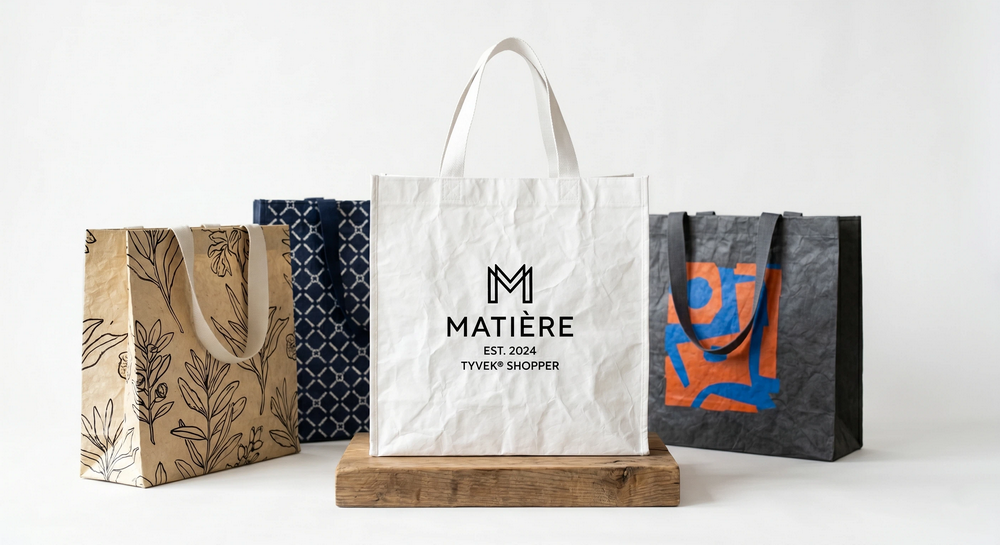
For brand teams, the first win is visual. A Tyvek tote bag often has a cleaner, more elevated appearance than a basic nonwoven promo bag, while avoiding the disposable feel many people associate with paper. That matters in categories where packaging aesthetics influence perceived value, such as beauty, fashion, bookstore retail, museum shops, and premium grocery.
For operations and procurement teams, the second win is performance-to-weight ratio. DuPont describes Tyvek as a 100% synthetic material made from high-density spunbound polyethylene fibers that is lightweight, durable, and resistant to water and abrasion. For branded totes, that usually translates into a bag that travels well, stores flat, and holds up better than paper in repeated-use scenarios. [📊 Cite: DuPont, What is Tyvek?]
For print and branding teams, the third win is decoration quality. DuPont also notes Tyvek is widely used as a printing substrate because of its light weight, smooth surface, dimensional stability, toughness, and durability. In practical terms, that makes it attractive for logos, typography-led layouts, and premium monochrome or minimal-color branding concepts. [📊 Cite: DuPont, Tyvek Technical User Guide]
That said, brands should position the material carefully. A Tyvek-style tote may support reusable and lightweight branding goals, but it should not be marketed as a legal compliance substitute for checkout paper bags under state bag laws unless a qualified legal and product review supports that claim. The smarter positioning is usually around repeat use, durability, portability, and premium brand experience.
How retail and policy trends are increasing attention on reusable carry solutions
The main takeaway is that regulation is strengthening reusable-bag behavior, even when it does not specifically endorse Tyvek.
California is the clearest example. CalRecycle’s SB 1053 program guidance states that beginning January 1, 2026, stores will only be allowed to distribute recycled carryout paper bags at the point of sale for a minimum charge of $0.10 per bag. The rule closes the earlier path that allowed certain thicker plastic bags at checkout. [📊 Cite: CalRecycle, SB 1053 Program News]
That does not mean a Tyvek tote bag becomes an automatic checkout-law replacement. It does mean something commercially important for B2B sellers: retail buyers and consumers are being trained to think more actively about reusable and non-traditional carry formats. When that mindset strengthens, branded totes become easier to justify as part of retail packaging, loyalty, gifting, and event distribution strategies.
The opportunity is especially strong for brands that want a bag people keep. A reusable branded bag that is attractive enough to reuse outside the original purchase moment can generate far more impressions than a single-use packaging format, especially in travel, commuting, bookstore, museum, lifestyle, and trade show contexts.
Where a Tyvek tote bag delivers the highest conversion value
The best use cases are the ones where the bag functions as both packaging and brand media.
1. Premium retail packaging
A Tyvek tote bag works best in retail when the brand wants the package itself to feel worth keeping.
Fashion, beauty, museum, bookstore, and lifestyle brands benefit most here. The bag can replace a lower-perceived-value takeaway package and extend the branded experience after checkout. That is especially useful when the visual identity is minimalist, editorial, or premium.
2. Trade show and conference bags
Trade show programs convert better when the tote is lightweight, durable, and visibly above standard giveaway quality.
A Tyvek-style tote bag is easier to carry all day than many heavier fabric options and typically looks more premium than low-cost expo bags. That can improve pickup rates at the booth and increase post-event reuse, which is where many branded event bags generate their real ROI.
3. Travel and on-the-go campaign gifts
Travel-focused campaigns perform well when the bag feels packable and functional, not bulky.
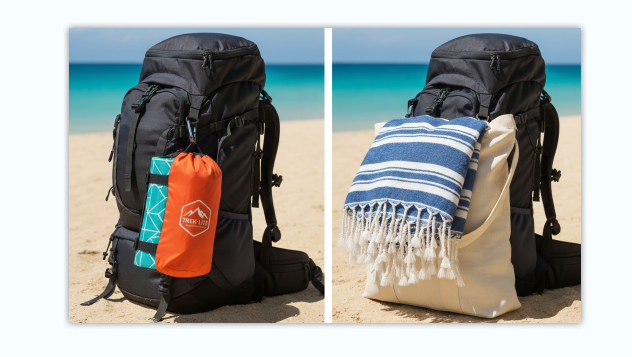
Outdoor, travel, and lifestyle brands can use a Tyvek tote bag for product launches, seasonal kits, airport retail, influencer seeding, or loyalty gifts. The material story aligns well with mobility, convenience, and lightweight carry.
4. Membership and VIP merchandise
Member or donor programs convert better when the tote feels collectible rather than generic.
Museums, bookstores, nonprofits, clubs, and premium grocery programs can use branded totes as part of paid memberships, event bundles, or annual renewals. In these settings, the bag often supports both retention and social visibility.
5. GWP and limited-edition campaign drops
Gift-with-purchase campaigns work best when the bag feels like a bonus item customers would choose on its own.
Beauty, fashion, and lifestyle brands can use limited-edition Tyvek-style bags to lift cart value, increase launch participation, or differentiate seasonal campaigns. The lighter weight can also help manage shipping economics better than heavier canvas in some programs.
Which brands are the best fit for a Tyvek tote bag
The strongest fit is for brands that sell portability, design, or premium everyday utility.
The categories most likely to benefit are:
- Outdoor: lightweight, packable, practical brand story
- Travel: easy-carry utility and modern mobility positioning
- Fashion: premium visual language without full luxury-cost packaging
- Beauty: giftable presentation with better keepability than paper
- Lifestyle: everyday-use format with high repeat visibility
- Bookstore and museum: collectible, design-led merchandising
- Premium grocery: reusable lifestyle signaling with cleaner brand presentation
- Trade show marketing: better booth conversion and post-event impressions
The weakest fit is usually for brands that need either the absolute lowest possible unit cost or a heavy-duty load profile closer to industrial utility. In those cases, paper, PP nonwoven, or heavier fabric constructions may still be the better choice.
How buyers should balance branding, cost, durability, and sustainability messaging
The right sourcing decision is usually a trade-off exercise, not a material purity test.
Procurement teams typically start with cost, but marketing teams usually start with brand impression. The best decision happens when both sides evaluate the bag by cost per useful impression, not just cost per unit. A slightly higher-cost bag can still outperform if it is reused more often and better aligned with brand positioning.
Finance and operations teams should also look at freight, storage, and event handling. Because Tyvek is lightweight, it may help in programs where shipping efficiency matters. That does not guarantee lower total landed cost in every case, but it can improve the economics compared with heavier alternatives in some campaigns.
Sustainability messaging should be precise. The strongest claims are usually about reusability, longer usable life than paper in many scenarios, lightweight construction, and thoughtful brand use-case alignment. The weakest claims are vague statements that imply universal recyclability or legal compliance without market-specific validation.
Procurement checklist for B2B buyers
| Priority | What to Evaluate | Why It Matters | Best-Fit Question |
|---|---|---|---|
| Branding | Surface look, print quality, color accuracy, premium feel | Determines whether the bag elevates the product or event experience | Does this bag look like part of our brand, not just a giveaway? |
| Cost | Unit price, decoration cost, freight, storage efficiency | Prevents underestimating total program spend | What is the landed cost, not just the ex-factory price? |
| Durability | Tear resistance, water resistance, handle construction, repeat-use suitability | Affects reusability and real-world brand impressions | Will recipients realistically reuse it 5+ times? |
| Sustainability Messaging | Reusable positioning, material transparency, end-of-life guidance | Protects brand credibility and avoids overclaiming | Can we explain the material honestly in one sentence? |
| Channel Fit | Retail, gifting, trade show, membership, travel, e-commerce insert | A bag that works in one channel may fail in another | Where will this tote actually be used first? |
What a strong Tyvek tote bag brief should include before you source
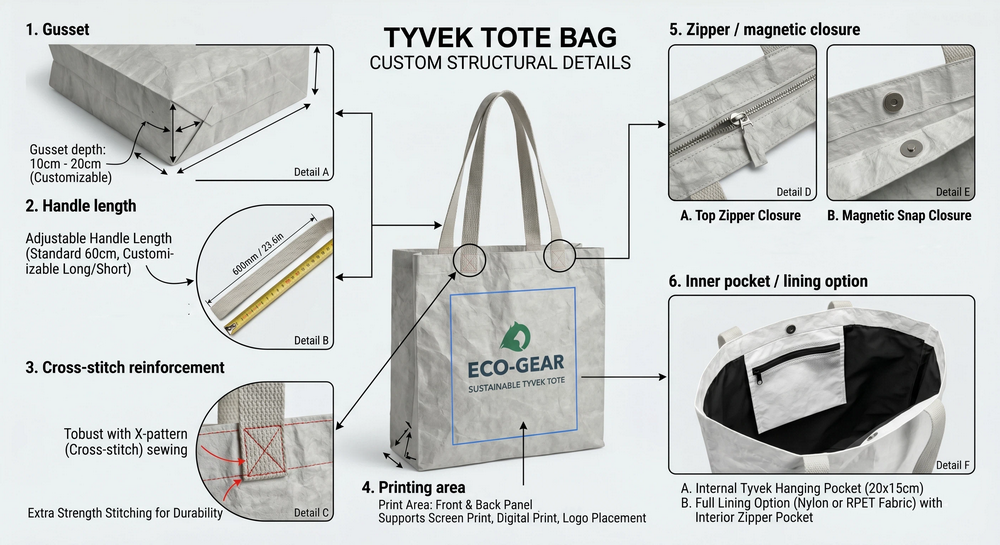
The best sourcing briefs define use case first, then material, then decoration.
Start with the scenario. Is the bag for checkout-adjacent retail, event handout, gift-with-purchase, or loyalty merchandise? That answer determines the right dimensions, gusset style, handle length, finish, and print approach faster than debating material in isolation.
Then define the brand role. Some brands need a bold logo bag. Others need a quiet, design-led tote that feels like merchandise first and advertising second. A clear brief helps suppliers recommend the right construction instead of forcing one template across every campaign.
Finally, define claim boundaries early. If your team wants to talk about reusable positioning or sustainability, align legal, sourcing, and marketing language before production. That is especially important when selling into retail categories already influenced by policy shifts and shopper scrutiny.
FAQ
Is a Tyvek tote bag a good choice for promotional campaigns?
Yes, a Tyvek tote bag can be a strong promotional choice when you want a lighter, more premium-looking bag that recipients are likely to reuse. It is especially effective for trade shows, gift-with-purchase campaigns, and retail-adjacent branding.
Is Tyvek better than paper for branded bags?
Tyvek is often more durable and water-resistant than paper, which can improve repeat use. Paper may still be the better choice when your priority is checkout compliance, lowest unit cost, or a fully paper-based packaging system.
Which industries benefit most from Tyvek-style tote bags?
Outdoor, travel, fashion, beauty, lifestyle, bookstore, museum, premium grocery, and trade show marketing programs are often strong fits. These categories usually value portability, appearance, and repeat-use visibility.
How should brands talk about sustainability with Tyvek tote bags?
Brands should use precise language focused on reusability, durability, and intended repeat use. Avoid broad or unverified claims about recyclability, compostability, or regulatory compliance.
What matters most when sourcing a Tyvek tote bag in bulk?
The most important factors are use case, branding requirements, total landed cost, durability expectations, and realistic sustainability messaging. The right bag is the one that matches both your channel and your brand promise.