A packable blanket can look simple online. But a weak stuff sack, poor stitching, or wrong filling can make it feel cheap fast.
A retail-ready packable outdoor blanket needs the right shell fabric, filling weight, folded size, stuff sack, logo route, care label, packaging, and sample checks. The product must look good packed, open, and in use.
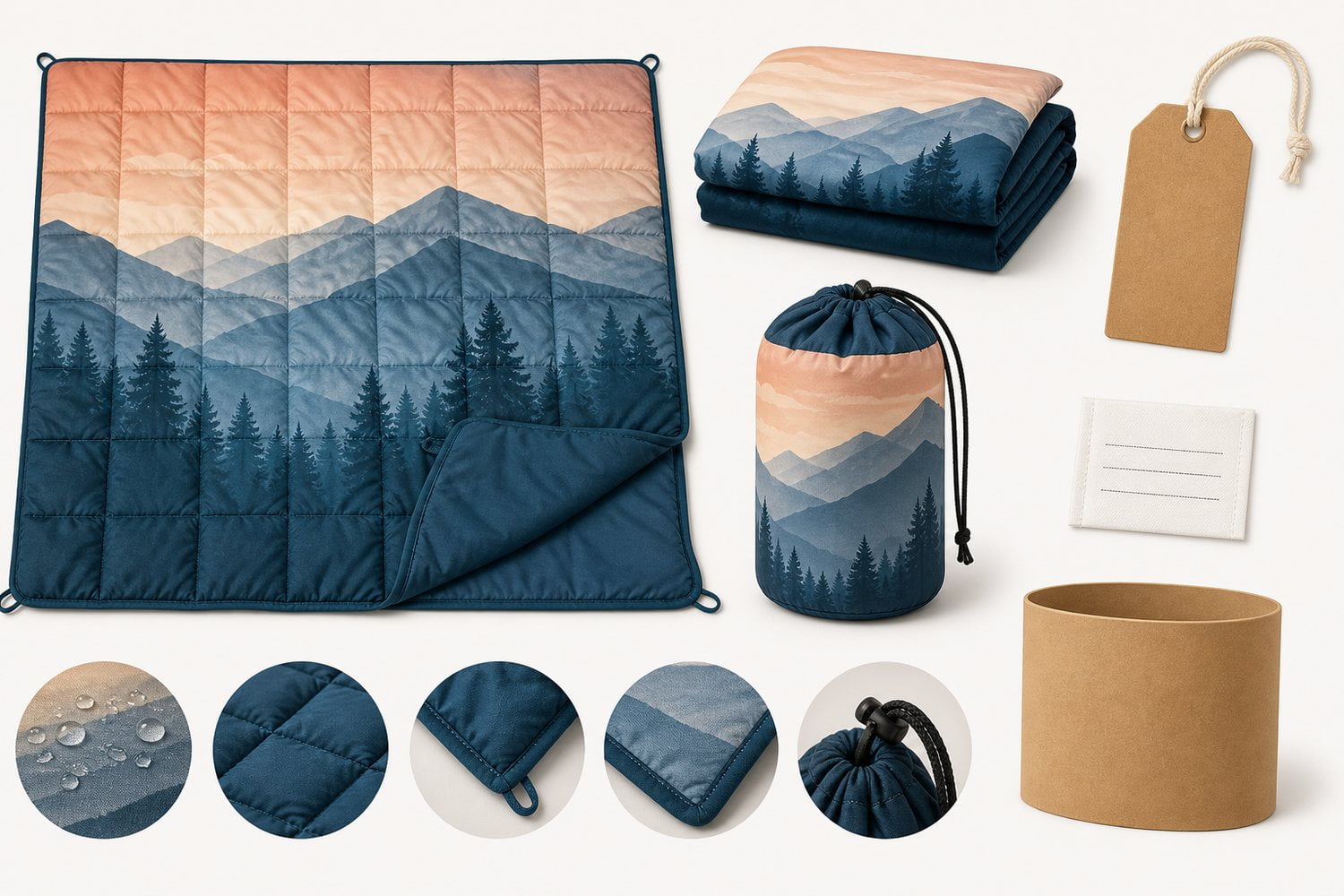
I look at packable blankets as a product system. The blanket is only one part. The stuff sack, folded volume, print effect, drawstring, label, and packaging decide whether the buyer can sell it as a higher-value product.
What does packable really mean for an outdoor blanket?
Packable does not only mean small. It means the user can fold or stuff the blanket without frustration. It means the storage bag is not too tight. It means the drawstring does not break. It means the blanket still looks good after being compressed.
A buyer should check three states.
| State | What to check |
|---|---|
| Open | Size, print alignment, quilting, binding, corner loops, handfeel |
| Folded | Bulk, thickness, creasing, recovery after compression |
| Packed | Stuff sack size, drawstring strength, logo position, shelf presentation |
If the blanket only looks good when it is open, it is not retail-ready. The packed form is often what the consumer sees first.
Which shell fabrics are best for printed outdoor blankets?
For many printed gift and brand merchandise programs, I recommend polyester taffeta first. It is cost-friendly. It is suitable for large-area printing. It can carry beautiful patterns, event artwork, logos, and seasonal designs.
Nylon is better when the buyer wants a softer handfeel and a higher-end route. But nylon usually costs more. It is also not always the easiest route for large printed artwork.
Pongee and Oxford can also be used. I would be careful with both. Oxford can be low cost, but the handfeel can be rough. It fits some rugged or budget use cases, but it may not fit a soft gift product. Fine pongee can feel more premium, especially on the skin side, but the printing and fabric cost can rise.
| Fabric | Best use | Main trade-off |
|---|---|---|
| Polyester taffeta | Printed gifts, merch, cost control | Lower premium handfeel than nylon |
| Nylon | Higher-end outdoor or retail line | Higher cost, less ideal for some prints |
| Polyester pongee | Soft inner side, premium touch | Higher cost when used widely |
| Oxford | Budget or rugged projects | Rougher handfeel |
How should buyers choose filling weight and packed size?
Filling GSM changes the product completely. Thin filling packs smaller and costs less. Heavy filling feels warmer and more premium, but it takes more space.
For corporate gifts, event rewards, and brand merchandise, 60 to 80gsm can make sense. It keeps cost and packed volume lower. The product still feels useful, especially when the goal is gift value and brand exposure.
For serious outdoor use, car travel, camping, or a product line that should sell as a main SKU, I prefer 180gsm or 200gsm. The blanket feels warmer. It has more loft. It can also work as a multi-use travel blanket or temporary sleeping bag layer.
The buyer should decide the real use before choosing the filling. A low filling weight used in a cold environment will disappoint users. A heavy filling used for a cheap promotional gift may destroy the target price.
Why does the stuff sack affect retail value?
The stuff sack is not a small accessory. It is part of the first impression.
Common mistakes include:
- The bag is too small and hard to repack.
- The opening is too tight.
- The drawstring is weak.
- The stitching at the mouth breaks.
- The sack fabric does not match the blanket quality.
- The logo placement looks like an afterthought.
For puffer blankets, I usually like a drawstring stuff sack. It is simple, practical, and good for outdoor use. If the buyer wants a more premium look, a better cord stopper, thicker drawstring, cleaner seam, or shaped bag can improve the result.
What should a buyer check before approving a sample?
Before bulk production, I would check the sample in a practical way.
| Sample check | Why it matters |
|---|---|
| Stitching | Weak seams can fail after repeated packing |
| Quilting | Poor quilting can let filling move |
| Print effect | Large artwork can shift or lose detail |
| Stuff sack opening | Too small creates user frustration |
| Packed volume | Retail buyers often care about shelf and shipping space |
| Binding | Loose binding makes the product look cheap |
| Label and hangtag | They support the brand story and care instructions |
This is also where LISO can help. A buyer can send the target channel, artwork, expected retail price, MOQ, and use scene. We can suggest fabric, filling, packing, and sample details before the buyer spends time on the wrong route.
For a broader program, this product can link to the Outdoor Blankets product page and the Private Label Outdoor Collection hub when the buyer wants a full collection instead of one item.
Related product pages for this sourcing decision
- Outdoor Blankets product page
- Outdoor Patio product hub
- Outdoor Patio Living solution
- Custom outdoor cushions
- Outdoor chair pads
- Sand-free waterproof beach mat
Related puffer blanket sourcing guides:
- Puffer Blanket vs Picnic Blanket: What Should Importers Source?
- How to Choose Fabric and Filling for Custom Puffer Blankets?
Conclusion
A retail-ready packable blanket must work as a product, a package, and a brand story at the same time.
My Role
I help buyers turn one packable blanket idea into a practical specification. Send your channel, artwork, target price, and packing needs. I can recommend the right route.