Searches for “top beach bags 2026,” “best beach bags 2026,” and “trendy beach bags 2026” point to a practical retail question: which bag direction fits a particular customer and summer assortment?
There is no credible universal winner without a defined use case, price position, construction specification, and validation plan. This guide presents five editorial directions for B2B range planning. It is not a laboratory ranking, named-product review, or claim that one material outperforms every alternative.
What “Top” Means in This 2026 Guide
“Top” means five distinct directions worth comparing for a 2026 beach collection. Their order is not a performance score. Each direction is matched to a use case, followed by the questions a buyer should resolve on the final sample.
Before selecting a concept, define:
- the target customer and primary use;
- the intended dimensions, capacity, and representative contents;
- closure, pocket, handle, and strap requirements;
- the exact material, lining, coating, and reinforcement;
- the care instructions and claims that may appear at retail;
- the test method, sample stage, and acceptance criteria for each performance claim.
A stylish beach bag can be commercially relevant without unsupported trend statistics. The useful comparison is whether its appearance, construction, and evidence fit the intended channel.
Five Stylish Beach Bag Directions for 2026
| Direction | Best-fit scenario | Main specification focus | Key trade-off |
|---|---|---|---|
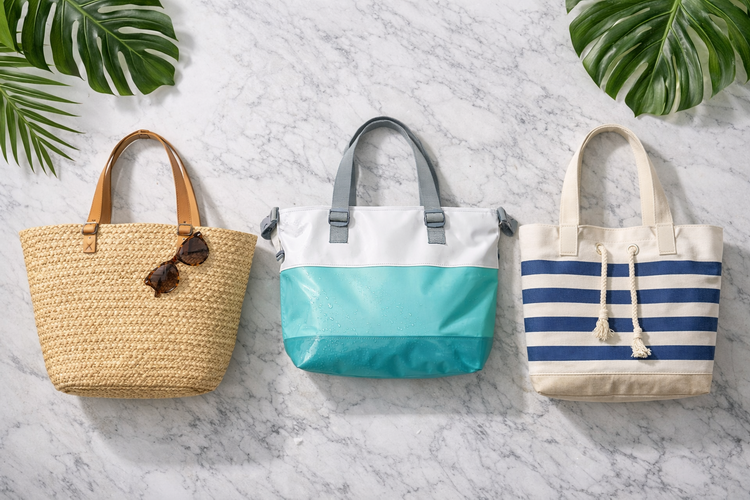
| Natural-look tote | Resort, gift, and boutique assortments | Material identity, lining, handles, shape | Moisture and snag behavior require checking |
| Wipe-clean coated tote | Pool, travel, and beach-club ranges | Coating, seams, closure, claim scope | Fabric performance is not finished-bag performance |
| Oversized organizer tote | Family and group use | Capacity, pockets, base, load balance | More features create more seams and inspection points |
| Structured lightweight tote | Urban-to-beach collections | Shape, weight, ventilation, care | Structure and packability can conflict |
| Packable zip-top tote | Travel and promotional ranges | Folded size, closure, handles, recovery | Repeated folding may affect appearance and coatings |
1. Natural-Look and Documented-Material Tote
Best fit: assortments where texture and visual merchandising matter more than wet-use performance.
A natural-looking tote may use plant-derived fibers, paper-based raffia, cotton or jute blends, or a synthetic construction designed to create a similar appearance. The material identity must be stated accurately. A natural appearance does not prove that a bag is organic, biodegradable, recycled, or environmentally preferable.
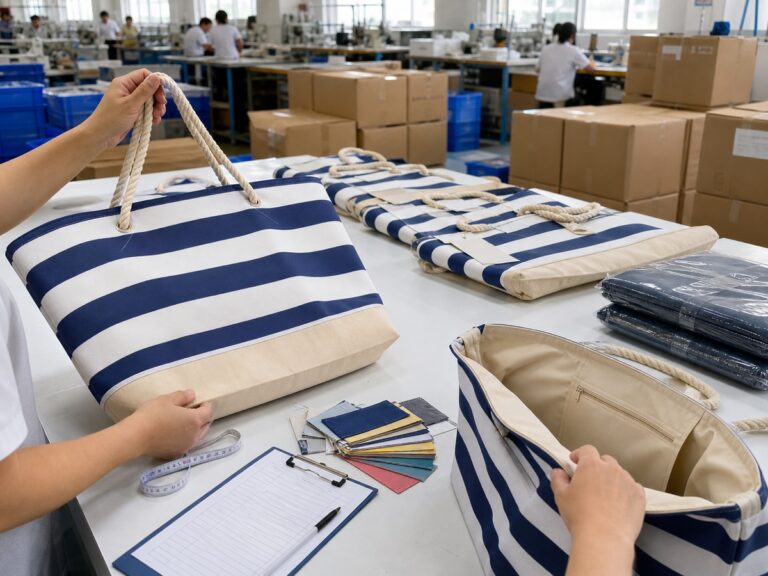
Specify whether the body is lined, how the top closes, how the base is supported, and how the handles attach. On the sample, check loose fibers, snagging, edge finishing, handle distortion, lining movement, closure alignment, and behavior under the intended load. If wet towels are part of the use case, evaluate that condition instead of assuming moisture tolerance.
This direction can support a premium boutique presentation, but price positioning and durability still need to be confirmed against the selected construction.
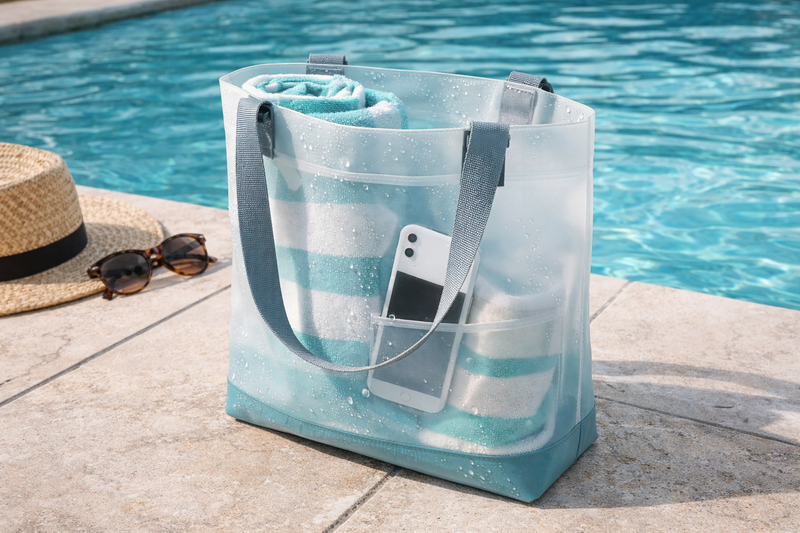
2. Wipe-Clean Coated Tote
Best fit: contemporary pool, beach, and travel collections that need an easy-clean surface or a carefully scoped water-resistance claim.
Possible constructions include coated woven fabrics, laminated fabrics, and flexible polymer-based sheets. TPU, PVC, coated polyester, and other options vary by formulation, thickness, backing, surface finish, and assembly method. A material name alone does not establish odor, flexibility, UV behavior, durability, or environmental superiority.
Define whether the intended claim applies to the face material, one compartment, or the complete bag. Water can enter through seams, needle holes, zippers, closures, and openings even when the main material resists penetration. Check reinforcement, closure operation, surface cleaning, and the finished construction under the agreed procedure.
Use wording such as “wipe-clean” or “splash-resistant” only when it matches the evidence for the exact product. Do not transfer an enclosure rating or generic supplier claim to a soft bag without an applicable test scope.
3. Oversized Organizer Tote
Best fit: family travel and group outings where capacity and item separation are primary requirements.
Start with representative contents rather than an arbitrary pocket count. Map spaces for towels, bottles, footwear, sunscreen, valuables, or damp items, then define the usable dimensions of each compartment.
The brief should record finished external dimensions, a capacity measurement method, base width and support, handle drop, closure access when full, and the intended maximum load for evaluation. On the loaded sample, check balance, base deformation, pocket access, handle attachment, closure operation, and whether small items remain retrievable.
More pockets do not automatically create a better bag. They add seams, binding, alignment points, material, and inspection work. The best organizer is the one whose layout remains useful under the intended load.
4. Structured Lightweight Tote
Best fit: urban-to-beach assortments that need a defined silhouette without excessive packed weight.
Structure may come from fabric construction, binding, piping, laminated panels, mesh zones, or a removable base. Each route changes hand feel, recovery, ventilation, cleaning, and packing behavior. “Lightweight” should be tied to a measured finished weight and size, not used as a general impression.
If mesh or perforated panels are used, specify aperture, position, binding, privacy, and base protection. A design may release some loose sand while retaining particles in damp fabric, pockets, seams, or binding, so avoid a universal sand-proof claim.
Check the sample before and after packing, loading, and the proposed cleaning procedure. Record shape recovery, edge curl, panel distortion, seam condition, and color or coating changes rather than assuming that one material will always retain its form.
5. Packable Zip-Top Tote
Best fit: travel, resort, and promotional ranges where closure security and compact storage matter.
A packable tote can use a self-pocket, separate pouch, fold sequence, or roll-and-strap format. Define the packed dimensions, folding method, zipper or closure specification, handle construction, and the acceptable appearance after recovery.
Sample evaluation should include repeated packing and unpacking under an agreed procedure, followed by inspection of coating creases, print damage, zipper alignment, seam stress, handle attachment, and recovered dimensions. A folded display sample is not enough to establish long-term performance.
This direction is useful when the customer values portability. If a more structured silhouette is the priority, the buyer should acknowledge the trade-off instead of trying to maximize both attributes without testing.
Turn Style Language Into Verifiable Requirements
Words such as “durable,” “waterproof,” “fade-resistant,” and “heavy duty” are not complete specifications. Translate each intended statement into:
- the exact material, component, or finished product covered by the claim;
- a defined method and test conditions;
- the sample revision and number of specimens;
- an agreed acceptance threshold;
- the actual result and units;
- the report owner and approval date.
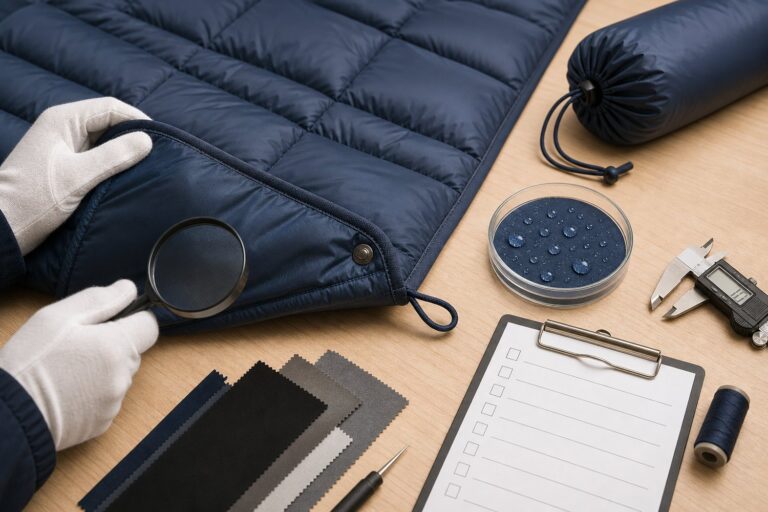
Fabric data does not replace finished-product checks for handles, seams, hardware, closures, or pockets. If a method is not appropriate to the selected material or claim, choose another method rather than citing a standard for appearance.
For environmental wording, the US FTC Green Guides advise against broad, unqualified environmental-benefit claims and call for clear, specific qualifications. A recycled-content claim should identify the relevant component and percentage. A biodegradability claim requires evidence for the finished composition and stated disposal conditions.
The Global Recycled Standard verifies and tracks recycled raw materials through a chain-of-custody system. A reference to GRS should match the current certificate scope and documentation for the relevant material, facility, supply chain, and order. It is not automatic proof that an entire bag is environmentally superior to every alternative.
Buyer Specification Checklist
Keep one approved project brief containing:
- target market, customer, and retail channel;
- dimensions, measurement points, capacity method, and tolerances;
- body material, lining, coating, reinforcement, and approved color reference;
- closure, pockets, handles, straps, and hardware;
- representative load and product-level evaluation sequence;
- cleaning instructions and post-cleaning inspection points;
- claim scope, method, threshold, and supporting documentation;
- decoration, labels, packaging, carton, and barcode requirements;
- change-control rules for material, construction, and supplier substitutions.
This turns “stylish” and “best” into an operational decision. It also allows two samples to be compared against the same requirements.
Frequently Asked Questions
Which beach bag material is best?
There is no universal best material. Natural-look constructions may support boutique presentation; coated materials can support an easy-clean brief; woven textiles allow broad decoration and structure choices; and mesh can support ventilation. Compare the exact sample against the intended use and claim requirements.
Does water-resistant fabric make the finished bag waterproof?
Not necessarily. Seams, needle holes, zippers, closures, and openings have separate effects. Ask what was tested, under which method, and whether the result applies to material, a compartment, or the complete bag.
Are oversized beach bags suitable for every retailer?
No. A large format may suit family use but can create trade-offs in weight, balance, display, storage, and shipping. Validate dimensions with representative contents and the target customer.
Can a bag be called sustainable because it contains recycled material?
Recycled content can be stated when the component, percentage, scope, and chain-of-custody evidence support the wording. It does not by itself substantiate an unqualified claim that the complete product is sustainable.
How should buyers compare samples?
Use the same written specification, representative load, evaluation sequence, and acceptance criteria. Record measurable results separately from subjective comments about color, hand feel, or appearance.
Key Takeaways
- The five directions are scenario-based choices, not tested product rankings.
- Preserve the useful 2026 style question, but define the customer before selecting a silhouette.
- Treat a material name as an input, not proof of finished-product performance.
- Keep environmental wording specific to documented materials and claim scope.
- Approve one specification and test plan before comparing commercial offers.
For a private-label program, review the custom beach bag wholesale sourcing page and send the target dimensions, intended use, reference images, preferred construction, branding, target market, and required claim evidence.
Availability, minimum order quantity, sample timing, testing scope, production lead time, and commercial terms must be confirmed in writing for the exact project.