What is a sand free beach mat?
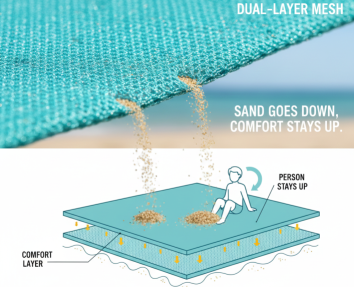
A sand free beach mat is a beach mat made with a mesh-like, dual-layer structure that helps sand drop through the surface instead of staying on top.
In B2B terms, it’s a premium beach accessory positioned to solve a clear pain point: customers hate bringing sand back to the car, bag, or hotel room.
How does a sand free beach mat work?
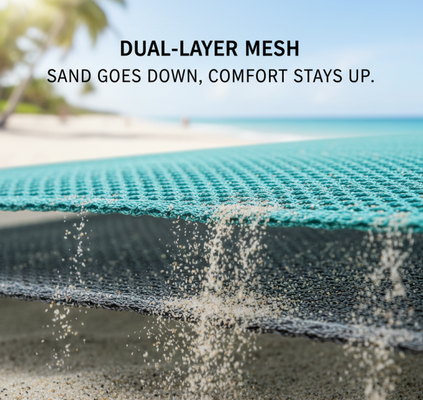
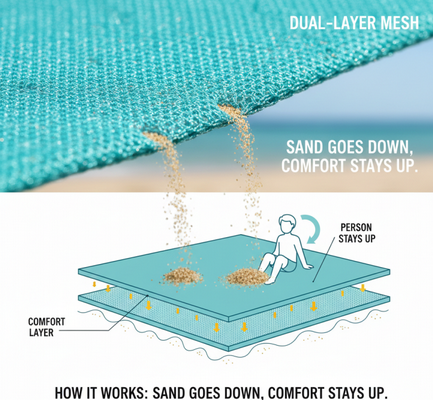
A sand free beach mat works by using a dual-layer mesh where sand falls through the top layer into the lower layer, while the top surface stays relatively clear.
The simplest selling explanation is: “Sand goes down, comfort stays up.”
The dual-layer mechanism (the core product story)
A strong-performing design typically depends on three engineering factors:
- Mesh aperture (hole size): Too small → sand gets trapped; too large → uncomfortable feel or “toe catch.”
- Top-layer stiffness & hand feel: A stable top layer supports the body and avoids a “saggy” feel.
- Bottom-layer design: Helps prevent sand from migrating back up during movement.
Who is a sand free beach mat for in B2B?
For B2B, a sand free beach mat fits channels where customers value cleanliness, convenience, and premium utility.
1) Amazon/Shopify sellers
A sand free beach mat is a strong category when you need a clear differentiator against generic blankets.
It’s highly visual, so product videos and “sand demo” shots can lift conversion.
What to highlight: washability, quick-dry, carry bag, size options, family vs solo use.
2) Outdoor brands & private label
Brands can position it as a premium add-on next to beach tents, umbrellas, chairs, and towels.
Customization matters: logo, color, packaging, hang tags, and an insert explaining “how it works.”
3) Gift companies & corporate promotions
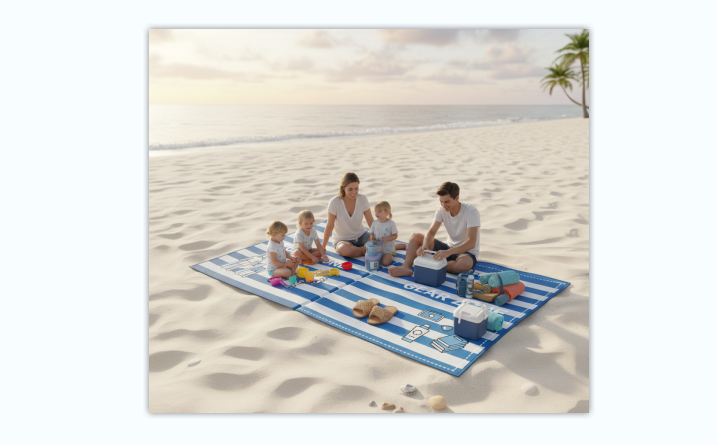
It’s ideal for summer campaigns because it’s practical and offers a large branding surface.
Confirm printing method and abrasion resistance to avoid logo-fading complaints.
4) Resorts, hotels & travel agencies
For hospitality, it works as a guest amenity or upsell bundle for beach experiences.
Priorities: durability, easy cleaning, compact storage, and consistent supply.
5) Events & sponsorships
Great for festivals, marathons near beaches, and outdoor brand activations.
Priorities: reliable lead time, simple packaging, and bulk logistics efficiency.
What specs should B2B buyers check when sourcing?
When buying sand free beach mat wholesale or sand free beach mat OEM, the biggest risk is not “does it look good,” but will it hold up and reduce returns.
Quick spec checklist (use this for RFQs)
| Spec | Why it matters | Common pitfall |
|---|---|---|
| GSM (fabric weight) | Signals durability & hand feel | Too light → tears, curls, “cheap” perception |
| Mesh aperture | Controls sand-release & comfort | Too big → uncomfortable; too small → sand sticks |
| Binding & edging | Prevents fraying, extends life | Weak stitching → edges fail first |
| Tear strength | Predicts longevity & claim risk | No test data → inconsistent batches |
| UV resistance | Prevents fading & brittleness | Sun exposure accelerates aging |
| Colorfastness | Protects branding and reduces complaints | Dye/print bleeds after wash |
| Load rating | Avoids “sagging” and disputes | No clear rating → higher complaint rate |
| Washability | Key to repeat use | Shrinkage, deformation, delamination |
| Pilling resistance | Keeps premium look over time | Pills quickly → “looks old” reviews |
What are the most common sourcing mistakes?
The most common mistakes are choosing only by unit price, skipping test evidence, and ignoring end-use scenarios.
Mistake 1: Comparing only initial price (ignoring TCO)
A cheaper mat can cost more after returns, replacements, and negative reviews.
Estimate total cost of ownership (TCO) with a simple model:
Mistake 2: Not aligning mesh design to the target buyer
If you sell to families, comfort and stability matter more.
If you sell to minimalist travelers, weight and pack size matter more.
Mistake 3: Weak edges and stitching
Edges fail first in real use due to dragging, folding, washing, and sand abrasion.
Add seam details to your QC checklist and request close-up production photos.
Mistake 4: No proof of UV/colorfastness for bright colors
Bright colors sell, but they also trigger complaints when they fade.
Request wash and sunlight exposure references (even internal lab methods/data).
How to evaluate sand free beach mat manufacturers for OEM?
- What mesh structure do you use (layers, aperture range)?
- What GSM options do you offer, and what use cases do you recommend?
- What binding/edging options and stitching specs do you use?
- Which tests can you provide (tear, colorfastness, UV, wash)?
- What customization options (logo, print, packaging) and MOQ?
- What is your QC process and sampling standard (e.g., AQL if used)?
Is a sand free beach mat the same as a sand-free blanket?
Not always. A sand free beach mat typically emphasizes structured mesh for sand release, while “sand-free blanket” is sometimes used for softer, fabric-first products that can still trap sand.
For B2B merchandising, use clear naming and visuals to reduce customer confusion.
People Also Ask / Related Questions
- Does a sand free beach mat work on all sand types?
- What mesh size is best for a sand free beach mat?
- Are sand free beach mats comfortable to sit on?
- What should I request for OEM quality control?
FAQ Schema
Q: How does a sand free beach mat work?
A: A sand free beach mat uses a dual-layer mesh that allows sand to fall through the top layer into a lower layer while keeping the surface cleaner. Results depend on mesh aperture, top-layer stability, and edge construction.
Q: Who should buy sand free beach mat wholesale?
A: Sand free beach mat wholesale works best for Amazon/Shopify sellers, outdoor brands, gift companies, resorts/hotels, travel agencies, and event sponsors who want a premium beach accessory with a clear, visual differentiator.
Q: What should I check when sourcing sand free beach mat OEM?
A: For sand free beach mat OEM, check GSM, mesh aperture, binding/stitching quality, tear strength, UV resistance, colorfastness, load rating, washability, and pilling resistance. These factors directly affect durability and return rates.
Q: What are the most common quality issues?
A: Common issues include weak edge binding, inconsistent mesh aperture, fading prints/colors after sun exposure, deformation after washing, and fast pilling—often leading to negative reviews and returns.
Q: Is higher GSM always better?
A: Not always. Higher GSM often improves durability and feel, but it can increase weight and drying time. The best GSM depends on your target market: family/resort buyers usually prefer sturdier mats, while travel buyers often prefer lighter options.
Key Takeaways
- A sand free beach mat works best when its dual-layer mesh is engineered for both sand-release and comfort.
- For B2B, it fits premium channels: ecommerce sellers, outdoor brands, gift companies, resorts, travel, and events.
- The biggest sourcing wins come from controlling GSM, mesh aperture, binding, tear strength, UV/colorfastness, washability, and pilling.
- Don’t price-shop blindly—optimize for lower returns and longer usable life (TCO).
- Build your RFQ around a spec + test + QC sheet to reduce batch inconsistency.