Lock spring/summer soft goods orders around Chinese New Year 2027 with a clear factory calendar.
Every year we get the same email in early January: “Can you still ship this before Chinese New Year?” By then, the honest answer is often “part of it, maybe.” For 2027 the window closes earlier than many buyers expect: Lunar New Year falls on Saturday 6 February 2027, which SEKO Logistics notes is 11 days earlier on the calendar than in 2026.
We are LISO HOME (Hangzhou LISO Home Co., Ltd.), an OEM/ODM soft-goods manufacturer in Hangzhou. Since 2013 we have made beach bags, beach mats and towels, outdoor cushions and pet travel products for importers and private-label brands. This guide covers one question: when and how should you lock your spring/summer 2027 soft goods orders around CNY?
It is not a month-by-month summer sourcing calendar. It covers:
- the difference between official holiday dates and factory shutdown / ramp-up periods,
- a reverse-planning example that starts from your warehouse date,
- the risks specific to soft goods (printed fabrics, trims, packaging),
- three shipping strategies and the use case each one fits,
- a written confirmation checklist to agree with any supplier, us included.
All lead times below are typical ranges or common practice. Where we quote logistics estimates, we name the source. None of them are guarantees from LISO or anyone else. Always confirm dates for your own program in writing.
What are the actual CNY 2027 dates, and which ones matter to a buyer?
Which dates are official?
These dates are confirmed by public calendar sources:
- Lunar New Year’s Eve: Friday 5 February 2027
- Lunar New Year’s Day (1st day of the 1st lunar month): Saturday 6 February 2027. Source: the Hong Kong Observatory’s Gregorian–Lunar calendar conversion table for 2027.
- Lantern Festival (15th day of the 1st lunar month): Saturday 20 February 2027. This traditionally marks the end of the Spring Festival period.
- Hong Kong general holidays: the GovHK 2027 general holidays list includes Lunar New Year’s Day (6 Feb) plus the third and fourth days of Lunar New Year (8–9 February 2027).
What is the mainland China official holiday block?
Confirmed on 5 November 2026. The State Council General Office notice sets the 2027 Spring Festival holiday as Friday 5 February through Saturday 13 February 2027 (9 days), covering Lunar New Year’s Eve through the eighth day of the first lunar month. Make-up workdays are Sunday 31 January 2027 and Sunday 14 February 2027. Source: Xinhua authorized release of the State Council General Office notice, 5 November 2026.
That matches earlier media discussion under the 2024 holiday-rule revisions that a Friday Eve could produce a 9-day break. The notice is now the authority for the official block; factory shutdown and ramp-up still need each supplier’s own written calendar.
Why is the factory calendar different from the official one?
The official public holiday is only part of the picture. For production planning, the factory operational calendar matters more: when lines slow down, when they fully stop, and when they actually get back to normal output.
SEKO Logistics’ public Lunar New Year 2027 Complete Supply Chain Planning Guide says to treat CNY as a six-to-eight-week operational window, not a single week. Here is how the two calendars compare:
| Item | Date(s) for 2027 | Type | Source |
|---|---|---|---|
| Lunar New Year’s Eve | Fri 5 Feb 2027 | Official calendar | Hong Kong Observatory calendar |
| Lunar New Year’s Day | Sat 6 Feb 2027 | Official calendar | Hong Kong Observatory calendar; GovHK 2027 holidays |
| HK general holidays (3rd & 4th day) | Mon 8 – Tue 9 Feb 2027 | Official (Hong Kong only) | GovHK 2027 holidays list |
| Lantern Festival | Sat 20 Feb 2027 | Official calendar | Hong Kong Observatory calendar |
| Mainland China Spring Festival holiday block | Fri 5 – Sat 13 Feb 2027 (9 days); make-up workdays Sun 31 Jan and Sun 14 Feb 2027 | Official (mainland) | State Council General Office notice via Xinhua, 5 Nov 2026 |
| Pre-holiday slowdown | ~9–16 Jan 2027 | Logistics estimate | SEKO Logistics |
| Complete shutdown cluster | ~30 Jan – 14 Feb 2027 | Logistics estimate | SEKO Logistics |
| Gradual resumption (SEKO cites ~35% workforce early on) | ~20 Feb – 6 Mar 2027 | Logistics estimate | SEKO Logistics |
| Full recovery | ~6 – 20 Mar 2027 (about 4–6 weeks after the holiday begins) | Logistics estimate | SEKO Logistics |
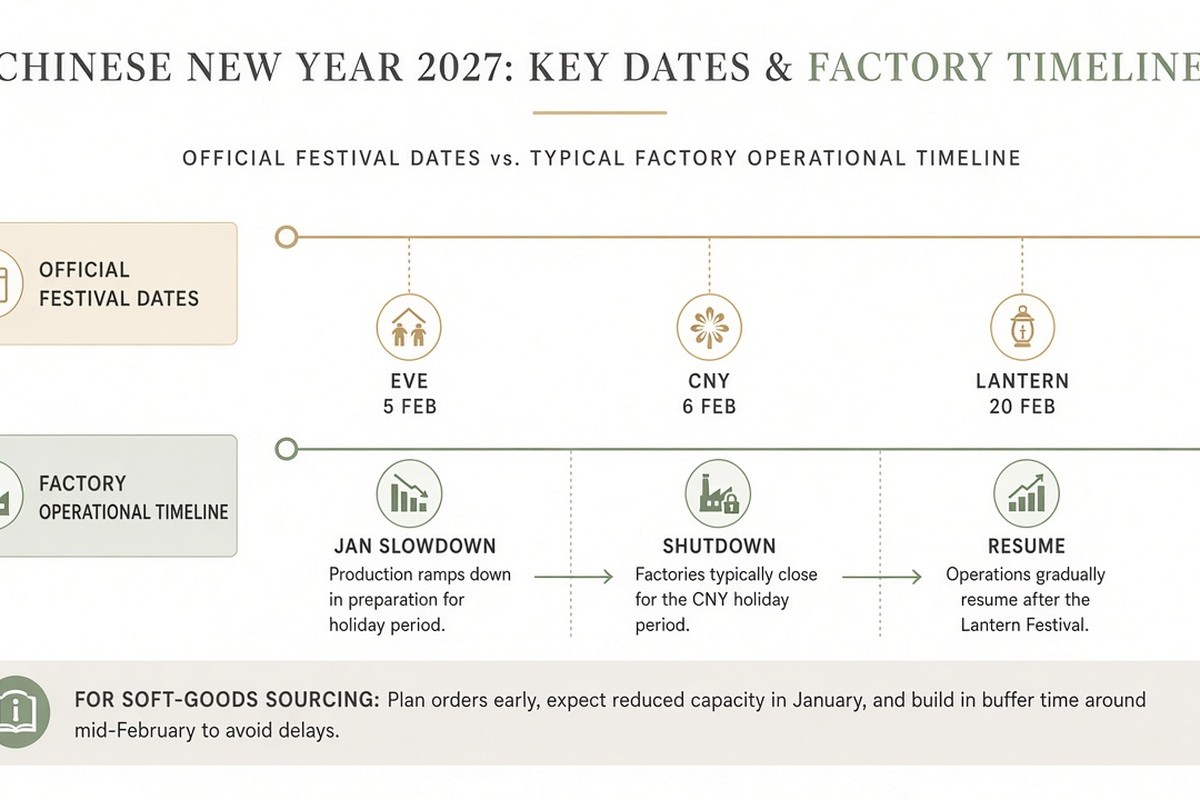
Official festival dates are fixed; factory shutdown and recovery bands are logistics estimates and vary by supplier.
How to read this table: The official dates are fixed. The factory-side bands are industry estimates and will vary by region, product category and individual factory. A cut-and-sew line, a fabric printing mill and a carton supplier in the same city may close and reopen on different days. That is why the checklist later in this article asks for each supplier’s own dates in writing.
When is the last comfortable point to lock a spring/summer PO?
What does common practice say?
Many logistics guides, SEKO’s included, advise finalizing production orders roughly 8–10 weeks before CNY. For 2027 that means late November to early December 2026. SEKO frames rush-order cut-offs at roughly 3–4 weeks before the holiday (early-to-mid January 2027), but that is a cut-off for urgent work, not a planning target.
What does “locked” actually mean?
From the factory side, an order is “locked” when four things are done:
- The sample is approved in writing. That covers colour, print, size, logo placement and packaging.
- The PO is issued with final quantities per SKU and colourway.
- The deposit is received, so the factory can release fabric, trim and packaging orders to its own suppliers.
- Artwork is final for prints, labels, hangtags and colour boxes.
If any of these four is still open, the order is not locked yet, whatever the PO date says. In our experience, missing artwork and late colour approvals delay more pre-holiday orders than sewing capacity does.
What if my sample isn’t approved yet?
For reference, on our beach and outdoor programs samples typically take about 7–10 business days. More complex custom items often take 14–21 days. Each revision round adds time. If your samples are still in development in mid-November, a pre-CNY ship date may still be possible for simple items, but it gets tighter with every revision. See the scenarios below.
How do I reverse-plan from my warehouse arrival date?
Start from the date goods must be in your warehouse and work backwards. The example below is for a beach bag program shipped by ocean before CNY.
EXAMPLE ONLY. These dates are for illustration. They use typical ranges: about 30–40 days bulk production for beach programs, SEKO’s estimated shutdown window, and SEKO’s advice to book ocean space roughly 4–5 weeks ahead around the CNY peak (versus a standard 3–4 weeks). Your forwarder’s transit quote, your inspection company’s availability and your factory’s written dates come first.
| Step (working backwards) | Example timing for a pre-CNY ocean shipment | Notes |
|---|---|---|
| Warehouse arrival | Loading date + your forwarder’s quoted door-to-door transit | Use a real quote for your lane. Asia–Europe services may be routed via the Cape of Good Hope, which SEKO notes adds roughly 10–14 days |
| Container loading / cargo handover | Aim for ~mid-January 2027, before the pre-holiday slowdown deepens | SEKO notes inland trucking in China becomes very scarce around the holiday, so leave buffer before the factory-to-port leg |
| Final inspection (third-party or in-house) | A few days before loading, around early-to-mid January | Book inspectors early; their calendars fill too |
| Ocean booking | ~4–5 weeks before the planned departure, around early-to-mid December 2026 | SEKO advice for the CNY peak; containers can still be rolled, so ask about fallback sailings |
| Bulk production | ~30–40 days for typical beach programs, roughly early December to early-to-mid January | Complex constructions or large volumes take longer |
| Fabric, trims & packaging in-house | Before the production start | Printed fabric, custom webbing/zips and colour boxes have their own lead times (see next section) |
| PO + deposit | Late November – early December 2026 | Matches the common 8–10-weeks-before-CNY guidance |
| Sample approval (written) | Mid-to-late November 2026 | Samples typically take 7–10 business days, complex ones 14–21 days, plus revision rounds |
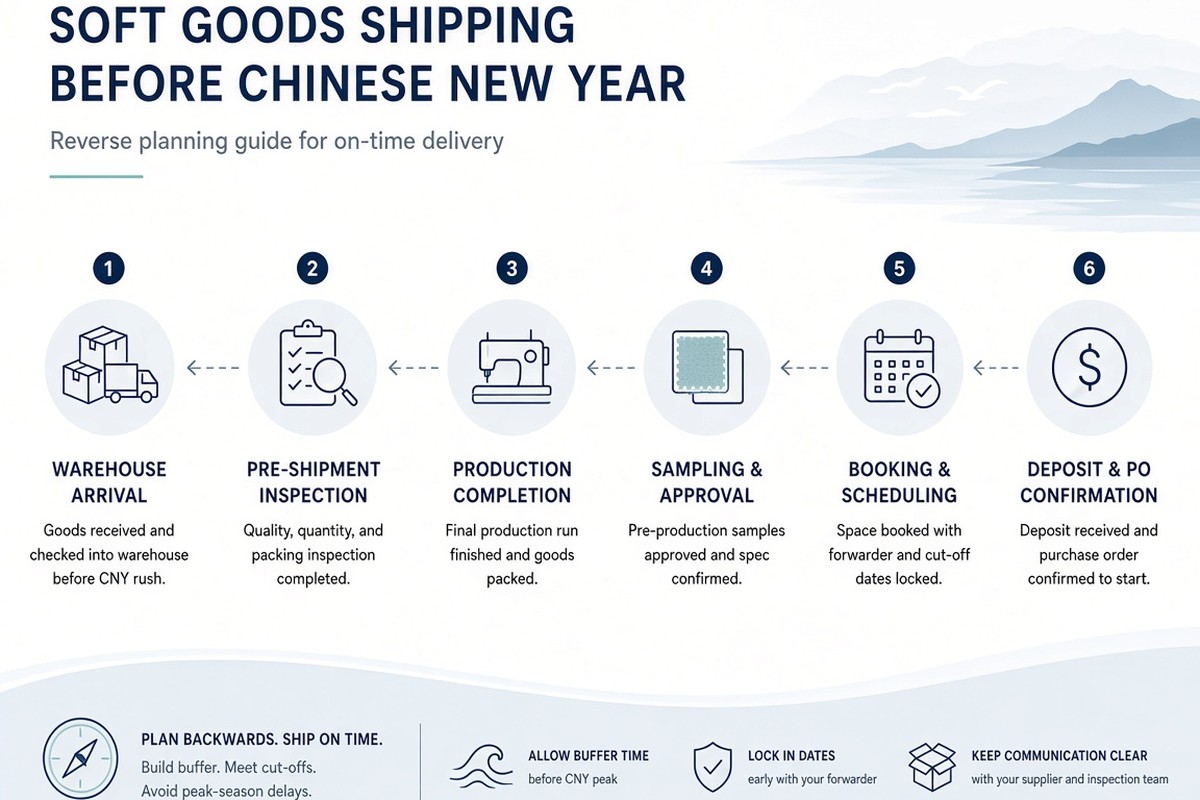
EXAMPLE: work backwards from the warehouse date before you lock a pre-CNY ship plan.
If your dates come out earlier than today, the plan does not work as drawn. Switch to strategy 2 or 3 below.
Why are soft goods especially exposed to CNY?
Doesn’t the sewing line just stop and restart?
No. A finished beach bag or outdoor cushion depends on a chain of tier-2 suppliers, and they are on their own CNY calendars. Some of them close earlier and reopen later than the assembly factory.
Which inputs carry the most risk?
- Printed and custom-dyed fabrics. Custom prints, lab-dip colour matching and recycled fabrics (for example GRS-certified materials) need mill time before cutting starts. If the print mill closes before your strike-off is approved, the whole program waits.
- Custom trims. Branded webbing, custom zipper pulls, woven labels, metal or resin hardware and embroidered patches usually come from small specialist workshops, and they often close early for the holiday.
- Packaging. Colour boxes, printed polybags, hangtags and inserts come from printing houses. Retail-ready packaging with barcodes and compliance marks has to be approved and printed before packing. It is a frequent last-minute bottleneck.
- Fillings and foams (outdoor cushions, pet beds). Specific densities or certified fills may need to be ordered in advance rather than taken from general stock.
What should I do about it?
Ask your supplier which components are already in stock and which are made to order, and agree release dates for each. Approving the artwork for labels, hangtags and colour boxes at the same time as the product sample is one of the simplest ways to protect a pre-CNY date. Our custom beach bag manufacturer sampling checklist covers the details to lock at sample stage. For cushions, see what to check on replacement outdoor cushions before sampling.
Is quality riskier on the first lots after CNY?
Why does it happen?
It can be. SEKO’s guide estimates that up to around 25% of factory workers may not return to their previous employer after the holiday, and that resumed factories may start with only about 35% of their workforce. These are industry-wide estimates, not figures for any specific factory, and the effect varies a lot by region and employer. The direction is well known, though: early post-holiday weeks often run with new or re-trained operators and lines that are not yet at full rhythm.
How should I tighten QC on post-CNY lots?
- Re-approve a pre-production (PP) sample made on the actual post-holiday line, even if the style ran before the holiday.
- Ask for an inline inspection early in production, not only a final inspection, on the first post-CNY lot.
- Re-check high-risk points for soft goods: seam strength and stitch density on bag handles, zipper function, print registration and colour shade against the approved standard, and fill weight and cover fit on cushions.
- Confirm the same materials are being used. If a tier-2 supplier did not restart on time, ask in writing before any substitution.
None of this means post-CNY production is poor. It means the first lots deserve more checking than a mid-season reorder.
Which of the three shipping strategies fits my program?
Most spring/summer 2027 soft goods programs will fall into one of three patterns. None is right for every buyer. The choice depends on your in-store or on-site date, your order size and how final your development is.
Strategy 1: Should I ship everything before CNY?
How it works: sample approval, PO and deposit by late November or early December 2026. Production runs through December and early January, with loading before the pre-holiday slowdown deepens.
Suits: repeat or near-repeat styles, simple constructions, buyers with early spring set dates (for example, warm-climate retailers or southern-hemisphere timing), and programs where artwork is already final.
Trade-offs: you commit capital earlier and hold inventory longer. Pre-CNY ocean rates and space also tend to tighten. SEKO notes rates typically climb from mid-December through January.
Strategy 2: Should I plan for the first post-CNY production lot?
How it works: you finish development calmly in November–January, issue the PO before the holiday so materials can be booked, and production starts as the factory ramps back up. SEKO’s estimate is resumption from about 20 February and full recovery around 6–20 March 2027.
Suits: new developments that need more sampling rounds, summer-peak items (main beach season, mid-year outdoor living), and buyers with later floor dates.
Trade-offs: you depend on how fast the factory and its tier-2 suppliers ramp up, and the QC risk above applies. Placing the PO before CNY still matters, because it puts you in the post-holiday production queue rather than behind orders confirmed in March.
Strategy 3: Should I split an MOQ trial into pre- and post-CNY batches?
How it works: ship a smaller trial before CNY, then a larger replenishment after the holiday.
Suits: new categories, new retailers or marketplaces, and private-label brands testing designs or colourways before committing to depth. On our side, MOQs on existing designs typically start around 100 pcs, beach sets often around 200–300 pcs, and fully custom developments often around 1,000 pcs, depending on materials and construction. Our article on MOQ 100–200 pcs: how buyers can test new categories without burning cash goes further into trial order structure.
Trade-offs: two production runs, two inspections and possibly two shipments, so unit and freight costs are usually higher than one bulk order. Ask whether fabric and trims for both batches can be booked together before CNY, so the second batch matches the first and isn’t waiting on a restarting mill.
What should I confirm with my factory in writing?
Phone calls and chat messages are useful in December. A short written schedule confirmed by email avoids “I thought you said…” in February. SEKO also recommends asking suppliers about shutdown dates, restart dates, last order acceptance and holiday-period contacts. Here is the checklist we suggest buyers send to any soft goods supplier:
CNY 2027 written confirmation checklist
- [ ] Last day to accept a new PO for pre-holiday production
- [ ] Last sample approval date that still allows pre-holiday shipment
- [ ] Material cut-off dates: last order dates for fabric, printed fabric, trims and packaging, per tier-2 supplier where relevant
- [ ] Last production day before the holiday
- [ ] Last inspection day that the factory and your inspection provider can support
- [ ] Last loading / cargo handover day, and whether trucking to port is confirmed
- [ ] Official holiday dates the factory will observe (mainland notice: 5–13 Feb 2027; make-up workdays 31 Jan and 14 Feb 2027), plus any extra local or factory days
- [ ] Post-holiday restart day for the office and for the production line (often different)
- [ ] Expected date of normal output, plus any plan for new-operator training
- [ ] Holiday emergency contact, by name, with channel (email / WeChat / WhatsApp)
- [ ] Where finished but unshipped goods will be stored during the shutdown, and under what conditions (for example, dry storage for textiles)
- [ ] Incoterm and handover point: FOB, CIF or DDP, and who books freight
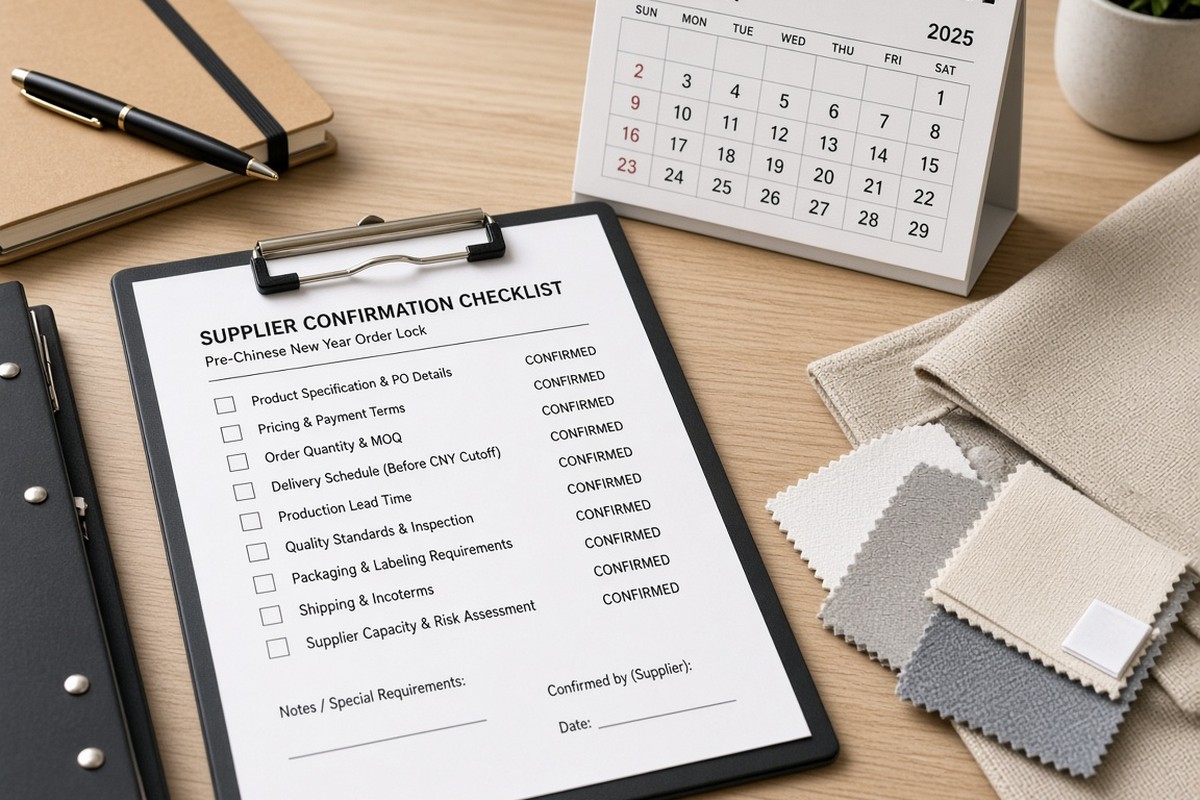
Ask every factory for written dates: last production, inspection, loading, and post-holiday restart.
To speed up the whole quote-to-order process, see our practical workflow from RFQ to PO in 10 days. It covers the information to send with an RFQ so quotes and samples don’t stall.
What does this mean for outdoor, beach and pet travel programs specifically?
Beach programs
Beach bags, beach towels, sand-free mats and beach sets usually need custom prints, coordinated colourways and retail packaging, so tier-2 lead times matter most here. For typical beach programs, bulk production often runs around 30–40 days after approvals. You can browse the beach day essentials product range or see how we approach beach day essentials programs for brands and retailers.
Outdoor and patio programs
Outdoor cushions and seat pads depend on performance fabric availability (for example UV-resistant or solution-dyed options) and on foam or fill specifications. Lock fabric selection and fill specifications early. See our outdoor patio range and private-label outdoor collections.
Pet travel programs
Pet carriers, car seat covers and travel beds tend to have more structured components: frames, mesh panels, buckles and safety tethers. For airline-oriented carriers, they also carry dimension-related claims that need checking at sample stage. These items reward early sampling. Explore our pet travel solutions.
Compliance documents
If your retailer needs certificates or test reports, include them in the plan. Testing labs have holidays too. Ask which certifications apply to your specific materials and factory scope. LISO’s certifications include BSCI, OEKO-TEX, ISO 9001 and GRS, and we will share current certificates on request. Our guide to compliance and documentation US/EU buyers ask for before ordering has more.
Want to talk about pre-holiday capacity for your 2027 program?
If you are planning spring/summer 2027 outdoor or beach soft goods, or pet travel items, and want to know whether a pre-CNY, post-CNY or split schedule fits, send us:
- product type and target quantities per SKU,
- your target warehouse or in-store date and destination market,
- your preferred Incoterm (FOB, CIF or DDP),
- reference images, tech packs or the existing styles you’d like to adapt.
We’ll reply with a realistic schedule based on our current production calendar and our material suppliers’ holiday dates, and confirm the key dates in writing.
Email: [email protected]
Website: lisohome.com

Talk through pre-holiday capacity for outdoor, beach and pet travel programs while the window is still open.
FAQ
When is Chinese New Year 2027?
Lunar New Year’s Day is Saturday 6 February 2027, and the Eve is Friday 5 February 2027 (Hong Kong Observatory calendar). The Lantern Festival is Saturday 20 February 2027.
Has China published its official 2027 Spring Festival holiday schedule?
Yes. The State Council General Office notice (authorized release via Xinhua on 5 November 2026) sets Spring Festival as Friday 5 February through Saturday 13 February 2027 (9 days), with make-up workdays on Sunday 31 January and Sunday 14 February 2027.
How long do factories actually close for CNY 2027?
It varies by factory and region. SEKO Logistics estimates a complete shutdown cluster around 30 January – 14 February 2027, gradual resumption from about 20 February, and full recovery around 6–20 March 2027. Get each supplier’s own dates in writing.
When should I place my spring/summer 2027 soft goods order?
Common practice, reflected in guides such as SEKO’s, is to finalize production orders about 8–10 weeks before CNY, which means late November to early December 2026 for a pre-holiday shipment. Even for post-CNY production, placing the PO before the holiday helps secure materials and a place in the restart queue.
Can I still order after early December?
Often yes, especially for existing designs or a post-CNY ship date. Expect fewer options for pre-holiday loading, tighter ocean space and possibly higher freight costs. Ask your supplier for a written schedule before committing.
Is it safe to order right after CNY?
Yes, with more QC. Industry estimates point to workforce turnover after the holiday. Ask for a pre-production sample from the post-holiday line, an early inline inspection and a check that materials match the approved standard.
Sources
- Hong Kong Observatory: Gregorian–Lunar Calendar Conversion Table, 2027. https://www.hko.gov.hk/en/gts/time/calendar/pdf/files/2027e.pdf
- GovHK: General Holidays for 2027. https://www.gov.hk/en/about/abouthk/holiday/2027.htm
- SEKO Logistics: Lunar New Year 2027: Complete Supply Chain Planning Guide for Asia Sourcing. https://www.sekologistics.com/en/resource-hub/knowledge-hub/lunar-new-year-complete-supply-chain-planning-guide-for-asia-sourcing/
- State Council General Office: Notice on partial holiday arrangements for 2027 (authorized Xinhua release, 5 November 2026). https://www.news.cn/20261105/ac6792e1565949dc8e7d6e8261b9a055/c.html
- People’s Daily / Wuhan Municipal People’s Government portal (early Nov 2026): pre-notice discussion of 2027 holiday length under the revised national holiday rules. https://www.wuhan.gov.cn/hdjl/rdhy/202611/t20261102_2872494.shtml
Timelines in this article are typical ranges and third-party estimates for planning purposes only. They are not commitments by LISO HOME. Confirm all dates for your program in writing with your supplier and logistics provider.