Many replacement cushion projects start with a simple request. Then fading, mildew, wrong fabric, loose sizing, and MOQ problems appear after sampling.
Importers should prevent outdoor cushion replacement problems by confirming size, use scene, fabric route, color-fastness target, water wording, filling type, MOQ limits, packaging, and bulk tolerance before sampling. For seat cushions and chair pads, the wrong material decision often creates more risk than the sewing itself.
I see buyers focus on the visible cushion first. They send a photo, ask for a price, and hope the factory can copy it. I understand that habit. But outdoor cushion replacement is not only a shape problem. It is a use-scene problem.
Search demand also supports this topic. The SEMrush topic export showed very large surfaces around outdoor cushions and patio furniture. Public consumer content keeps talking about mold, mildew, storage, and outdoor living trends. Southern Living has covered why outdoor cushions can create mold risk when moisture is handled badly, and this matches the complaints that buyers often hear from end customers.
If you are comparing suppliers now, you can also review our custom outdoor cushions page and our Outdoor Patio product hub after reading this guide.
Why do outdoor replacement cushions fail after sampling?
Buyers often think the sample is only about size and look.
Outdoor replacement cushions usually fail because the buyer confirms appearance before confirming the use scene. Patio, poolside, and beach-resort cushions face different sunlight, water, chlorine, salt, drying, storage, and color-fastness risks. The sample may look correct but still be wrong for real outdoor use.
What should buyers compare first?
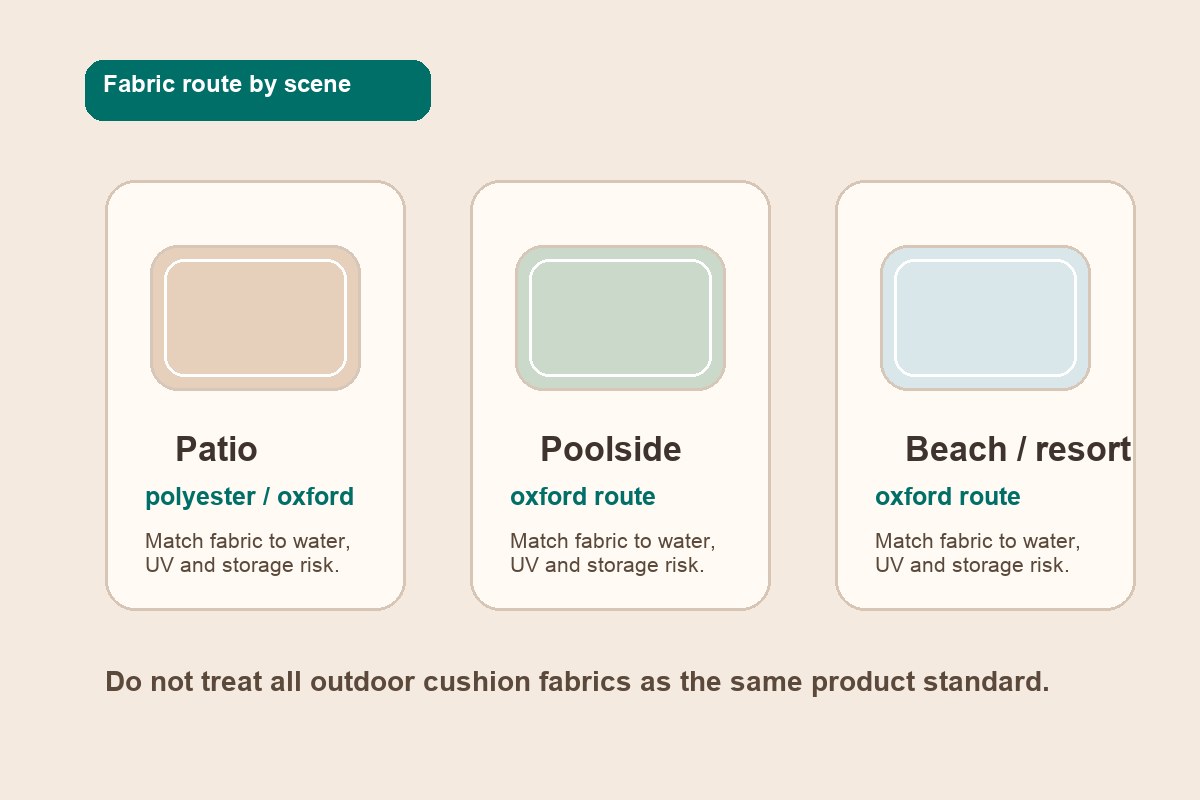
The first question should not be only "can you make this cushion?" The better question is "where will this cushion live?" A patio cushion under a covered area has a different life from a poolside cushion that touches chlorine water. A beach or resort cushion may face sun, salt, sand, wet storage, and stronger washing pressure. The same outdoor word cannot cover all these conditions.
For patio-only use, I usually recommend polyester fabric or Oxford fabric, depending on the buyer's price target and product style. For poolside and beach-resort use, I prefer an Oxford route because it gives a more practical base for water, abrasion, and outdoor handling. This does not mean every Oxford fabric is automatically good. The finishing, coating, color route, and stitching still matter.
| Use scene | Practical fabric route | Main risk | Buyer note |
|---|---|---|---|
| Covered patio | Polyester or Oxford | UV fading and dust | Good for price-sensitive patio lines |
| Open patio | Better outdoor polyester or Oxford | UV, rain and wet drying | Ask for color-fastness target |
| Poolside | Oxford route | Chlorine water and wet storage | Do not use vague waterproof wording |
| Beach / resort | Oxford route | Salt, sand, sun and washing | Confirm color, coating and drying logic |
My sourcing view
I do not like using one material answer for every outdoor cushion. I first ask about the scene. Then I ask about the buyer type. A resort buyer may accept a stronger fabric and higher cost because complaints are expensive. A small retailer may need lower MOQ and use available fabrics first. The right fabric route depends on the business plan, not only the product photo.
What measurement mistakes happen with seat cushions and chair pads?
A cushion can look simple and still be hard to measure.
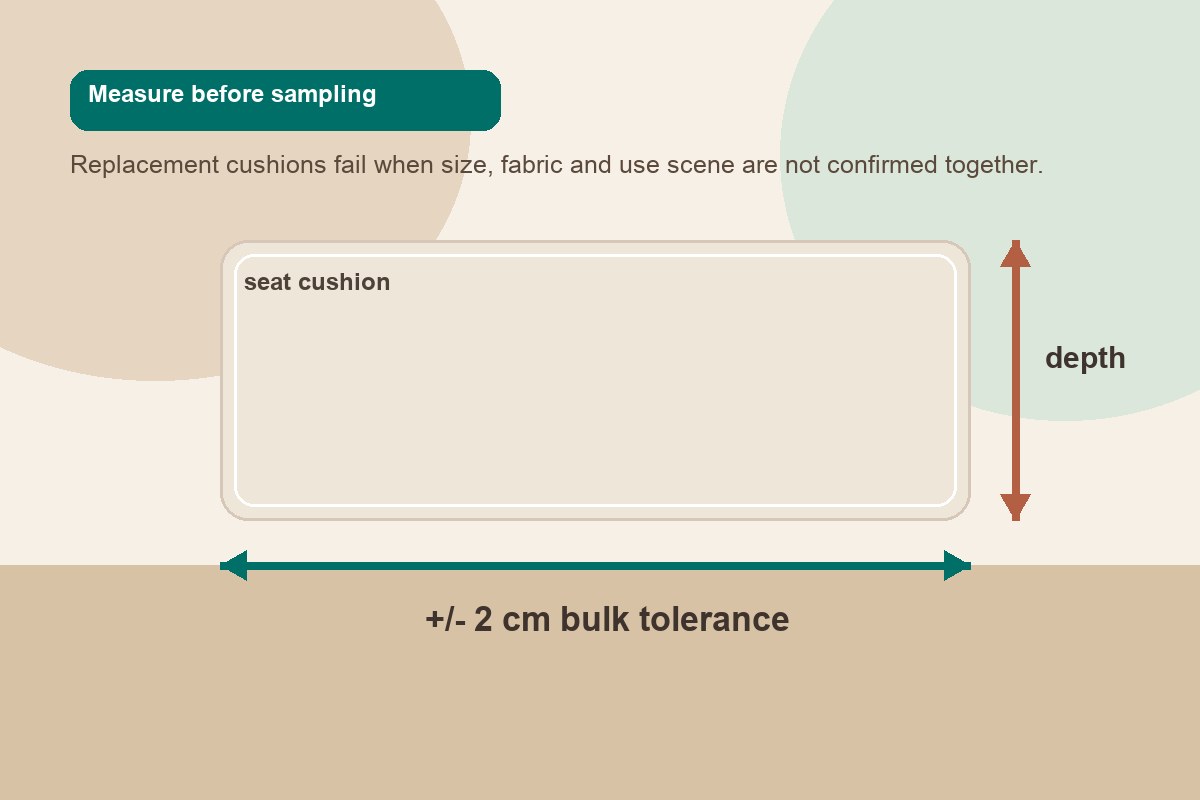
For seat cushions and chair pads, buyers often send incomplete measurements or focus only on length and width. They also forget thickness, corner shape, tie position, seam allowance, foam behavior, cover shrinkage, and furniture fit. A realistic bulk tolerance is often around +/- 2 cm.
What should buyers send before sampling?
For replacement cushions, the buyer should send more than a flat size. They should send length, width, thickness, corner shape, tie or strap position, zipper side, cover style, use scene, fabric preference, target quantity, color reference, and packaging requirement. These details keep the first quote more accurate. They also reduce repeated sample changes.
The tolerance question should be discussed early. For cushion and chair pad bulk production, +/- 2 cm can be a realistic working tolerance in many soft-goods cases. Fabric behavior, filling recovery, sewing tension, and compression can all affect the final size. A rigid furniture part is not the same as a filled textile product.
| Detail | Why it matters | Common mistake |
|---|---|---|
| Length and width | Basic fit | Buyer measures only the old cover |
| Thickness | Comfort and appearance | Buyer forgets filling compression |
| Corner shape | Furniture fit | Rounded corner copied as square |
| Tie position | Usability | Ties do not match chair frame |
| Fabric route | Outdoor performance | Buyer chooses by color only |
| Packaging | Retail and freight | Cushion is compressed too much |
My sourcing view
When a buyer asks for a replacement cushion, I want dimensions and use scene first. Then I want fabric preference, quantity, packaging requirement, and color reference. These are the most important inputs. Without them, a factory can quote, but the quote may not protect the buyer. The cheapest quote may simply hide missing information.
Buyers who need chair pad details can also compare our outdoor chair pads page.
Why are fading and mildew the most common outdoor cushion complaints?
Outdoor buyers often think fading and mildew are separate problems.
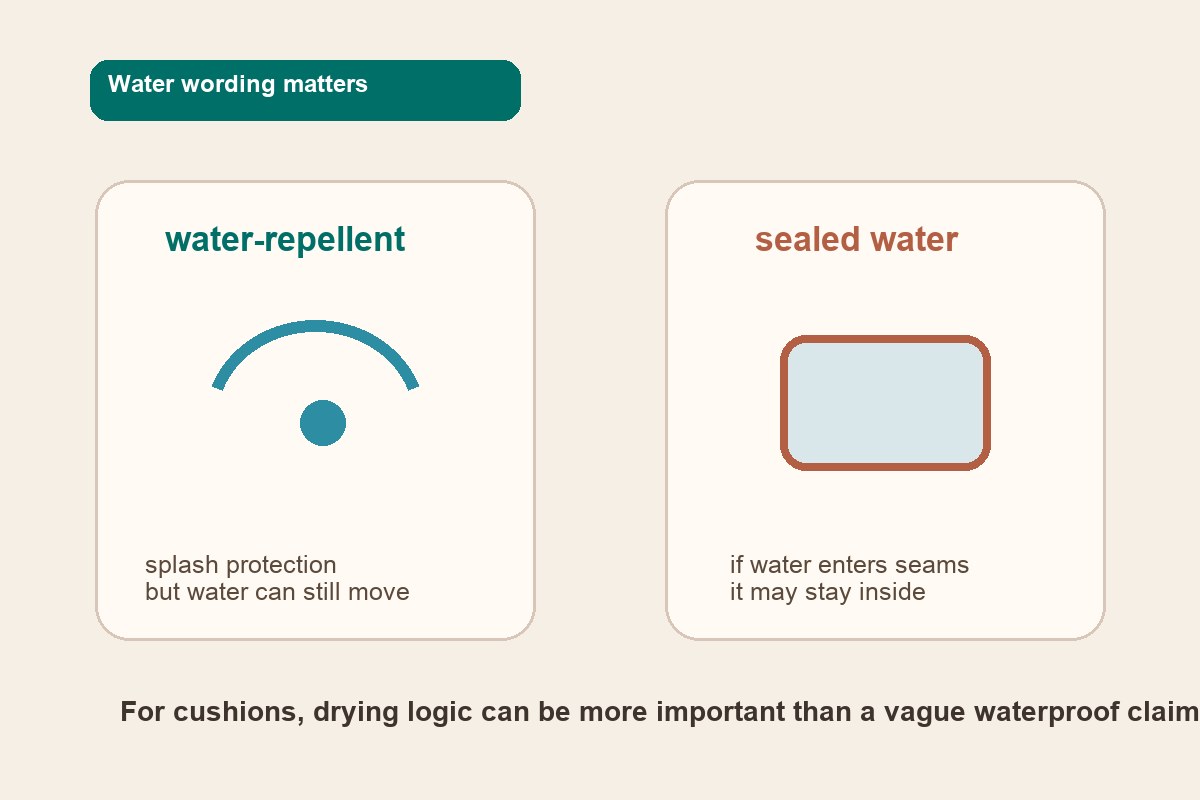
Fading usually comes from weak color fastness or the wrong fabric for the use scene. Mildew often comes from poor water management. Many factories confuse water-repellent and waterproof claims, so cushions may trap moisture instead of drying correctly.
What is the real difference between water-repellent and waterproof?
Many Chinese factories use "waterproof" too loosely. Water-repellent means water can bead up and roll off for a period of time. Waterproof can mean a stronger barrier, but that barrier may create another problem if water enters from seams, zipper edges, or stitching holes. If the water cannot move out, the cushion may stay wet inside. That creates odor and mildew risk.
For outdoor cushions, the buyer should ask a more exact question. Is the fabric water-repellent? Is the backing waterproof? Is the cover removable? Is the foam quick-dry? Can moisture escape? How will the product behave after rain, pool splashes, washing, or wet storage?
Southern Living's outdoor cushion coverage shows that consumer complaints still connect strongly to moisture and mold. This is a useful signal for B2B buyers. A claim on a label does not solve the whole problem. The construction must match the claim.
| Claim | What buyers may think | What buyers should verify |
|---|---|---|
| Water-repellent | Water will not be a problem | How long the finish works and how seams behave |
| Waterproof | Cushion is fully protected | Whether water can enter and whether it can dry out |
| Quick-dry | No mildew risk | Foam, backing, cover and storage all matter |
| Outdoor fabric | Safe for all outdoor scenes | Patio, poolside and beach are not the same |
My sourcing view
I would rather explain a limitation clearly than sell a vague waterproof promise. A buyer may think full waterproofing sounds stronger. But for cushions, full water blocking can be risky if the structure traps water. I usually ask how the end customer will use and store the cushion. The answer decides the construction.
For more on this topic, read our guide on why outdoor cushions fade, mold, or lose shape.
How should importers choose fabric for patio, poolside, and beach-resort cushions?
The fabric choice should follow the use environment.
For patio cushions, polyester and Oxford fabric can both work when the color-fastness target and coating are clear. For poolside and beach-resort cushions, I prefer Oxford routes because chlorine water, salt, wet storage, and stronger abrasion make the environment harder.
What should buyers ask about color fastness?
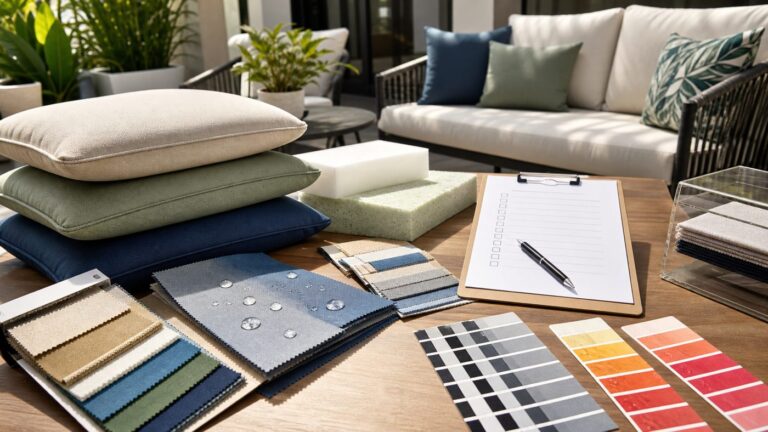
Color fastness is not only a color card issue. It is a time and exposure issue. Buyers should ask how the supplier defines the target: exposure hours, rating method, washing risk, chlorine contact, seawater contact, and real use environment. It is safer to write a clear target than to claim the product will never fade.
In one real case, a customer came to us because their previous supplier's outdoor cushion color fastness was weak. End customers complained about fading. We improved the color-fastness route, and the customer continued working with us after that. The point is not that a fabric can beat every environment. The point is that the fabric must match the environment before bulk production.
LISO can support solution-dyed polyester, acrylic, olefin, Oxford, printed polyester, and recycled polyester routes. But I would not push every buyer into the most expensive option. If the buyer needs low MOQ, available fabric may be the practical first step. If the buyer is building a brand or resort program, stronger fabric control is often worth the cost.
My sourcing view
I do not treat "outdoor" as one standard. Patio-only products can use a practical fabric route. Poolside and beach-resort products need stricter thinking because chlorine water and salt can expose weak color fastness faster. I want buyers to state the use scene before sampling. That one step prevents many complaints.
What filling trade-off should buyers understand before ordering outdoor cushions?
Filling is not only a comfort decision.
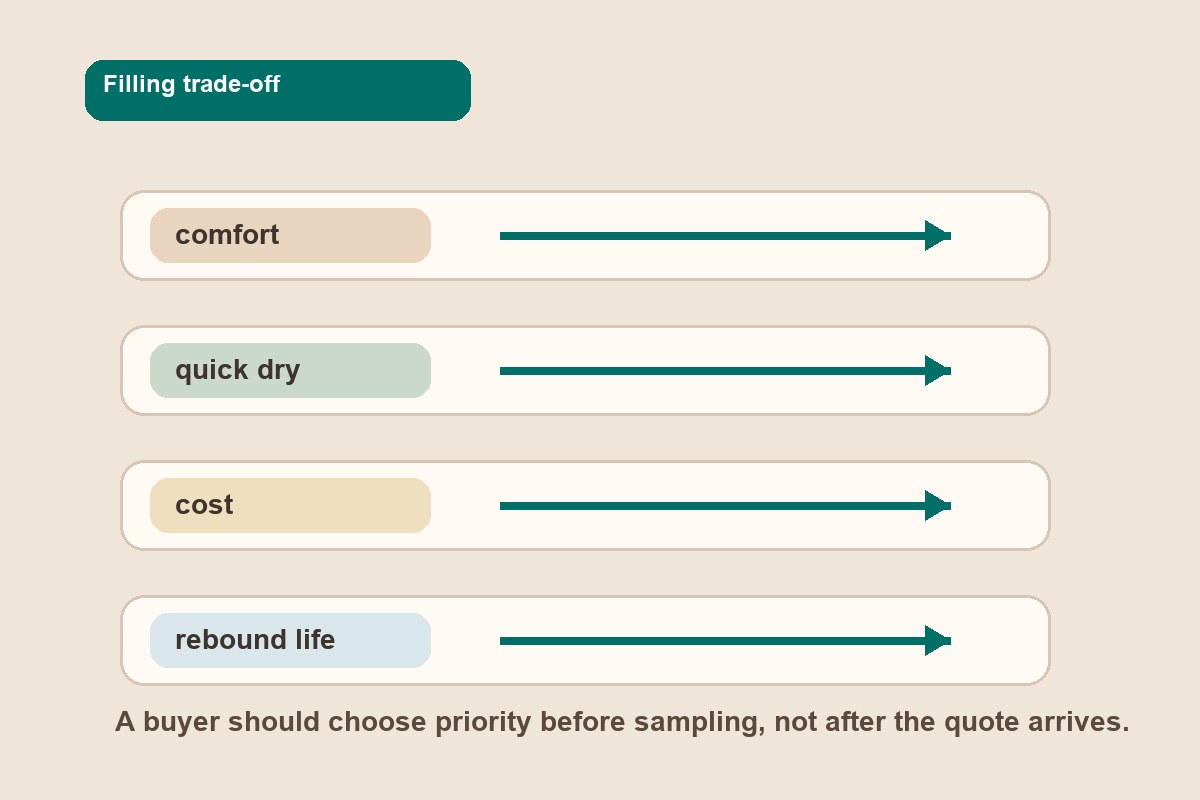
Outdoor cushion filling should be chosen by comfort, quick drying, cost, rebound life, and after-sales risk. Regular sponge, quick-dry foam, polyester fiber, PP cotton, mixed filling, and removable inserts can all work, but each route changes price and performance.
What changes the final filling choice?
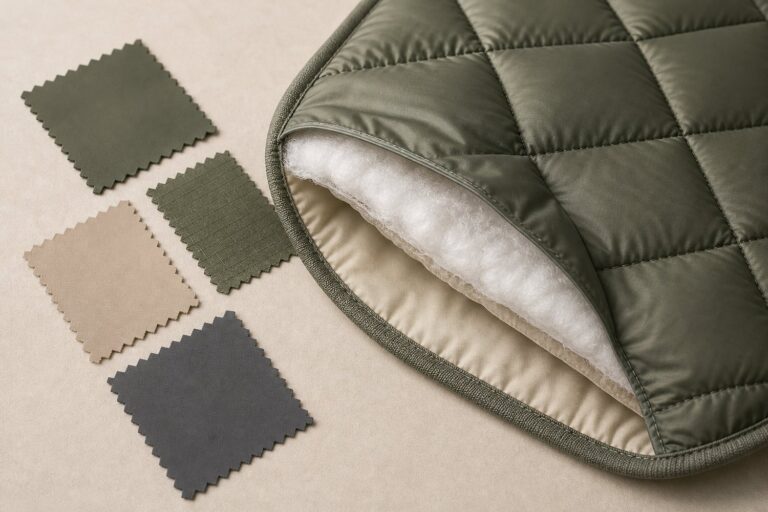
A buyer cannot maximize everything at the lowest cost. A cushion that feels very soft may not recover as well. A fast-drying route may cost more. A lower-cost filling may work for a short seasonal product, but it may not protect a brand that wants repeat orders. A removable insert can help washing and service, but it may add production steps and packaging considerations.
The buyer should decide the priority before sampling. Is the goal a price-sensitive retail seat cushion? Is it a resort cushion that needs repeated use? Is it a chair pad that must stay thin and easy to pack? Is it a bench pad that needs shape stability? These questions matter more than asking for the cheapest foam.
| Filling route | Best for | Main risk | Buyer note |
|---|---|---|---|
| Regular sponge | Cost-sensitive cushions | Slow drying or shorter life | Good only when use scene is clear |
| Quick-dry foam | Poolside and wet-use scenarios | Higher cost | Better for moisture control |
| Polyester fiber | Soft hand feel | Shape may shift | Works for pillows and some back cushions |
| PP cotton | Volume and softness | Recovery varies by density | Needs clear fill weight target |
| Removable insert | Washing and service | More construction steps | Useful for better programs |
My sourcing view
When a buyer asks me which filling is best, I ask what complaint they fear most. If they fear price, one route may work. If they fear mildew, another route is safer. If they fear collapse, rebound and density matter more. The honest answer is a trade-off, not a single magic material.
How does low MOQ affect custom outdoor cushion replacement projects?
Low MOQ is helpful, but it has a real limit.
For custom outdoor replacement cushions, low MOQ is usually limited by fabric. If buyers use available fabric, low MOQ is easier. If they require custom fabric, custom color, custom print, custom packaging, and many sizes, low MOQ becomes harder and unit cost rises.
What should buyers plan before asking for low MOQ?
Low MOQ can reduce inventory risk. I support that. But low MOQ does not automatically create low price. Fabric mills, printing, coating, trims, labels, and packaging all have setup cost and minimums. If the buyer asks for too many colors and sizes at a low quantity, fabric waste and management risk increase.
The practical route is to make the first test simple. Use available fabric when the buyer needs low MOQ. Choose fewer colors. Group sizes around real demand. Use one packaging system. Confirm the target market and order quantity early. Then, after the first season proves sales, the buyer can move into stronger custom fabric or a wider coordinated collection.
| Buyer goal | Better MOQ route | Why |
|---|---|---|
| Fast market test | Available fabric | Lower fabric barrier |
| Brand color control | Custom fabric or controlled batch | Stronger visual consistency |
| Resort program | Stronger fabric route | Lower complaint risk |
| Many replacement sizes | Fewer first-launch sizes | Less waste and fewer mistakes |
My sourcing view
I do not sell low MOQ as a miracle. I sell it as a planning tool. If the buyer accepts available fabric and a focused SKU plan, low MOQ can work well. If the buyer wants everything custom at a very small quantity, the buyer should expect a higher unit cost or a weaker range of choices.
If your project is moving from a single cushion to a series, read our guide on coordinated outdoor cushion collections.
What should buyers confirm before sampling replacement cushions?
Sampling should start with a clear brief.
Before sampling replacement cushions, buyers should confirm size, tolerance, use scene, fabric route, color reference, filling route, MOQ, packaging, and target market. These details help the supplier quote correctly and reduce sample revisions before bulk production.
Pre-sampling checklist
- Size: length, width, thickness, corner shape, tie position, zipper side, and cover structure.
- Use scene: patio-only, open garden, poolside, beach-resort, retail replacement, or hospitality.
- Fabric preference: polyester, Oxford, acrylic, olefin, printed polyester, recycled polyester, or available fabric route.
- Color reference: Pantone, fabric swatch, print file, or previous approved sample.
- Filling: sponge, quick-dry foam, polyester fiber, PP cotton, mixed filling, or removable insert.
- MOQ: available fabric route or custom fabric route.
- Packaging: compressed pack, retail pack, carton pack, hangtag, label, or private-label packaging.
- Target market: brand, wholesaler, resort, retailer, importer, or e-commerce seller.
- Quantity: sample quantity, first bulk quantity, and possible reorder scale.
This checklist is not paperwork for its own sake. It protects the buyer from false comparisons. Two factories may quote different prices because they are quoting different assumptions. A professional buyer should make the assumptions visible.
For broader sourcing risks, read our article on outdoor cushion buying mistakes and compare the outdoor cushion manufacturer page.
FAQ
What is the most common problem with outdoor replacement cushions?
Fading and mildew are the most common problems. Fading often comes from weak color fastness or the wrong use-scene fabric. Mildew often comes from poor water management, wet storage, or unclear waterproof construction.
What size tolerance is realistic for custom outdoor cushions?
For many soft outdoor cushion and chair pad projects, a realistic bulk tolerance can be around +/- 2 cm. The exact tolerance should be confirmed before sampling because fabric, filling, sewing, and compression affect the final size.
Can low MOQ custom outdoor cushions be made?
Yes, low MOQ can be possible when buyers use available fabric and a focused SKU plan. Low MOQ becomes harder when buyers need custom fabric, custom colors, many sizes, custom packaging, and strict color control at the same time.
Is waterproof fabric enough for outdoor cushions?
No. Waterproof wording is not enough. Buyers must ask whether the fabric is water-repellent, waterproof-backed, quick-dry, breathable, washable, and suitable for the actual use scene. Cushions also need correct seam and drying logic.
What information should importers send before sampling?
Importers should send dimensions, use scene, fabric preference, color reference, quantity, packaging requirement, filling preference, and target market. These details help the factory avoid wrong samples and inaccurate quotes.
Conclusion
Outdoor cushion replacement succeeds when buyers confirm the use scene, fabric, water logic, filling, MOQ, and tolerance before sampling.
My Role
I help buyers turn outdoor cushion requests into practical sourcing decisions. My job is not only to quote a cushion. I help buyers prevent fading complaints, mildew risk, wrong fabric choices, and sample-to-bulk surprises before production starts.
## Which replacement outdoor cushion page should buyers compare next?
If the project is moving from problem check to sampling, I usually suggest comparing our [custom outdoor cushions manufacturer page](https://lisohome.com/product/outdoor-patio/custom-outdoor-cushions/). It helps buyers turn replacement outdoor cushions, patio replacement cushions, outdoor cushion covers, foam recovery, mildew risk and color fastness questions into a clearer OEM sample brief.