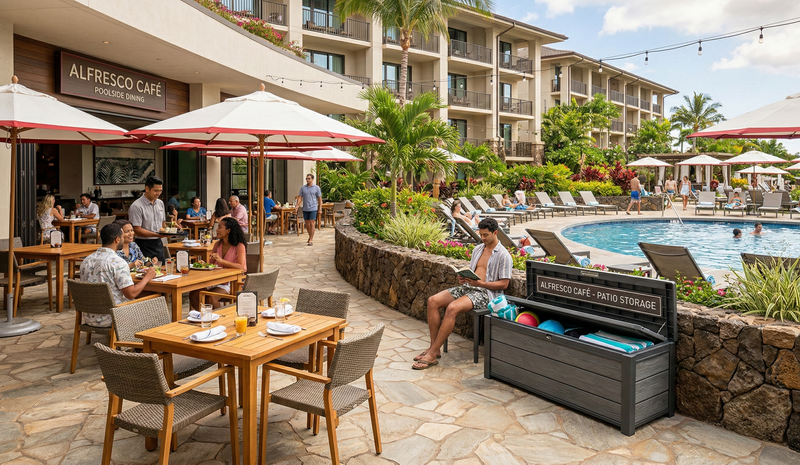
A protective textile cover is not the storage bench itself. It does not change the bench’s load rating, hinge function, drainage, or internal enclosure performance. Its role is to reduce direct exposure when the cover is correctly specified, fitted, installed, and maintained.
For buyers evaluating an outdoor storage bench cover manufacturer, the sourcing rule is simple: bench geometry, use conditions, material construction, sewing details, test methods, and acceptance criteria must resolve to one approved specification. A material name or fabric weight alone is not enough.
Buyers defining a wider assortment can first review the outdoor furniture cover range and decide whether the storage bench cover should share materials, trims, colors, or packaging with related cover SKUs.
Start With the Bench, Not a Generic Cover Size
Do not develop a fitted patio storage cover from a retail product name or nominal length-by-width-by-height statement. Use a dimensioned drawing supported by photographs of the actual bench.
| Measurement field | What to record |
|---|---|
| Overall length | Maximum length, including handles, hinges, or projecting trim |
| Overall width | Maximum width at the lid, body, feet, or other protrusions |
| Overall height | Highest point to the intended lower edge of the cover |
| Lid and hinge geometry | Overhang, slope, hinge projection, and required movement |
| Base and feet | Foot locations, recesses, and ground clearance |
| Handles and latches | Position, projection, and whether access is required |
| Corners and profiles | Radius, taper, sloped lid, and irregular side panels |
| Installation direction | Front, back, label orientation, vents, and fastening points |
Ease allowance and manufacturing tolerance are different. Ease is intentionally added for installation and removal; tolerance defines the permitted production variation. Record both and approve them on a fitted sample.
If one cover is intended for several bench models, list every model and dimension set. Check the smallest and largest relevant geometry rather than assuming one prototype represents the full range.
The use brief should also record whether the bench is fully exposed or sheltered, expected rain and irrigation, sunlight, wind, dust, airborne salt, temperature range, seasonal or year-round use, cleaning frequency, and whether the lid must open while the cover is installed.
Choose Fabric and Coating as a System
Terms such as “Oxford,” “heavy duty,” “premium,” or a denier number do not define finished performance. A usable material specification records:
- fiber composition, weave or knit construction, and agreed areal mass;
- yarn size when it is relevant to the approved construction;
- coating or laminate chemistry, application side, and material reference;
- surface finish, color standard, and permitted lot variation;
- compatibility with thread, seam tape, adhesive, or welding processes;
- supplier material code and change-control requirements;
- buyer-defined restricted-substance and destination-market requirements.
A higher denier does not automatically establish a longer service life. Weave density, coating adhesion, flex behavior, seam design, color system, and exposure conditions can all affect the result.
PU-backed, PVC-backed, laminated, and other coated constructions have different trade-offs. Compare the exact samples for water penetration, coating adhesion, flexibility, surface feel, odor requirements, cleaning, temperature exposure, and target-market restrictions. Do not declare one coating universally superior without a defined basis.
Water-related wording should separate three questions:
- Surface wetting: how the face resists wetting under a defined spray method.
- Fabric penetration: how the material resists water pressure through the textile sheet.
- Finished-cover leakage: what occurs after seams, vents, fasteners, and openings are assembled.
A result for one scope does not answer the others. A surface-spray result does not establish hydrostatic resistance, and a fabric result does not establish the behavior of a sewn weather-resistant patio cover.
Construction Details That Control Real-World Use
Seams and reinforcement
Specify seam type, seam allowance, thread reference, stitch-density range, sealing or taping locations, and reinforcement at buckles, handles, and load points. More stitches are not automatically better on a coated textile because every needle penetration changes the material.
Where seam tape or adhesive is proposed, evaluate compatibility with the exact coating after conditioning and flexing. A process that works on one backing should not be assumed equivalent on another.
Ventilation
Vents can support air exchange, but they cannot guarantee that condensation, odor, or microbial growth will not occur. Define vent position, opening size, rain flap, mesh, stitching, and orientation relative to runoff. Include the vented finished cover in fit and spray evaluation.
Instructions should tell the user to allow the bench and cover to dry before prolonged storage. Cleaning and drying language must match the approved material and coating.
Fastening and lower-edge control
Possible elements include adjustable webbing straps, buckles, drawcords, elastic sections, and leg-positioned attachment points. Choose them according to geometry and exposure rather than adding every feature.
The specification should define component material, size, position, adjustment range, and attachment construction. The sample review should check installation time, access, interference with the bench, hem clearance, and retention under a buyer-defined procedure.
Fastening features do not establish a wind-performance claim by themselves. Any such claim requires a stated finished-product method and acceptance value.
Handles, labels, and openings
Installation handles should match real handling steps and be reinforced at their attachment points. They must not imply that the bench can be lifted through the cover. Record care labels, orientation marks, size identification, and access openings only after the intended use has been reviewed.
Match Test Methods to Claims
The following official standards describe methods or practices. Citing one does not mean that a material or product passed it. The RFQ still needs the applicable edition, procedure, specimen preparation, conditioning, sample count, result format, and acceptance threshold.
| Property | Official method | What it evaluates | Boundary |
|---|---|---|---|
| Surface resistance to wetting | AATCC TM22 | Wetted pattern after controlled spray on fabric | Does not establish hydrostatic resistance or cover leakage |
| Fabric water penetration | AATCC TM127 | Resistance under hydrostatic pressure | Does not represent seams, vents, or openings |
| Coated-fabric properties | ASTM D751 | Selected strength, tear, hydrostatic, adhesion, and seam procedures | The specific procedure and target must be named |
| Controlled UV and moisture exposure | ASTM G154 | Exposure used to evaluate defined material-property changes | It is not a product threshold or field-life prediction by itself |
| Textile color under artificial light | ISO 105-B02 | Color-fastness response under the stated method | Does not establish every aspect of outdoor durability |
For accelerated exposure, define what will be measured before and after exposure—for example color change, coating condition, or retained strength. Exposure hours alone are not a complete performance result.
For a finished-cover spray evaluation, record the bench or fixture, installation, sample conditioning, spray source, angle, duration, flow or pressure, inspection timing, and permitted internal wetting. “Passed a water test” is not reproducible without these conditions.
Sampling and Quality-Control Workflow
1. Requirement brief
Freeze the bench model, environment, target market, material objectives, functional features, appearance, and packaging inputs.
2. Engineering drawing
Approve reference points, finished dimensions, ease, tolerances, seam locations, vent positions, fasteners, handles, and label placement.
3. Material approval
Approve the exact face textile, backing or coating, color, thread, tape, and trim references. Record supplier codes so substitutions require written review.
4. Fit and function sample
Install the prototype on the actual bench or an approved equivalent fixture. Check removal, fastening, lid interaction, hem clearance, vent orientation, and the agreed performance procedures.
5. Pre-production approval
Put all corrections into one controlled specification. A physical sample can remain a workmanship reference, but dimensions, materials, and acceptance values belong in the written source of truth.
6. Production change control
Require written approval before changing material, coating, thread, tape, buckle, pattern, dimensions, process, or test method. A visually similar substitute is not automatically equivalent.
Production inspection should verify incoming material codes, color lots, pattern revision, cutting orientation, seam construction, component positions, finished dimensions, fit, appearance, agreed performance checks, and packaging. The purchase order should define the sampling plan, lot, decision rules, report owner, and action for a nonconforming result.
RFQ Acceptance Matrix
| Requirement | Method or reference | Target | Sample stage | Evidence owner |
|---|---|---|---|---|
| Bench fit | Approved drawing and fixture | Buyer-defined ease and tolerance | Fit sample and production | Supplier with buyer approval |
| Surface wetting | Named spray method | Buyer-defined rating | Material and approved color | Agreed laboratory or supplier |
| Fabric penetration | Named hydrostatic method | Buyer-defined value | Material lot | Agreed laboratory |
| Finished leakage | Agreed installed-cover protocol | Buyer-defined permitted wetting | Fit sample and production check | Supplier or inspection party |
| Color response | Named light-exposure method | Buyer-defined change | Approved material/color | Agreed laboratory |
| Seam and fastening | Drawing plus agreed load or inspection | Buyer-defined acceptance | Sample and production | Supplier/inspection party |
| Dimensions | Defined measurement points | Written tolerances | Sample and production | Supplier/inspection party |
| Packaging | Approved pack specification | Correct fold, label, barcode, and carton | Pre-production and shipment | Supplier/inspection party |
Leave unknown fields open for confirmation instead of filling them with assumptions. A standard number without a procedure and target is not an acceptance requirement.
Frequently Asked Questions
Is a denier number enough to choose the fabric?
No. Denier describes yarn linear density. It does not define weave construction, areal mass, coating, adhesion, seam behavior, water penetration, color stability, or finished-cover performance.
Should the cover fit tightly?
It needs enough ease for installation without uncontrolled excess material. The right value depends on geometry, coating stiffness, access requirements, fastening, and production tolerance. Approve it through the drawing and fitted sample.
Which coating is best?
There is no universal answer. Compare exact constructions against water-resistance, flexibility, adhesion, odor, cleaning, temperature, target-market, and cost requirements.
Do vents prevent condensation?
No guarantee should be made. Bench moisture, weather, airflow, vent geometry, installation, and maintenance all affect the outcome.
Does a fabric report cover the finished product?
Only if the report explicitly tested the finished product under an applicable protocol. Material reports normally apply to the identified specimen; seams, vents, fasteners, and openings need separate evaluation.
Can one cover fit several bench models?
Only after the relevant geometries have been compared and the agreed fit range verified. A shared commercial size name is not sufficient evidence.
Turn the Cover Specification Into a Product Program
The Outdoor Patio OEM Solution is the wider collection route for buyers planning multiple patio textile categories. Use the patio fabric solution when cover and cushion textiles need a coordinated color or material review.
If the bench program includes seating, review custom outdoor cushions as a separate fit, filling, and comfort specification. A protective cover and a cushion can share a collection while retaining different drawings and acceptance criteria.
For a feasibility review, send the bench drawing, photographs, use conditions, requested quantity levels, target market, material objectives, performance criteria, and packaging brief. If the project falls within current manufacturing capabilities, the next response should confirm the proposed construction, open technical questions, sample path, quotation basis, testing scope, and exclusions in writing.
No material performance, timing, quantity, or commercial condition should be treated as committed until it appears in the approved specification and quotation.