A cheap orthopedic dog bed can look premium in photos. The failure usually appears later: flattened foam, hard edges, noisy liners, weak zippers, poor washability and customer complaints.
The real difference between a high-end and low-end orthopedic dog bed is not the word "orthopedic." It is whether the bed keeps its support after repeated use, protects the foam core from moisture, survives cover washing, recovers after compression packing and can be repeated consistently in bulk production.
For buyers building a private label dog bed line, this question is commercial, not only technical. A low quote may still work for an entry-level SKU. A premium retail program needs tighter foam, cover, liner, stitching, packaging and QC decisions from the start. If you are comparing samples, use LISO's dog bed manufacturer page as the commercial sourcing route, then use this guide to judge the product structure.
From LISO's sourcing experience, the most expensive mistakes often happen before mass production starts. Some low-price beds use 20D-25D low-density foam, shredded foam instead of a solid foam core, or foam that is vacuum packed even though it was not designed for compression. These details may not look obvious in product photos, but they decide whether the bed still supports the dog after months of use and whether it recovers properly after sea freight.
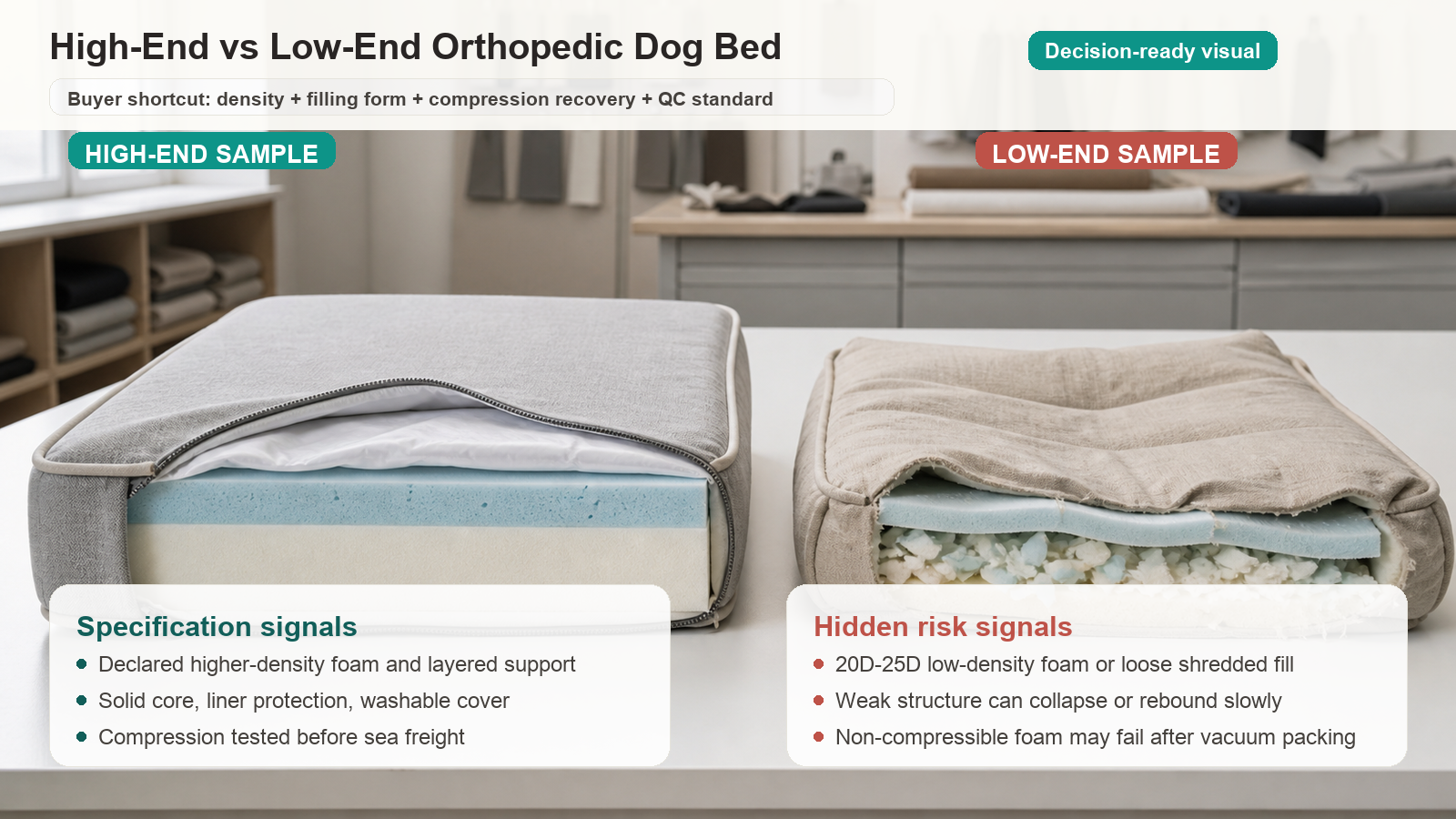
Quick Comparison: High-End vs Low-End Orthopedic Dog Beds
| Decision point | High-end orthopedic dog bed | Low-end orthopedic dog bed | Buyer risk |
|---|---|---|---|
| Foam core | Higher-density memory foam or layered foam system with declared density | Thin PU foam, 20D-25D low-density foam, foam scraps or loose fill | Flattens quickly and loses support |
| Filling form | Solid foam core or designed layered foam structure | Shredded foam used as the main support core | Uneven support and shifting fill |
| Layer design | Comfort layer plus support layer | One thin layer used for all dog weights | Large dogs bottom out |
| Cover | Removable, washable, durable textile | Non-removable or weak thin fabric | Poor cleaning experience and short life |
| Inner protection | Waterproof or water-resistant liner around foam | No liner, or noisy/fragile film | Foam absorbs urine, odor and moisture |
| Zipper | Covered zipper, stronger slider, replaceable cover logic | Exposed low-grade zipper | Breakage after washing or digging |
| Packaging | Compression tested with recovery standard | Non-compressible foam vacuum packed to save freight | Bed arrives flat or misshaped |
| QC | Foam density, size tolerance, seam strength, wash test | Visual inspection only | Batch inconsistency and review risk |
| Supplier transparency | Foam, compression and QC limits are explained before sampling | Process risks are hidden until problems appear | Buyer pays for returns, delays and review damage |
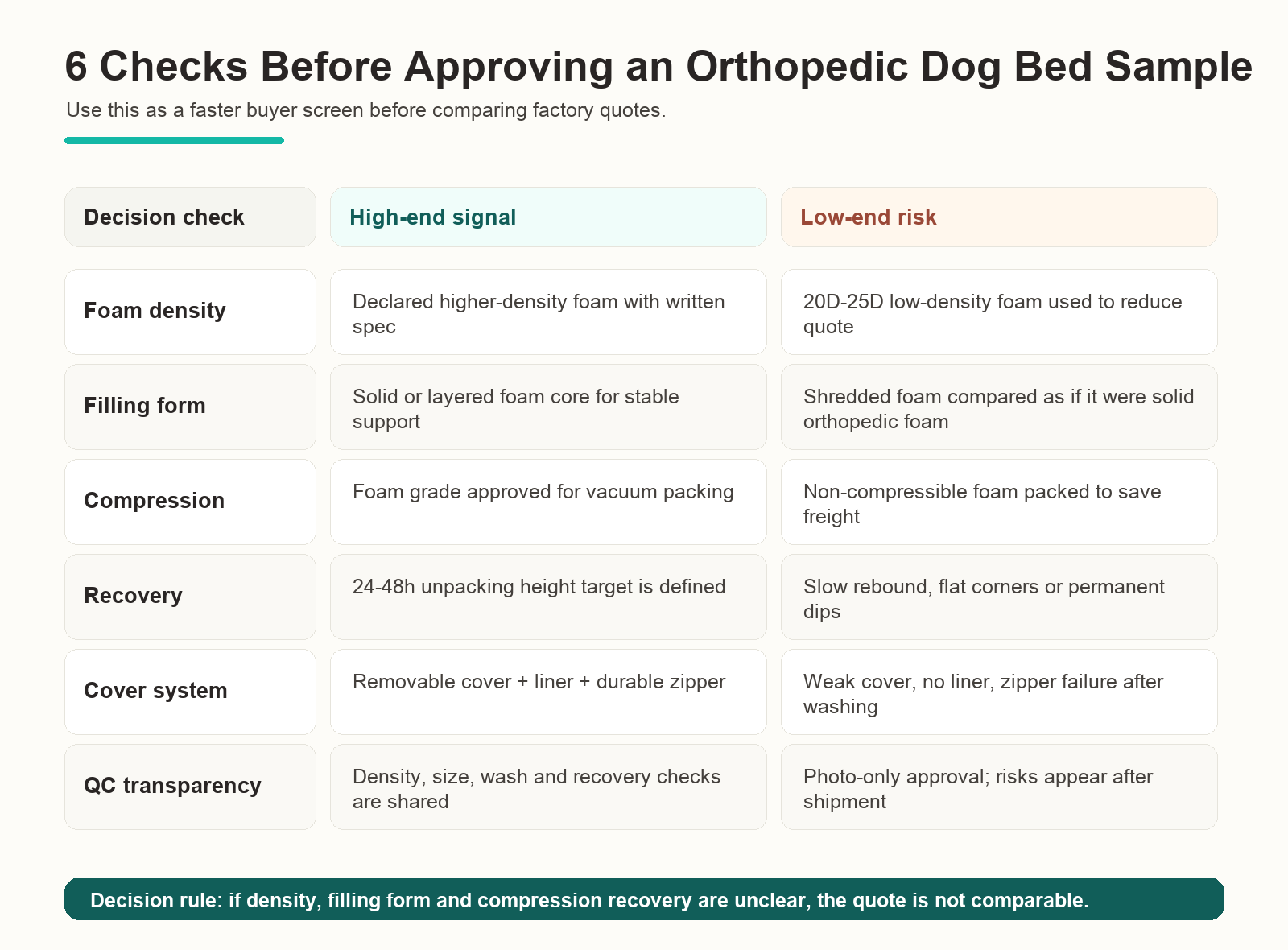
Why Is "Orthopedic" Not Enough as a Product Specification?
"Orthopedic" sounds technical, but it can be vague if the buyer does not define what it means in the purchase order.
A buyer should not accept "orthopedic" as a standalone spec. A real orthopedic dog bed program should define foam density, foam thickness, layer structure, cover material, liner protection, dog weight range, compression recovery and quality testing.
Veterinary experts quoted by SELF note that dog beds labeled orthopedic do not follow strict universal criteria. The term often suggests more support, memory foam or a thicker base, but the label itself does not prove quality. That matters for private-label buyers because two factories can both quote "orthopedic dog bed" while using very different materials.
From a sourcing view, the first failure is semantic. If the RFQ only says "orthopedic dog bed, washable cover, low price," a supplier can answer with a low-density foam block and a zipper cover. The product may look acceptable on day one. It may still fail after three months of use because the support system was never specified.
For a premium SKU, write the definition before asking for price:
- Target dog size and weight range.
- Foam type and density.
- Total bed height after recovery.
- Comfort layer and support layer structure.
- Cover fabric and wash requirement.
- Waterproof liner requirement.
- Packaging method and recovery test.
- QC acceptance standard before shipment.
This turns a marketing word into a product standard.
What Foam Difference Separates Premium Beds From Cheap Beds?
Foam is where many orthopedic dog bed programs win or fail.
High-end orthopedic dog beds usually use higher-density memory foam, gel memory foam, HR foam or a layered foam construction. Low-end beds often rely on thin PU foam, low-density egg crate foam, shredded foam or fiber filling that feels soft at first but compresses faster.
In low-price sourcing, one common risk is 20D-25D low-density foam. It can reduce the first quote, but it is more likely to lose height and support after repeated use. The issue may not appear during a quick showroom check. It often appears after months of daily pressure, when the foam rebounds slowly, forms a permanent dip or fails to return to its original height.
The second risk is filling form. Shredded foam can be useful for bolsters, cuddler beds or soft comfort beds, but it should not be treated as the same thing as a solid orthopedic support core. A solid foam core gives more stable support. Shredded foam can shift, clump and create uneven support unless the product is intentionally designed around that loose-fill feel.
Density terms can vary by supplier and market, so buyers should ask for the exact unit, foam type and test method. Do not approve a premium orthopedic bed from a label such as "high-density foam" alone.
CertiPUR-US notes that older, arthritic or injured dogs may require extra support from an orthopedic bed with high-density orthopedic foam. The same source also explains that nearly all dog beds use flexible polyurethane foam, either conventional foam or memory foam. That is why buyers need to ask what type of foam is inside, not only whether the bed is "foam-filled."
Foam choices buyers should compare
| Foam type | Best use | Premium risk control | Low-end failure mode |
|---|---|---|---|
| Standard PU foam | Entry-level dog beds, budget SKUs | Use only when orthopedic claim is modest | Compresses and forms permanent dips |
| Egg crate foam | Airflow, lighter dogs, budget orthopedic surface | Specify base foam density and thickness | Peaks flatten under heavier dogs |
| Solid memory foam | Premium comfort and pressure distribution | Control density, thickness and recovery | Thin low-density foam bottoms out |
| Gel memory foam | Premium warm-climate or senior dog line | Keep density standard, not only gel claim | Gel marketing hides weak foam base |
| Layered foam | Medium/large dogs, premium retail | Separate comfort and support layers | One layer must do too much |
| Shredded foam | Cuddler or low-cost comfort bed | Use only when loose feel is intentional | Uneven support and shifting fill |
For B2B sampling, I would not approve a premium orthopedic dog bed by hand feel alone. A soft sample can feel attractive in a showroom and still fail under daily load. Ask the factory to record foam density, foam thickness, compression recovery and finished bed height after unpacking.
Foam questions buyers should ask before price negotiation
- Is the main support core solid foam, layered foam or shredded foam?
- What is the foam density, and what unit is being used?
- Is the foam in the 20D-25D low-density range, or is it a higher-density support foam?
- How long should the foam keep its rebound under normal use?
- Can the foam be compressed for shipping without damaging recovery?
- What recovery standard is used after unpacking?
Why Does Layer Construction Matter More Than Thickness Alone?
A thick bed can still be low-end if the foam is weak.
A premium orthopedic dog bed separates comfort and support. The top layer should reduce pressure and improve comfort. The base layer should stop the dog from sinking to the floor. A cheap bed often uses one soft layer and calls the entire product orthopedic.
This matters most for large dogs and senior dogs. A small dog may sleep comfortably on a thinner foam pad. A 30 kg dog puts much more pressure through the hips, shoulders and elbows. If the bed compresses until the dog feels the hard floor, the orthopedic positioning is not credible.
Better construction logic
| Layer | Function | Common premium choice | What to verify |
|---|---|---|---|
| Top comfort layer | Surface comfort and pressure relief | Memory foam or gel memory foam | Density, thickness, surface recovery |
| Base support layer | Load support and anti-bottoming | High-density PU or HR foam | Firmness, height retention, dog weight range |
| Bolster fill | Head support and nesting comfort | Fiberfill or foam-filled bolster | Fill volume, seam strength, shape retention |
| Bottom fabric | Floor grip and durability | Anti-slip fabric or Oxford backing | Skid resistance and abrasion |
A low-end supplier may quote "10 cm orthopedic foam" without explaining whether the foam is one layer, two layers, memory foam or standard PU foam. That is not enough. A buyer should ask for a cutaway photo, material sheet and sample testing before bulk order approval.
Why Can Compression Packing Become a Hidden Sourcing Trap?
Compression packing saves freight space, especially for e-commerce and sea freight. But not every foam should be compressed.
A high-end orthopedic dog bed program should confirm whether the foam is compressible before vacuum packing. A low-end sourcing trap is using non-compressible foam in a compressed product without telling the buyer, which can cause poor rebound after unpacking.
This problem is easy to miss during quotation. A buyer asks for compressed packaging to reduce carton volume. A factory agrees because the target price depends on freight savings. But if the foam is not suitable for compression, the bed may arrive with weak height recovery, uneven corners or a permanently flattened look.
For an overseas buyer, the cost is not only the foam. It becomes:
- poor unboxing experience;
- customer complaints that the bed looks thinner than advertised;
- extra replacement or refund cost;
- slower product launch because the first batch needs correction;
- damage to reviews if the product is sold online.
Compression should be treated as a material spec
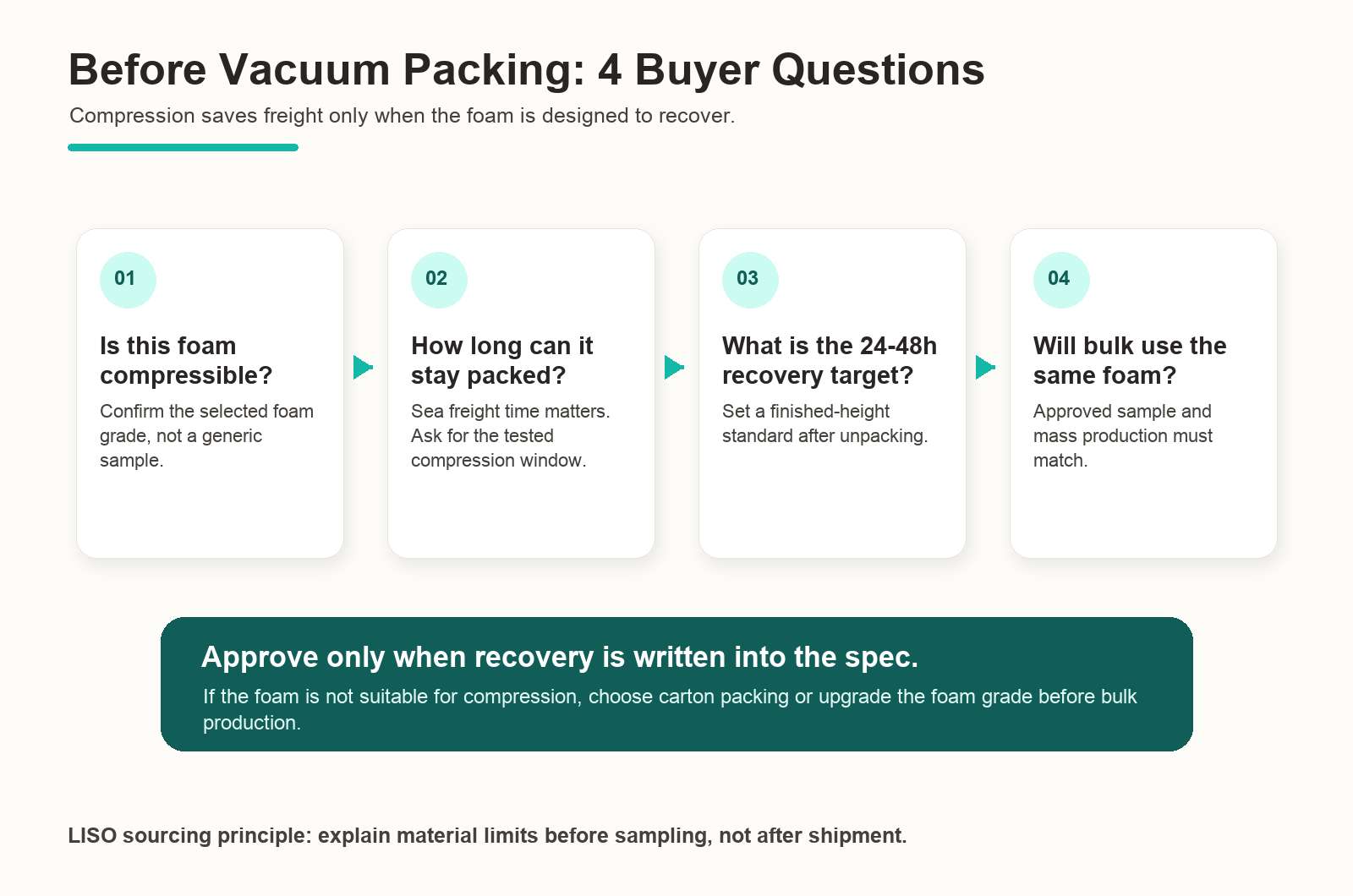
Do not ask only, "Can you vacuum pack this bed?" Ask:
- Is this exact foam grade suitable for compression?
- How many days can the bed stay compressed without recovery loss?
- What is the expected recovery time after unpacking?
- What finished height should the bed recover to after 24-48 hours?
- Has the factory tested this foam with the same packaging method and shipping time?
- Will the approved sample and bulk order use the same foam and compression process?
The honest answer may be that a cheaper foam should not be compressed, or that the product needs a different foam grade if compression packing is mandatory. That answer protects the buyer more than a low quote that hides the limitation.
How Do Covers, Liners and Zippers Change the Product Grade?
The foam gets attention, but the cover system decides daily usability.
A high-end orthopedic dog bed should have a removable washable cover, a protected inner foam core, a durable zipper path and fabric that matches the dog's use case. A low-end bed often uses a thin cover, weak zipper and no liner, so the foam becomes difficult to protect or clean.
The Spruce Pets repeatedly highlights removable machine-washable covers, waterproof liners, water-resistant covers and non-slip bottoms as important features in tested orthopedic dog beds. CertiPUR-US also recommends choosing a machine-washable bed or one with a removable machine-washable cover because accidents, fleas, mites and muddy paws are real use cases.
For OEM production, this becomes a spec list:
- Outer cover fabric: teddy fleece, sherpa, suede, Oxford, velvet, boucle, canvas or cooling fabric.
- Liner: waterproof or water-resistant inner layer protecting the foam.
- Zipper: hidden zipper, covered zipper, stronger slider and safe placement.
- Care label: machine wash, cold wash, line dry, spot clean or cover-only washing.
- Bottom: anti-slip fabric, Oxford base or PVC-dot backing depending on market.
The hidden cost of a weak cover
A cheap cover can turn a good foam core into a bad product. If the zipper breaks, the customer cannot remove the cover. If the liner tears, the foam absorbs urine or odor. If the cover shrinks after washing, the foam no longer fits smoothly. If the fabric pills quickly, reviews describe the whole bed as low quality even if the foam is acceptable.
For premium programs, the cover is not decoration. It is part of the product's service life.
What QC Tests Should Buyers Require Before Bulk Production?
Visual inspection is not enough for orthopedic dog beds.
Buyers should test high-end orthopedic dog beds by foam density, finished size, compression recovery, cover wash performance, zipper durability, seam strength, liner protection and packaging recovery. A low-end program usually skips these checks and relies on appearance approval.
When a buyer asks why one quote is higher, the answer is often not only material cost. It is the number of product risks controlled before shipment.
Practical sample approval checklist
- Measure finished bed size after unpacking.
- Measure foam thickness at multiple points.
- Confirm foam density against the agreed spec.
- Press the foam and check recovery after load.
- Confirm whether the foam grade supports compression packing.
- Compress pack the sample and check recovery after 24-48 hours.
- Remove and reinstall the cover three times.
- Open and close the zipper repeatedly.
- Wash the cover according to the care label.
- Check whether the cover still fits after washing.
- Test whether the liner protects the foam from moisture.
If the product is vacuum packed, recovery becomes especially important. A bed can leave the factory within tolerance and arrive looking underfilled if the foam does not recover well after compression. For e-commerce brands, this creates immediate refund and review pressure.
When Is a Low-End Orthopedic Dog Bed Still a Reasonable Choice?
Low-end does not always mean wrong. It is wrong only when the claim and price position are stronger than the product.
A low-end orthopedic dog bed can be reasonable for entry-level retail, seasonal promotions, small dogs or light-use programs if the buyer is honest about the support promise. It becomes risky when marketed as a premium senior-dog, large-dog or long-life orthopedic product.
The right question is not "cheap or expensive?" The right question is "What promise does the brand need the product to defend?"
Entry-level can work when:
- The dog size range is small or medium.
- The product is positioned as comfort bedding, not medical support.
- The bed is not expected to last several years.
- The cover is still removable and washable.
- The retail price matches the construction.
- The packaging does not overpromise senior-dog support.
Premium is necessary when:
- The target customer owns large or senior dogs.
- The listing says orthopedic, memory foam or pressure relief.
- The brand expects repeat orders and strong reviews.
- The bed will be vacuum packed for e-commerce.
- The buyer wants low return rate and premium retail pricing.
- The product must survive frequent cover washing.
This is where many brands make the wrong trade. They save a few dollars in factory cost, then pay for it through refunds, replacement covers, review damage and lower repeat purchase.
How Should Buyers Compare Supplier Quotes?
The lowest quote often hides the missing spec.
Buyers should compare orthopedic dog bed quotes line by line: foam type, foam density, layer thickness, cover fabric, liner, zipper, bottom fabric, packaging, carton size, sample lead time, MOQ and QC scope. Without the same spec sheet, two quotes are not comparable.
Use this quote comparison structure before choosing a supplier:
| Quote item | Ask every supplier | Why it matters |
|---|---|---|
| Foam | What foam type, density and thickness? | Controls support and lifespan |
| Filling form | Solid core, layered core, shredded foam or fiber? | Controls whether the bed offers stable support |
| Layering | One layer or comfort plus support layer? | Controls anti-bottoming performance |
| Cover | What fabric and GSM? | Controls touch, durability and cost |
| Liner | Is the foam protected by a liner? | Controls cleaning and odor risk |
| Zipper | What zipper grade and placement? | Controls cover usability |
| Bottom | Anti-slip, Oxford, PVC-dot or plain fabric? | Controls floor stability |
| Packing | Vacuum, roll pack or carton only? | Controls freight and recovery |
| Compression | Is this foam grade approved for compression? | Controls unpacking height and complaint risk |
| MOQ | Per size, per color or per style? | Controls launch flexibility |
| QC | What is measured before shipment? | Controls batch consistency |
For a private-label launch, ask the supplier to keep one approved sample as the production reference. The bulk order should match that sample in size, foam hand feel, cover fit, stitching and packaging recovery.
What Should a Premium Orthopedic Dog Bed Spec Include?
A premium spec should be specific enough that another factory could quote the same product.
A premium orthopedic dog bed specification should include target dog weight, foam density, layered structure, cover material, liner material, zipper standard, finished size tolerance, compression recovery, packaging method, care label and QC acceptance criteria.
Here is a practical starting spec for a premium private-label program:
| Component | Premium spec direction |
|---|---|
| Bed structure | Layered foam base with optional bolster |
| Foam core | Declared-density memory foam top plus support foam base; avoid vague "orthopedic foam" wording |
| Cover | Removable washable cover, fabric chosen by retail position |
| Liner | Water-resistant or waterproof inner liner around foam |
| Zipper | Hidden or covered zipper with durable slider |
| Bottom | Anti-slip bottom or Oxford backing |
| Packaging | Vacuum pack only after confirming the foam is suitable for compression and passes recovery testing |
| Branding | Woven label, care label, hangtag or retail box |
| QC | Size, foam thickness, cover fit, zipper, seam, packing recovery |
| Claims | Supportive, pressure-relief, senior-dog comfort; no medical cure claims |
For a more technical breakdown of foam choices, read LISO's guide to orthopedic dog bed filling. For production planning, the commercial route should stay on the dog bed manufacturer page.
How Can LISO Support Private Label Orthopedic Dog Bed Programs?
For LISO, the article should convert research intent into a sample discussion.
LISO supports OEM and private-label dog bed programs by helping buyers define the foam, cover, liner, size, branding, packaging, MOQ and QC plan before sampling. The goal is not just to make a dog bed, but to make the product promise repeatable in bulk production.
For a high-end orthopedic dog bed program, the first sample discussion should cover:
- target retail channel and price band;
- dog size and weight range;
- foam type, density and layer structure;
- whether the main core is solid foam, layered foam or shredded foam;
- cover fabric and washable requirement;
- waterproof or water-resistant liner;
- zipper and bottom fabric details;
- whether the selected foam supports vacuum packing or carton packing;
- logo, label and retail packaging;
- MOQ by size/color/style;
- QC checkpoints before shipment.
LISO's principle is to make these process details visible before the buyer commits to bulk production. If a foam is not suitable for compression, the buyer should know early. If a low-density foam is only appropriate for an entry-level SKU, the buyer should know the tradeoff. The purpose is to help importers, wholesalers, project managers and founders reduce sourcing mistakes, shorten decision time and protect future commercial opportunities.
If the product will sit inside a broader pet travel product line, the dog bed should also match the brand's carrier, stroller, car accessory and pet comfort positioning.
FAQ: High-End vs Low-End Orthopedic Dog Beds
Are cheap orthopedic dog beds always bad?
No. A cheaper orthopedic dog bed can work for entry-level retail, small dogs or short-term promotional programs. It becomes a problem when the product is marketed as premium, senior-dog, large-dog or long-life support without the foam and cover system to defend that claim.
Is memory foam always better than egg crate foam?
Not always. Memory foam is stronger for premium pressure-relief positioning, especially when density and thickness are controlled. Egg crate foam can work for airflow, lighter dogs and budget products, but buyers should confirm the base foam density and avoid using the surface shape as the only support claim.
Should an orthopedic dog bed have a waterproof liner?
For premium programs, yes. The liner protects the foam from urine, drool, moisture and odor. A removable washable cover helps cleaning, but it does not fully protect the foam unless there is also an inner liner or protective layer.
What is the biggest hidden risk in orthopedic dog bed sourcing?
The biggest risk is an undefined foam spec. If the quote only says "orthopedic foam," the supplier can use low-density PU foam, thin egg crate foam, shredded foam or other cheaper fillings. Buyers should specify foam type, density, thickness and recovery.
Is 20D-25D foam enough for a premium orthopedic dog bed?
Usually no. In LISO's sourcing experience, 20D-25D low-density foam is more suitable for low-cost or entry-level products. It can feel acceptable in a sample, but it is more likely to collapse, rebound slowly or lose height after months of use. Premium orthopedic positioning needs a clearer density and recovery standard.
Is shredded foam the same as a solid orthopedic foam core?
No. Shredded foam can be comfortable for bolsters, cuddler beds or soft comfort products, but it does not provide the same stable support as a solid or layered foam core. If a supplier uses shredded foam as the main filling, buyers should not compare it directly with a solid-core orthopedic quote.
Can every orthopedic dog bed be vacuum packed?
No. Some foam grades recover well after compression, while others should not be compressed for long shipping periods. Buyers should ask whether the selected foam is suitable for compression, how long it can stay packed and what finished height it should recover to after 24-48 hours.
Can an orthopedic dog bed treat arthritis or hip dysplasia?
No. A supportive bed can improve comfort and reduce pressure during rest, but it should not be marketed as a medical treatment. For dogs with serious joint pain or mobility issues, owners should work with a veterinarian.
What should buyers ask before requesting a sample?
Ask for foam type, foam density, layer structure, cover fabric, liner, zipper, finished size, vacuum-pack recovery, MOQ, logo method and QC plan. Then decide whether the target product is entry-level, mid-range or premium before asking for price.
CTA
Building an orthopedic dog bed program should start with the product promise, not only a target price.
If you are comparing high-end and low-end dog bed samples, send LISO your target market, dog size range, desired retail price, cover preference and packaging needs. We can help you request an orthopedic dog bed sample plan before bulk production.