Your dog sleeps 12 to 14 hours a day. The wrong bed filling makes every one of those hours work against their joints. Here is exactly what the filling inside an orthopedic dog bed1 should and should not be.
The best filling for an orthopedic dog bed1 is high-density memory foam2, ideally at 48kg/m³ (3 lbs/ft³) or above. Egg crate foam works as a budget-friendly, breathable option for lighter or younger dogs. Gel-infused memory foam is the top-tier choice for joint pain relief3 and heat dissipation. Regular polyurethane foam4 should be avoided entirely.
I have spent years working with factories that produce pet beds at scale. Most buyers come to me asking about materials only after a product launch has gone wrong — after their customers complain that the bed went flat in three months, or that their arthritic dog still limps off the bed in the morning. The answer almost always comes back to one thing: what is inside the bed. This article breaks down every major filling option, what it actually does, and which dogs it is right for.
Why Does Regular Foam Fail Your Dog's Joints?
You pick up the bed, squeeze it, and your fingers touch the floor on the other side. That single test tells you everything. A filling that compresses that easily cannot support a dog through eight hours of sleep. Yet this is exactly what most "orthopedic" dog beds on the market contain.
Regular polyurethane foam4 — also called standard foam or low-density foam — compresses quickly and does not recover. Once it flattens, it stays flat. The dog ends up sleeping on a thin layer of degraded material directly above a hard surface, which is worse for joints than sleeping on the floor.
The label "orthopedic" has no legal or technical definition in the pet industry. Any manufacturer can put it on a product without using any specific material or meeting any standard. I have seen beds filled with low-density foam, shredded foam scraps, polyfill wadding, and recycled foam chips — all marketed as orthopedic. The difference between a real orthopedic filling5 and a fake one shows up not on day one, but after three to six months of daily use.
What Makes a Foam "Non-Orthopedic"?
The problem with regular foam is not just softness. It is density. Density in foam means how much material is packed into a given volume — and it directly controls how well the foam resists compression over time.
| Foam Type | Density Range | Recovery After Compression | Lifespan |
|---|---|---|---|
| Regular PU foam | Below 25 kg/m³ | Poor — permanent indent forms | 3–6 months |
| Standard egg crate (25 kg/m³ base) | 20–28 kg/m³ | Moderate | 6–12 months |
| High-density memory foam (48 kg/m³+) | 48–65 kg/m³ | Excellent — slow return | 4–6 years |
| Gel-infused memory foam (48 kg/m³+) | 48–65 kg/m³ | Excellent — slow return | 4–6 years |
A bed that cannot hold its density after repeated use stops being orthopedic the moment it flattens. For a brand building a long-term product reputation, this is a returns problem, a reviews problem, and a trust problem.
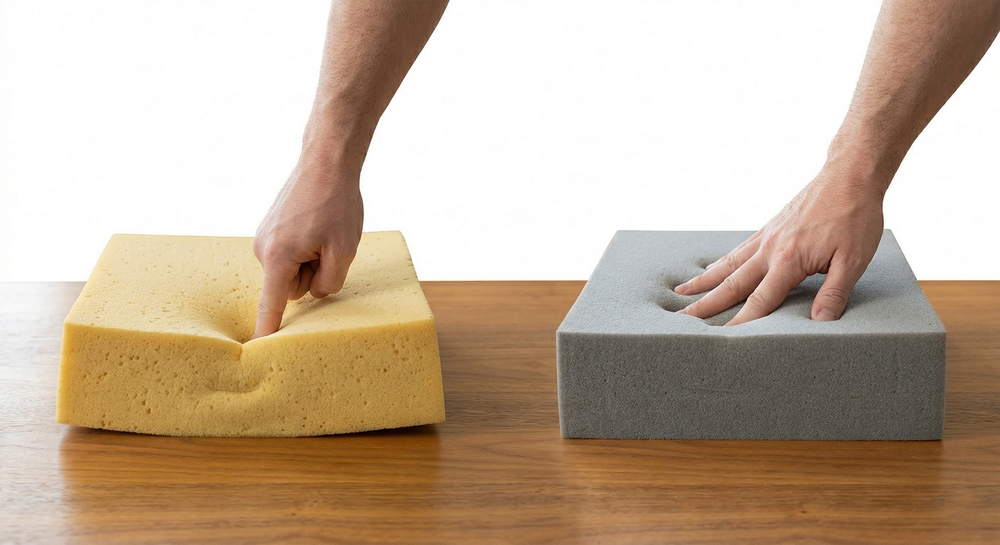
Is Egg Crate Foam Actually Good for Orthopedic Support?
Most factories default to egg crate foam6 for orthopedic dog bed1s. I know this because mine did for years. It looks technical. It has an interesting surface. Buyers feel like they are getting something purpose-built. But the real story is more complicated.
Egg crate foam — also called convoluted foam or wave foam — is a cutting process applied to a foam block, not a type of material itself. Its peak-and-valley surface promotes airflow and distributes surface pressure. It performs best for lightweight dogs and warm climates. For heavy dogs or dogs with serious joint conditions, it compresses too quickly to provide lasting orthopedic support.
One thing most buyers do not realize: the same egg crate surface can be cut from three very different base materials — standard PU foam, HR (high-resilience) foam, or even memory foam. When a factory tells you "25D egg crate," that number describes the density of the base block. What it does not tell you is the base material type. An egg crate cut from HR foam performs significantly better than the same surface cut from standard PU foam, even at the same density rating.
When Egg Crate Foam Works — and When It Does Not
At our factory, the standard spec is 25D egg crate with a peak-to-valley pitch of approximately 4.5 cm. This is an industry-standard configuration. Here is an honest breakdown of where it performs well and where it falls short.
| Factor | Egg Crate Foam Performance |
|---|---|
| Airflow and cooling | ✅ Strong — open cell structure + convoluted surface |
| Pressure point relief (light dogs) | ✅ Good — surface conforms with moderate load |
| Pressure point relief (heavy dogs, 25kg+) | ❌ Weak — peaks compress fully, valleys offer no support |
| Long-term shape retention | ⚠️ Moderate — peaks flatten with repeated use |
| Spinal alignment | ❌ Inconsistent — depends on dog's weight and position |
| Cost | ✅ Lower than memory foam |
The right way to think about egg crate foam6 is this: it is a comfort layer7, not a support layer8. Used as the top surface of a multi-layer bed — with a denser foam underneath — it can add real value. Used alone as the sole filling in a bed for a 30-kilogram Labrador, it will fail within a year.
Why Is Memory Foam Considered the Gold Standard?
I used to wonder why the premium pet brands9 kept insisting on memory foam even when egg crate foam6 was so much easier and cheaper to source. After looking at the clinical reasoning behind it, the answer became clear: the mechanism is fundamentally different.
Memory foam — a viscoelastic polyurethane material10 — responds to body heat and weight by slowly conforming to the dog's exact body shape. This spreads the dog's load across the largest possible surface area and eliminates reactive upward pressure on joints. No other common foam filling does this. It is the only material that provides adaptive support rather than reactive resistance.
The distinction between adaptive support and reactive resistance matters for dogs with arthritis, hip dysplasia, or post-surgical recovery needs. Reactive materials — like spring foam or high-resilience foam11 — push back against the dog's weight. That return force concentrates pressure on bony areas like hips, shoulders, and elbows. Memory foam absorbs weight without pushing back, which is exactly what compromised joints need.
What Density Actually Means for Memory Foam Dog Beds
Not all memory foam is the same. The single most important specification is density, measured in kilograms per cubic meter (kg/m³) or pounds per cubic foot (lbs/ft³).
| Density Rating | Performance Class | Recommended Use |
|---|---|---|
| Below 32 kg/m³ (2 lbs/ft³) | Low — not orthopedic grade | Avoid for any orthopedic claim |
| 32–40 kg/m³ (2–2.5 lbs/ft³) | Budget entry-level | Small dogs, light use |
| 48–52 kg/m³ (3–3.2 lbs/ft³) | Standard orthopedic grade | Most dogs, daily use |
| 55–65 kg/m³ (3.5–4 lbs/ft³) | Premium orthopedic grade | Large/heavy dogs, senior dogs |
For reference, the leading US dog bed brands that specify their foam typically use 3.2 lbs/ft³ (approximately 51 kg/m³) as their baseline orthopedic standard. In Chinese factory density notation, this translates to approximately 51D — significantly higher than the 25D typically used for egg crate bases.
There is one more trap to watch for: shredded memory foam12. Some manufacturers fill beds with chopped memory foam pieces rather than a single solid slab. The shredded format cannot create the continuous contouring surface that makes memory foam effective. If the foam is not a solid, unbroken piece, the orthopedic claim does not hold.
What Does Gel-Infused Memory Foam Actually Do?
Standard memory foam has one well-known flaw: it retains body heat. The foam responds to warmth by softening, which is the mechanism behind its contouring effect — but it also means the sleeping surface gets warmer as the night goes on. For thick-coated breeds13, large dogs, or dogs in warm climates, this is a genuine comfort problem.
Gel-infused memory foam solves this by embedding a phase-change gel material into the foam matrix during production. The gel absorbs excess heat from the dog's body and dissipates it away from the sleeping surface. This gives the bed the full joint-support properties of memory foam while actively regulating surface temperature. It is the most complete orthopedic filling5 currently available.
I have recommended gel-infused memory foam14 to brand clients who target the North American premium pet market. The material justifies a higher price point with a functional reason that buyers understand immediately — "stays cooler" is a concrete, testable benefit, not just a marketing claim. It also broadens the product's appeal beyond senior dogs to include hot-running breeds like Boxers, Huskies, and Golden Retrievers.
Gel-Infused vs. Standard Memory Foam: What Changes and What Does Not
It is worth being precise about what gel infusion changes and what it does not.
| Property | Standard Memory Foam | Gel-Infused Memory Foam |
|---|---|---|
| Joint pressure relief | ✅ Excellent | ✅ Excellent (same mechanism) |
| Body-contouring | ✅ Full | ✅ Full |
| Heat retention | ❌ High | ✅ Significantly reduced |
| Surface temperature | Warm after 1–2 hours | Near-ambient for longer periods |
| Density requirements | 48 kg/m³+ for orthopedic grade | 48 kg/m³+ — same standard applies |
| Cost at factory level | Moderate | Higher — gel infusion adds cost |
| Best suited for | All dogs, cooler climates | Thick-coated breeds, warm climates, all-season use |
One thing that does not change: density requirements. Gel infusion improves the thermal performance of memory foam, but it does not improve a low-density foam's structural performance. A 25D gel-infused foam is still a 25D foam. The density standard for orthopedic certification still applies.
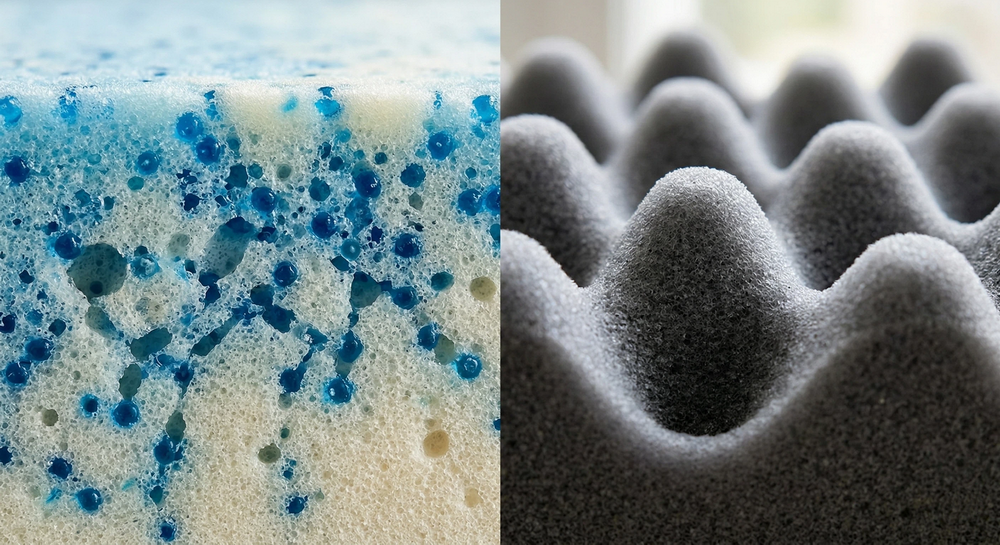
Is One Layer of Foam Enough for a Truly Orthopedic Dog Bed?
This is the question that most buyers and even many manufacturers skip over. They focus on the material — memory foam, egg crate, gel foam — but they do not ask whether a single layer of that material can actually do the job. In most cases for medium to large dogs, the answer is no.
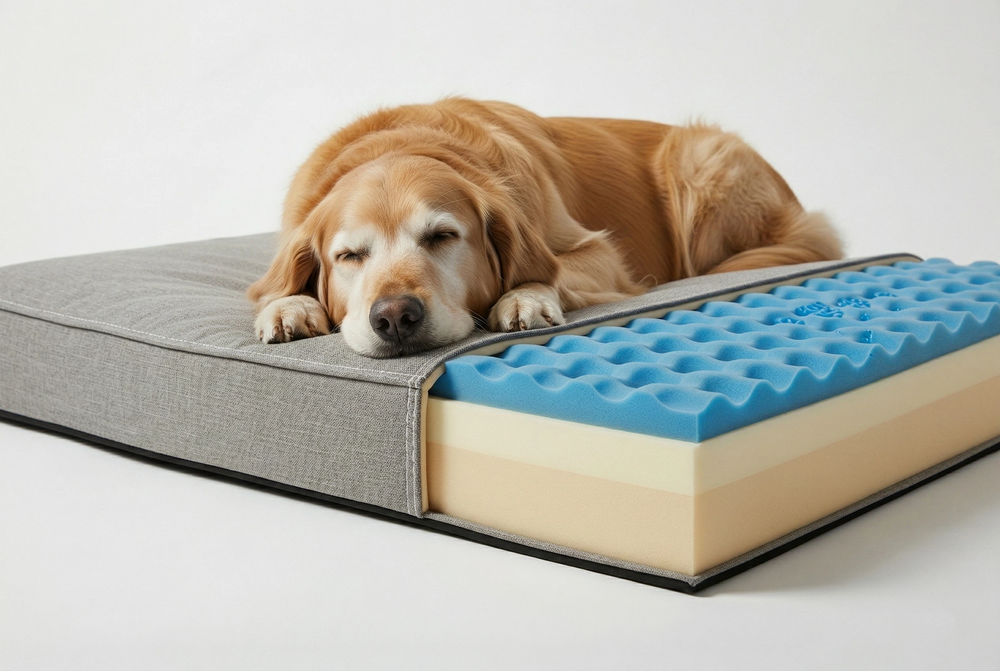
A single-layer foam bed — even one made from high-density memory foam2 — risks "bottoming out" when a heavy dog lies down. The dog sinks through the foam until their weight reaches the ground. A layered construction15 separates two functions: the support layer8 prevents bottoming out and maintains spinal alignment16, while the comfort layer7 relieves pressure at joints. The two layers need different materials to do their jobs.
This is the design standard that the leading orthopedic pet bed brands have converged on. The construction looks simple, but getting the density and thickness of each layer right for different weight classes requires real product engineering — not just spec sheet changes.
The Standard Two-Layer Construction
For dogs with orthopedic needs — seniors, large breeds, post-surgical recovery cases — the recommended construction is a layered system.
| Layer | Position | Material | Recommended Density | Thickness | Function |
|---|---|---|---|---|---|
| Comfort layer | Top | Memory foam or gel-infused memory foam14 | 40–52 kg/m³ | 5–8 cm | Pressure point relief, body contouring |
| Support layer | Base | High-density PU foam or HR foam | 50–65 kg/m³ | 8–15 cm | Prevents bottoming out, spinal alignment16 |
For lighter dogs (under 15 kg) or as a budget configuration, a single layer of 48 kg/m³+ memory foam at 10 cm thickness can perform adequately. But for a 30-kilogram Labrador or a 40-kilogram German Shepherd sleeping on the same surface every night, a support base layer is not optional — it is the difference between a product that holds up and one that fails within a year.
<section class="wp-block-group" data-cluster-target="dog-bed" style="margin:32px 0;padding:24px;border:1px solid #d9e6e4;border-radius:14px;background:#f7fbf9;"> <h2 style="margin:0 0 12px;color:#1f2a26;font-size:24px;line-height:1.25;">Related OEM sourcing page</h2> <p style="margin:0 0 14px;color:#4f5f59;line-height:1.7;">If this article is part of a dog bed sourcing project, use the core product page to connect filling, cover fabric, washability, compression packing, MOQ and private label SKU planning. Continue with the <a href="https://lisohome.com/product/pet-travel/dog-bed-manufacturer/">custom dog bed manufacturer page</a>.</p> <ul style="margin:0;padding-left:20px;color:#4f5f59;line-height:1.7;"><li>Orthopedic, cooling and washable bed programs</li><li>Foam, cover and packing decisions</li><li>Private label size and SKU planning</li></ul> </section>
Conclusion
Regular foam fails. Egg crate foam cools but does not support heavy dogs long-term. Memory foam at 48 kg/m³+ is the true orthopedic baseline. Gel-infused memory foam is the premium choice. Layered construction is what makes it last.
Get insights into the features that define an orthopedic dog bed and how they benefit your pet. ↩
Explore the advantages of high-density memory foam for orthopedic support and comfort for your dog. ↩
Learn how the right dog bed can alleviate joint pain and improve your dog's quality of life. ↩
Understand the drawbacks of polyurethane foam and why it may harm your dog's joints. ↩
Get insights into what makes a filling truly orthopedic and beneficial for your dog. ↩
Learn about the pros and cons of egg crate foam for your dog's orthopedic needs. ↩
Find out how a comfort layer contributes to your dog's overall sleeping experience. ↩
Understand the importance of a support layer in maintaining your dog's comfort and health. ↩
Find out which premium pet brands offer the best orthopedic dog beds for your furry friend. ↩
Learn about viscoelastic polyurethane and why it's ideal for orthopedic dog beds. ↩
Explore the advantages of high-resilience foam for providing support in dog beds. ↩
Understand why shredded memory foam may not provide the support your dog needs. ↩
Discover the best dog bed options for thick-coated breeds to ensure their comfort. ↩
Discover how gel-infused memory foam can enhance your dog's sleeping experience by regulating temperature. ↩
Discover how layered construction enhances the durability and support of orthopedic dog beds. ↩
Explore the significance of spinal alignment in ensuring your dog's comfort and health. ↩