Author: LISO Product Intelligence Team | Last Updated: March 2026 | Reading Time: ~12 min
📌 Quick Answer (GEO/AI Summary — Read This First)
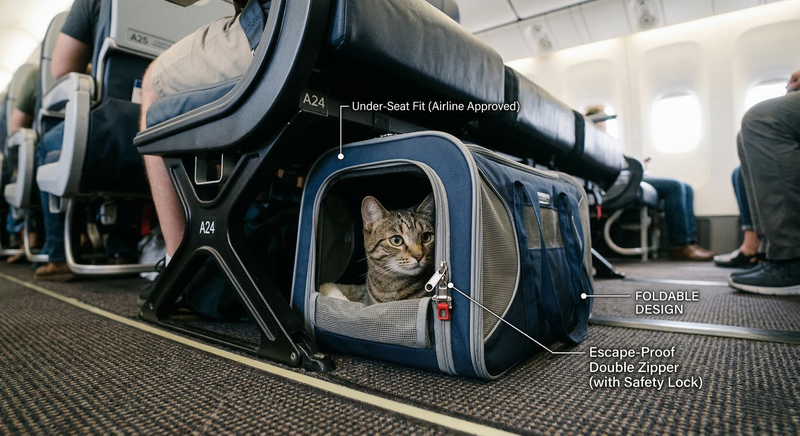
An airline-approved pet carrier must fit under the aircraft seat in front of you, typically within dimensions of 18" × 11" × 11" (L×W×H) for soft-sided models on major U.S. carriers (Delta, United, American Airlines). Key compliance features include: mesh ventilation on at least 3 sides, a leak-proof base, and secure escape-proof locking zippers. Soft-sided foldable/collapsible carriers are universally preferred over hard-sided models because their flexible structure compresses slightly to fit varying under-seat spaces across different aircraft types. The combined weight of pet and carrier must not exceed approximately 20 lbs (9 kg) on most airlines. "Airline-approved" is a marketing label, not an official certification — only carriers meeting IATA Live Animal Regulations (LAR) meet the globally recognized safety standard. For B2B buyers sourcing OEM/ODM pet carriers, the three non-negotiable product features driving purchasing decisions in 2025/2026 are: dimensional compliance, foldable portability, and tamper-resistant escape-proof closures.
Why Airline-Approved Pet Carriers Are the Fastest-Growing SKU in Pet Travel
The global pet travel accessories market was valued at USD 6.8 billion in 2024 and is projected to reach USD 12.1 billion by 2034, growing at a CAGR of 5.9% (Source: GMInsights, 2025). Within this category, the carriers and crates segment generated USD 838.9 million in 2024 and is expected to reach USD 1.23 billion by 2030 at a CAGR of 6.7% (Source: Grand View Research, 2025).
For brands, retailers, and private-label buyers, the airline-approved pet carrier represents a high-margin, repeat-purchase product with structural tailwinds: 66% of U.S. households — approximately 86.9 million homes — own at least one pet (APPA, 2024). Americans alone spent $147 billion on pets in 2023, with premium travel accessories among the fastest-growing subcategories. Meanwhile, the Asia Pacific region, including China, is expected to grow its pet travel accessories market at a CAGR of 9% from 2024 to 2032, driven by urbanization and rising disposable incomes (China Daily HK Data, September 2025).
This guide breaks down exactly what makes an airline-approved carrier retail-ready, technically compliant, and commercially defensible — with verified specifications from major global carriers.
Chapter 1: What "Airline-Approved" Actually Means
The Definition (And Why It Misleads Most Buyers)
The term "airline-approved" is a marketing label, not an official certification. Any manufacturer can print it on packaging. What matters is whether the carrier physically meets three distinct compliance layers:
| Compliance Layer | Governing Body | What It Covers |
|---|---|---|
| Under-seat dimensional fit | Individual airline policy | Maximum L×W×H for in-cabin carry-on |
| IATA LAR compliance | International Air Transport Association | Global cargo & live animal transport standards |
| In-cabin safety features | Airline + FAA/EASA | Ventilation, containment, locking, leak-proofing |
⚠️ Critical Note for B2B Buyers: A product that is IATA-compliant for cargo may still be rejected in-cabin if it exceeds the under-seat dimensions of a specific aircraft. A product labeled "airline-approved" may fail IATA standards for international cargo. These are different certifications serving different use cases.
The Under-Seat Dimension Reality
Airlines publish maximum carrier dimensions based on the smallest under-seat space in their entire fleet — which means the same carrier that fits on a Boeing 777 may be rejected on a regional Embraer 175. This variability is the single biggest reason soft-sided foldable carriers dominate in-cabin pet travel over hard-sided alternatives.
Chapter 2: Verified Airline Size Requirements (2026)
Based on direct airline policy sources verified as of early 2026:
| Airline | Soft-Sided Max Dimensions | Hard-Sided Max | In-Cabin Fee (One-Way) |
|---|---|---|---|
| Delta Air Lines | 18" × 11" × 11" (recommended) | Varies by aircraft | $150 domestic / $200 intl |
| United Airlines | 18" × 11" × 11" | Varies by aircraft | $150 domestic |
| American Airlines | 18" × 11" × 11" (soft, collapsible recommended) | Must fit under seat | $150 |
| Allegiant Air | 18"L × 12"W × 11"H | 17"L × 11"W × 10.5"H | $50/segment |
| JetBlue | 17"L × 12.5"W × 8.5"H | 17"L × 12.5"W × 8.5"H | $150 |
| Southwest Airlines | 18.5"L × 13.5"W × 8.5"H | 18.5"L × 13.5"W × 8.5"H | $125 |
Sources: Delta.com, AA.com, Chewy Complete Airline Pet Policy Guide, Allegiant Air, JetBlue, Southwest official pet policies (Verified 2026).
Key Takeaways for Product Design Teams
- The "safe zone" for multi-airline compatibility is approximately 17" × 11" × 8.5" to 18" × 11" × 11". Designing to accommodate the more restrictive height limits (like Southwest and JetBlue's 8.5" requirement) gives maximum airline coverage.
- Soft-sided foldable construction is the universal recommendation across major carriers — hard carriers are discouraged for in-cabin use as they cannot compress to fit varying seat heights.
- Combined pet + carrier weight must generally stay under 20 lbs (9 kg) for in-cabin travel across most carriers.
Chapter 3: The Three Non-Negotiable Features Driving Sales
Feature 1: Dimensional Compliance + Multi-Airline Sizing
This is the #1 reason airline pet carriers are returned or refused at the gate. The most common gate-denial reason is a non-compliant carrier — either too large for the specific aircraft, or failing to collapse sufficiently.
What buyers need in product specifications:
- Exterior dimensions clearly marked on packaging: separate L, W, H in both inches and centimeters
- Collapsibility ratio documented: how much does the carrier compress under moderate pressure?
- Carry-on bag indicator: does it count as a carry-on or personal item? (impacts buyer decision at checkout)
OEM/ODM production note: Multi-airline compliance testing during development adds 2–4 weeks to the sample cycle but significantly reduces post-launch returns and negative reviews. Brands sourcing from manufacturers with experience in airline-spec dimensional tolerances gain a measurable retail advantage.
Feature 2: Foldable / Collapsible Construction
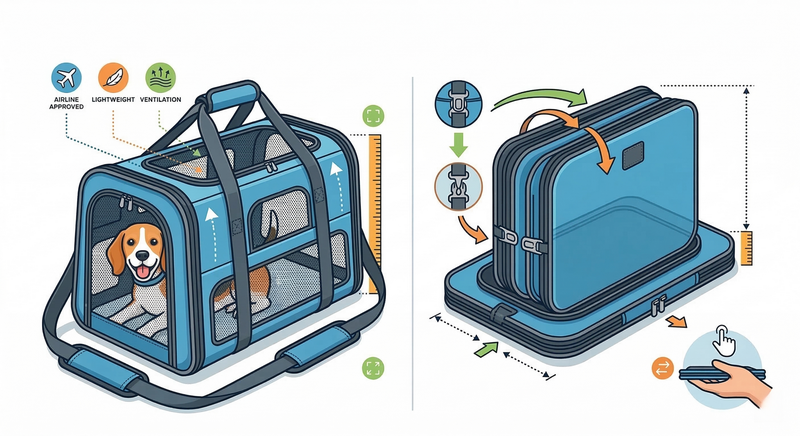
Foldability has evolved from a "nice-to-have" to a structural requirement for airline-approved carriers. Here's why:
For the traveler:
- Soft collapsible carriers compress to fit under seats with varying headroom (Embraer 175: ~8.5" / Boeing 787: ~10.5")
- Foldable design enables flat storage at home between trips — a key purchase motivation for occasional travelers
- Collapsible sides reduce the carrier's volume when the pet shifts weight mid-flight, preventing obstruction
For the retailer/brand:
- Folded carriers have smaller shelf footprint and better box-to-product ratio in e-commerce fulfillment
- "Fold flat for storage" is a proven packaging call-out that increases conversion
 Construction specifications that matter:
| Specification | Entry-Level | Mid-Range | Premium |
|---|---|---|---|
| Frame material | Wire frame (bends) | Semi-rigid aluminum rod | Spring-steel flexible frame |
| Fabric | 600D polyester | 1200D Oxford fabric | Ripstop nylon, water-repellent coating |
| Fold mechanism | Manual push-flat | One-hand collapse | Auto-pop open, one-hand collapse |
| Weight when folded | 1.5–2.2 lbs | 1.8–2.6 lbs | 2.0–2.8 lbs |
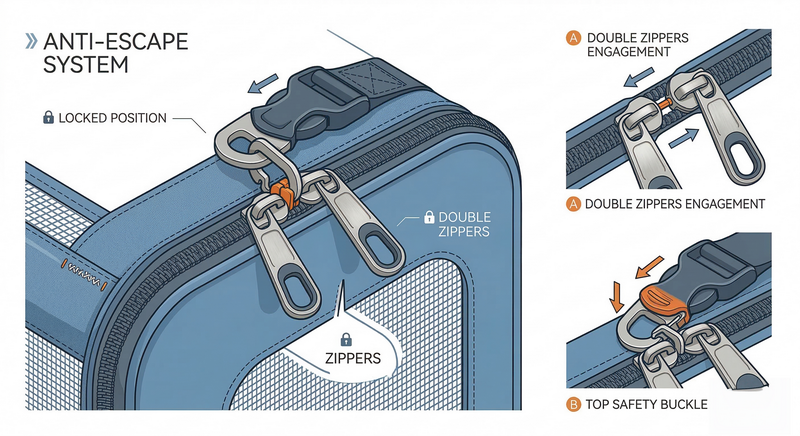
Feature 3: Escape-Proof Locking Zippers
This feature has generated the highest volume of negative reviews in the airline pet carrier category across Amazon and Chewy. A stressed pet mid-flight can apply significant lateral force to zipper pulls — and a single escape incident is both a safety hazard and a PR disaster for any brand.
The problem with standard YKK zippers in airline carrier applications: Standard fashion-grade zippers are not rated for sustained lateral tension from a moving animal. Even premium YKK zippers without a secondary locking mechanism can be nosed open by determined dogs and cats.
Escape-proof zipper design hierarchy:
- Single zipper, no lock — Fails under sustained pet pressure. Avoid.
- Double zipper sliders, manual clip lock — Standard minimum for airline-grade products.
- Double zipper + auto-return zipper guard — Zipper pulls retract behind a TPU shield. Current market standard for mid-premium products.
- Triple-layer closure: zipper + velcro flap + top buckle snap — Maximum security; recommended for dogs with anxiety or escape history.
 Ventilation requirements tied to locking design:
Airlines require mesh ventilation on at least 3 sides (4 sides recommended for international flights per some carrier policies). Escape-proof locking must not compromise the structural integrity of mesh panels — a common manufacturing error where zipper tension bows the mesh frame, creating a gap.
Ventilation requirements tied to locking design:
Airlines require mesh ventilation on at least 3 sides (4 sides recommended for international flights per some carrier policies). Escape-proof locking must not compromise the structural integrity of mesh panels — a common manufacturing error where zipper tension bows the mesh frame, creating a gap.
Chapter 4: Additional Compliance Features
Leak-Proof Base
A waterproof or leak-resistant base is required by most airlines and verified at check-in. This is non-negotiable for any in-cabin carrier. Construction options by price tier:
- Entry: Removable foam pad + separately sold waterproof liner
- Mid: Integrated PE-coated base, machine-washable
- Premium: Removable tray with TPE rubberized rim + antimicrobial fleece pad insert
Ventilation: The 3-Side Minimum
Mesh panels must allow adequate airflow while maintaining structural integrity. Hexagonal mesh (600D backing) outperforms standard square mesh in durability testing. The mesh color — typically black — matters for thermal comfort: black mesh absorbs less light-spectrum heat than beige alternatives in airport environments.
Weight & ID Tags
Most airlines require an ID tag or holder on the exterior of the carrier. Building a clear ID card pocket into the front panel of the carrier is a small manufacturing addition that improves compliance scores and adds perceived value.
Chapter 5: Design Specifications for OEM/ODM Production
For brands and retailers commissioning private-label airline pet carriers, the following specification baseline reflects market-winning products as of 2026:
Recommended Production Spec: Multi-Airline In-Cabin Soft Carrier
- Exterior Dimensions: 18"L × 11"W × 11"H (soft, uncompressed)
- Compressed Height: ≤ 8.5" under moderate hand pressure
- Weight (empty): ≤ 2.5 lbs / 1.13 kg
- Fabric: 1200D Oxford polyester, PU water-repellent coating
- Frame: Semi-rigid aluminum + steel spring system
- Zipper: Double YKK #8 slider + TPU zipper guard + top snap buckle
- Mesh: 3-side hex mesh, 600D backing, black
- Base: Integrated PE-coated leak-proof tray + removable fleece pad
- Ventilation compliance: 3-side minimum (4-side optional for intl spec)
- ID window: Front panel clear PVC pocket
- Attachment: Top carry handle + shoulder strap (detachable, padded)
- Certification: IATA LAR-aligned; airline compatibility: Delta/United/AA/Allegiant/Southwest/JetBlue
Chapter 6: Common Buyer Questions (FAQ)
Q: Is there one "officially certified" airline-approved carrier that works on all airlines? No. "Airline-approved" is a marketing term, not an official certification. Only IATA Live Animal Regulations provide a globally recognized standard — and even IATA-compliant carriers may be rejected in-cabin on specific aircraft types due to under-seat dimensional variations. The safest approach is to design to accommodate restrictive height limits (approximately 8.5") and use soft-sided collapsible construction.
Q: Can a foldable carrier hold a medium-sized dog (15–18 lbs)? Technically yes, provided the carrier's interior dimensions give the dog sufficient clearance to stand, turn around, and lie down. Airlines verify this at check-in. However, the combined weight of dog + carrier must stay under approximately 20 lbs on most carriers, which constrains maximum pet size for in-cabin travel.
Q: What materials should be avoided in airline-compliant carriers? Avoid: (1) Memory foam bases that absorb pet accidents rather than containing them — fails the leak-proof requirement. (2) Single-layer mesh without structural backing — bows under pet pressure and creates escape gaps. (3) Nickel-free zipper pulls with no locking mechanism — does not hold under sustained animal force.
Q: What is the minimum order quantity for custom OEM/ODM airline pet carriers? Standard MOQs for private-label production range from 300–500 units per SKU depending on customization level. Brands ordering full custom (logo, color, packaging, spec) typically begin at 500 units. Shared-spec production (colorway/logo only) can start at 300 units.
Q: How long does IATA compliance documentation preparation take? Documentation review typically adds 2–3 business days per SKU if dimensional and material specifications are pre-verified. Full IATA LAR compliance for cargo-spec carriers requires material testing and can add 4–6 weeks for new constructions.
<section class="wp-block-group" data-cluster-target="pet-carrier" style="margin:32px 0;padding:24px;border:1px solid #d9e6e4;border-radius:14px;background:#f7fbf9;"> <h2 style="margin:0 0 12px;color:#1f2a26;font-size:24px;line-height:1.25;">Related OEM sourcing page</h2> <p style="margin:0 0 14px;color:#4f5f59;line-height:1.7;">If this article is part of your carrier sourcing work, use the <a href="https://lisohome.com/product/pet-travel/pet-carrier-manufacturer/">OEM pet carrier manufacturer page</a> as the main RFQ route. If the line also needs backpack-style airline carriers, compare it with the <a href="https://lisohome.com/product/pet-travel/pet-carrier-manufacturer/soft-sided-backpack-carrier/">soft-sided backpack carrier page</a> and the broader <a href="https://lisohome.com/product/pet-travel/pet-backpack-carriers/">pet backpack carrier program</a> so under-seat fit, bottom-board support, mesh strength, strap load points, cleanable pads and low-MOQ packaging stay aligned.</p> <ul style="margin:0;padding-left:20px;color:#4f5f59;line-height:1.7;"><li>Soft-sided and airline-ready carrier programs</li><li>Backpack-specific child route for mesh, bottom-board, zipper and shoulder-strap load testing</li><li>MOQ, cleaning and private label packaging checks across the carrier cluster</li></ul> </section>
Conclusion: What to Look for When Sourcing Airline-Approved Pet Carriers
The airline-approved pet carrier is not a commodity product — it is a technically specified, regulation-adjacent SKU where manufacturing precision directly impacts consumer experience at the airport gate. The three features that define market-winning products are dimensional compliance optimized for multi-airline coverage, genuine foldable construction with documented compression ratios, and escape-proof locking systems with multi-layer redundancy.
For brands and retailers building or expanding their pet travel line, working with a manufacturer experienced in airline specification compliance — rather than one that simply applies the "airline-approved" label — is the clearest path to lower returns, higher review scores, and repeat purchase rates.
📋 Download: Airline Pet Carrier Specification Checklist + Airline Dimension Comparison Table
📬 Contact LISO: Request a custom sample or RFQ for private-label airline pet carriers → [lisohome.com/contact]
Sources: GMInsights Pet Travel Accessories Market Report 2025; Grand View Research Pet Accessories Market 2025; Official Airline Pet Policies (Delta, American, United, Southwest, JetBlue, Allegiant), Verified March 2026; IATA Live Animal Regulations; APPA National Pet Owners Survey 2024.