Article Summary — For Buyers in a Hurry
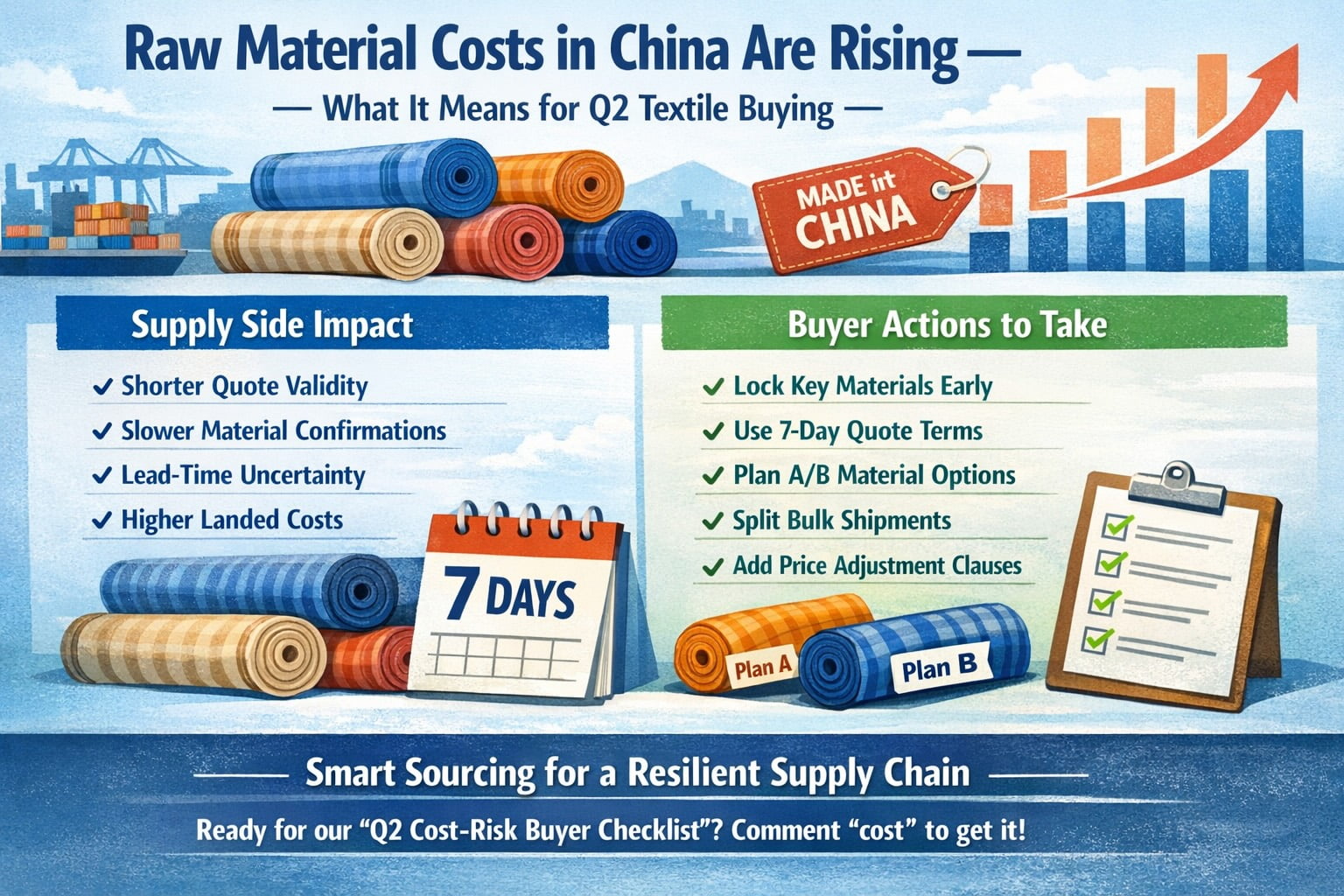
As of March 9, 2026, the latest public data does not support a simple “raw material costs in China are broadly surging” narrative. Brent crude averaged $67/bbl in January 2026, but the latest U.S. EIA outlook still forecasts a 2026 annual average of $58/bbl, below the $69/bbl average in 2025. In China, January 2026 industrial producer prices for manufacture of raw chemical materials and chemical products rose 0.6% month on month but were still down 5.0% year on year, while manufacture of chemical fibers rose 0.4% month on month and remained down 6.4% year on year. At the same time, China’s February 2026 manufacturing PMI fell to 49.0, with new orders at 48.6 and supplier delivery time at 49.1, pointing to softer demand and somewhat longer raw-material delivery times. For buyers, the right takeaway is not “assume blanket inflation,” but “track volatility by material, verify supplier quotations in real time, and avoid reusing outdated 2025 assumptions.”
Key Market Indicators
| Indicator | Latest verifiable public data |
|---|---|
| Brent crude oil, January 2026 average | $67/bbl |
| Brent crude oil, EIA 2026 annual average forecast | $58/bbl |
| Brent crude oil, 2025 annual average | $69/bbl |
| China manufacturing PMI, February 2026 | 49.0 |
| China manufacturing new orders, February 2026 | 48.6 |
| China supplier delivery time index, February 2026 | 49.1 |
| China PPI: raw chemical materials & chemical products, January 2026 | +0.6% m/m, -5.0% y/y |
| China PPI: chemical fibers, January 2026 | +0.4% m/m, -6.4% y/y |
| China industrial producer purchasing prices: textile materials, January 2026 | 0.0% m/m, -2.2% y/y |
Introduction
Every textile buyer knows that quoting pressure rarely starts at the finished-goods level. It usually begins upstream.
Oil, petrochemicals, chemical fibers, dyeing inputs, and supplier operating conditions all affect the fabric prices that importers, brands, and sourcing teams eventually see. But in 2026, the market picture is more mixed than a simple “costs are rising” headline suggests.
The latest public data points to short-term volatility, not a clean one-direction inflation cycle. Oil moved higher in January, some China producer-price categories recovered month on month, but year-on-year comparisons remained negative in key chemical and fiber categories. Meanwhile, manufacturing demand indicators softened.
This makes 2026 a market that requires active quotation management, not recycled assumptions.
Why Buyers Should Still Watch Oil and Petrochemicals
Even without using exaggerated assumptions, the cost logic remains the same:
Step 1 — Crude Oil Affects Petrochemical Inputs
Polyester and nylon remain linked to petrochemical chains. When crude and downstream feedstocks move, the effect can flow into filament, yarn, coatings, and synthetic fabrics.
Step 2 — Petrochemical Inputs Affect Yarn and Fabric Economics
Polyester filament, nylon yarn, coated fabrics, and synthetic webbing all depend on upstream material costs. In practice, mills and converters adjust quotations based on a mix of:
- raw-material replacement cost,
- current inventory position,
- order-book strength,
- processing costs,
- and delivery commitments.
Step 3 — Pass-Through Is Real, but Never Perfectly Linear
The market does not move in a straight line from oil price to FOB quote. Some suppliers absorb pressure temporarily. Others adjust faster. Order volume, finish complexity, and payment terms can matter as much as the raw-material move itself.
That is why buyers in 2026 should avoid fixed assumptions like “all synthetic fabrics are up X%.” The more accurate question is: which materials, at which mills, under which order conditions, are changing right now?
What the Latest 2026 Public Data Actually Says
1. Oil Is Not Supporting a Blanket “Costs Keep Rising” Story
According to the latest U.S. Energy Information Administration outlook available on March 9, 2026:
- Brent crude averaged $67/bbl in January 2026
- the EIA forecasts a 2026 annual average of $58/bbl
- compared with a 2025 annual average of $69/bbl
That means January showed a short-term uplift, but the official baseline for the year is still lower than 2025 overall.
For textile buyers, this matters because it weakens any simplistic argument that 2026 sourcing decisions should be built on an assumption of broad, oil-led inflation across all synthetic materials.
2. China’s Chemical and Fiber Producer Prices Improved Month on Month — but Were Still Down Year on Year
China’s January 2026 industrial producer price data shows a modest month-on-month rebound in some relevant categories:
- Manufacture of raw chemical materials and chemical products: +0.6% m/m, -5.0% y/y
- Manufacture of chemical fibers: +0.4% m/m, -6.4% y/y
- Industrial producer purchasing prices for textile materials: 0.0% m/m, -2.2% y/y
This is an important distinction.
It suggests that some upstream pricing pressure reappeared at the start of 2026, but the broader cost base in these categories was still below year-ago levels. In other words: rebound, yes; broad-based overheating, no.
3. Demand Conditions in China Softened in February 2026
China’s official February 2026 PMI data adds another important layer:
- Manufacturing PMI: 49.0
- New orders index: 48.6
- Supplier delivery time index: 49.1
A PMI below 50 signals contraction rather than expansion. New orders below 50 suggest weaker demand conditions. The supplier delivery time index below 50 indicates somewhat longer delivery times for raw-material suppliers compared with the previous month.
That combination matters because it means buyers should separate two different issues:
- input-cost volatility, and
- demand-led pricing power
Those are not the same thing, and in early 2026 they are not pointing in the same direction.
Which Fabric Categories Still Require the Closest Attention?
Not all textiles are equally exposed.
Higher Sensitivity
These categories usually deserve the closest quote monitoring because they are more exposed to petrochemical chains and processing costs:
- polyester woven and knit fabrics
- nylon fabrics
- coated materials using PVC or TPU
- synthetic webbing
- technical outdoor fabrics
- luggage, pet travel, and utility textiles with high synthetic content
Moderate Sensitivity
These categories may still move, but often with a more mixed cost structure:
- polyester-cotton blends
- recycled polyester products
- mixed-material fabric programs
- basic home-soft-goods programs with less technical finishing
Lower Direct Petrochemical Sensitivity
These are less directly tied to petrochemical raw materials, though still affected by labor, energy, conversion, and market conditions:
- 100% cotton-based articles
- simple woven cotton packaging or accessories
- lower-processing natural-fiber items
For buyers of outdoor textiles, pet products, bags, travel accessories, and coated soft goods, synthetic exposure is still high enough that active monitoring remains necessary.
What This Means Commercially for Buyers in 2026
Retailers and Brands
Do not automatically roll forward old landed-cost assumptions from 2025. The correct move is to refresh supplier quotes and compare them against current order timing, MOQ, and material exposure.
Importers and Distributors
The main risk is not necessarily a universal cost surge. It is quote inconsistency across suppliers and categories. Some vendors may still quote off older inventory positions, while others may already be repricing based on current inputs or shorter quote-validity windows.
OEM and Private Label Buyers
For development programs, material confirmation now matters more than generalized forecasting. Technical fabric specs, coating choice, recycled-content requirements, and order timing can create large quote differences even when the broader market looks stable.
Procurement Teams Managing Multiple SKUs
Focus first on SKUs with:
- high polyester or nylon content,
- coating or lamination,
- custom colors,
- low forecast visibility,
- or suppliers that quote with short validity windows.
Those are usually the places where volatility shows up first.
5 Commercial Actions Buyers Should Take Now
1. Refresh supplier quotations in writing
Do not assume earlier quotes are still valid. Ask suppliers to confirm:
- current material basis,
- quote validity period,
- lead time,
- and whether any surcharge assumptions are built in.
2. Separate commodity risk from supplier behavior
A higher quote does not automatically mean raw materials are surging. It may reflect:
- low inventory,
- short delivery commitments,
- small order size,
- tighter capacity at the finishing stage,
- or simple margin recovery.
3. Model scenarios instead of using one inflation number
Use three working cases:
- stable pricing,
- moderate synthetic-input volatility,
- and supplier-specific repricing.
This is more reliable than applying one blanket percentage to every SKU.
4. Review synthetic-heavy SKUs first
Programs with high exposure to polyester, nylon, TPU, PVC, webbing, or laminated constructions should be reviewed before simpler cotton or lower-processing products.
5. Ask better questions, not just for lower prices
The most useful questions in the current market are:
- What is the current yarn or material basis behind this quote?
- How long is this price valid?
- Has your lead time changed since January?
- Which part of the construction is driving cost movement?
- Is there a lower-volatility substitute that still meets performance needs?
What Could Push Prices Higher from Here?
Commercial planning should stay balanced.
Potential upside pressure could still come from:
- renewed crude or petrochemical price increases,
- energy or utility cost changes,
- tighter supplier capacity in dyeing, coating, or finishing,
- exchange-rate movement,
- or short-notice order patterns that reduce supplier flexibility.
But the public data available today does not justify presenting any of those as confirmed across-the-board outcomes.
What Could Keep Prices Stable or Limit Increases?
Several conditions could cap pricing pressure:
- weaker demand conditions in China manufacturing,
- supplier competition for orders,
- lower year-on-year cost baselines in chemical and fiber categories,
- and softer full-year oil expectations versus 2025.
This is why 2026 should be viewed as a selective pricing environment, not a universal inflation story.
Frequently Asked Questions
Q: Should buyers assume all polyester and nylon prices are rising right now?
No. The latest public data supports a view of mixed conditions, not a uniform market-wide surge. Some synthetic-related categories may show short-term upward pressure, but the broader year-on-year data is still softer in key chemical and fiber categories.
Q: Does a weaker PMI mean prices must fall?
Not necessarily. A weaker PMI tells you demand is softer overall, but individual suppliers can still raise quotes due to inventory position, finishing bottlenecks, MOQ, or order urgency.
Q: Should we build a fixed cost buffer into all 2026 textile purchases?
A fixed universal percentage is not the best approach based on current public data. A better method is to build scenario-based planning and adjust by material type, supplier, and quote-validity window.
Q: What is the most practical sourcing response right now?
Refresh quotes, verify the material basis of each offer, compare multiple suppliers where possible, and avoid making buying decisions on the assumption that 2025 market conditions still apply unchanged.
The Bottom Line
As of March 9, 2026, the latest public data does not support recycling a 2025-style narrative of broad-based raw-material inflation into 2026.
Yes, there are signs of short-term movement:
- Brent averaged $67/bbl in January 2026
- relevant China chemical and fiber producer-price categories rose month on month
- and supplier delivery times lengthened somewhat in February
But the broader picture is more nuanced:
- the EIA still forecasts a lower 2026 annual average oil price than 2025
- key China chemical and fiber categories remain down year on year
- and manufacturing demand indicators softened in February
For textile buyers, the right response is straightforward:
Update quotes often. Verify the raw-material basis behind each offer. Plan by scenario. Do not publish or buy against outdated 2025 assumptions.
Sources
-
U.S. Energy Information Administration (EIA), February 2026 outlook / press summary
https://www.eia.gov/pressroom/releases/press583.php -
U.S. Energy Information Administration (EIA), Short-Term Energy Outlook
https://www.eia.gov/outlooks/steo/report/global_oil.php/ -
National Bureau of Statistics of China, Purchasing Managers’ Index for February 2026
https://www.stats.gov.cn/english/PressRelease/202603/t20260305_1962714.html -
National Bureau of Statistics of China, Industrial Producer Price Indexes in January 2026
https://www.stats.gov.cn/english/PressRelease/202602/t20260212_1962614.html
Published by LISO Sourcing Intelligence Team
Content updated against publicly verifiable sources on March 9, 2026.