How We Evaluated / Criteria We Used
These “Top 10” trends are ranked by what tends to move real B2B orders: compliance, repeatability, margin, and brand fit.
| Evaluation Dimension | Weight | What It Means for Wholesale Buyers |
|---|---|---|
| Compliance & Claims Safety | 30% | Lower risk on chemical limits, labeling, and “eco” marketing claims |
| Durability & Returns Risk | 25% | Less fraying, fewer mold/odor issues, longer life in high-heat logistics |
| Private Label Readiness | 20% | Packaging, insert cards, hangtags, barcode, consistent color lots |
| Lead Time & Scalability | 15% | Stable capacity, raw material availability, reliable delivery windows |
| Total Landed Cost (TLC) | 10% | Product + packaging + testing + freight + rework/returns |
1. Traceable Natural Fibers (Not Just “Straw”) — Best for Audit-Ready Retailers
Score: ⭐ 4.9/5
Traceable fiber sourcing is the #1 shift for 2026 because larger distributors and retailers increasingly ask for origin clarity, not generic “natural” descriptions.
What to look for (spec-ready):
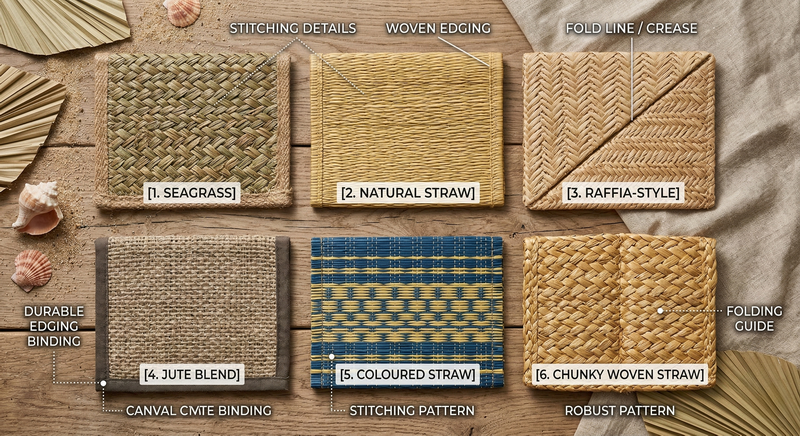
- Fiber type declared on PO: seagrass / wheat straw / paper straw / jute blend / raffia-style
- Batch-level traceability: harvest region + processing facility + packing list match
- Clear material percentages if blended (e.g., “70% seagrass + 30% cotton binding”)
 Pros:
Pros: - Fewer claim disputes and easier onboarding to large accounts
- Cleaner SKU differentiation (“seagrass roll mat” sells better than “straw mat”)
Cons:
- Some fibers vary seasonally in color/texture (need tolerance ranges)
[📊 Cite: FSC chain-of-custody explains how verified material claims are maintained across the supply chain (useful when paper-based components or packaging are involved).]
Supplier tip: Ask for a Material Declaration Sheet + photos of raw fiber bales and weaving line for your exact SKU. Make it part of the sampling checklist.
2. “Low-Odor” & Low-VOC Finishes — Best for Premium Channels
Score: ⭐ 4.8/5
Eco-friendly straw beach mats wholesale programs often fail on a simple issue: smell after container transit. In 2026, buyers are prioritizing low-odor finishes and better drying control.
What to specify:
- “No added fragrance” (yes, some factories mask odor)
- Moisture target before packing (set a QC threshold)
- Optional third-party testing for VOCs when required
Pros:
- Fewer buyer complaints and chargebacks
- Better unboxing experience for DTC resellers
Cons:
- Requires stronger process control (drying time, humidity monitoring)
[📊 Cite: OEKO-TEX® STANDARD 100 updates include expanded focus areas and limit values; align your testing plan with current requirements.]
Supplier tip: Require a carton “sniff test” protocol: open-carton evaluation after 7 days sealed storage + pass/fail notes in QC report.
3. Anti-Fray Edge Binding & Reinforced Corners — Best for High-Volume Wholesale
Score: ⭐ 4.7/5
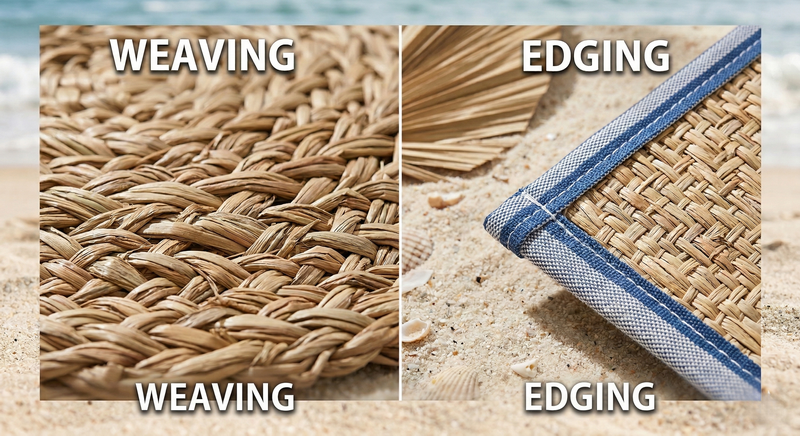
Straw mats look great—until edges fray in handling. Reinforced edges are now a standard expectation for distributors who want fewer returns.
Design options that scale:
- Cotton/linen binding tape (double-stitch)
- Folded hem with hidden stitch line
- Corner patches (matching fabric or vegan leather alternative)
Pros:
- Big durability lift with small cost impact
- Works for both roll-up and foldable mats
Cons:
- Color matching adds complexity (need lab dips)
 Supplier tip: Include a drop + abrasion test on pre-production samples (even a simple internal standard) to compare suppliers objectively.
4. Foldable “Suitcase” Formats with Handle — Best for Retail Packaging Efficiency
Score: ⭐ 4.6/5
Buyers want mats that pack tight for pallets and shelves. Foldable formats reduce cubic volume and can improve freight efficiency.
Key specs:
- Fold line reinforcement (to reduce cracking/creasing)
- Handle stitching strength
- Carton pack count optimized for pallet patterns
Pros:
- Lower freight per unit and easier merchandising
- Higher perceived value vs. basic roll mats
Cons:
- Fold lines can weaken if weave is too brittle
Supplier tip: Ask for ISTA-style carton drop testing (or your own simplified drop test) before you approve mass packaging.
5. Washable or “Shake-Clean” Hybrid Weaves — Best for Hospitality & Resorts
Score: ⭐ 4.5/5
Pure straw can trap sand. Hybrid weaves (straw + cotton warp, or tighter weaving patterns) support easier cleaning—ideal for resorts and rental programs.
Pros:
- Higher repeat purchase for B2B programs
- Better customer satisfaction in humid climates
Cons:
- Blends must be disclosed accurately (claims risk)
Supplier tip: Put cleaning method in writing: “shake-clean,” “spot clean,” or “hand rinse” with limits. Don’t let marketing overpromise.
6. Safer Dyes & Color Consistency (Natural Neutrals + Muted Pastels) — Best for Brand Lines
Score: ⭐ 4.5/5
2026 color is less “bright boho,” more coastal neutrals with controlled accents. The real B2B value is not the palette—it’s consistent color lots.
Pros:
- Easier to integrate into brand collections
- Less rejection from inconsistent dye lots
Cons:
- Natural fiber variation still exists (set tolerances)
[📊 Cite: Use recognized textile safety frameworks (e.g., OEKO-TEX®) to guide restricted substances planning for dyed bindings or labels.]
Supplier tip: Require approved golden samples + tolerance ranges (ΔE where relevant) for bindings and trims.
Score: ⭐ 4.4/5
In AI search and AI shopping assistants, products that ship with clear, structured information win. In 2026, buyers want suppliers who can deliver brand assets fast.
What to bundle:
- Hangtag templates (materials + care)
- QR page hosting (origin story, compliance docs)
- Barcode/GTIN and carton markings
Pros:
- Faster listing approval and higher conversion
- Reduces back-and-forth with your design team
Cons:
- Requires supplier to have stable packaging partners
Supplier tip: Ask if they can deliver print-ready dielines and whether they support multi-language inserts for your markets.
8. Plastic-Free, Shelf-Ready Packaging — Best for Eco Retailers
Score: ⭐ 4.3/5
Wholesale buyers are reducing polybags where possible. Paper bands, belly wraps, and carton-ready presentation matter.
Pros:
- Better “eco” positioning and store acceptance
- Less packaging waste
Cons:
- Needs humidity protection planning in transit
[📊 Cite: FSC chain of custody is commonly used for credible claims on forest-based packaging and paper components.]
Supplier tip: Use a two-layer approach: paper-based consumer packaging + optional outer moisture barrier only for container transit (document it so claims stay accurate).
9. Mold & Moisture Control for Ocean Freight — Best for Long-Route Importers
Score: ⭐ 4.2/5
Natural fibers and sea freight are a risky mix. 2026 sourcing includes moisture management as a standard line item.
Pros:
- Dramatically fewer “arrival damaged” claims
- Better warehouse storage performance
Cons:
- Adds small cost (desiccants, humidity cards, longer drying)
Supplier tip: Require:
- Drying record before packing
- Humidity indicator cards in master cartons
- Desiccant quantity per cubic meter (supplier should recommend)
10. Compliance Packs for Big Buyers (Testing, Factory Audits, Social Compliance) — Best for Enterprise Procurement
Score: ⭐ 4.1/5
Large wholesalers increasingly require a “ready folder” of documentation. If your supplier can’t produce it, you’ll lose time—or the account.
Typical compliance pack items:
- Product specs + BOM (bill of materials)
- Testing plan + recent test reports (as applicable)
- Social compliance / audit summaries (if required)
- Packaging specs and labeling proofs
[📊 Cite: GOTS and FSC provide frameworks for credible certified claims where relevant (e.g., organic textile components, forest-based packaging).] ]
Supplier tip: Ask for a document index at the sampling stage. If they can’t organize docs early, mass production will be slower and riskier.
Comparison Summary / What “Good” Looks Like for 2026 Wholesale Orders
| Trend Area | Minimum Acceptable | Best-in-Class (2026) | Best For |
|---|---|---|---|
| Materials | Generic “straw” label | Declared fiber + batch trace | Enterprise buyers |
| Odor/VOC | No guarantee | Low-odor protocol + checks | Premium channels |
| Durability | Basic edge fold | Binding + corner reinforce | High-volume |
| Packaging | Polybag only | Plastic-free + shelf-ready | Eco retail |
| Logistics | No moisture plan | Drying log + indicators | Long-route import |
How to Choose / Supplier Shortlist Checklist (Wholesale)
If you’re buying eco-friendly straw beach mats wholesale for large accounts, shortlist suppliers with these five proofs:
- Spec discipline: they can repeat your weave + size + binding exactly across batches.
- QC transparency: they share in-line QC photos and final inspection reports.
- Moisture control: they can explain drying, packing humidity, and container protection.
- Packaging capability: they can execute barcode/carton marks + shelf-ready packaging.
- Claims safety: they avoid vague “100% eco” language and support documented claims.
[🎯 CTA: Want a supplier scorecard template (QC + compliance + packaging) for straw beach mats? Send your target market and MOQ, and we’ll share a ready-to-use checklist for RFQs.]
FAQ Schema
Q: What does “eco-friendly straw beach mat wholesale” really mean in procurement terms?
A: It means the mat uses primarily natural or responsibly sourced fibers, avoids risky finishes where possible, and includes documentation that supports material and safety claims. For B2B buyers, “eco-friendly” must be spec’d and verifiable, not just marketing language.
Q: What MOQ should I expect for straw beach mats wholesale in 2026?
A: MOQ varies by weave complexity and private label requirements. Plain mats can start lower, while custom size, binding colors, and retail packaging usually raise MOQ. Always request MOQ by SKU, not by “style family.”
Q: How do I reduce odor and mold issues during ocean freight?
A: Use a moisture-control plan: verify drying before packing, add humidity indicator cards, include desiccants per carton volume, and ensure cartons aren’t packed while fibers retain moisture. This is one of the highest-ROI steps for lowering claims.
Q: Which certifications matter most for B2B buyers?
A: For trims, bindings, and textile components, buyers often reference recognized textile safety systems (e.g., OEKO-TEX®). For forest-based packaging or paper components, chain-of-custody frameworks (e.g., FSC) help support credible claims. Choose certifications that match your product components and market requirements.
Q: What’s the fastest way to compare suppliers objectively?
A: Use a weighted scorecard covering compliance docs, sample repeatability, edge durability, odor control, packaging execution, and lead time. Require golden samples and a documented pre-production checklist before you place a large PO.
Key Takeaways
- The 2026 winners in eco-friendly straw beach mats wholesale are traceable, low-odor, reinforced, and packaging-ready.
- Most costly failures come from moisture/odor, edge fray, and unverified “eco” claims—solve these at sampling.
- Ask for compliance packs early; document discipline predicts production discipline.
- Use a scorecard to turn subjective sampling into predictable purchasing decisions.
[🎯 CTA: If you share your target market (US/EU/UK/AU), preferred fiber, and estimated annual volume, we can suggest an RFQ spec sheet structure that suppliers can quote accurately—so you get comparable pricing and fewer production surprises.]