Why the "Durable + Foldable" Combo is So Hard to Source
You’re basically asking a natural-fiber aesthetic to act like an engineered plastic. That’s why sourcing durable, foldable straw beach mats is tough.
Durability relies on weave stability, but the moment you introduce a fold, you create stress points that crack coatings, snap stitches, and warp the mat over time. For B2B buyers, the real risk isn't the first shipment—it’s the second and third. A supplier might nail the first batch, but if they can’t hold the weave density or strap anchoring steady on a repeat order, you're the one eating the chargebacks.
🎯 Pro Tip: Stop doing piecemeal quotes. If you know your target size, fold style, and logo method, put it on a single-page spec sheet. It forces suppliers to quote apples-to-apples and cuts your shortlisting time in half.
What "Straw" Actually Means on the Spec Sheet
A material label on a beach mat can hide a lot of sins. Depending on your target market, here is what you're actually dealing with:
- Natural-Fiber Look (Seagrass, Reed, Paper Blends): Great for eco-friendly branding and premium boutiques. The catch: They hate shipping containers. You have to actively manage moisture, mildew, and brittle fibers during transit.
- PP Straw (Woven Polypropylene): The workhorse for beach rentals and high-volume wholesale. Easy to clean and highly durable. The catch: If the factory packs them too tightly in a hot container, they will warp.
- Coated / Laminated Surfaces: Sells well as "sand-proof." The catch: If the factory uses the wrong hinge design, that coating will crack right down the fold line after a few uses.
- Backed Constructions (EVA/PE): Built for comfort. The catch: They eat up container space. Your freight costs will jump.
| Material | Durability | Foldability Risk | Best Market Fit |
|---|---|---|---|
| PP Straw / Woven | High | Low–Medium | Volume wholesale, rentals |
| Natural-Fiber | Med–High | Medium | Boutiques, eco-brands |
| Coated / Laminated | Med–High | High | "Sand-proof" positioning |
| Backed (EVA/PE) | High | Medium | Comfort-driven, thick mats |
The Specs That Actually Prevent Returns
Don't accept vague promises about "high quality." Force the supplier to confirm these exact metrics before you wire a deposit:
1. Weave Density & Structure
If a supplier refuses to give you a tolerance range, they don't have batch control. Ask for:
- Weave density (e.g., picks per 10 cm).
- Strip thickness tolerance (critical for PP straw).
- Target weight per mat (the easiest way to check if they skimped on material).
2. Edge Binding & Seams
This is where mats fail first. Specify:
- Binding tape: Material (Polyester/PP), width, and thickness.
- Stitching: Demand lock stitching over chain stitching, plus a specific stitch density.
- Corners: Require bar-tacking or double stitching.
3. Strap Anchoring
If it has a carry strap, it will get yanked. Require:
- Anchor method: It must be stitched through a reinforcement patch, not just sewn into the edge binding.
- Load testing: The handle needs to hold 10–15 kg for 1 minute without the seams popping.
Foldability: Surviving the Stress Test
A "foldable" tag means nothing if the mat won't lie flat after one beach trip.
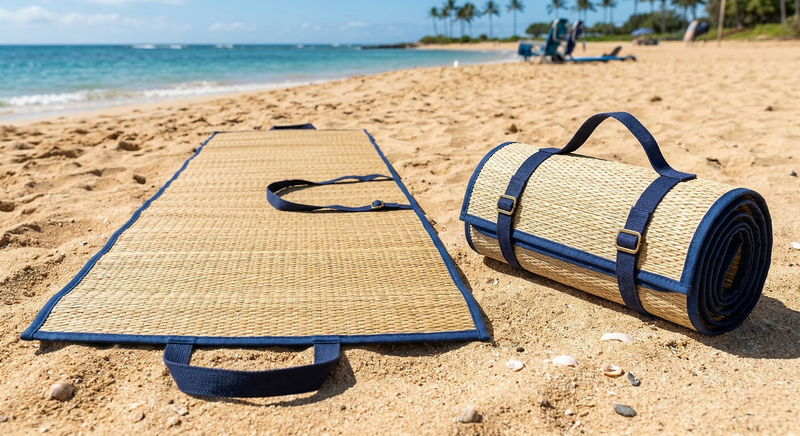
- Tri-fold / Quad-fold: Standard and easy to pack, but requires perfectly aligned panels and seam overlaps to prevent buckling.
- Roll-up: Better for natural fibers because it avoids hard creases. Spec the roll diameter.
- Fabric Hinge: Mandatory for coated mats. The tape specs here have to be exact.
Require proof before production: Ask for a fold-cycle test (200+ folds) with photos. Check for curling, cracked laminations, and blown-out hinge seams.
Vetting the Chinese Supply Chain
Don't get hung up on the "Factory vs. Trading Company" debate. What you actually care about is control. Factories give you direct production oversight. Trading companies are fine if you need to consolidate multiple items (mats, bags, towels) and they have a serious QC team on the ground.
Questions that reveal who is actually in charge:
- Do you weave and sew in-house? What exactly gets subbed out?
- Send me a line video of the mats running right now.
- How do you trace material lots to finished cartons?
- Who executes your AQL inspections?
Stop Arguing Over QC After the Container Ships
Quality control has to be locked in before production starts, not debated after the goods arrive at your 3PL.
- Lock the PPS: Your Pre-Production Sample dictates exact materials, binding, and packaging. No substitutions allowed.
- Golden Samples: Keep one signed sample on your desk; make the factory keep the matching pair on the production floor.
- AQL Inspections: Run an ANSI/ASQ Z1.4 final inspection. Focus heavily on broken seams, sharp edges, and mildew. Tie your final balance payment to a passed inspection.
Freight, Packaging, and Compliance
Beach mats are light but bulky. Your margins will bleed out in freight if you aren't careful.
- Packaging constraints: Don't let them over-compress the bales, or the fold creases will be permanent. Always mandate inner polybags with desiccants, especially for natural fibers.
- Cartons: Specify heavy-duty master cartons if you are routing through a 3PL network.
- Compliance: Check if your buyers require REACH (EU) or Prop 65 (US) for the coatings and dyes. If you're pitching big retail, ask the factory for their BSCI or SEDEX audit reports upfront.
RFQ & Negotiation Tactics
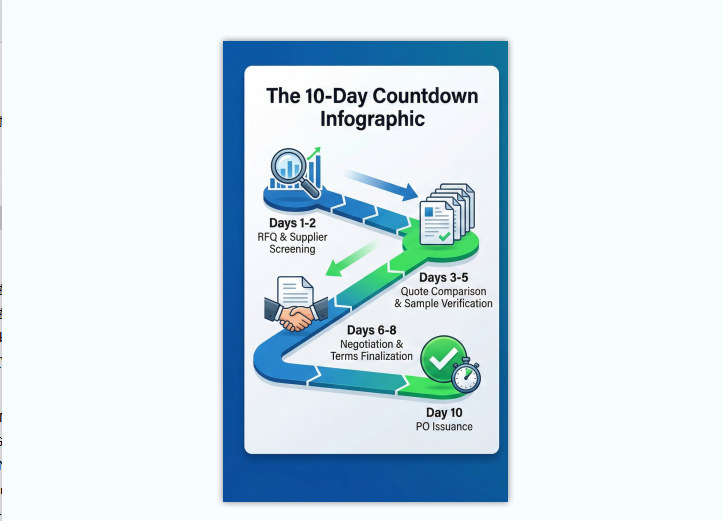
A tight RFQ stops the back-and-forth. Give them the exact dimensions, target weight, material, binding specs, and packaging requirements.
Pro-moves for negotiating:
- Trade stability for price: Guarantee fewer mid-production changes in exchange for a better unit cost.
- Optimize the pack: Sometimes tweaking the fold style by an inch changes your carton dimensions enough to save thousands in container freight.
🎯 Ready to source? > Drop your specs into our Free Sample & Spec Review form (target size, fold style, logo method, annual volume). We’ll hit you back with a supplier recommendation and a realistic quote range within 48 hours.