You check the best-seller list. You pick a high-ranking stroller. You place the order. Six months later, your warehouse is full and your retailer is asking for markdowns.
Choosing a pet stroller by sales rankings fails because the list mixes completely different buyer types into one ranking. The correct selection logic is scene matching — identifying the specific use scenario your retail channel serves, then sourcing specs that fit that exact scenario.
Sales rankings work well for pet snacks and shampoos. For strollers, they create a false picture. I want to show you why, and give you a better framework to use instead.
Is "Pet Products" the Right Category Frame for Pet Strollers?
You open a sourcing platform. You search "best-selling pet strollers." You see a ranked list. You feel like you have data. You don't.
Treating pet strollers as a generic "pet product" is the first sourcing mistake. Strollers are durable, low-frequency purchases. The competitive dimension is not flavor or formula — it is scene fit. Ranking data cannot tell you which scene your buyer is buying for.
I have seen this pattern many times. An importer plans a pet stroller product line. They look at what is selling well across the pet category. They assume the logic that works for treats and grooming will work for strollers.
It does not.
Pet snacks are high-frequency consumables. A buyer who runs out of their dog's favorite treat will search for a replacement fast. Sales volume data is useful here. It reflects real, repeated demand.
Strollers are different. A buyer purchases one stroller and uses it for three to five years. The repeat purchase rate is very low. The decision is bigger, slower, and more specific. There is no "running out" moment that creates urgency.
| Category Type | Purchase Frequency | Decision Driver | Ranking Data Usefulness |
|---|---|---|---|
| Pet treats / snacks | Weekly to monthly | Taste preference, price | High |
| Pet grooming products | Monthly | Formula, scent | High |
| Pet strollers | Once every 3–5 years | Scene fit, specs | Low |
The ranking list for pet strollers reflects who happened to buy what during a measurement window. It does not tell you why they bought it, how they use it, or whether that buyer profile matches your retail channel. Those are the questions that matter. And the ranking cannot answer any of them.
Applying the logic of high-frequency consumables to a low-frequency durable is the core error. The moment you put strollers in the "pet products" bucket, you have already framed the problem wrong.
What Does "Scene Matching" Actually Mean for Pet Stroller Selection?
You keep hearing the phrase "scene matching" in sourcing conversations. It sounds strategic. But what does it mean in practice, and why does it change what you buy?
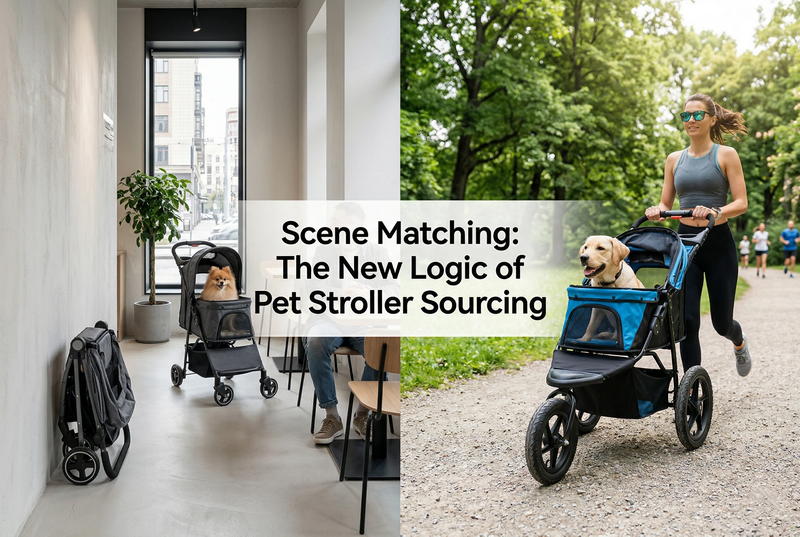
Scene matching means identifying the primary use context of your end buyer before you pick a spec. A stroller suited for a city apartment owner and a stroller suited for an athletic owner share the same product category name but almost no overlapping specs.
The clearest way to explain scene matching is to put two buyer profiles side by side.
The first is the city apartment pet owner. They live in a flat, probably without a yard. They walk their dog on sidewalks, through café districts, on public transit. Their core problem is storage and portability. They need a stroller that folds small, feels light, and fits through doorways without drama.
The second is the athletic pet owner. They run. They might do trail runs, park loops, or weekend long runs with their dog. Their core problem is performance and stability. They need pneumatic tires that absorb impact, a lockable front wheel for straight-line movement, and a frame that does not rattle at pace.
| Spec Priority | City Apartment Owner | Athletic Owner |
|---|---|---|
| Frame weight | Lightweight (under 7 kg) | Secondary concern |
| Folded size | Compact, fits in storage closet | Secondary concern |
| Tire type | Foam or rubber, flat-proof | Pneumatic, air-filled |
| Front wheel | Standard swivel | Lockable for running |
| Handle design | Adjustable for daily use | Fixed sport ergonomic grip |
| Price sensitivity | Medium | Lower — willing to pay for spec |
Both buyers appear in "best-selling pet stroller" data. Their purchases get counted together. Their preferences cancel each other out. The ranking gives you a product that is average across all scenes — and no real buyer is average. Scene matching is the skill of breaking the average apart and asking which slice you are actually serving.
What Does the City Apartment Pet Owner Actually Need in a Stroller?
I talk to importers who serve urban retail accounts. They describe the same customer: someone in a small flat, a dog under 10 kg, and zero patience for products that are hard to store.
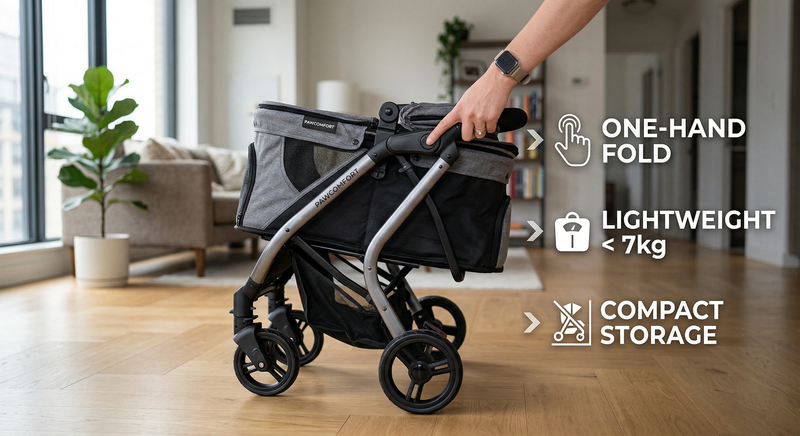
The city apartment pet owner's primary purchase criteria are fold size and carry weight. All other features — color, cup holders, ventilation mesh — are secondary. A stroller that folds to more than 60 cm or weighs more than 7 kg will face resistance in this channel.
I visited a pet retail chain in a dense urban market. Their floor space was tight. Their storage room was tighter. The store buyer told me something I have not forgotten: "If I can't fold it and lean it against the wall, I can't stock it."
That is a real constraint. It shapes every sourcing decision for that channel.
Fold mechanism is the most important feature. One-hand fold is strongly preferred. Buyers in this segment are often carrying a bag, a coffee, or a leash when they need to collapse the stroller. Two-hand mechanisms create friction at the exact moment the buyer is most frustrated.
Weight comes second. A 9 kg stroller feels manageable in a showroom. On the third floor of a walk-up building, it becomes a problem. Lightweight aluminum frames and reduced accessory weight matter. Every kilogram above the acceptable threshold becomes a return risk.
Folded footprint is third. The buyer stores the stroller in a hallway or under a bed. Tall, narrow folded profiles work better than wide, flat ones for apartment environments.
Wheel type is less critical for this buyer. They use sidewalks and smooth floors. Foam-filled flat-proof tires handle the use case well and reduce maintenance complaints after purchase.
Price ceiling for this segment sits in the mid-range. The buyer is practical. They will not pay a premium for running features they will never use. Every dollar spent on pneumatic tires or lockable wheels is a dollar they did not ask for and will not value.
This spec profile does not emerge from a best-seller ranking. It emerges from knowing the scene.
What Does the Athletic Pet Owner Look for in a Stroller?
This buyer is often misrepresented in general ranking data. The athletic pet owner is a smaller segment. But they are willing to pay more, they know exactly what they want, and they will return products when the spec does not match.
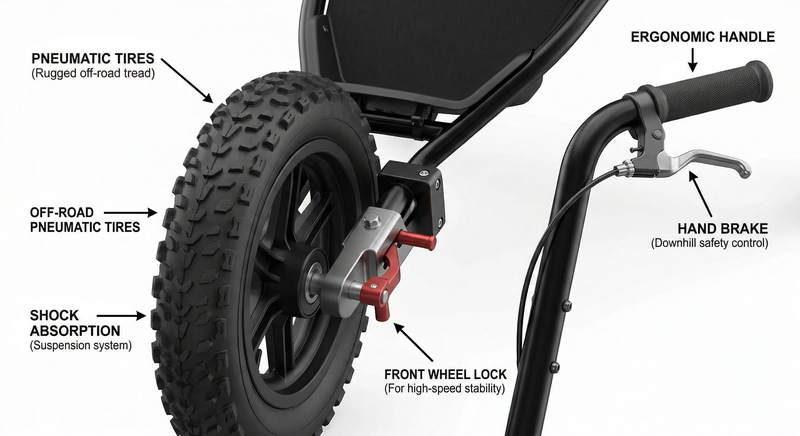 The athletic pet owner requires pneumatic tires, a lockable front wheel, and a frame built to absorb repetitive impact. These are non-negotiable specs. Sourcing a stroller without these features for a fitness-oriented retail account will produce returns and lost trust — both of which are expensive.
I once saw an importer source a "jogging stroller" line based on sales volume. The product ranked well on a general platform. It had foam tires. It had a swivel front wheel. It looked the part.
The returns came back in six weeks.
Athletic buyers test products under real conditions. Foam tires transmit ground vibration directly to the pet. A swivel front wheel wobbles at running pace and forces the owner to steer constantly. These are not aesthetic problems. They are functional failures.
| Feature | Why It Matters to Athletic Buyers | Consequence of Wrong Spec |
|---|---|---|
| Pneumatic (air) tires | Absorbs impact on uneven terrain | Vibration discomfort; pet refuses stroller |
| Lockable front wheel | Maintains direction at speed | Wobble, user fatigue, safety concern |
| Rigid frame construction | Prevents lateral flex during movement | Rattle, instability above walking pace |
| Hand brake | Speed control on downhill paths | Safety issue on any incline |
| Wrist safety strap | Prevents runaway on steep terrain | Standard expectation in this segment |
The athletic buyer knows these terms. They search for them by name. They will not buy a product that cannot specify them on the listing page. You cannot substitute a visually similar product and expect the same outcome.
Source this segment correctly, and the margin is strong. The athletic buyer pays for spec. Source it wrong, and the return cost erases the profit — along with the retail relationship.
How Should Importers Build a Scene-First Selection Framework?
You want a better approach. You know rankings are not the answer. But where do you actually start?
A scene-first selection framework starts with one question: what type of pet owner makes up the largest share of my retail channel's customer base? That answer defines the spec priority list. The spec list defines the factory brief. This sequence produces strollers that fit the channel.
I use a four-step process when helping buyers plan a stroller line. It requires one thing that ranking-based sourcing skips entirely: talking to the channel before you talk to the factory.
Step one: Define your retail channel's dominant buyer persona.
Go to your retail partner. Ask them who buys strollers. Not demographics — scenarios. Do they see mostly urban buyers who take public transit? Do they serve a suburban market with parks and yards? Do they have a fitness-oriented customer base? Most retail buyers can answer this question in five minutes. It is the most valuable input in your sourcing decision.
Step two: Map the persona to a spec priority list.
| Persona | #1 Priority | #2 Priority | #3 Priority | Price Tier |
|---|---|---|---|---|
| City apartment owner | Fold size | Frame weight | One-hand fold mechanism | Mid |
| Suburban yard owner | Interior pet space | Canopy coverage | All-terrain tires | Mid–High |
| Athletic / runner | Pneumatic tires | Lockable front wheel | Frame rigidity | High |
| Elderly pet owner | Push stability | Low entry height | Reliable brake system | Mid–High |
Step three: Write a factory brief from the spec list, not from a competitor's product.
Most importers factory-shop by handing over a competitor's photo and saying "make this." That approach replicates the scene assumption built into the original product — which may not match your channel at all. Write a brief that starts with the scenario, then specifies three non-negotiable features. Let the factory propose a product that meets the brief.
Step four: Validate the product back against the scenario before committing.
Before you approve samples, test in the actual scenario. If it is a city stroller, fold it 20 times with one hand. Carry it up a flight of stairs. Measure the folded footprint. If it is a running stroller, have someone push it at pace on an uneven surface.
Ranking data cannot run this test. You have to.
<section class="wp-block-group" data-cluster-target="pet-stroller" style="margin:32px 0;padding:24px;border:1px solid #d9e6e4;border-radius:14px;background:#f7fbf9;"> <h2 style="margin:0 0 12px;color:#1f2a26;font-size:24px;line-height:1.25;">Related OEM sourcing page</h2> <p style="margin:0 0 14px;color:#4f5f59;line-height:1.7;">If this article is part of a stroller development project, use the core product page to compare frame platform, wheel choice, fold size, carton planning, load rating, MOQ and 2-in-1 options. Continue with the <a href="https://lisohome.com/product/pet-travel/pet-stroller-manufacturer/">pet stroller manufacturer page</a>.</p> <ul style="margin:0;padding-left:20px;color:#4f5f59;line-height:1.7;"><li>City, senior dog, travel and large dog stroller programs</li><li>Frame, wheel and fold-size decisions</li><li>Load, brake and carton QC</li></ul> </section>
Conclusion
Stop sourcing strollers from rankings. Start from the scene. Know your buyer's daily reality, build the spec list from that, and then find the factory that matches.