I see many importers lose money here. The frame looks bigger, the spec sheet looks stronger, and then the one-star reviews start after two walks.
No, I cannot treat a large dog stroller as a scaled-up small model. A true large model needs a new frame geometry, a different chassis layout, and a stronger front steering structure to stay stable under 25–40 kg moving loads.
When I talk with buyers, I notice the same problem again and again. Many suppliers say they can make a large dog stroller. In fact, they often just enlarge the cabin and thicken the tube wall a little. On paper, that sounds fine. In real use, it is not fine at all. A 5 kg toy poodle and a 30 kg Labrador do not load a stroller in the same way. The dog is not dead weight. The dog shifts, leans, turns, and pushes against the side. That changes everything. I have seen importers trust load ratings and ignore structure. Later, their customers complain that the stroller pulls sideways, feels shaky, or starts to deform. This is why I see large dog strollers as one of the highest-barrier segments in the whole pet stroller market, even though there are fewer real competitors in it.
Why Does Frame Geometry Matter More Than Thicker Steel?
 I often see factories sell “heavy-duty” by adding metal. The trouble starts when buyers think more tube thickness means real engineering.
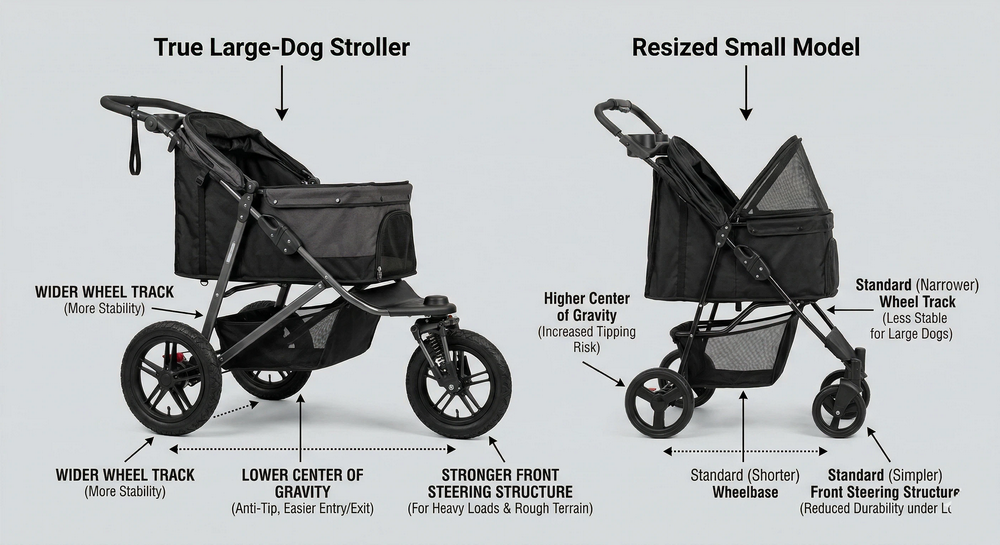
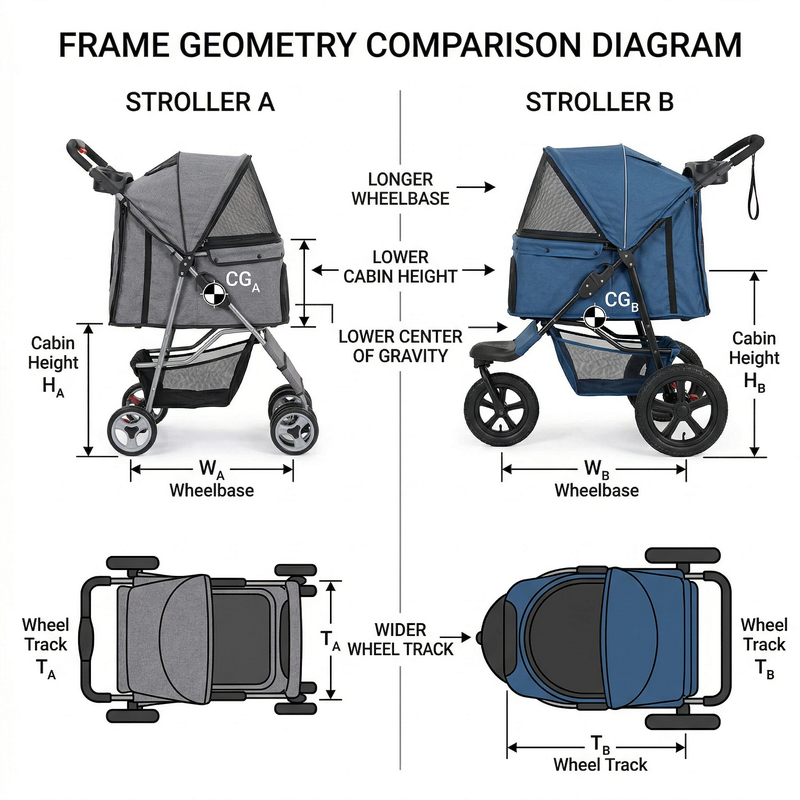
For a true large dog stroller, frame geometry matters more than thicker steel. I need a wider wheel track, longer wheelbase, and lower center of gravity so the stroller stays stable when a heavy dog moves inside.
When I evaluate this product, I start from geometry, not from wall thickness. I do that because geometry controls stability across the whole stroller. If the body sits too high, the track is too narrow, or the front and rear wheel spacing stays too short, the stroller becomes easy to disturb. A 30 kg dog only needs to lean or turn once to expose that weakness. This is basic stability logic. It is close to what NHTSA explains about static stability factor, where width and center of gravity affect rollover resistance. I do not need to calculate an SSF for a pet stroller to understand the lesson. I just need to see how the stroller reacts under side load. A true large-dog platform feels planted. A resized small model feels like it is being held together by thicker tubes and hope. I have learned that tube thickness can improve local strength, but it cannot fix wrong proportions. That is why I never treat “1.5 mm steel” as proof of a real large model.
| Item | True Large-Dog Stroller | Resized Small Model |
|---|---|---|
| Wheel track | Wider | Often unchanged or only slightly wider |
| Wheelbase | Longer | Close to small model layout |
| Center of gravity | Lower | Higher because cabin grows faster than base |
| Frame logic | New platform design | Old platform stretched bigger |
| Real-world feel | Stable under movement | Sways when dog shifts |
Why Is Chassis Design the Real Test of a Large-Dog Platform?
Many people look at the basket first. I look at the underbody first, because the chassis tells me whether the stroller was built to carry weight or just to display it.
A true large-dog chassis is built for dynamic load, not just static load. It must stay straight, balanced, and controllable when a heavy dog shifts position, not only when fixed weight sits in the basket.
This is the point many importers miss at first. A dumbbell and a living dog are not the same load. A dumbbell sits still. A dog does not. A French Bulldog or Labrador can change direction inside the cabin in one second. That puts torsion into the lower frame and side force into the wheel system. If the chassis was not redesigned, the stroller may pass a simple vertical load check and still fail in use. I have seen this pattern too many times. The frame does not break at once. It starts to drift. Then the wheel line changes. Then the body looks slightly twisted. After that, the online reviews go bad. This is also why I pay attention to the wider safety world. ASTM F833 and the CPSC stroller safety and recall pages both reflect a bigger truth: stroller safety is not only about carrying weight. It is about stability, restraint, alignment, and durability under use. In my own sourcing work, I treat the chassis as the real dividing line between a “true large model” and a “made-to-fit” compromise.
Why Does Front Fork Material Expose Fake Large-Dog Models So Fast?
I often find that the weakest truth in a fake large model appears at the front end. That is where steering error shows up first.
Front fork material matters because heavy side loads need stiffness and steering control. If I reuse a small stroller’s ABS fork on a large model, side push can cause flex, tracking drift, and poor handling.
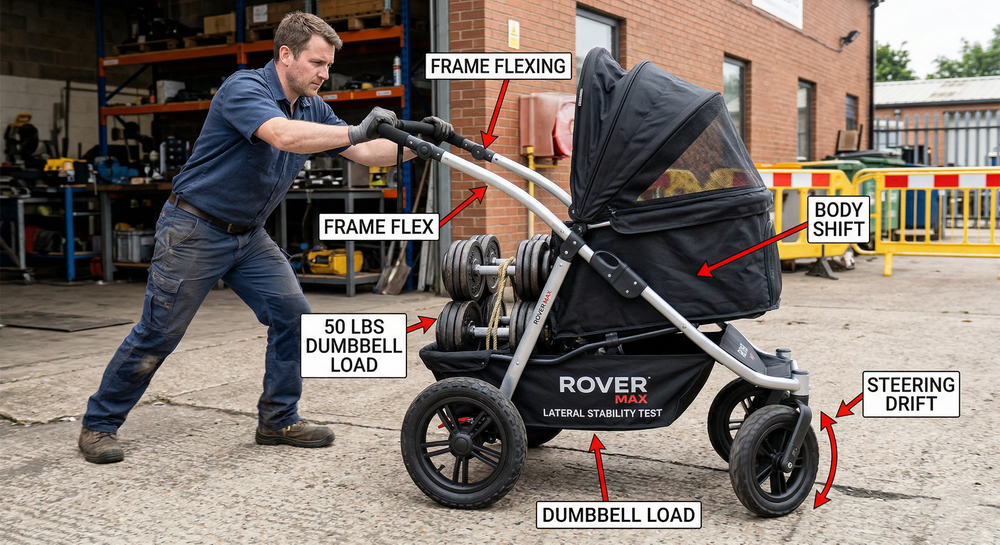
When I inspect a large dog stroller, I do not just ask what material the fork uses. I ask how the whole front steering unit was redesigned. That is important because the fork takes side force during turning, uneven pavement, and off-center pushing. On small models, ABS parts may be acceptable in some positions because the load stays low. On a large-dog model, that same choice can become a weak point. General engineering references such as MatWeb’s ABS resource show why people use ABS. It is practical and common. But that does not make it the right answer for every high-load steering job. I have seen large models that still use small-model ABS front forks. They move forward, yes. But when I apply side force, the stroller starts to deviate. It does not hold the line well. That is a real warning sign for importers. In my view, steering quality is one of the fastest field checks because buyers can feel the weakness at once, even before visible damage appears.
How Do I Tell a True Large-Dog Supplier From a “Good Enough” Supplier?
Many suppliers say yes to everything. I need a fast test that makes weak engineering hard to hide.
I use a simple validation method: I put dumbbells equal to rated load into the stroller and apply side force. If the body shifts, drifts, or deforms clearly, I treat it as a resized small model.
This test is simple, but I trust it because it forces the supplier to show real behavior, not just a nice drawing or a spec table. I load the stroller close to its rated capacity. Then I ask for side input. I want to see the body, wheel line, and front steering reaction. If the stroller shows obvious lateral offset, unstable recovery, or visible flex, I know enough. A serious factory should not refuse this. In my experience, the factories that can truly do this product are not common. China has real capability in this segment, but the number is still limited. I usually hear buyers focus on regions such as Taizhou in Zhejiang and Foshan in Guangdong because those places have stronger mold and frame development experience. What matters more to me, though, is not the city name. It is whether the factory can explain the platform from geometry, chassis, and steering structure. That is the language of a real engineering supplier. The language of a weak supplier is usually “we made the tube thicker.”
<section class="wp-block-group" data-cluster-target="pet-stroller" style="margin:32px 0;padding:24px;border:1px solid #d9e6e4;border-radius:14px;background:#f7fbf9;"> <h2 style="margin:0 0 12px;color:#1f2a26;font-size:24px;line-height:1.25;">Related OEM sourcing page</h2> <p style="margin:0 0 14px;color:#4f5f59;line-height:1.7;">If this article is part of a stroller development project, use the core product page to compare frame platform, wheel choice, fold size, carton planning, load rating, MOQ and 2-in-1 options. Continue with the <a href="https://lisohome.com/product/pet-travel/pet-stroller-manufacturer/">pet stroller manufacturer page</a>.</p> <ul style="margin:0;padding-left:20px;color:#4f5f59;line-height:1.7;"><li>City, senior dog, travel and large dog stroller programs</li><li>Frame, wheel and fold-size decisions</li><li>Load, brake and carton QC</li></ul> </section>
Conclusion
I do not judge a large dog stroller by size. I judge it by geometry, chassis behavior, and front-end control under real load.