Most pet strollers sell for under $150. Most importers fight over that same $79–$149 band. If that sounds like your market, you are already losing.
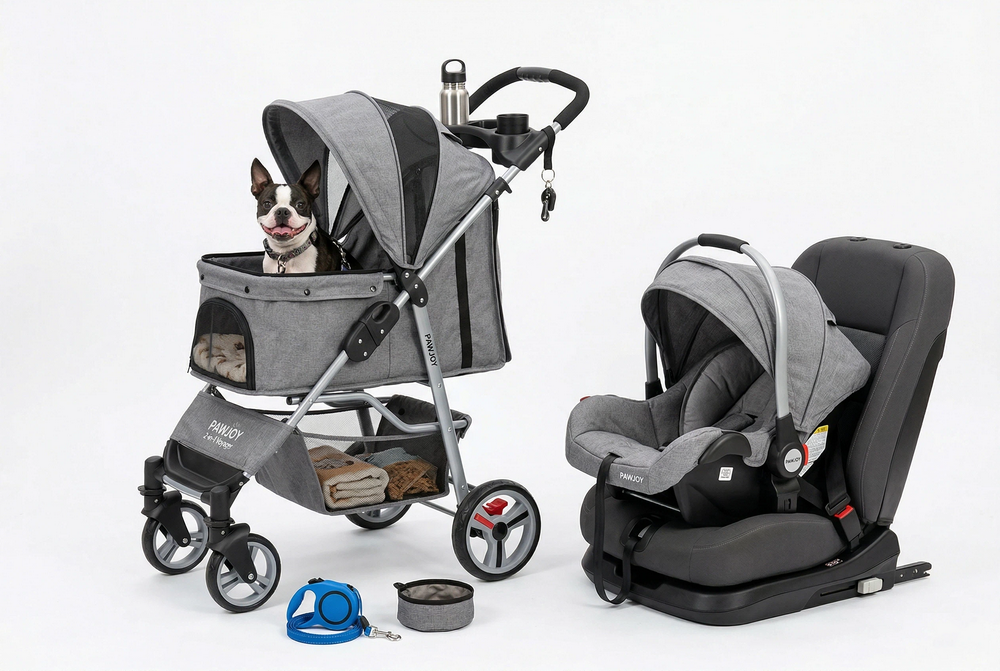
A 2-in-1 pet stroller that also functions as a car seat carrier retails for $149–$299. That is 30–40% above what buyers would pay for both products purchased separately. The premium is not driven by material cost or extra features. It is driven by the value of removing a decision from the buyer's life.
I have spent years working directly with factories and importers in the pet product space. One thing I keep seeing is this: the importers with the best margins are not selling the cheapest products. They are selling the most convenient ones. The gap between a commodity SKU and a premium SKU is not always about the product. It is about how the product fits into the buyer's life. Let me break down exactly why multi-function integration is a pricing lever—and why most importers still have not figured this out.
Where Does the 30–40% Price Premium Actually Come From?
You might assume the premium is just the sum of two separate products. It is not. The market pays more than that, and most importers leave that money sitting on the table.
A standalone pet stroller retails for $79–$149. A standalone pet car seat sells for $39–$89. The combined retail value of both is roughly $118–$238. But a 2-in-1 product in this category typically retails for $149–$299—above the additive total, because the act of combining them creates value that neither product has alone.
Breaking Down the Price Gap With Real Numbers
I show this table to importers who are skeptical. The numbers do the work.
| Product | Typical Retail Price | Margin Pressure |
|---|---|---|
| Single pet stroller | $79–$149 | High—crowded market |
| Single pet car seat | $39–$89 | High—commoditized |
| 2-in-1 stroller + car seat | $149–$299 | Low—fewer competitors |
Here is the specific math that matters. A stroller at $99 and a car seat at $59 add up to $158 in combined retail value. But the 2-in-1 version sells for $199–$249. That gap is $40–$90 of pure premium per unit. That premium does not come from components. It does not come from labor. It comes from a perception of value that the buyer creates internally.
Why does a buyer pay $40 more for the combined product? Because they are not doing the math on components. They are doing the math on their own time and stress. They need a stroller. They also need a car seat carrier. The 2-in-1 product means one search, one listing, one order, one delivery, one box to open, one product to learn. That simplicity has a dollar value. And that dollar value is higher than most suppliers expect.
For an importer, every $40 of premium per unit compounds quickly at scale. At 500 units per month, the 2-in-1 product generates $20,000 more in revenue than a single-function product at the same volume—without selling a single additional unit.
How Does "Decision Simplification" Translate Into Real Dollars?
Consumers say they want more options. Research consistently shows the opposite. More decisions create friction and fatigue. A product that removes a decision commands a premium in almost every consumer category—and pet products are no different.
"Decision simplification" is the economic value of reducing the number of choices a buyer has to make. When a pet owner needs both a stroller and a car seat carrier, a 2-in-1 product compresses two purchase journeys into one. Buyers willingly pay 30–40% more for that compression. They are not paying for features. They are paying for relief.
The Real Cost of a Two-Product Purchase Journey
This concept has a name in behavioral economics: decision fatigue. Every choice a person makes depletes a small amount of mental energy. A product that removes a choice functions like a service. Pet owners do not always recognize this consciously, but their purchasing behavior shows it clearly.
Here is what the two-product purchase journey looks like compared to the 2-in-1 experience:
| Buyer Step | Two Separate Products | One 2-in-1 Product |
|---|---|---|
| Research | Read reviews for stroller + read reviews for car seat | Read reviews for one product |
| Purchase | Two separate orders, possibly on two platforms | One order |
| Delivery | Track two packages, two arrival windows | Track one package |
| Unboxing | Open two boxes, dispose of two sets of packaging | Open one box |
| Setup | Learn two systems, store two products | Learn one product |
| Returns | Two return processes if either fails | One return process |
Every row in that left column is a friction point. Friction costs the buyer time and mental energy. When a product eliminates friction, the buyer assigns real monetary value to that elimination—often more than the seller anticipates.
I have seen this pattern clearly in listing performance data. The 2-in-1 versions with simple, direct positioning—"one product, two uses"—outperform single-function listings in conversion rate even at significantly higher price points. The buyer's mental calculation is not "is this product worth $199?" It is "is removing this hassle worth $40 more than buying two separate things?" Almost always, the answer is yes. This is the same reason premium grocery chains sell pre-cut vegetables at three times the price of whole ones. Convenience is the product. In the pet stroller category, the importers who understand this are not selling hardware. They are selling a simpler life.
Why Is the Multi-Function SKU a Better Business for Importers?
Selling a cheaper product is not a simpler business. It is a harder one. More competitors, thinner margins, and constant pressure from the next seller willing to undercut you by two dollars. The single-function stroller market is not a market—it is an auction.
Importers who sell single-function pet strollers compete on price. Importers who sell 2-in-1 multi-function SKUs compete on value. The two categories are not just different price points. They are different businesses, with different buyer types, different competitor dynamics, and fundamentally different margin structures.
The Business Case for Moving Up the Complexity Ladder
I talk regularly with importers who are stuck in a price war. They are selling strollers at $89 and watching their margins compress quarter over quarter. The solution almost never comes from finding a cheaper factory. It comes from moving to a product where fewer competitors exist.
Here is a direct comparison of the business dynamics across the two categories:
| Business Metric | Single-Function Stroller | 2-in-1 Stroller + Car Seat |
|---|---|---|
| Typical retail price | $79–$149 | $149–$299 |
| Competitor density | Very high | Low to moderate |
| Buyer price sensitivity | Extreme | Moderate |
| Gross margin potential | 20–30% | 35–50% |
| Buyer profile | Price-focused | Value-focused |
| Return rate | Higher | Lower |
| Listing defensibility | Difficult | Easier |
The right column is a different business. The buyer who spends $249 on a 2-in-1 product is not the same buyer hunting for the cheapest $79 stroller. They are a value buyer. They read reviews more carefully. They care more about product quality and brand trust. And they are less likely to return a product over a minor issue.
For an importer, this means fewer returns, stronger review scores, and a listing that is harder to undercut. A competitor cannot steal your sales by cutting price by $5 when your product solves two problems and theirs solves one. The value gap is real, and it compounds over time. I always tell importers: if you are tired of competing on price, stop selling commodities. The 2-in-1 pet stroller is one of the clearest, most accessible paths out of the commodity trap in this category right now.
What Engineering Barrier Keeps the Competition Out?
Any factory in Guangdong can make a basic pet stroller. Not every factory can make a stroller that is structurally compatible with a car seat mounting system. That engineering gap is not just a product detail. It is your competitive moat.
The 2-in-1 pet stroller requires a shared chassis that simultaneously supports a stroller folding mechanism and a car seat restraint system. These are structurally different load requirements. Getting them to coexist in one chassis is an engineering challenge that filters out the majority of factories—and that filtering protects your margins.
Why Engineering Complexity Is a Revenue Shield
Most people think of engineering complexity as a cost center. In this product category, it is also a margin protector.
A standard pet stroller needs a folding frame, a fabric seat, and wheels. The manufacturing requirements are basic. Hundreds of factories across major pet product hubs can produce this product with minor variation. This is precisely why the single-function stroller market is commoditized.
The 2-in-1 product needs something different:
| Engineering Requirement | Single-Function Stroller | 2-in-1 Stroller + Car Seat |
|---|---|---|
| Frame design | Standard folding joint | Shared chassis with dual mounting points |
| Load path design | Stroller use only | Must handle both stroller and in-car restraint forces |
| Safety certification | Basic ASTM F833 | Additional car safety testing requirements |
| Factory tooling investment | Low | Significantly higher |
| Design iteration cycle | Short | Longer due to dual-use validation |
| Supplier pool | Very large | Much smaller |
Each row in the right column raises the barrier to entry. The tooling investment is higher. The testing requirements are more complex. The design process is longer. Fewer factories can do this well. And the factories that can are not going to hand off their tooling to the next buyer for a low MOQ trial order.
For an importer, this creates two compounding advantages. First, the product is harder to replicate. A new competitor cannot simply find a factory on a sourcing platform and launch a copycat product within 90 days—the engineering timeline alone prevents it. Second, once you find a factory with genuine capability in this area, that relationship has more long-term value. Switching costs are higher on both sides, which means more stability in your supply chain. I have worked with importers who moved from single-function strollers to 2-in-1 products after one product cycle. Almost all of them said the same thing afterward: they wished they had made the move earlier. The margin difference was immediate, and the competitive pressure was lower from the first month of launch.
<section class="wp-block-group" data-cluster-target="pet-stroller" style="margin:32px 0;padding:24px;border:1px solid #d9e6e4;border-radius:14px;background:#f7fbf9;"> <h2 style="margin:0 0 12px;color:#1f2a26;font-size:24px;line-height:1.25;">Related OEM sourcing page</h2> <p style="margin:0 0 14px;color:#4f5f59;line-height:1.7;">If this article is part of a stroller development project, use the core product page to compare frame platform, wheel choice, fold size, carton planning, load rating, MOQ and 2-in-1 options. Continue with the <a href="https://lisohome.com/product/pet-travel/pet-stroller-manufacturer/">pet stroller manufacturer page</a>.</p> <ul style="margin:0;padding-left:20px;color:#4f5f59;line-height:1.7;"><li>City, senior dog, travel and large dog stroller programs</li><li>Frame, wheel and fold-size decisions</li><li>Load, brake and carton QC</li></ul> </section>
Conclusion
Multi-function integration is a pricing lever, not just a product feature. A 2-in-1 pet stroller earns 30–40% more because convenience has a dollar value—and importers who understand that compete in a fundamentally different, more profitable market.