Every factory I've visited in Zhejiang will show you a beach bag and tell you it's waterproof. Not some of them — all of them. I've seen this cost buyers thousands of dollars in return claims when the product reaches retail and customers find out their phone didn't survive a pool day inside a bag marketed as "100% waterproof." The word covers three completely different construction realities in this category. Each one has different materials, different real-world performance, and a different FOB price1. Most factories either don't know the difference, or they choose not to explain it.
📌 Key Takeaways
- "Waterproof2" in beach bag sourcing describes three distinct construction tiers — and factories rarely distinguish between them unprompted
- Water-resistant fabric (PVC or TPU-coated Oxford3) repels surface water but leaks at every seam — it is a splash-protection bag, not a dry bag
- True waterproof construction requires both a waterproof zipper4 (YKK Aquaseal5 or equivalent) and seam-sealed stitching6 — this adds $2–$4 FOB and delivers a genuinely dry bag
- RF-welded TPU construction7 hits IP67 rating8, supports a $65–$120 retail price point, and is now accessible at 500-unit MOQs from factories in Ningbo and Guangzhou
- The tissue paper test9 takes five minutes and tells you exactly which tier your sample delivers — before you commit to a production run
Is "Waterproof2 Fabric" Actually Making Your Beach Bag Waterproof2?
The most common construction I see in this category uses PVC-coated Oxford fabric or TPU-coated nylon. The fabric surface repels water. That part is true. Rain hits the panels and beads off. This is what most factories in Quanzhou, Fujian and Jiaxing, Zhejiang are producing when they quote you a beach bag at $3.50–$6.50 FOB at 500 MOQ. It accounts for the large majority of beach bags being sold into hotel kit procurement10 and beachside retail at the $15–$25 price point. The fabric is real, the material spec is real, and the invoice will say "waterproof beach bag" without any asterisk.
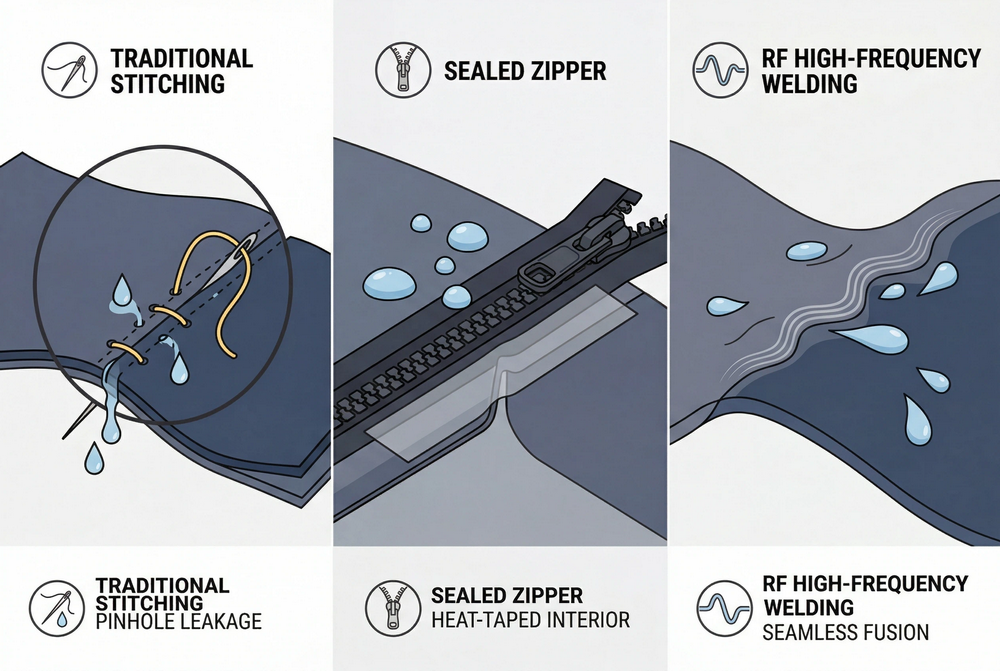
Here's what they won't tell you: the stitching doesn't repel water. Every needle that passes through fabric leaves a micro-hole. Hundreds of those holes sit on every seam line. When the bag sits on wet sand, or when water pressure builds at the base during a beach session, those needle holes let moisture in. The bottom of the bag gets wet. If there's a phone inside, it's at risk. I've run the tissue paper test9 on these bags many times — fill the bag with tissue paper, zip it shut, pour water over every surface for five minutes, then open it. The paper at the base is always wet. This is a water-resistant bag. Using "waterproof" to describe it is where importers get into trouble.
This construction is the right choice for specific use cases: poolside towel totes, hotel amenity kits, beach accessory carriers11 where the bag never sits in standing water. If your channel is hotel procurement for a 200-room resort or a budget beachware12 brand at $15 retail, this tier is cost-efficient and appropriate. If your channel is surf retail13, outdoor specialty, or any brand that will market the product as "waterproof dry storage," this tier will produce returns. The issue is not the product — the issue is using one word to sell two different performance levels.
What Does a Real Waterproof2 Beach Bag Construction Cost — and How Do You Spec It?
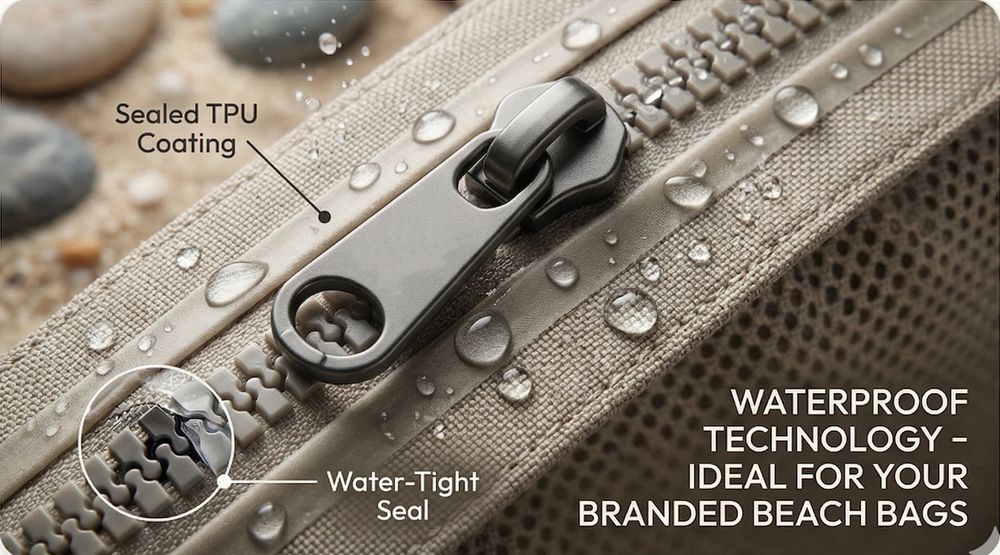
The actual waterproof standard requires two things working together: a waterproof zipper4 and sealed seams. Neither one alone is enough. Most importers who've been burned once start by specifying a waterproof zipper4, which is a step forward — but if the seams aren't sealed, water still enters through every stitch point on the body of the bag. I see this half-measure quoted as "waterproof construction" by factories regularly.
The zipper standard I use on client orders is YKK Aquaseal5, or a domestic equivalent from SBS at a comparable grade. YKK Aquaseal5 adds $0.40–$0.80 to your unit cost over a standard zipper. Domestic waterproof zipper4s from SBS run $0.20–$0.40 extra. What these zippers do is close the gap between the coil tracks with a membrane coating. That gap is where water enters on every standard zipper under any sustained water exposure. Without it, the zipper is the first failure point, even if everything else is sealed correctly.
Sealed seams are the second requirement. Factories apply thermoplastic seam tape14 to the inside of every stitched seam line under heat pressure. This closes the needle holes. Depending on bag size and seam count, seam tape14 adds $1.50–$2.50 per unit. Combined with the waterproof zipper4 upgrade, you're looking at $2.00–$4.00 added to FOB over the first tier. At 1,000 units, that's $2,000–$4,000 in total additional cost. At 5,000 units, it's $10,000–$20,000. This is the number that makes importers hesitate — and the gap that factories exploit when they quote "waterproof" without the spec detail.
I ran the tissue paper test9 on a correctly built bag last quarter for a client sourcing from a factory in Xiamen. Filled the bag, zipped it, poured a sustained stream over every panel, every seam, and the zipper track for five full minutes. The tissue came out dry. That is the result a properly spec'd mid-tier waterproof bag should deliver. For retail at $25–$55, this construction is the honest mid-market sweet spot. When you're sending a spec sheet to factories, write "seam-sealed construction with YKK Aquaseal5 or SBS equivalent waterproof zipper4" in exact terms. If the factory asks what seam sealing15 means, that factory has never built a real waterproof bag.
When Does RF Welding Make Commercial Sense for Your Beach Bag Line?
RF welding — also called high-frequency welding — eliminates stitching entirely. Two layers of TPU material are fused together under heat and pressure. No needle holes. No seam tape14 that can delaminate over time. The construction meets IP67 standards: submersible to one meter for 30 minutes. There is nothing in a standard beach bag construction that comes close to this performance level.
This process started in white-water sports equipment and packraft manufacturing. Over the past two to three years, it has moved into the premium sustainable beach bag16 segment — driven by the availability of recycled TPU fabric and by the growing demand for a product story that goes beyond basic water resistance. Factories in Ningbo and Guangzhou that originally built RF welding capacity for kayaking and diving gear have started accepting beach bag orders at lower MOQs. Some now work at 500 units per colorway. Three years ago, the minimum was 2,000 units. That shift has made this construction accessible to mid-sized importers for the first time.
The cost difference is real. An RF-welded beach bag in recycled TPU runs $8.50–$14.00 FOB at 500–1,000 units, compared to $5.00–$10.50 for a seam-sealed bag at the same size. But the retail ceiling moves up with it. Brands are successfully pricing RF-welded beach bags at $65–$120 retail. The product narrative — no seams, IP67 rated, made from recycled ocean plastic TPU — is a complete and defensible story for a specialty outdoor retailer or a direct-to-consumer17 sustainable brand. That's a 2–3x retail multiple over the first tier, on a unit cost premium of $4–$8. The math works if your channel supports it.
The Three-Tier Comparison: Materials, Performance, and Cost at a Glance
| Construction Type | Key Materials | Waterproof2 Performance | FOB Cost (500–1,000 units) | Retail Price Range | Best Channel |
|---|---|---|---|---|---|
| Water-resistant fabric only | PVC-coated Oxford or TPU-coated nylon | Splash and light rain only — seams leak | $3.50–$6.50 | $12–$25 | Hotel kits, poolside accessories, budget beachware12 |
| Seam-sealed + waterproof zipper4 | TPU nylon + YKK Aquaseal5 or SBS equivalent + seam tape14 | Sustained rain and water exposure — seams stay dry | $6.00–$10.50 | $25–$55 | Surf retail, beach brand wholesale, mid-market outdoor18 |
| RF welded — no stitching | Recycled TPU, heat-bonded panels | IP67 — submersible 1m for 30 minutes | $8.50–$14.00 | $65–$120 | Premium sustainable brand, specialty outdoor retail |
How Do You Know Which Tier Your Supplier Is Actually Delivering?
Before you commit to any production run, run this test on the sample. Pack 10 sheets of tissue paper inside the bag. Zip it fully closed. Pour water over every surface — all fabric panels, every visible seam line, and the zipper track — for five full minutes of continuous flow. Then open the bag and check the tissue.
Tier one delivers wet tissue at the base. The fabric held, but the seams didn't. Tier two delivers dry tissue throughout. The seam tape14 and waterproof zipper4 held under sustained pressure. Tier three shows no change in the tissue — no moisture, no dampness, even after full submersion. This test takes five minutes, costs nothing, and tells you exactly which tier the factory delivered — regardless of what the product description, the spec sheet, or the sales conversation said. I have never had a factory argue with the result.
This is the test I run for every new supplier I qualify for a client. If the sample fails tier two when the order spec called for tier two, that's a factory conversation to have before production, not after. Most of the time, the factory wasn't being dishonest — they genuinely did not distinguish between the three tiers in their own production process. The ones who do know the difference and ship tier one while billing tier two — those are the suppliers worth avoiding permanently.
If you're sourcing waterproof beach bags with zipper and want to get the construction spec right before your first production run, reach out directly. I can review your current supplier's sample result, recommend the correct construction tier for your retail channel, and connect you with vetted factories in Zhejiang and Fujian that deliver on the spec they quote.
Understanding FOB pricing is essential for budgeting and cost management in sourcing. ↩
Understanding the term 'waterproof' is crucial to avoid costly returns and ensure product quality. ↩
Discover the differences in fabric types to choose the right material for your beach bags. ↩
Explore the significance of waterproof zippers in ensuring the effectiveness of beach bags. ↩
Find out how YKK Aquaseal zippers enhance waterproofing in beach bags. ↩
Understand how seam-sealed stitching contributes to the overall waterproof performance. ↩
Learn about this advanced construction method that offers superior waterproofing. ↩
Discover the significance of IP67 ratings in ensuring product reliability. ↩
This simple test can help you verify the waterproof claims of your samples. ↩
Learn about the specific needs of hotel kit procurement for sourcing beach bags. ↩
Explore the various applications of beach accessory carriers in the market. ↩
Understanding budget beachware helps in targeting the right consumer segment. ↩
Understanding surf retail helps in targeting the right audience for beach bags. ↩
Learn how seam tape enhances the waterproof capabilities of beach bags. ↩
Understanding seam sealing is crucial for ensuring the waterproof integrity of bags. ↩
Explore the benefits of sustainable materials in beach bag production. ↩
Discover the advantages of direct-to-consumer sales models for beach bags. ↩
Explore the characteristics of mid-market outdoor products for effective positioning. ↩