If you are sourcing private-label orthopedic dog beds, foam density is not a small specification line. It decides whether the bed keeps its shape, whether a large or senior dog bottoms out, whether vacuum packing is safe, and whether the product can be sold as a serious support bed rather than a soft pet mat.
At LISO HOME, we use foam density, layer structure and compression recovery as pre-RFQ decision points. This checklist is written for importers, pet retailers, Amazon sellers, brand founders and OEM project managers who need to compare dog bed quotes quickly without being trapped by a low unit price.
Quick OEM answer
For an orthopedic dog bed program, do not approve the sample only by touch, thickness or photo.
Before you confirm price, ask the supplier for:
- Foam density grade: 30D, 40D or 45D for real support routes.
- Firmness/support data: density is not the same as surface firmness.
- Filling form: solid foam, layered solid foam, shredded foam or hybrid construction.
- Compression rule: whether the exact foam can be vacuum packed and how it recovers after 72 hours.
- Recovery acceptance: thickness, crease and support check after unpacking.
- Cover construction: removable washable cover, zipper, liner, anti-slip bottom and stitching.
- QC record: incoming foam density check, compression simulation and final packing inspection.
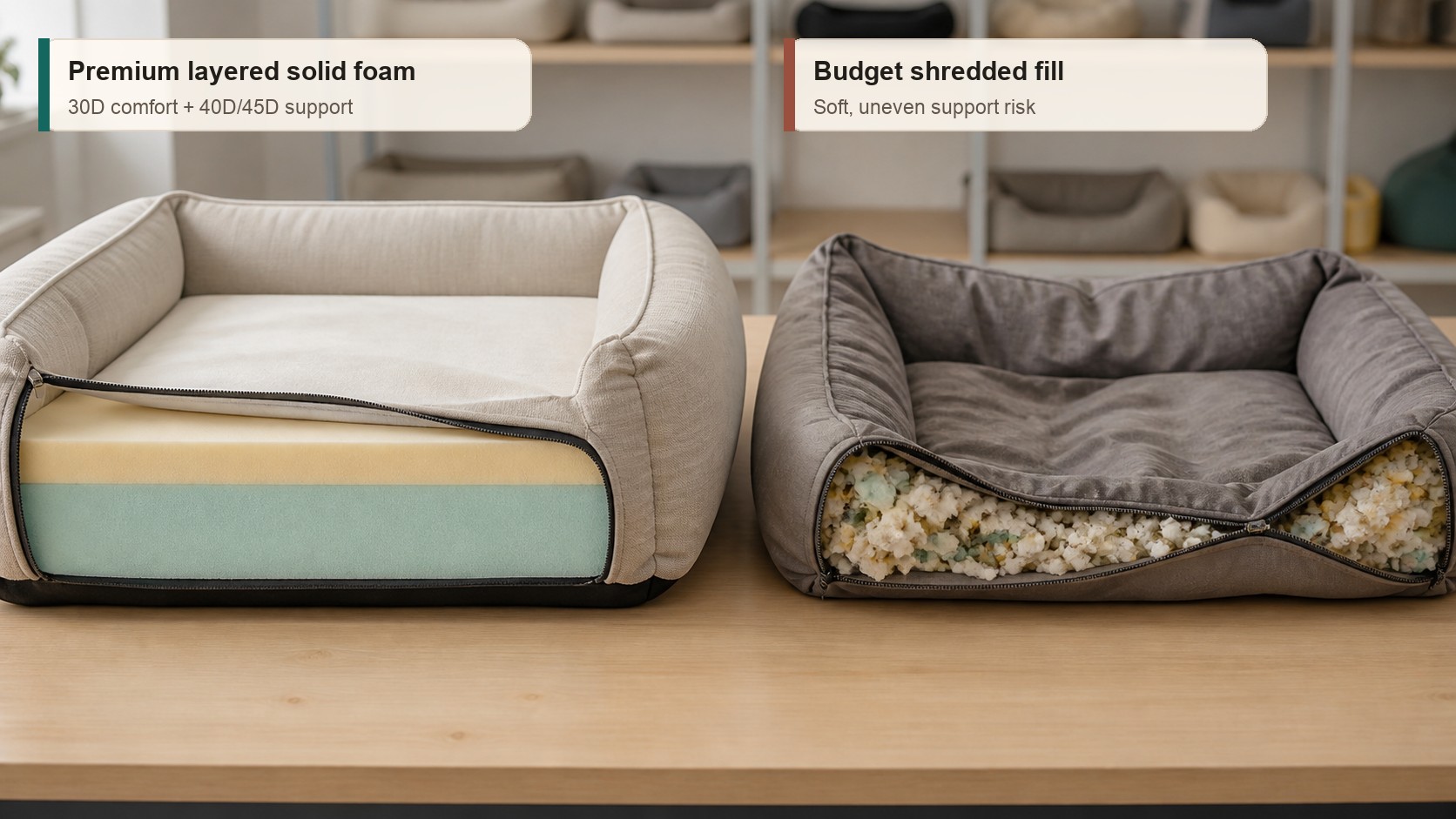
The safest premium route is usually a layered design: a softer comfort layer on top and a high-density support layer underneath. For budget routes, be honest with the product positioning. A low-density or shredded-fill bed may be suitable as a soft pet resting bed, but it should not be sold as a high-support orthopedic bed for heavy, senior or joint-sensitive dogs.
Density is not the same as firmness
One important correction: foam density and foam firmness are related in sourcing conversations, but they are not the same fact.
The Polyurethane Foam Association explains foam density as mass per unit volume, and it notes that density affects durability and support retention. The same source separates density from firmness, which is measured by indentation force deflection, often called IFD or ILD. In practical terms, a high-density foam can still be formulated to feel softer at the surface, and a lower-density foam can be made to feel firm for a short time but lose height faster.
For buyers, this means:
- Use density to judge durability and long-term support risk.
- Use IFD/ILD, support factor and sample testing to judge feel and load support.
- Use layer structure to balance comfort and orthopedic positioning.
When suppliers only say "high density" without test values, weight check, sample recovery or layer details, the quotation is incomplete.
Foam density selection by dog weight
Use this table as a sourcing screen before sample approval.
| Foam grade | Best use | Dog weight route | OEM recommendation |
|---|---|---|---|
| 20D | Very soft temporary mat | Very small puppies only | Do not position as orthopedic. High collapse risk. |
| 25D | Budget soft pet bed | Light small dogs or low-price promo programs | Suitable for low-end soft beds, not real orthopedic support. LISO MOQ: 200 pcs. |
| 30D HR foam | Mainstream comfort/support balance | Small dogs 1-8 kg and many medium dogs 9-25 kg | Good volume route for general orthopedic-style beds if recovery and support pass testing. |
| 40D HR foam | High-density support | Medium short-leg breeds, large dogs 26-45 kg, senior dogs | Recommended support layer for serious orthopedic positioning and premium retail lines. |
| 45D high-density foam | Very strong support | Giant, overweight or recovery-use dogs over 45 kg | Best for heavy-duty premium beds, with higher cost and stronger support positioning. |
For small dogs such as toy poodles, bichons, pomeranians and yorkshire terriers, 30D high-resilience foam is usually a better starting point than 20D or 25D. The dog is light, but the bed still needs to keep a flat support surface rather than swallowing the spine into a soft pit.
For medium dogs, split the line by positioning. A general home-use bed can use 30D if the sample passes compression and support testing. Short-leg or joint-sensitive breeds such as corgis and french bulldogs are better matched with a 40D support layer because the product can carry a stronger premium claim and reduce after-sales complaints.
For large dogs such as golden retrievers, labradors, german shepherds and young alaskan malamutes, 40D is the safer OEM route. In LISO's sourcing practice, 30D can look acceptable during sample approval but is more likely to show body-zone depression after several months of heavy use.
For giant, overweight or senior recovery-use dogs, 45D gives the strongest support route. The cost can be around 15-25% higher than a standard route, but it gives the buyer a clearer premium product story.
High-end export dog beds rarely rely on one foam grade only. A stronger structure is:
| Layer | Typical route | Purpose |
|---|---|---|
| Top comfort layer | 2-3 cm 30D foam or controlled comfort layer | Softer contact feel and pressure relief. |
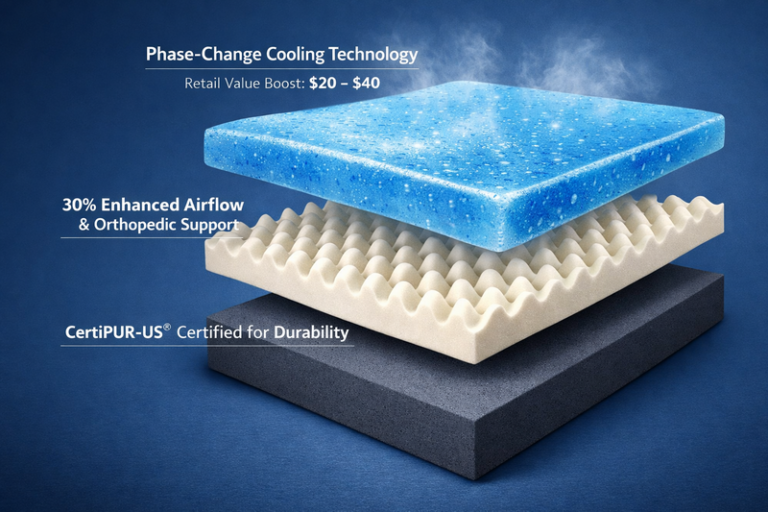
| Bottom support layer | 40D or 45D high-density foam | Load bearing, shape retention and orthopedic support. |
| Cover system | Removable washable fabric with zipper and optional liner | Easier cleaning, lower complaint rate and better retail value. |
This route lets the bed feel comfortable while still keeping the dog away from the floor. It also gives the buyer a clearer reason to pay for a higher product grade.
Solid foam vs shredded foam
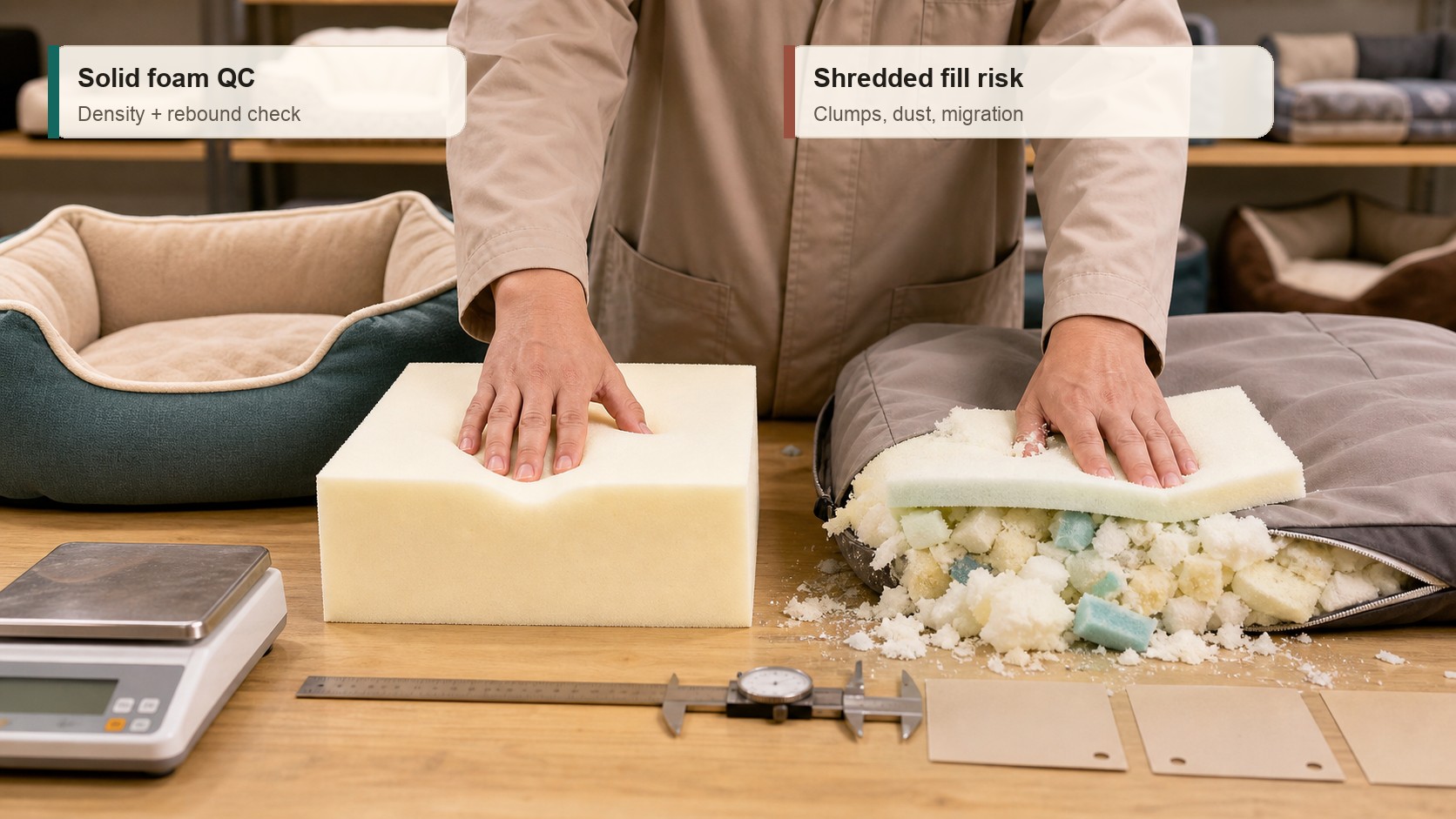
Solid foam and shredded foam solve different problems. Treat them as two product routes, not as interchangeable fillings.
| Filling route | Best-fit customer | Main advantage | Main risk |
|---|---|---|---|
| Solid one-piece foam | Premium orthopedic brands, pet stores, large-dog beds, senior-dog products | Uniform support, cleaner QC, lower return risk | Higher material cost, larger shipping volume, less flexible for irregular shapes. |
| Layered solid foam | Mid-high and high-end OEM lines | Balances comfort and support; easier to justify premium pricing | Requires clearer spec control and sample approval. |
| Shredded foam or shredded memory foam | Budget beds, round nests, irregular shapes, small dogs under 8 kg, low-price volume programs | Lower cost, high compression ratio, easy fill for curved shapes | Clumping, migration, dust, odor, low support and shorter life. |
| Hybrid route | Cost-sensitive buyers who still need support | Solid support base with a thin comfort layer | Must prevent buyers from confusing comfort fill with orthopedic support. |
Shredded foam can be useful for low-price channels, round nests, soft cat beds and adjustable-fill products. It can also reduce shipping volume because the fill compresses well. But it is difficult to defend as a true orthopedic support material for large, senior or joint-sensitive dogs.
The five common after-sales risks are:
- Clumping and collapse in the sleeping zone.
- Fill migration to the corners, leaving the center thin.
- Foam dust from cut edges or recycled low-grade fill.
- Shorter useful life, often showing complaints after several months.
- Moisture retention, odor and mildew risk after urine, saliva or humid storage.
If a customer insists on shredded foam, LISO recommends internal compartments or baffles to reduce fill movement. The product should be positioned honestly as a soft or budget pet bed unless support testing proves otherwise.
Compression packing: approve it only after testing
Vacuum packing can reduce ocean freight volume, but it can also destroy the buyer's profit if the foam does not recover. The key question is not "Can this bed be compressed?" The right question is "Has this exact foam, thickness, layer structure and packing time passed recovery testing?"
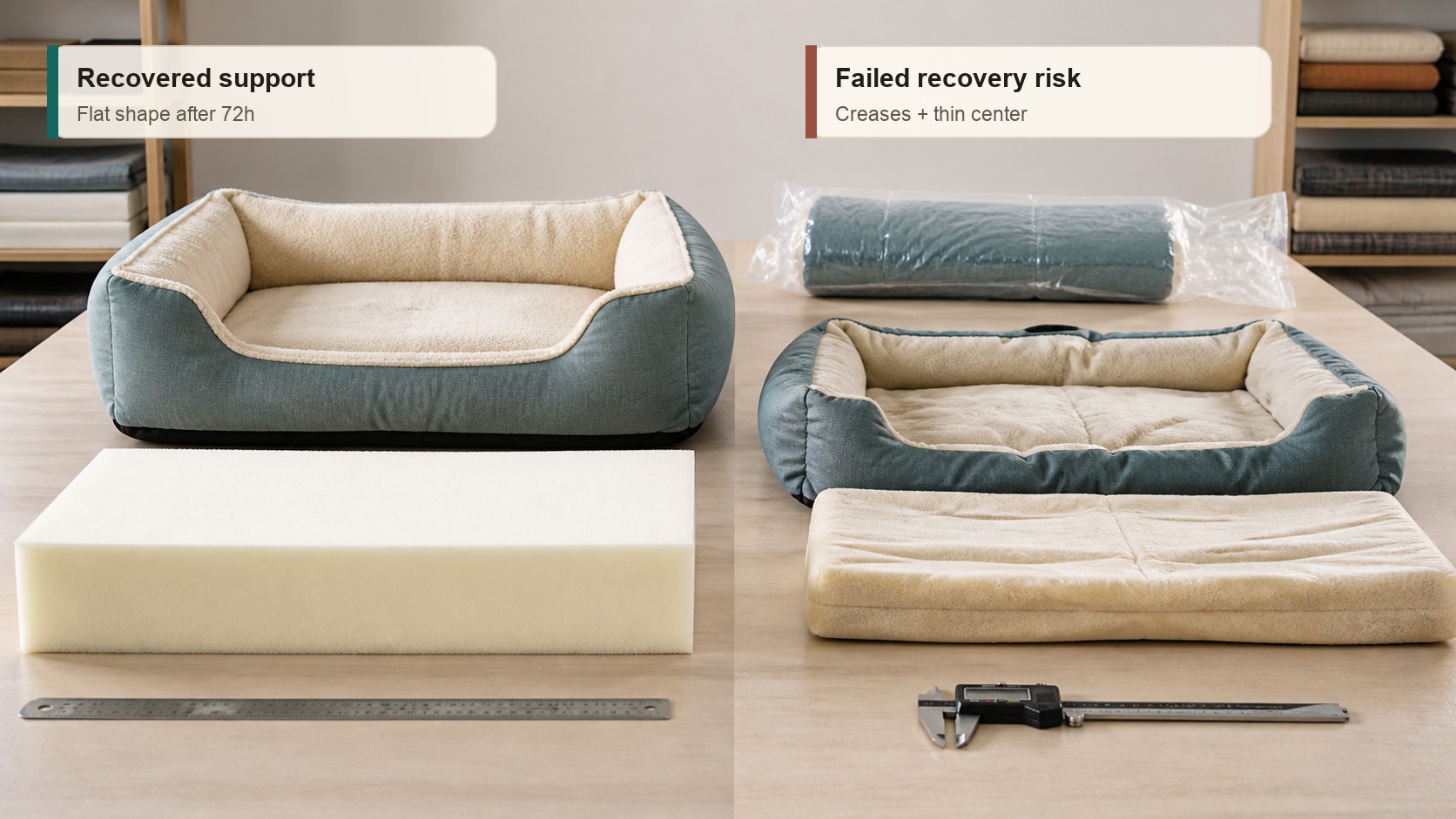
In LISO's production practice, the safer compression routes are:
- 30D/40D/45D high-resilience open-cell foam that has passed sample recovery.
- Shredded foam products where orthopedic support is not the claim.
- Thin 25D pads for small low-price items, only for short compression windows.
Higher-risk routes include:
- Slow-recovery memory foam that has not passed a vacuum recovery test.
- Low-density recycled or filler-heavy foam.
- Hard composite foam that may crease, split or delaminate.
- Any foam where the supplier cannot give a recovery rule by time and environment.
Memory foam deserves special care. Some mattress and bedding products are compressed successfully, but that does not mean every pet-bed memory foam formula, thickness or shipping window is safe. For OEM sourcing, approve compression by sample test, not by material name.
72-hour compression recovery standard
For export orthopedic dog beds, LISO recommends writing a 72-hour recovery instruction into the product spec and packaging insert.
At room temperature around 20-25 C, our practical recovery checkpoint is:
| Time after unpacking | Expected condition for HR solid foam |
|---|---|
| 24 hours | Shape mostly opened; creases can remain; about 85% thickness recovery can be acceptable during early check. |
| 48 hours | Creases reduce; around 95% thickness recovery; product can usually be evaluated for normal use. |
| 72 hours | Thickness, shape and support should reach the approved sample standard. |
Cold warehouses and winter delivery can extend recovery time by about 50%. Long vacuum storage, especially over about 45 days, should be treated as higher risk and may need another 24 hours of recovery time. If the buyer's product page does not mention recovery time, end customers may open the package, see creases immediately and leave avoidable negative reviews.
Why recovery fails
Most recovery failures start before packing.
| Failure source | What happens | Buyer risk |
|---|---|---|
| Density mislabeling | A quoted 40D foam behaves closer to low-density foam. | Product flattens in months; reviews attack support claim. |
| Filler-heavy formulation | Foam cell walls become weak and break under pressure. | Permanent compression set and poor rebound. |
| Recycled or mixed foam | Hidden glue layers or mixed scraps deform after vacuum pressure. | Uneven surface, odor and shape complaint. |
| Over-compression | Vacuum pressure pushes foam below a safe thickness. | Creases and collapsed zones remain after unpacking. |
| Long hot container storage | Heat plus pressure damages recovery. | Large shipment can arrive with systemic defect risk. |
The PFA industry standards page lists ASTM D3574 as a key standard covering density, IFD, compression force deflection, compression sets, airflow, resilience, fatigue and recovery tests for flexible polyurethane foam. Buyers do not need to become lab engineers, but they should ask suppliers which test method or internal QC rule is used for density and recovery.
LISO incoming foam and finished-goods QC checklist
Use this checklist before approving bulk production:
| QC stage | Checkpoint | Acceptance logic |
|---|---|---|
| Incoming foam | Density check by sample weight and volume | Confirm the purchased 30D/40D/45D route is real, not just written in a quotation. |
| Incoming foam | Hand rebound and recovery check | Press for 3 seconds; fast recovery and no visible dent should be the baseline screen. |
| Lab or factory simulation | 72-hour compression recovery | Use thickness, crease and support comparison against the approved sample. |
| Visual inspection | Holes, cracks, yellowing, glue marks, odor | Reject foam that already shows instability before assembly. |
| Finished bed | Fill flatness and support surface | Solid foam should not have local hollows; shredded foam should use compartments where possible. |
| Finished bed | Size tolerance | Keep length, width and thickness within the agreed tolerance. For orthopedic beds, thickness shrinkage is not acceptable. |
| Cover system | Zipper, seams, removable cover, anti-slip bottom | These details decide washing experience and return risk. |
| Packing | Vacuum pressure and instruction label | Avoid over-compression and tell end users to allow 72 hours for full recovery. |
For higher-end programs, LISO can add density and compression-recovery notes to the QC file and carton/insert wording. For cost-sensitive programs, the supplier and buyer should still be honest about the product grade.
RFQ questions buyers should ask
Copy these questions into your supplier RFQ:
- Is the foam solid, layered solid, shredded or hybrid?
- What is the real density grade: 25D, 30D, 40D or 45D?
- Is the quoted density measured by sample weight and volume?
- What is the support layer thickness?
- Is the comfort layer different from the support layer?
- Has this exact foam passed a 72-hour recovery test after vacuum packing?
- How long can the product stay vacuum packed before recovery risk increases?
- Can the package include a 72-hour recovery instruction?
- What is the cover fabric, zipper route, liner and anti-slip base?
- What is the size tolerance for length, width and thickness?
- Is the product positioned as orthopedic support or only as a soft pet resting bed?
- What MOQ applies to the selected foam grade?
For LISO HOME, current MOQ guidance is:
| Foam route | MOQ guide |
|---|---|
| High-density orthopedic foam route | 500 pcs |
| 25D low-end foam route | 200 pcs |
Customization can include logo, size, color, fabric and package. Sampling usually takes about 10 days. Bulk production is usually about 20-30 days after the approved sample and confirmed materials.
What we tell buyers directly
Our position is simple: high-quality products need cost support. A dog bed cannot be both the cheapest route and a premium orthopedic product at the same time.
If a buyer wants a low-price volume product, we can help choose a cost-controlled structure and label it honestly. If the buyer wants a high-end orthopedic bed for senior dogs, large dogs or premium retail, we recommend real support foam, clear density control, compression recovery testing and transparent QC documentation.
That transparency saves decision time before purchase and reduces complaints after delivery.
To build an OEM orthopedic dog bed program, start from the custom dog bed manufacturer page or contact LISO HOME with your target market, dog size range, foam route, cover fabric and packaging plan.
For related decisions, also read:
- High-end vs cheap orthopedic dog beds: what wholesale buyers should check
- Best orthopedic dog bed filling for OEM dog beds
- Dog bed materials wholesale sourcing guide
- Pet travel and comfort product range