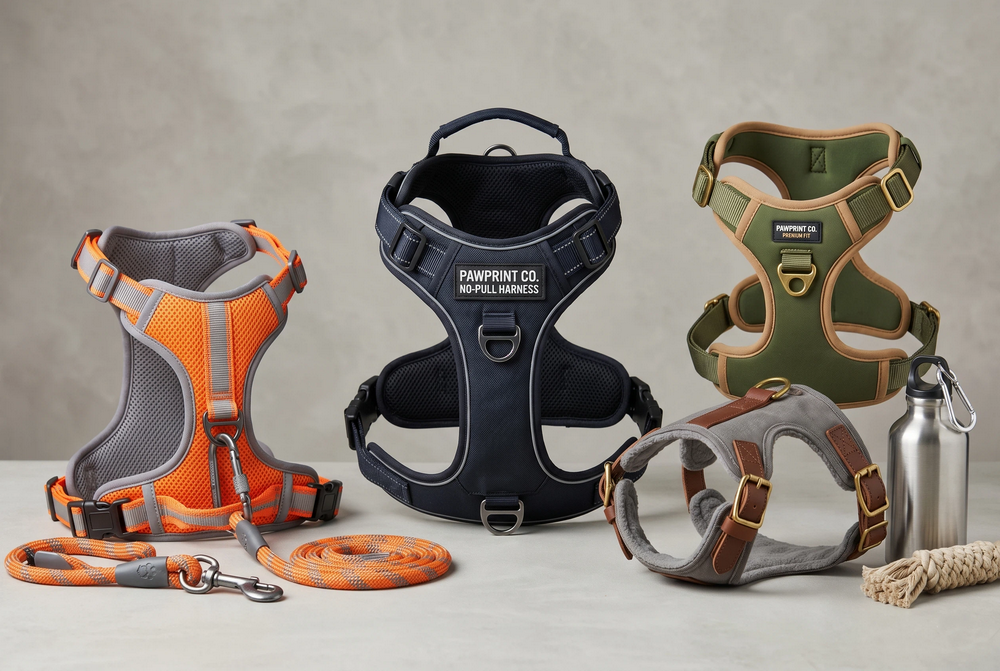
Many people choose a dog harness or collar by color, style, or price. I used to do that too. Then I learned that safety matters more.
The most important safety features in a dog harness or collar are proper fit, strong materials, secure buckles, reflective details, pressure-reducing design, soft padding, escape-proof structure, control handles, ID features, and reliable manufacturing quality. These features help prevent injury, slipping out, and getting lost during daily walks.
A good harness or collar should make every walk calmer. It should protect my dog, not just decorate my dog. When I choose one, I now ask one simple question. Can this product keep my dog safe when something unexpected happens?
Why Is Proper Fit the First Safety Feature?
A loose harness can let my dog slip out. A tight collar can hurt the neck. I cannot call any product safe if it does not fit well.
A dog harness or collar should fit close to the body without pressing into the skin. A simple rule is that I should be able to place two fingers between the product and my dog’s body. This gives both control and comfort.
How I Check Fit Before Every Walk
Fit sounds simple, but it is the part I see many owners miss. Dogs do not stay the same size forever. Puppies grow fast. Adult dogs may gain or lose weight. Some dogs also have thick winter coats and thinner summer coats. So I do not treat sizing as a one-time job.
I measure the neck, chest, and sometimes body length before buying. I also compare those numbers with the brand’s size chart. I do not guess by breed only, because two dogs of the same breed can have very different body shapes.
| Fit Point | What I Check | Why It Matters |
|---|---|---|
| Neck area | Two-finger space | Prevents choking and rubbing |
| Chest area | Snug but not tight | Keeps the harness stable |
| Shoulder area | Free movement | Allows natural walking |
| Belly strap | Not too far back | Reduces slipping and twisting |
I also watch my dog after putting it on. If my dog freezes, scratches, coughs, or walks strangely, I take that as useful feedback. A safe product should not fight the dog’s body.
Why Do Durable Materials Make a Harness or Collar Safer?
A weak product can fail at the worst moment. I may not notice the problem until my dog suddenly pulls, jumps, or runs.
Durable materials such as strong nylon, polyester webbing, quality leather, and reinforced fabric help a harness or collar resist pulling, rubbing, and daily wear. Strong material lowers the risk of tearing or breaking during walks.
What I Look For in the Material
Material is not only about how thick the strap feels. I look at the whole structure. I check the stitching, the edge finish, the webbing density, and the stress points. A strap may look strong, but loose stitching can make it unsafe.
I also think about my dog’s habits. A calm small dog may not need the same hardware as a strong dog that lunges when excited. A dog that hikes, swims, or rolls in dirt needs material that can handle moisture and washing. A city dog may need something lighter and more flexible.
| Material Feature | Good Sign | Warning Sign |
|---|---|---|
| Webbing | Thick and tightly woven | Thin, stretchy, or fraying |
| Stitching | Dense and reinforced | Loose threads |
| Edges | Smooth and sealed | Sharp or rough |
| Stress points | Extra stitching or layers | Single weak seam |
I also avoid products that feel flimsy around the leash attachment area. That is the place where force gathers. If that part fails, the whole product fails.
Why Are Secure Buckles and D-Rings So Important?
A collar or harness may look strong, but the buckle is often the real safety test. One weak connection can undo everything.
Secure buckles and strong D-rings keep the harness or collar closed and connected to the leash. They should open smoothly by hand, but they should not pop open when the dog pulls, twists, or backs away.
How I Test the Connection Points
I see the buckle, D-ring, and stitching as one safety system. The leash pulls on the D-ring. The D-ring pulls on the fabric. The fabric pulls on the buckle and straps. So every part must work together.
For larger or stronger dogs, I prefer heavier buckles, metal hardware, or double-locking designs. Plastic buckles can still work, but they need to feel solid and close with a clear click. I do not trust a buckle that feels soft, loose, or uneven.
| Connection Part | What I Want | Why I Care |
|---|---|---|
| Buckle | Firm click and secure lock | Prevents sudden opening |
| D-ring | Thick metal or reinforced ring | Holds leash pressure |
| Stitching near ring | Box stitch or reinforced stitch | Stops tearing |
| Adjustment slider | Holds position | Prevents loosening during walks |
Before I go outside, I give the product a small pull test. I check that the buckle is fully closed and the ring is not bent. It takes only a few seconds, but it can prevent a serious escape.
Why Do Reflective Details Matter During Walks?
Low light can make even a nearby dog hard to see. I do not want my dog to depend only on my awareness.
Reflective strips, reflective stitching, and bright edges help cars, cyclists, and people see my dog in early morning, evening, or night conditions. This is especially useful for dark-colored dogs and busy streets.
When Visibility Becomes a Safety Feature
Reflective design is easy to ignore in a store. It may look like a small detail. But outside, it can be the difference between being noticed and being missed. I care about this most when I walk near roads, parking lots, apartment entrances, and bike lanes.
The best reflective parts are placed where light can hit them from different angles. A single tiny logo is not enough for me. I prefer longer reflective strips on the chest, sides, neck, or back. I also like reflective stitching because it adds visibility without adding weight.
| Walking Situation | Visibility Risk | Helpful Feature |
|---|---|---|
| Early morning | Dim natural light | Reflective chest strip |
| Evening walk | Car headlights | Reflective side panels |
| Parking lot | Moving cars | Bright color plus reflection |
| Dark-coated dog | Blends into shadows | Wider reflective areas |
I still use awareness, leash control, and sometimes a light. But reflective material gives me one more layer of protection.
How Can a Harness Reduce Neck and Spine Pressure?
Some dogs pull before they learn. Some dogs jump when surprised. If all that force goes to the neck, I get worried.
A well-designed harness spreads leash pressure across the chest and shoulders instead of concentrating it on the throat. This can reduce pressure on the trachea, neck, and spine, especially for small dogs, flat-faced dogs, senior dogs, and sensitive dogs.
Why Pressure Direction Matters
A collar can be useful for ID tags and calm walking. But when a dog pulls hard, the neck takes much of the force. I think about that more with toy breeds, short-nosed breeds, older dogs, and dogs with past neck discomfort.
A harness should not press directly into the throat. It should sit in a way that supports the chest and shoulders. It should also let the shoulder blades move. A poor harness can rub the armpits or restrict movement, so “harness” does not always mean “safe.” The shape matters.
| Dog Type | Common Concern | Safer Design Choice |
|---|---|---|
| Small dog | Delicate neck | Soft, lightweight harness |
| Flat-faced dog | Breathing pressure | No-pull chest design |
| Senior dog | Joint sensitivity | Padded support harness |
| Strong puller | Sudden force | Front-clip or dual-clip harness |
I also match the tool with training. A harness can reduce pressure, but it should not replace leash manners. I want both equipment safety and better walking habits.
Why Does Padding Improve Safety and Comfort?
A product that rubs will make my dog dislike walks. It may also cause red skin, hair loss, or sore spots.
Soft padding helps reduce friction and pressure on sensitive areas such as the chest, shoulders, armpits, and neck. Padding is especially important for short-haired dogs, active dogs, and dogs with sensitive skin.
Where Padding Should Be Placed
Padding is not only a comfort feature. It can be a safety feature because discomfort changes behavior. A dog that feels rubbing may twist, pull back, or try to escape. A dog that feels pressure under the armpits may stop moving or walk unevenly.
I look for padding in areas that carry force. The chest plate should feel soft but stable. The neck area should not be rough. The straps near the armpits should not cut into the skin. I also check that the padding dries well and does not trap dirt.
| Padding Area | Main Benefit | What I Avoid |
|---|---|---|
| Chest | Spreads pulling force | Hard narrow straps |
| Shoulder | Supports movement | Bulky stiff panels |
| Armpit area | Reduces rubbing | Edges that dig in |
| Neck inside | Prevents irritation | Rough seams |
I also touch the inside surface before buying. If it feels scratchy to my hand, I do not expect it to feel good on my dog’s skin.
When Is an Escape-Proof Design Necessary?
Some dogs can back out of ordinary gear in seconds. I learned that body shape and fear can change the whole safety need.
Escape-proof harnesses are important for dogs with narrow bodies, small heads, deep chests, or fearful behavior. These designs often use more coverage, more adjustment points, and extra belly or waist straps to reduce slipping out.
Which Dogs Need Extra Anti-Escape Features?
Not every dog needs a heavy escape-proof harness. But some dogs do. Sighthounds such as Greyhounds and Whippets often have body shapes that make regular collars and harnesses less secure. Some Shiba Inus, Huskies, and anxious rescue dogs are also skilled at backing out.
Fear changes everything. A calm dog may walk well in normal gear. The same dog may panic during fireworks, traffic noise, or an encounter with another dog. When a dog pulls backward, many harnesses become easier to slip out of.
| Risk Factor | Why It Matters | Feature I Prefer |
|---|---|---|
| Narrow head | Collar can slide off | Martingale-style collar for ID use |
| Deep chest | Harness may shift | Multi-point adjustment |
| Fearful behavior | Dog may back out | Escape-proof structure |
| Past escape | Higher repeat risk | Extra waist strap |
For a dog with escape history, I treat anti-escape design as essential. I do not see it as a bonus feature.
How Does a Handle Add Emergency Control?
A leash gives distance control. A handle gives close control. That difference matters in crowded or sudden situations.
A back handle on a dog harness lets me quickly hold my dog close during road crossings, elevator rides, car loading, crowded paths, or unexpected encounters. It is especially useful for large dogs, strong dogs, and dogs still in training.
When I Use a Harness Handle
A handle is not something I use every minute. It is something I want when the situation changes fast. When I cross a street, I can shorten my control without wrapping the leash around my hand. When another dog appears suddenly, I can guide my dog beside me. When my dog gets into a car, I can offer support.
For older dogs, a handle can also help with balance. I would not lift a dog by the handle unless the harness is designed for that purpose. But I can use it to steady the dog or guide movement.
| Situation | How the Handle Helps | Safety Benefit |
|---|---|---|
| Crossing road | Keeps dog close | Less sudden movement |
| Meeting dogs | Adds direct control | Reduces lunging |
| Getting in car | Guides body position | Prevents slipping |
| Training | Helps close handling | Improves focus |
For strong dogs, I like a wide, padded handle. A thin handle can hurt my hand and may be hard to grip.
Why Should a Collar or Harness Include ID Features?
Even careful owners can face accidents. A gate can open. A leash can drop. A scared dog can run.
ID tags, name patches, phone number labels, or embroidered contact information help people contact me quickly if my dog gets lost. Visible ID is useful even when the dog has a microchip, because most people cannot scan a chip immediately.
Why Visible Identification Still Matters
I see ID as part of safety, not decoration. A microchip is valuable, but it usually needs a vet clinic, shelter, or scanner. A phone number on a tag can work right away. That speed matters when a stranger finds a dog near a road or in a neighborhood.
I prefer ID that is easy to read and securely attached. Hanging tags are common, but they can fall off if the ring is weak. Flat tags, embroidered collars, and Velcro name patches can also work. The best option depends on the dog and the gear.
| ID Type | Main Strength | Possible Weakness |
|---|---|---|
| Hanging tag | Easy to read | Can make noise or fall off |
| Embroidery | Cannot detach easily | Less flexible if number changes |
| Name patch | Clear and visible | Needs strong attachment |
| Slide-on tag | Quiet and secure | Must fit strap width |
I keep the information simple. A phone number matters more than a cute message.
Why Do Different Dogs Need Different Safety Features?
There is no perfect harness or collar for every dog. A safe choice must match the dog in front of me.
Small dogs, large dogs, flat-faced dogs, senior dogs, strong pullers, and fearful dogs need different harness or collar features. The safest choice depends on body shape, strength, age, health, behavior, and walking environment.
How I Match the Product to the Dog
I do not choose gear by appearance first anymore. I begin with my dog’s real life. Where do we walk? Does my dog pull? Does my dog scare easily? Does my dog have a sensitive neck? Does my dog need extra support?
A small dog may need a light harness that does not press on the throat. A large dog may need stronger buckles and wider straps. A flat-faced dog may need a harness that keeps pressure away from the neck. A senior dog may need soft padding and easy step-in or over-head design.
| Dog Need | Safer Feature | Reason |
|---|---|---|
| Strong pulling | Front-clip harness | Helps redirect movement |
| Fearful behavior | Escape-proof harness | Reduces slipping risk |
| Sensitive neck | Chest-led design | Lowers throat pressure |
| Large size | Heavy-duty hardware | Handles stronger force |
| Senior age | Padded support | Adds comfort and stability |
I also think about the owner’s handling. A product should be easy to put on correctly. If it is too confusing, mistakes become more likely.
Why Does Manufacturing Quality Build Trust?
A safe design still needs good production. Poor stitching or weak parts can turn a smart design into a risky product.
Reliable manufacturing quality means the stitching, buckles, webbing, metal rings, and stress points are tested and finished well. Clear size guides, material details, weight guidance, and support information also show that a brand takes safety seriously.
What Details Make Me Trust a Product More
I look for small signs that show care. Clear sizing instructions help me choose correctly. Material descriptions help me understand strength and comfort. Photos of the inside and stress points help me inspect the design. Weight or strength guidance helps me avoid underbuilt products.
I also read reviews with care. I do not only look at star ratings. I look for comments about broken buckles, loose stitching, rubbing, slipping, and sizing problems. Repeated complaints tell me more than one perfect product photo.
| Quality Signal | Why It Helps |
|---|---|
| Clear size chart | Reduces wrong fit |
| Reinforced stress points | Improves pulling safety |
| Strong return policy | Helps if fit is wrong |
| Detailed product photos | Shows construction |
| Consistent reviews | Reveals real use problems |
A trustworthy product does not need to be the most expensive one. But it should show that safety was part of the design, not an afterthought.
Conclusion
I choose dog harnesses and collars for safety first. A good product fits well, holds strong, reduces pressure, prevents escape, and protects my dog every day.