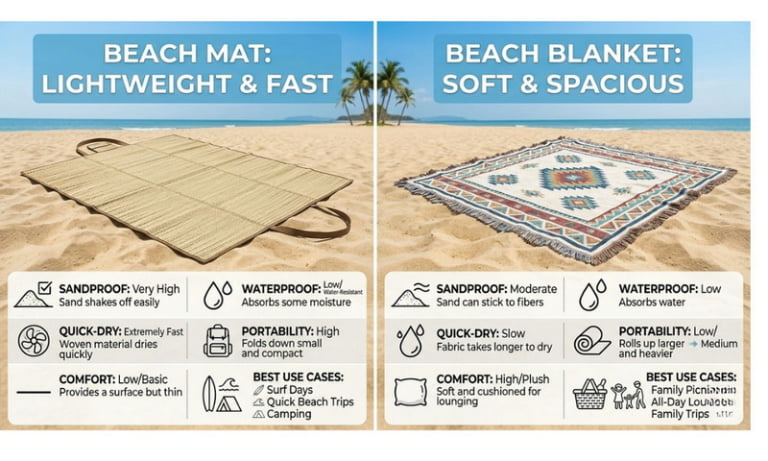
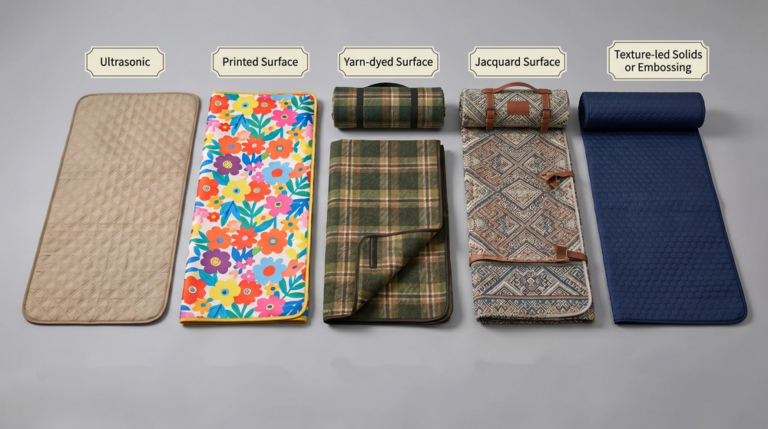
Cheap outdoor blankets often look fine in photos. The problem appears after packing, washing, sun, damp use, and real customer handling.
Most cheap outdoor blankets fail because buyers compare only unit price. They miss filling quality, quilting spacing, seam strength, fabric coating, print quality, compression recovery, snap quality, stuff sack strength and final inspection.
I understand why buyers ask for a lower price. But in outdoor textile products, the cheapest route can become expensive later. Complaints, returns, weak reviews, and lost reorder trust cost more than the small saving.
Why do some outdoor blankets fail after one season?
The most common failures I see in low-quality puffer blankets are weak stitching, poor recovery, and filling shift. These problems are not always visible in a photo.
A blanket can look clean when it is new. But after real use, the weak points appear. The stitching may open. The filling may move. The print may shift. The stuff sack may break. The snap may feel loose. The product may not recover after being compressed.
| Failure | What the buyer sees later |
|---|---|
| Weak stitching | Loose seams, open edges, ugly finishing |
| Filling shift | Cold spots, uneven handfeel, poor appearance |
| Poor recovery | Blanket stays flat after compression |
| Bad print control | Pattern shift, color difference, low retail value |
| Weak stuff sack | Broken drawstring or torn mouth |
| Poor snap quality | Hard to use or easy to detach |
How does filling quality affect warmth and recovery?
Filling quality decides whether the blanket feels full after use. A blanket can look thick at first, but if the filling is poor or recycled in a bad way, recovery may be weak.
Original down-like polyester fiberfill can have strong recovery. Lower-grade filling may feel flat after compression. Buyers can test this before bulk production. One simple method is to ask the supplier to compress the sample for shipping, then check how well it recovers after opening. It is not a perfect lab test, but it reveals a lot.
The buyer should also compare the quotation with the filling claim. If the price is much lower than the claimed material route, something may not match.
Why do stitching and quilting shape matter?
Quilting is not decoration only. It holds the filling in place.
If the quilting distance is too wide, the filling can move. If the quilting thread is weak, the structure can fail after use. If the edges are not bound well, the blanket can look cheap even when the fabric is acceptable.
I also care about the type of filling layer. If the factory does not use a stable full layer or the quilting is poorly controlled, the filling can become uneven. This creates cold spots and a poor handfeel.
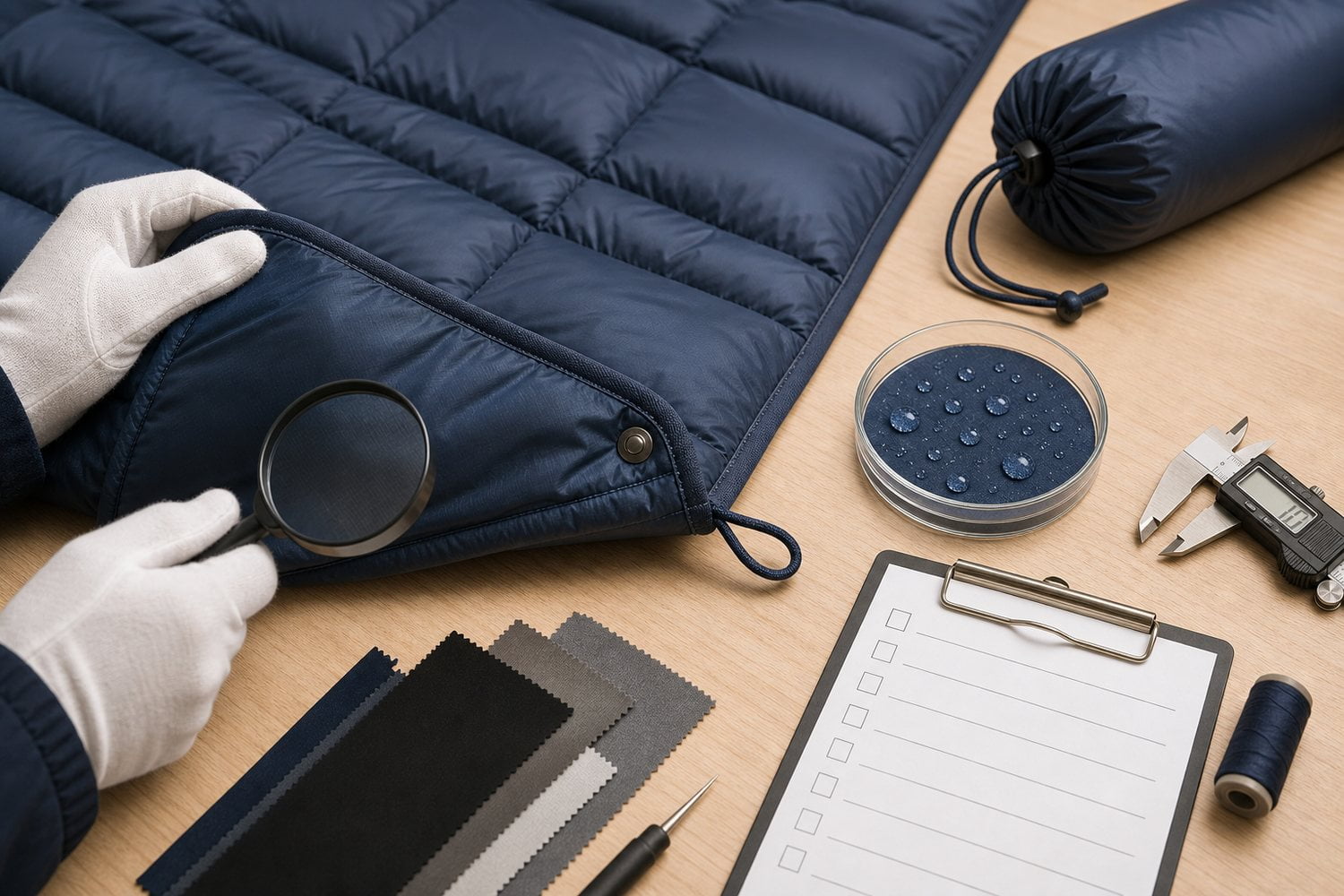
A buyer should not only approve the front view. The buyer should inspect the corner, binding, snap area, drawstring, quilting line, and the reverse side.
What should buyers check in fabric, snaps, stuff sack and packaging?
Outdoor blankets face damp air, grass, patio use, travel, car storage, and repeated packing. Fabric and coating matter.
Some low-cost fabrics have no real water-repellent treatment or coating. Some are only pressed or finished in a way that looks smooth at first. After use, the product may fade, absorb moisture, or lose surface performance.
Before bulk shipment, I would suggest:
- Check fabric handfeel and coating consistency.
- Check water beading when water resistance is claimed.
- Check quilting spacing and line strength.
- Pull the snap area lightly and check reinforcement.
- Open and close the stuff sack several times.
- Check print alignment and color consistency.
- Review packed size and carton packing.
- Use third-party inspection for larger orders.
How does LISO reduce bulk-production risk?
One UK customer told me at Canton Fair that his previous supplier in Hebei had serious quality problems. The blanket stitching was poorly finished. The print quality was weak. The pattern shifted. The packaging was wrong. Even the logo patch did not meet expectation.
We solved the project by rebuilding the details. For one hook-and-loop logo patch, I checked around ten suppliers before finding the result the customer accepted. That is the difference between only making a blanket and managing the sourcing risk.
LISO's value is not only sewing. It is checking how the fabric, filling, quilting, logo, packaging, and quality control work together.
This article should connect with the Outdoor Blankets product page and the Outdoor Patio Living solution because blanket quality problems often connect with the wider outdoor textile standard.
Related product pages for this sourcing decision
- Outdoor Blankets product page
- Outdoor Patio product hub
- Outdoor Patio Living solution
- Custom outdoor cushions
- Outdoor chair pads
- Sand-free waterproof beach mat
Related puffer blanket sourcing guides:
- Puffer Blanket vs Picnic Blanket: What Should Importers Source?
- What Makes a Packable Outdoor Blanket Retail-Ready?
Conclusion
A cheap outdoor blanket can become expensive after complaints. Buyers should inspect structure, filling, stitching and packing before bulk.
My Role
I help buyers review weak points before sampling or bulk shipment. Send your current blanket specification, target price, and use scene. I can flag the risky details.