A foldable bag can look simple in a photo but become expensive, bulky, or unreliable when the open bag, folded pouch, print, and load path are specified separately.
This guide explains how to specify foldable reusable shopping bags as one connected product system rather than a loose list of fabric and logo choices.
Buyers should specify foldable reusable shopping bags as two connected products: an open carrying bag and a folded storage system. The brief should align use case, open and folded dimensions, material, printing, handle attachment, test method, packing labor, and retail presentation before sampling begins.
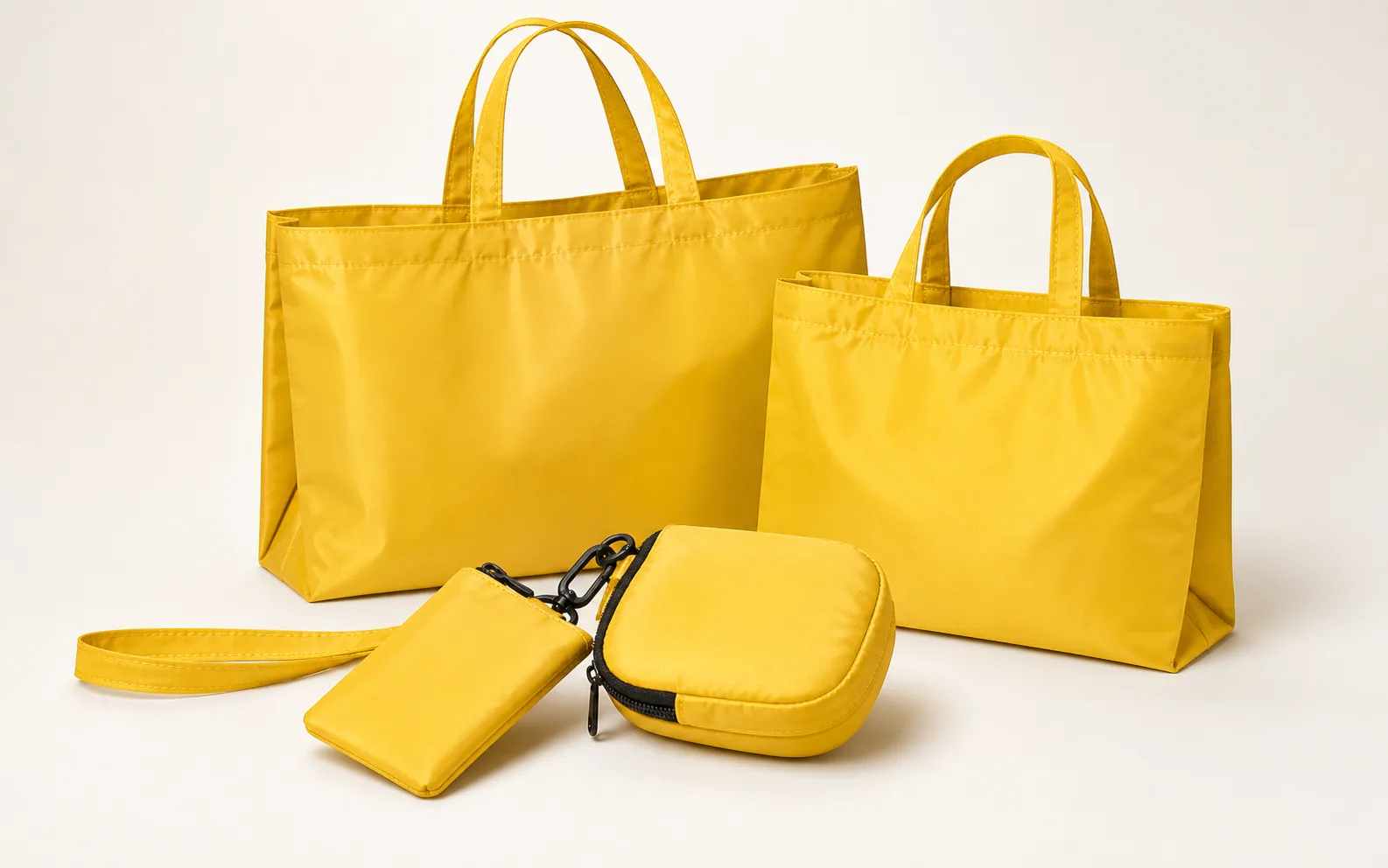
The smallest pouch is not automatically the best result. A successful program makes the bag easy to carry, easy to refold, useful at checkout, and repeatable in production at the buyer’s target cost.
What Should Buyers Define Before Choosing a Fabric?
Material discussions often start too early. A supplier cannot select the right construction from a request such as “lightweight, strong, low cost, and very small when folded.”
Buyers should define the shopping scenario, intended contents, carry method, open size, folded-size target, print coverage, price position, destination market, and retail packing first. These decisions reveal which trade-offs matter and prevent the fabric name from becoming a substitute for the complete product specification.
The same foldable bag is not ideal for every retail program. A supermarket bag may carry bottles, packaged food, or irregular groceries. A promotional bag may prioritize low packed volume and a large logo. A travel add-on may need a clip and a clean pouch. A resale item may require a barcode, instruction card, and consistent folded presentation.
Write these inputs into the brief before comparing nylon, polyester taffeta, or Oxford directions:
| Buyer input | Why it changes the bag |
|---|---|
| Intended contents | Changes the base, handle, seam, and load-test plan |
| Open dimensions | Controls usable volume and print area |
| Folded-size target | Changes fabric bulk, folding sequence, and pouch size |
| Branding route | Changes material compatibility, artwork, curing, and abrasion review |
| Retail channel | Changes labels, barcode, hangtag, individual packing, and presentation |
| Budget and order plan | Changes the practical balance among fabric, print, sewing, and packing labor |
Which Folding System Fits the Retail Program?
The folding system affects more than convenience. It changes the component count, seam positions, logo visibility, packing steps, and the risk that users lose a separate pouch.
Choose the folding route according to how the end user will store and refold the bag. Built-in pockets keep the storage component attached. Separate or zipper pouches can create a cleaner retail presentation but add components, sewing operations, packing controls, and another branding surface.
LISO has developed separate storage-pouch formats, including a set that holds two foldable shopping bags inside one compact pouch. Other programs may use a built-in pocket, snap, elastic, roll-up strap, or clip. None of these is automatically better.
| Folding route | Useful when | Main approval question |
|---|---|---|
| Built-in pocket | Daily refolding and loss prevention matter | Can users reverse and refold it easily? |
| Separate pouch | Gift or retail presentation matters | How is the pouch retained and counted? |
| Zipper pouch | The folded set needs protection and organization | Does the zipper add too much bulk or labor? |
| Snap or elastic | Simple promotional packing matters | Does repeated use change retention or placement? |
| Clip or strap | The pouch attaches to a handbag, cart, or travel kit | Is the attachment point secure in real use? |
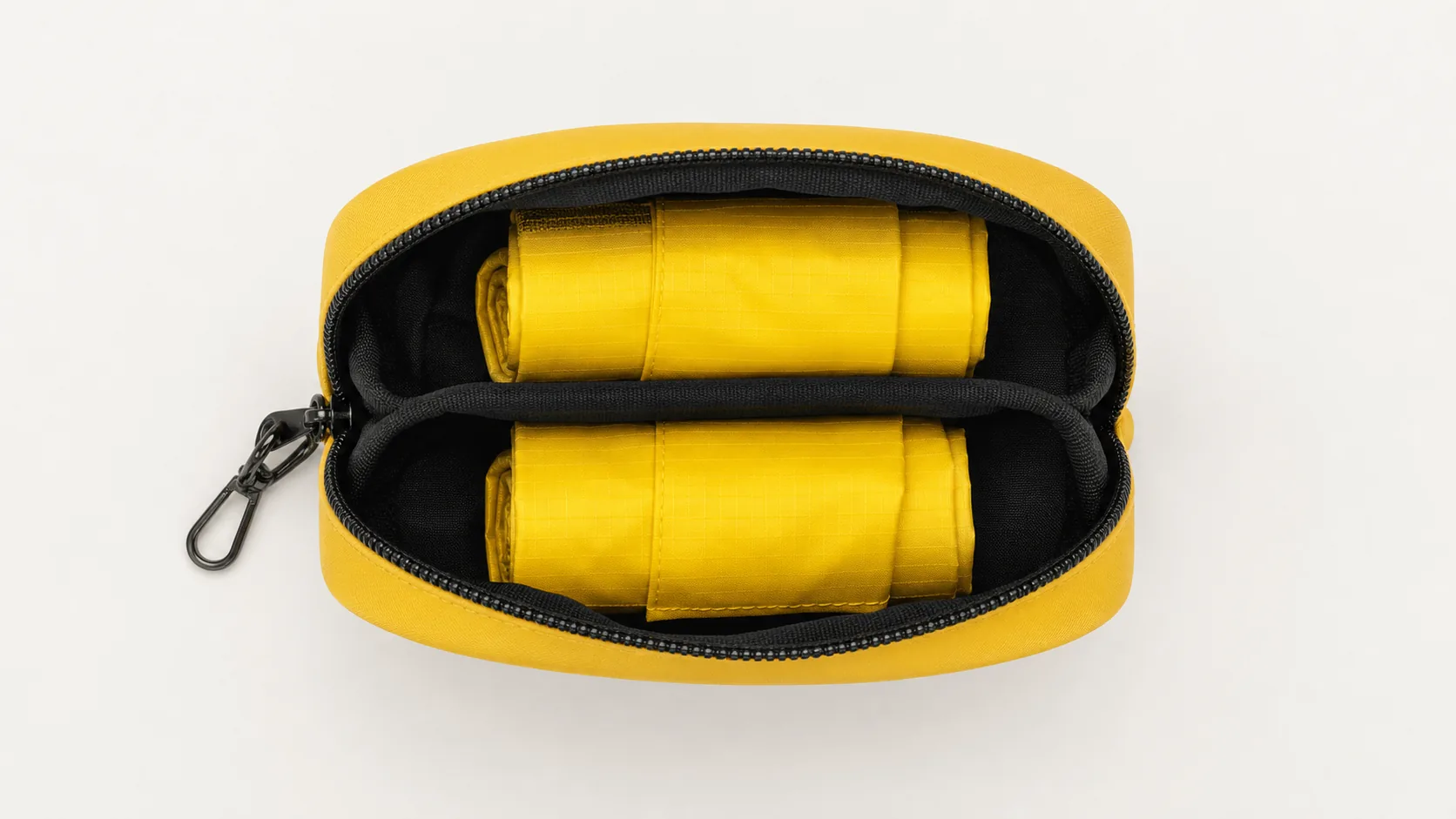
The sample review should include the complete fold and unfold sequence. A structure that looks neat when packed by trained workers may be frustrating for the end user.
How Should Buyers Compare Nylon, 210T Polyester Taffeta, and Oxford Directions?
Buyers often ask which material is “best,” but the answer changes with fold size, print, cost, handle design, and the evidence required for the finished bag.
There is no universally best material for foldable reusable shopping bags. Lightweight nylon can support a compact folded direction, while 210T polyester taffeta may fit a different print and cost plan. Oxford constructions may provide more body but can create a larger folded package. Actual samples must decide.
20D and 210T are different specification labels. D refers to yarn linear density; ISO 2060 covers a method for determining yarn linear density. T is commonly used in supplier fabric descriptions as a thread-count/construction shorthand, while ISO 7211-2:2024 addresses threads per unit length in woven fabric. Buyers should therefore record the supplier’s exact warp/weft construction instead of comparing the two numbers as a strength ranking.
| Material direction | Potential advantage for a brief | Trade-off to verify |
|---|---|---|
| Lightweight nylon | Small folded volume and light carry direction | Material/printing cost, hand feel, seam and abrasion behavior |
| 210T polyester taffeta | Digital-print and cost direction used in the LISO case | Folded thickness, print approval, and finished-bag load path |
| Oxford construction | More body or structure when the program needs it | Larger folded volume, sewing bulk, and pouch size |
The decision should be made with the intended shopping contents inside the finished sample. Fiber name or fabric code alone cannot approve the handle, seams, print, or folded usability.
How Does Printing Change the Material and Cost Decision?
Artwork is part of the product architecture. The open bag, folded pouch, seam lines, fold lines, and handle anchors may compete for the same visual area.
Printing must be approved together with the actual fabric and folding route. In LISO’s experience, nylon programs may use screen printing or heat transfer, while the discussed 210T polyester taffeta direction used digital printing. That project-specific solution should not be treated as a universal cost ranking.
A screen-printed logo, heat-transfer graphic, or digital print responds differently to material surface, pretreatment, ink or transfer system, curing, artwork coverage, and repeated folding. Therefore, the brief should define the required appearance rather than ask only for “a durable logo.”
Check the artwork in both states:
- Approve the logo scale and position on the open bag.
- Approve the pouch logo or folded presentation separately.
- Confirm that seams, zipper curves, snaps, and handle anchors do not cross critical artwork.
- Repeat folding and handling on the approved sample, then inspect the actual abrasion and crease areas.
- Lock the material, print route, color standard, and packing orientation in the approved specification.
Repeated use can create print-wear risk, but no article can predict the result without the actual material, process, artwork, and sample review.
Why Can a Smaller Folded Size Increase Production Cost?
A compact pouch may look efficient, yet an extremely tight folded target can slow production and create inconsistent retail presentation.
A smaller folded package can require thinner material, more precise folding, tighter pouch tolerances, and more manual packing time. If workers must repeatedly compress, align, and refold the bag, output can fall and labor cost can rise even when the bag uses less fabric.
This is a production-capacity issue as well as a design issue. The buyer should define an acceptable folded-size range instead of one ideal photograph. During the pilot run, the team should record whether the bag enters the pouch without excessive force, whether the pouch closes consistently, and whether workers can maintain the agreed presentation.
The folded target can also conflict with carrying performance. A very light direction may reduce bulk, while a more structured bag may need a larger pouch. The answer is not to declare one material better. It is to decide which buyer pain point has priority.
For a practical approval, compare at least two sample directions using the same open size and intended contents. Review folded volume, refolding time, print appearance, handle behavior, individual packing, and carton count together. This exposes the real trade-off before the bulk order.
Where Should Buyers Review the Handle Load Path?
The handle is not an isolated component. The load moves from the hand through the handle attachment, main panel, side or base construction, and bottom seams.
Buyers should review the complete handle load path on the finished bag. The specification should define the intended contents, test weight, load distribution, static hold time, lift cycles, sample quantity, conditioning, and pass/fail observations for handles, anchors, panels, gussets, and base seams.
LISO identified the handle-to-bag attachment as the most likely stress point in this foldable-bag direction. The risk may be fabric distortion around the stitch line, seam opening, local tearing, handle stretch, or failure somewhere else in the connected base structure.
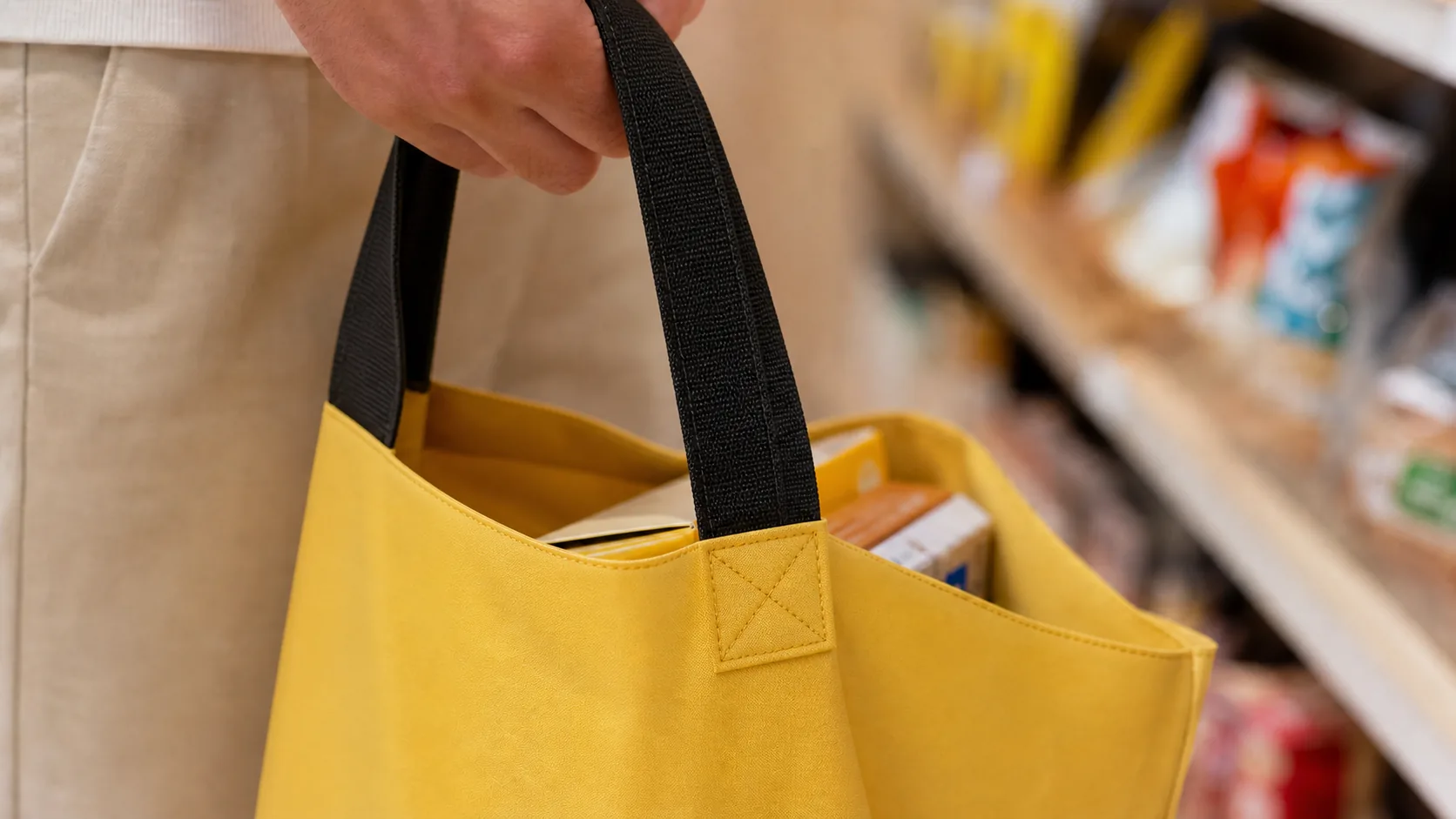
LISO reviews pre-production samples and performs QA/QC checks before shipment. The project record can include a defined weight, a static hold period, and a number of lifting cycles. Those variables belong to the approved buyer-supplier requirement; they are not universal pass numbers for every foldable bag.
For a deeper structural brief, use the related shopping bag handle, gusset, and load specification guide. The two documents should share the same intended-use facts.
What Did LISO Change for an Australian Two-Bag Pouch Program?
The first sample direction is not always the best commercial direction. A useful factory response connects the customer’s design idea to cost, production, and retail use.
For an Australian customer, LISO changed a two-bag pouch set from an initial lightweight nylon direction to 210T polyester taffeta with digital printing. The revised material/print route fit the target better, while a larger pouch solved the thicker folded result. The customer accepted it and placed regular monthly repeat orders.
The customer wanted an attractive, lower-cost set with two foldable shopping bags stored inside one small pouch. LISO first explored a nylon direction using screen printing or heat transfer. The compact fold was attractive, but the total material and print route exceeded the customer’s target.
The team then evaluated 210T polyester taffeta with digital printing. Under that customer’s artwork, volume, and price target, this combined material-and-print route fit the project better, but the folded bags were not as thin as the nylon direction. Instead of forcing the original pouch size, LISO recommended enlarging the storage pouch and rebalancing the presentation.
The customer’s name and order quantities remain confidential. The lesson is not that polyester taffeta is always cheaper or nylon is always better. The lesson is that the material, print route, pouch size, and customer budget must change as one connected system.
Buyers developing a similar two-bag pouch can send the open size, folded-size target, artwork, intended contents, quantity range, and retail packing through LISO’s custom shopping bags RFQ.
How Should Environmental Wording Be Controlled?
Reusable-bag programs often start with a sustainability goal, but broad environmental language can create a claim risk when it is not tied to the actual material and market.
Use specific, supportable wording. Reusable, recycled, recyclable, and eco-friendly do not mean the same thing. A buyer should document the actual material, recycled-content evidence where claimed, intended repeat-use program, care information, destination-market rule, and the exact wording used on tags and product pages.
Australia does not have one sentence that safely describes every bag rule in every state. For example, the NSW EPA plastics-ban FAQ describes restrictions on defined lightweight plastic bags. That rule should not be copied into a global product claim or presented as proof that any textile alternative is environmentally superior.
For US-facing marketing, the FTC Green Guides warn against broad, unqualified environmental benefit claims such as green or eco-friendly. Buyers should qualify the statement and keep the evidence behind it.
LISO can help translate the approved material and program facts into a clear specification. The buyer remains responsible for confirming market-specific claim and compliance requirements with the appropriate adviser or authority.
What Should Buyers Approve Before Mass Production?
A signed appearance sample is not enough when the bag must fold, carry, display branding, and arrive in a controlled retail pack.
Before mass production, approve one specification that connects the open bag, folded pouch, material, print, handle load path, test variables, labels, individual packing, and carton controls. Pre-production and shipment inspections should verify that same source of truth rather than separate verbal instructions.
Use this checklist:
- intended contents and shopping scenario;
- open width, height, side/base depth, and measurement convention;
- folded dimensions and acceptable tolerance;
- folding sequence and user refolding check;
- pouch type, zipper/snap/elastic/clip details, and component count;
- material construction, finish, color, and hand-feel approval;
- open-bag and folded-pouch artwork;
- handle material, width, drop, attachment, reinforcement, and seam route;
- recorded test weight, distribution, static hold time, lift cycles, sample quantity, and pass/fail observations;
- care wording and any environmental claim evidence;
- barcode, label, hangtag, individual packing, carton count, and folding orientation;
- golden sample, pre-production sample, inline/finished inspection points, and change-control owner.
Send the completed brief through LISO’s custom shopping bags RFQ. The quotation and sample should then reference the same approved inputs.
FAQ
Which Material Is Best for Foldable Reusable Shopping Bags?
Buyers should compare actual samples using the same open size, intended contents, print route, packing, and approval plan. Lightweight nylon can support a compact fold, 210T polyester taffeta can fit particular digital-print and cost directions, and Oxford constructions can provide more body; no material is universally best.
Is Nylon Always Stronger Than 210T Polyester Taffeta?
Finished-bag strength must be established through the complete construction and agreed test method. Nylon, polyester, 20D, and 210T do not prove strength by themselves; fabric construction, finish, seams, handle attachment, base structure, workmanship, and load distribution all influence the result.
Which Printing Method Works for a Foldable Shopping Bag?
The answer depends on the actual fabric, artwork, color coverage, budget, and expected abrasion. LISO has used screen printing or heat transfer in nylon directions and digital printing in the discussed 210T polyester taffeta project. Approve the print on the final material and repeat the folding review.
How Should Buyers Test the Load of a Foldable Shopping Bag?
Define the intended contents, test weight, distribution, static hold time, lift cycles, sample quantity, conditioning, and failure observations. Inspect the handle, attachment, panel, side/base construction, and bottom seams as one load path. Do not copy a load number from a different fabric or bag design.
Should a Reusable Shopping Bag Be Marketed as Eco-Friendly?
Buyers should use precise environmental wording supported by product documents and destination-market requirements. Reusable describes intended repeat use; it does not automatically prove recycled content, recyclability, biodegradability, or lower lifecycle impact, so a broad eco-friendly promise is not an adequate substitute for evidence.
Conclusion
Specify the open bag and folded storage system together. The best commercial result balances use, fold size, material, print, load path, labor, packing, evidence, and budget.
Sources
- LISO owner insight: Canaan, recorded 2026-07-12.
- NSW EPA, plastics-ban FAQ: https://www.epa.nsw.gov.au/Your-environment/Plastics/About-the-bans/Frequently-asked-questions
- FTC, Environmental Claims: Summary of the Green Guides: https://www.ftc.gov/business-guidance/resources/environmental-claims-summary-green-guides
- ISO 2060:1994, yarn linear density: https://www.iso.org/standard/6837.html
- ISO 7211-2:2024, woven-fabric threads per unit length: https://www.iso.org/standard/86700.html