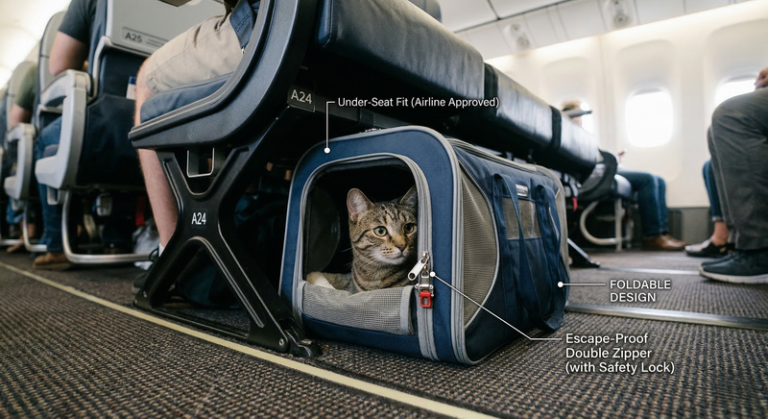
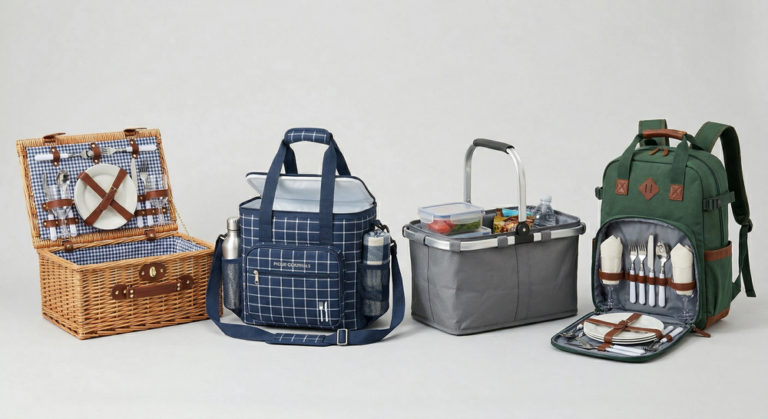
Neither 600D nor 900D is automatically better. A 900D yarn has 50% greater nominal linear density than a 600D yarn, but that number does not tell you the finished fabric weight, weave density, coating, tear strength, abrasion result, seam strength or bag load capacity. Choose the complete specification that fits the travel bag’s use, target weight, structure, price and approval tests.
If you are preparing an OEM brief, connect the material decision to the actual custom travel bag construction rather than approving a fabric from its denier label alone.
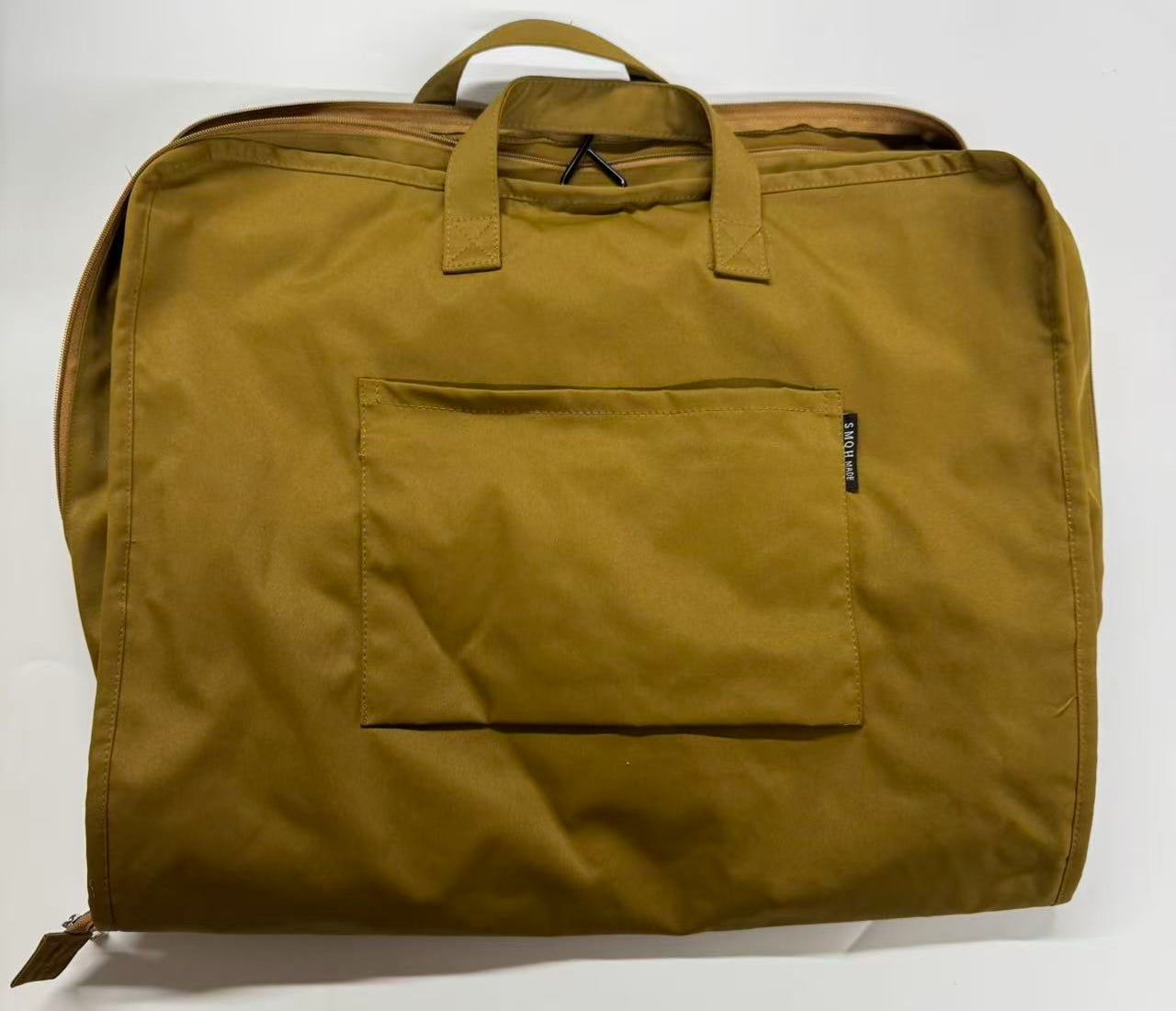
What does 600D vs 900D actually mean?
The D number describes yarn linear density, not finished-product durability. Denier is the mass in grams of 9,000 metres of yarn. In nominal terms, 9,000 metres of 600D yarn weighs 600 grams, while the same length of 900D yarn weighs 900 grams.
The calculation is simple:
900D ÷ 600D = 1.5
So 900D has 50% greater nominal yarn linear density. It does not follow that a 900D fabric is 50% heavier or 50% stronger. Strength relative to yarn size is a separate property, and a finished fabric contains many more variables.
A U.S. government weights-and-measures reference uses the 9,000-metre definition, while ISO 1144 covers the Tex system for expressing linear density and ISO 2060 covers measurement of yarn linear density.
For a travel-bag fabric, the D number does not state:
- whether the polymer is polyester or nylon;
- whether the yarn is virgin, recycled, standard-tenacity or high-tenacity;
- the warp and weft yarn combination;
- the weave, thread density or ripstop construction;
- the finished fabric weight in gsm;
- the type and amount of coating;
- tear, tensile or abrasion results;
- seam strength, zipper attachment or handle reinforcement;
- finished-bag weight or safe working load.
That is the first procurement rule: denier is one input, not the approval result.
Is 900D always stronger than 600D?
No. A higher denier may offer more performance potential when the other variables are genuinely controlled, but real commercial fabrics rarely differ in denier alone.
If two fabrics use the same polymer, yarn quality, weave, thread density, coating and test method, the coarser 900D yarn can support a heavier, more substantial construction. That makes it a reasonable direction for a bag exposed to frequent floor contact, rough handling or a deliberately structured appearance.
But change the weave, yarn quality or coating and the ranking may change. A dense, well-engineered 600D ripstop can control tear propagation better than a loosely woven commodity 900D. A high-tenacity 600D yarn can also be a better engineering choice than a weak 900D yarn. The exact result must come from comparable testing, not from the label.
This is not only a supplier argument. CORDURA Classic Fabric describes plain, dobby, basket and ripstop constructions within its fabric family, together with coating and lamination options. The yarn size is only one part of the construction.
Be cautious when a comparison says that 900D is “60%–80% stronger” without showing:
- the two complete fabric specifications;
- the test method and specimen direction;
- conditioning, load, abradant or endpoint;
- the laboratory report and sample identity.
Without those items, the percentage is false precision.
Does 900D always have a higher GSM than 600D?
No. Denier and grams per square metre measure different things. Denier describes yarn linear density; GSM describes the mass of a unit area of the finished fabric.
Published specifications demonstrate the difference. A 600D solution-dyed PU polyester sheet lists 260 gsm ±20 gsm; a 600D PU-coated ripstop sheet lists 280 gsm; and a 600D/84T WR PU sheet lists about 267 gsm. Published 900D products include examples around 270 gsm and 320 gsm, while other 900D constructions are marketed in a 220–280 gsm range.
Those examples are not an apples-to-apples performance comparison. They have different constructions and suppliers. They prove a narrower point: the GSM ranges overlap, so “600D equals one weight range and 900D equals another” is not a reliable purchasing rule.
Ask the mill or bag supplier to state both:
- base-cloth construction; and
- finished GSM with tolerance, including the coating or lamination basis.
Two fabrics called 600D PU can have different finished weights, thicknesses, hands and performance. The same is true for 900D.
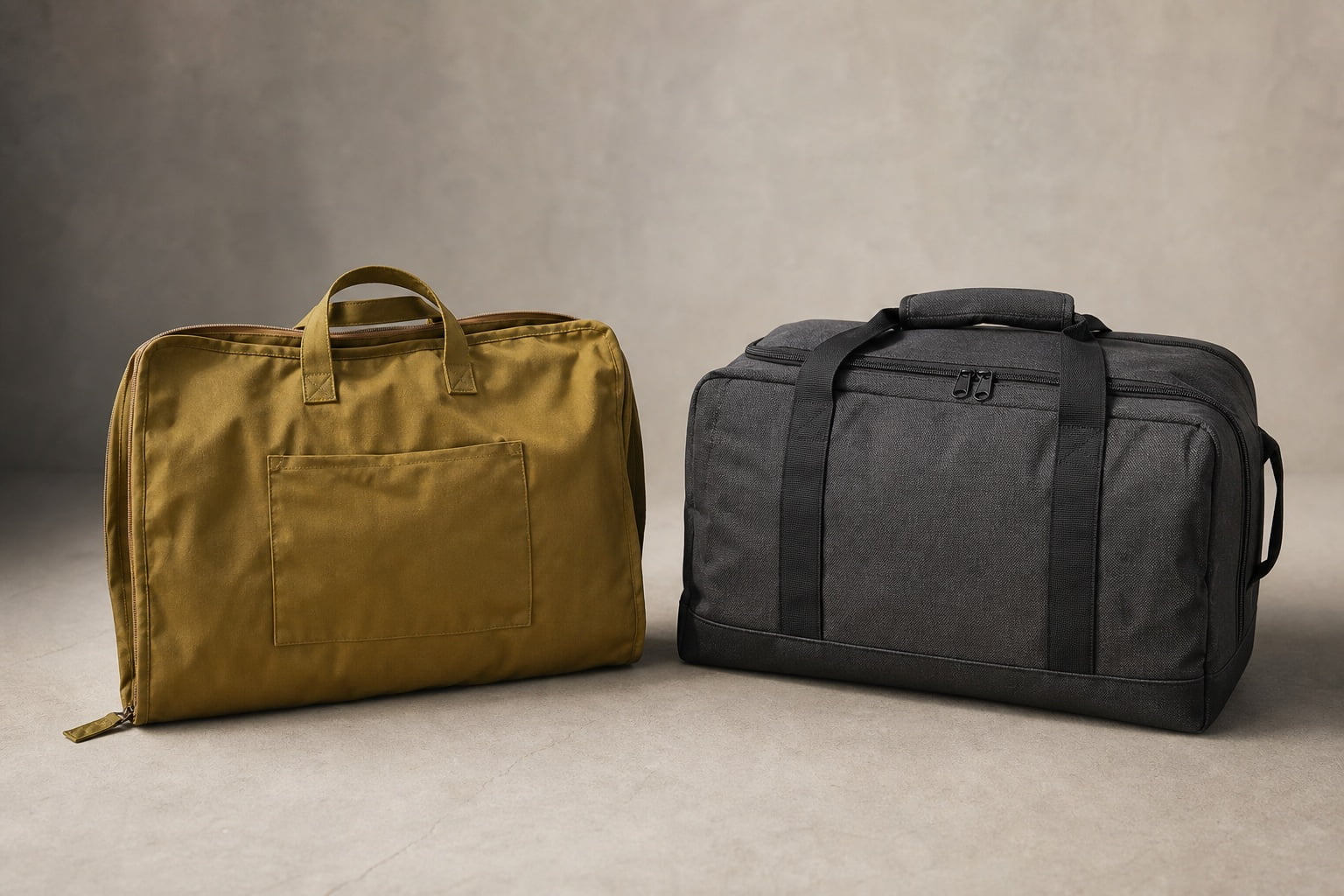
When is 600D a practical starting point for a travel bag?
Start with a suitable 600D construction when lower bulk, folding, carrying weight or a mainstream price position matters more than a heavy hand. The word “start” is important: the sample and test plan still decide whether the fabric is adequate.
Typical directions include:
- packing organizers and soft travel accessories;
- compact commuter or cabin bags;
- laptop sleeves with internal padding doing most of the structural work;
- small pet travel accessories;
- foldable or retail-packed products where carton efficiency matters;
- mainstream duffels that do not face continuous floor dragging or sharp tools.
LISO’s development experience is that a lighter or more flexible construction can make the product easier to fold and handle. It can also reduce the amount of stiffness that must be managed at corners, bindings and zipper seams.
However, do not translate that experience into a universal cost or carton percentage. A dense 600D fabric with a heavy PVC backing may be bulkier than a lighter 900D PU construction. The correct comparison is made after the final fabric, pattern, reinforcement and packaging are fixed.
When should a buyer evaluate 900D?
Evaluate 900D when the bag needs a more substantial hand, greater structure or performance headroom for repeated surface contact—but verify the exact construction.
Relevant travel and equipment-bag directions can include:
- large duffels that are frequently set on rough floors;
- equipment or tool travel bags;
- motorcycle or vehicle storage bags;
- structured gear cases;
- professional outdoor bags exposed to dragging and abrasion;
- premium products where a coarse, substantial textile appearance is part of the design brief.
The higher D number does not remove the need for reinforcement. A heavy bag can still fail at the handle joint, zipper end, shoulder-strap anchor, base corner or seam if its load path is poorly designed. The same principle is explained in LISO’s handle, gusset and load-path guide: material selection and construction must work together.
For a large travel bag, specify where the load should travel through the product. Then decide whether reinforcement, webbing, bartacks, seam geometry or a different base panel is needed. Do not ask the face fabric to solve every load problem by itself.
How do 600D and 900D affect cutting and sewing?
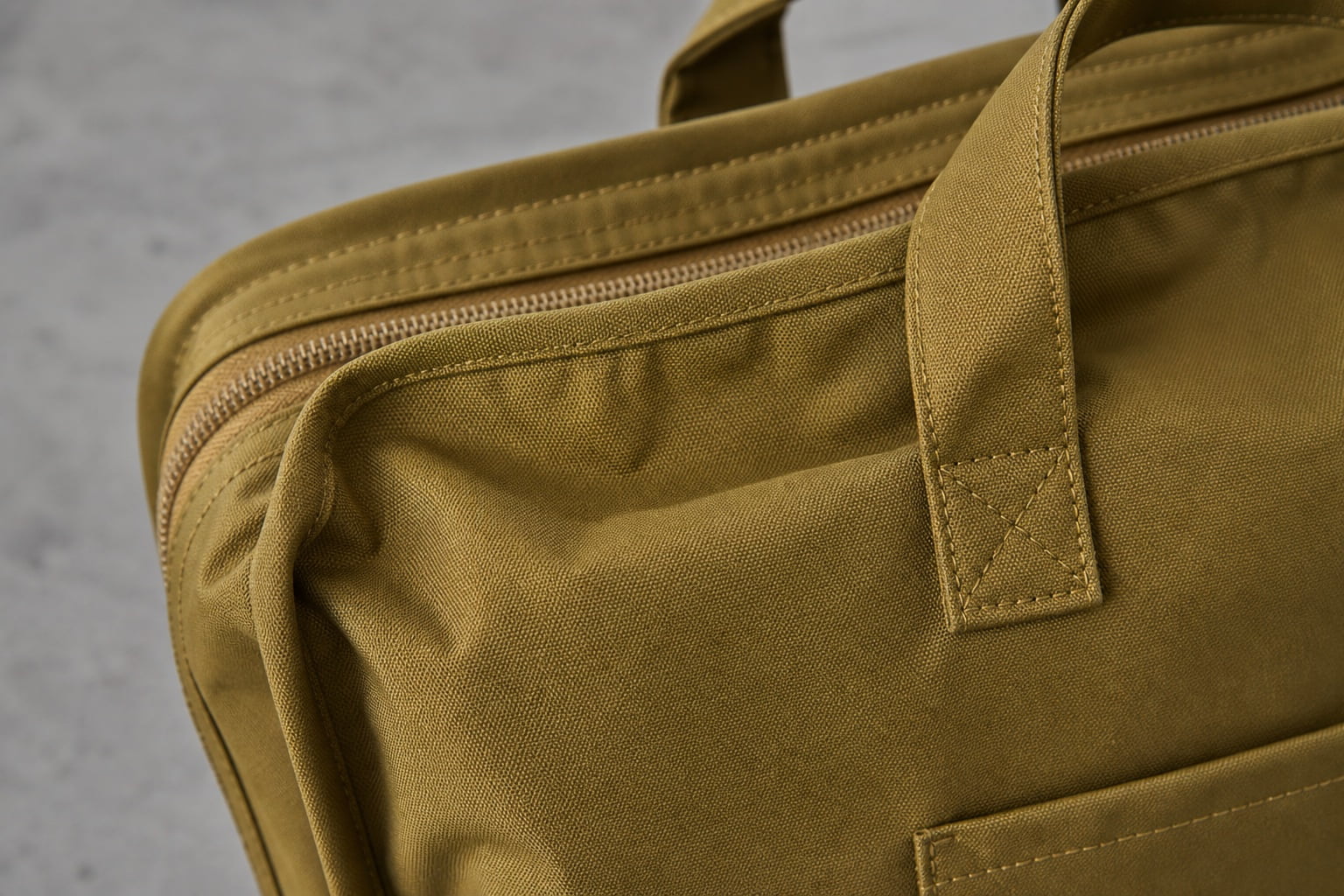
The factory difference comes mainly from the finished fabric’s thickness, stiffness, coating and seam stack—not from the D number in isolation.
In sample development, a thicker or stiffer coated construction may:
- reduce the stable lay height during cutting;
- require edge control if the fabric frays;
- increase bulk at bound seams and multi-layer intersections;
- resist tight corner turning and create puckering or a raised corner;
- create a larger thickness mismatch between face fabric and zipper tape;
- change feed balance, stitch formation and needle heating;
- require a different reinforcement shape around handles and zipper ends;
- produce a larger folded package even when the open dimensions are unchanged.
This is why fixed statements such as “600D always uses needle X” or “900D reduces line speed by 20%” are unreliable. Needle system and size, thread ticket, stitch length, seam type, binder, machine feed and speed must be trialled on the actual layer stack.
The approval sample should reproduce the difficult locations, not just a flat seam. LISO recommends reviewing at least:
- the thickest handle or strap attachment;
- a bound inside seam;
- the tightest three-dimensional corner;
- zipper start, end and curved sections;
- the base-to-side seam;
- any printed area that crosses a fold or seam.
Do PU, PVC, TPU and filament count matter more than denier?
They can. Coating and yarn construction change properties that the denier number does not describe.
A PU-coated fabric may be selected for a softer hand and lower bulk. A PVC-backed construction may be chosen for a firmer hand or a specific coated-fabric performance target. A TPU laminate can be considered when its flexibility, low-temperature behavior or other project-specific properties justify the added material and process requirements.
None of these outcomes should be promised from the coating name alone. Specify coating amount, adhesion, hydrostatic target, flex or low-temperature requirement and aging condition where relevant. ASTM D751 includes separate coated-fabric methods for mass, tear, hydrostatic resistance, coating adhesion, low-temperature behavior, seam strength and aging. That separation is the point: coating performance is not contained in the denier value.
Filament count also needs careful language. In a notation such as 600D/144F, F refers to the number of filaments in the yarn bundle. At the same total denier, 144 filaments are individually finer than 48 filaments. But a higher F count does not guarantee a softer fabric, because twist, texturing, weave, density and finish still influence hand feel.
How does the fabric choice affect finished weight and freight?
Calculate the effect from fabric area and finished GSM, then verify folded volume with a packing trial. Do not estimate freight from denier alone.
The material-weight relationship is:
fabric weight per bag (kg) = net fabric area (m²) × finished GSM ÷ 1,000
For illustration only, if a bag consumes 1.2 m² of face fabric:
- at
280 gsm, the face fabric contributes0.336 kg; - at
320 gsm, it contributes0.384 kg; - the difference is
0.048 kgbefore cutting waste, lining, webbing, zippers, foam and packaging.
This calculation is transparent, but it is not a full freight quote. The final commercial effect also depends on:
- marker efficiency and cutting loss;
- lining, foam and reinforcement changes;
- hardware and webbing;
- folded dimensions and compression recovery;
- pieces per carton and carton strength;
- volumetric versus actual freight weight;
- warehouse and parcel-carrier thresholds.
For a bulk order, compare two approved samples in the same carton and record the packed dimensions, gross weight and pieces per carton. That packing trial is stronger evidence than a generic claim that one denier always saves a fixed percentage.
What tests should buyers request for 600D vs 900D?
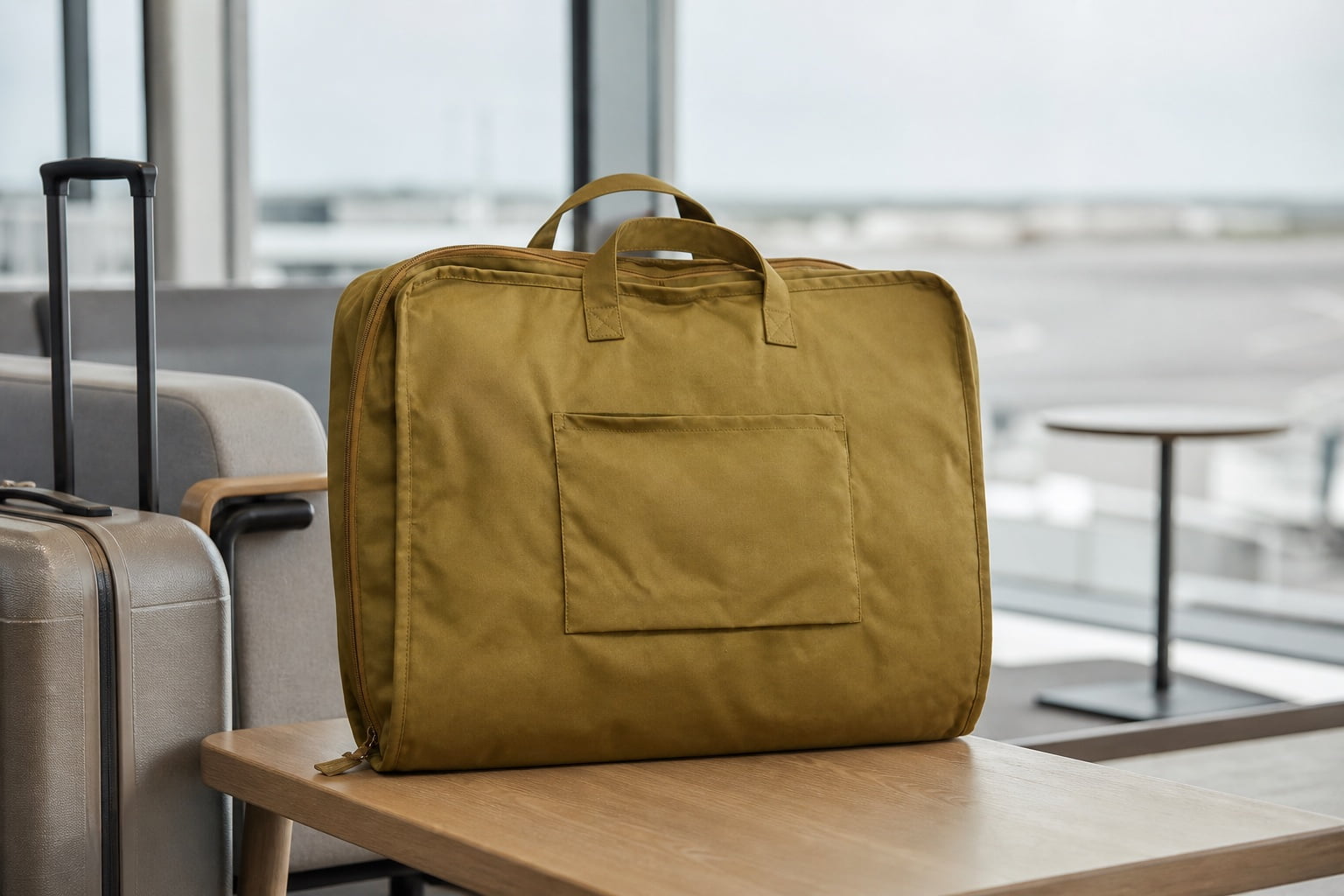
Choose tests from the bag’s failure model, and record the method, direction, condition and acceptance point. A list of test names without conditions is not a quality plan.
| Risk to control | Evidence to consider | Important limitation |
|---|---|---|
| Fabric tears from a cut or snag | Trapezoid or Elmendorf tear, agreed with the buyer | Results depend on method and warp/weft direction. |
| Surface wears through | Martindale or another end-use-relevant abrasion method | Cycle counts are not a universal service-life prediction. |
| Fabric breaks under force | Grab or strip tensile test | Fabric strength does not equal finished-bag load capacity. |
| Coating peels or cracks | Coating adhesion, flex, aging and low-temperature checks | Test the actual coating construction and conditioning. |
| Water penetrates the fabric | Hydrostatic pressure | Fabric water resistance does not make a sewn bag waterproof. |
| Seam ruptures or yarns slip | Sewn-seam test on the production seam assembly | A lab seam result does not capture every real-use failure. |
| Handle or base fails in use | Finished-bag static load and repeated-lift protocol | Weight, dwell time, lift count and inspection points must be project-specific. |
| Zipper fails | Zipper-cycle and loaded-opening checks | Use the production zipper, slider, tape and seam construction. |
ASTM D5587 covers trapezoid tearing strength for most fabrics. ASTM D4966 covers Martindale abrasion, but ASTM itself warns that abrasion results vary and should not predict end-use wear life without a demonstrated relationship. ISO 811:2018 covers hydrostatic resistance of fabrics.
Avoid copying obsolete or unsuitable methods from another supplier’s specification. ASTM D5733, for example, was withdrawn and was written for nonwoven fabrics; it is not the default tear method for woven polyester Oxford travel-bag fabric.
At LISO, pre-production and pre-shipment review can include material, workmanship and finished-product checks. When a bag is loaded and lifted, the agreed weight, static duration, lift count and observed failure points should be recorded. A universal 72 hours, 500 folds or 15-minute spray rule is not automatically appropriate for every bag.
What is the simple sales answer to “600D or 900D?”
Sales answer: There is no absolute winner. Choose 600D when lower bulk, easier folding and a mainstream travel-bag build are priorities. Evaluate 900D when you need a more substantial hand, more structure or greater abrasion and tear potential. In both cases, confirm GSM, weave, coating and the finished-bag test plan before ordering.
What is the technical answer for a buyer or designer?
Technical answer: 900D has 1.5 times the nominal yarn linear density of 600D, but no universal performance multiplier follows from that ratio. Compare the same polymer and yarn quality, warp/weft construction, weave and density, finished GSM, coating system and test method. Then validate the production seam assembly, handles, zipper points, base and loaded bag.
This answer is less dramatic than “900D is stronger,” but it produces a specification that a mill, sample room, quality team and buyer can all verify.
What should a 600D or 900D RFQ include?
Do not write only 600D waterproof polyester or 900D heavy-duty fabric. Send a complete decision brief.
Use this checklist:
- bag type, dimensions and target capacity;
- intended load and how the bag will be carried;
- abrasion, dragging, snagging and weather exposure;
- target finished-bag weight and folded volume;
- polymer and yarn requirements, including recycled-content evidence if claimed;
- warp/weft yarn construction, weave and density;
- finished GSM and tolerance;
- coating or lamination type, amount and performance target;
- colour, print, hand feel and appearance standard;
- lining, foam, webbing, binding and reinforcement construction;
- agreed fabric and finished-bag test methods;
- packing method, carton trial and shipping limits;
- approved swatch and golden sample as the visual source of truth.
The golden sample should not replace measurable requirements, and a specification sheet should not replace workmanship approval. Both are needed.
Frequently asked questions
Is 900D polyester waterproof?
Not from the D number alone. Water resistance depends on the fabric construction, coating or lamination and test result. A sewn bag also has seams, needle holes and zipper openings, so a fabric hydrostatic result is not proof that the finished bag is waterproof.
Is 900D 50% stronger than 600D?
No. It has 50% greater nominal yarn linear density. Strength depends on yarn tenacity, weave, density, coating, specimen direction and test method. Ask for a paired report if a supplier gives a strength percentage.
Can a 600D fabric outperform a 900D fabric?
Yes. A dense, high-quality or ripstop 600D construction can outperform a loosely woven or weak-yarn 900D in a relevant test. The exact ranking must be demonstrated on the candidate fabrics.
Does 900D always weigh more?
No. Finished GSM depends on yarn construction, weave density and coating. Published 600D and 900D product specifications overlap in finished weight.
Which fabric is better for a foldable travel bag?
A lighter, more flexible 600D construction is often the better starting point, but finished GSM and coating matter more than the label alone. Approve the folded sample and carton trial before confirming the order.
Which fabric is better for a heavy equipment duffel?
A suitable 900D or another engineered heavy-duty construction may be the better starting point. The base, handle anchors, webbing, seams and zipper points still need reinforcement and loaded-bag validation.
Build the specification before choosing the denier
600D and 900D are useful yarn designations, but they are not competing quality grades. The better travel-bag fabric is the one whose complete construction meets the product’s use, weight, hand, price and evidence plan.
Send LISO the bag dimensions, target load, expected abrasion, preferred hand, finished-weight limit, coating requirement and packing target. We can compare candidate constructions and build the approval plan around the finished product.