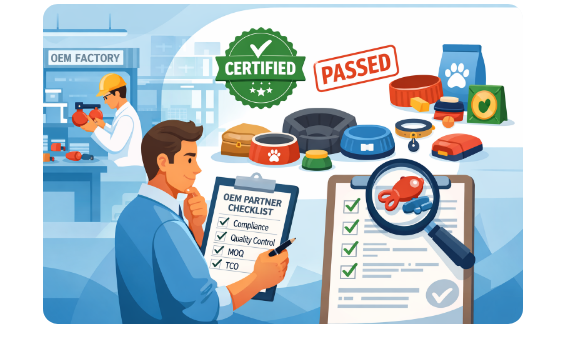
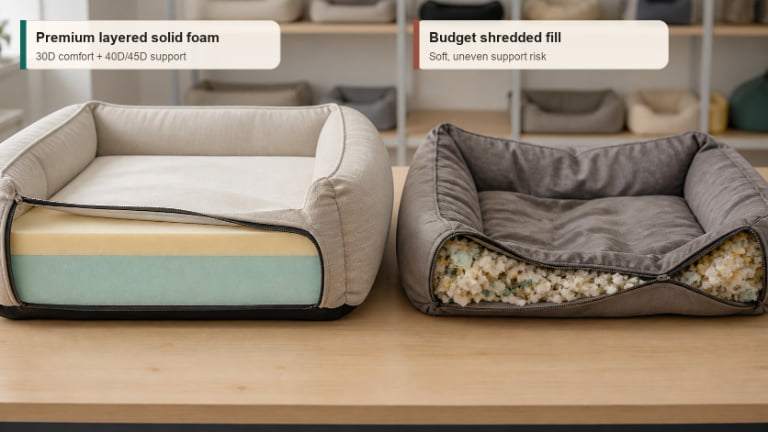
Two dog car backseat extenders can look almost identical in a quotation photo, yet their prices can be far apart. The visible surface is only one layer. The real difference may sit inside the construction: fabric, coating, lining, padding, support core, anti-slip base, webbing, thread, reinforcement and the factory's acceptance standard.
A hard-bottom dog car backseat extender should not be judged by price, fabric denier or board thickness alone. Buyers should compare the complete material stack, the unsupported vehicle span, the attachment path and a finished-product test. A lower quote may be correct for a simpler brief; it becomes a risk when the hidden specification has not been disclosed.
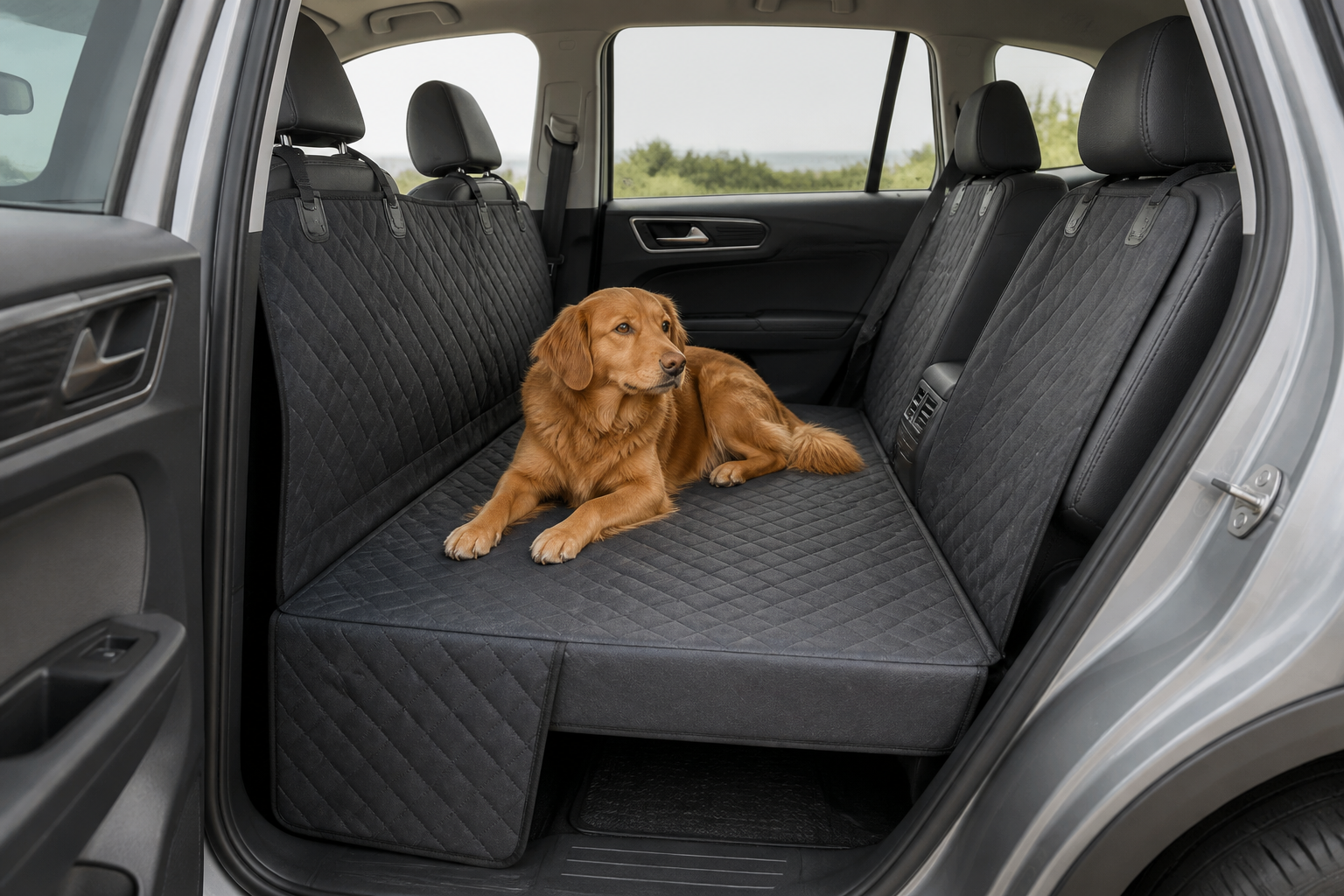
For B2B buyers, this is not a request to choose the most expensive sample. It is a request to make the comparison fair. A hard bottom dog car backseat extender may look similar in a quotation image while using a very different hidden specification. If one supplier quotes 600D fabric with an undefined coating, a light lining, no declared core and basic seam construction, while another gives a defined construction and test plan, the two quotations are not for the same product.
At LISO HOME, our sourcing position is simple: quality must be described in materials and construction that a buyer can inspect. “High quality” without a material stack, an approved sample and acceptance criteria is only marketing language.
What Should a Buyer Compare Before Comparing the Price?
Price is meaningful only after the product brief identifies what is inside the finished extender.
Ask for a layer-by-layer bill of materials, not a single product name. The buyer should compare outer fabric, coating, lining, fill, support core, underside, webbing, thread, reinforcement, hardware and the finished-product QC plan.
| Construction area | What can vary | What to ask for in a quotation |
|---|---|---|
| Outer shell | Yarn, weave, density, finish and colour treatment | Fabric specification, finished weight, coating type and test request |
| Inner lining | Denier, weave, coating and colour | Lining specification and where it is used |
| Padding | Fibre type, loft, bonding and quilting | Fill type, nominal weight or thickness, quilting pattern |
| Support core | PP hollow board, PP honeycomb, wood-based panel or another approved design | Exact board construction, thickness, panel layout, edge treatment and resin declaration |
| Base | Anti-slip fabric, backing and binding | Material description, coverage and wear test expectation |
| Load path | Webbing, thread, bar-tacks, seams and hardware | Webbing width/specification, stitch construction, reinforcement points and inspection criteria |
A good RFQ makes these fields comparable. A price-only RFQ does not. It invites suppliers to decide the hidden specification for you.
For a hard bottom dog car backseat extender, the RFQ should identify the finished system rather than a loose board or a fabric swatch. The practical comparison starts with the installed platform and then traces each visible and hidden layer back to its approved material specification.
Why Is “600D, 900D or 1200D” Not the Full Fabric Specification?
The outer fabric is visible, so it is often the first thing a buyer asks about. It is still not the whole answer.
600D, 900D and 1200D are commonly used sourcing descriptions, but denier alone does not prove abrasion resistance, tear resistance, coating adhesion, waterproof performance or seam durability. A fabric comparison needs the full finished construction and the test relevant to the program.
Denier is a yarn-size designation. It does not disclose the weave, yarn quality, finished fabric mass, coating formulation, coating amount, finishing process or the way the fabric is joined to the rest of the product. A 900D label is therefore not a universal quality certificate. It is one line in a technical brief.
Coating creates another major quotation difference. TPU, PU and PVC are different coating families. They can be selected for different hand feel, flexibility, processing, target market requirements and water-resistance objectives. None should be called “best” without the actual program criteria. A buyer who needs a water-resistance claim should request a defined test method and pass/fail requirement, rather than accept a generic label such as “waterproof.”
ASTM D751 is a useful reference point for coated-fabric programs because it includes methods for breaking strength, tearing strength, hydrostatic resistance, coating adhesion, seam strength and heat aging. It does not certify a dog car extender by itself. It shows why a coating name is not the same as a finished-performance result. ASTM D751 lists these coated-fabric test methods.
| Buyer question | Weak comparison | Strong comparison |
|---|---|---|
| What is the shell? | “900D Oxford” | Fibre/yarn description, weave, finished fabric mass, coating family and agreed test |
| Is it waterproof? | “Yes, waterproof” | Defined water-resistance test, specimen condition and agreed acceptance criterion |
| Is it durable? | “Heavy duty” | Relevant abrasion, tear, seam and coating-adhesion requirements |
| Is the coating premium? | “TPU/PU/PVC” | Coating selection tied to the brief, target market and test evidence |
The right decision is not “always buy 1200D.” The right decision is “choose the fabric construction that meets the target use and verify it on the approved finished sample.”
Why Does the Inner Lining Matter When the Buyer Cannot See It?
The inner layer can change cost, appearance, cleaning behavior and how the product holds its shape.
A lining such as 240D can be a legitimate part of a more defined construction, but its number alone does not prove a better product. Ask which panels use the lining, how it is joined to the shell and support core, and what the sample must show after use and cleaning.
Some programs specify a thin, economical lining. Others use a more substantial lining in areas that contact the support board or form the inside face of the extender. That difference may be invisible in a lifestyle image, yet it changes material cost and assembly time.
The buyer should also check that the lining is not discussed in isolation. A stronger lining cannot repair a poorly supported core, unreinforced webbing root or unfinished panel edge. It is one layer in a system.
When reviewing a sample, inspect the lining around corners, board pockets, fold lines, zippers and the points where a dog may stand or turn. Record any wrinkling, migration of the core, loose seams or exposed edge after the agreed use and cleaning procedure. This produces better feedback than simply asking whether the lining “feels thick.”
How Do Padding and the Support Core Change What the Product Is?
Padding can improve comfort. A support core helps a hard-bottom extender bridge a vehicle footwell. They perform different jobs.
For a hard-bottom dog car backseat extender, spray-bonded padding is a comfort layer, not a substitute for a defined structural core. PP hollow board, PP honeycomb board and wood-based panels are possible core directions, but the finished product must be evaluated by its actual panel construction, span, attachment path and test method.
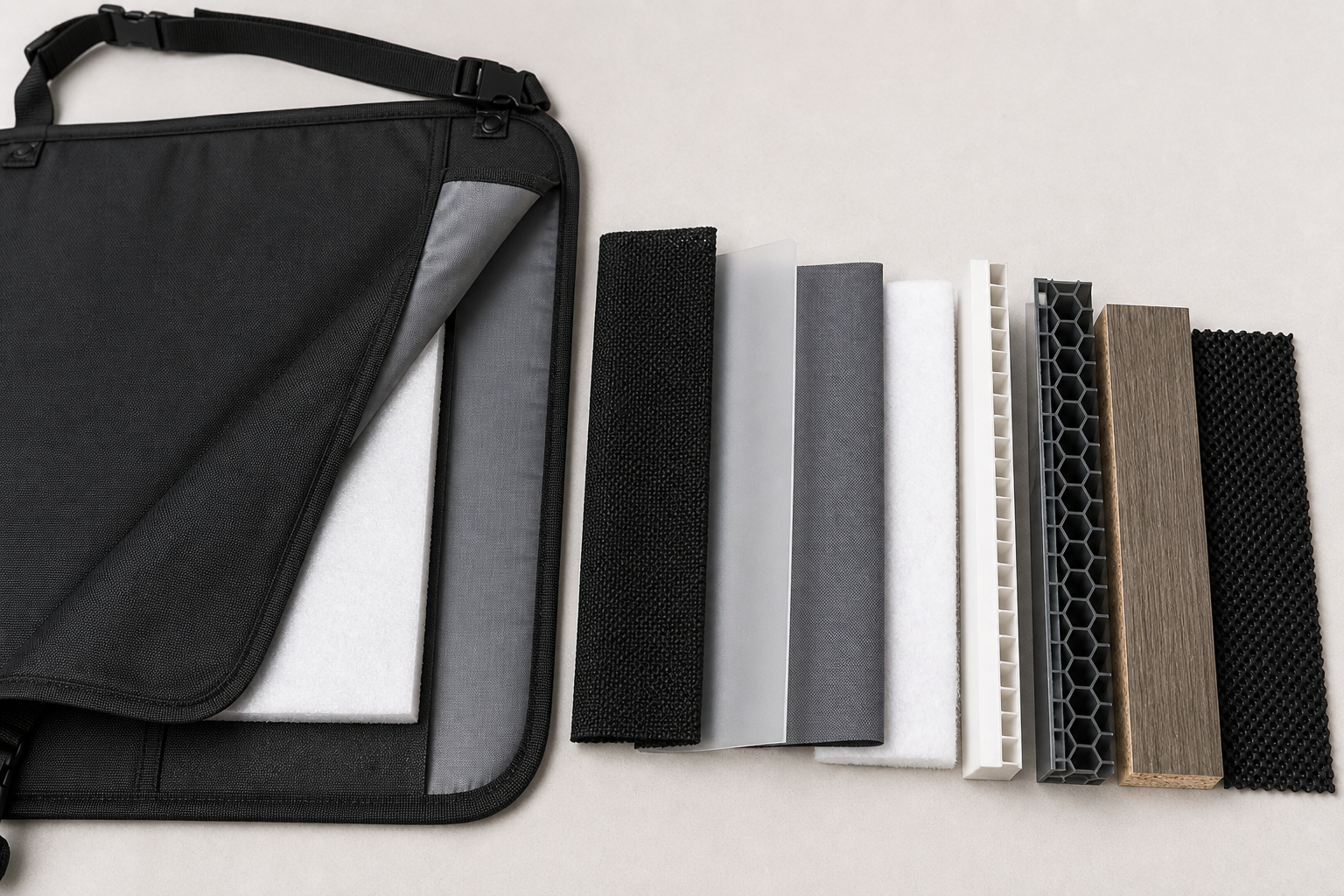
The market commonly discusses 5 mm, 8 mm and 10 mm PP hollow-board options, plus 8 mm and 10 mm honeycomb options. Those can be useful sample variables. They must not become a universal public chart that maps one thickness to a dog weight. The same nominal thickness can perform differently with another panel geometry, resin grade, unsupported span, front-seat position, seam design and attachment route.
| Core direction | Role in a sourcing comparison | What it does not prove alone |
|---|---|---|
| Padding only | Surface comfort and cushioning | A rigid bridge across an open footwell |
| PP hollow board | Lightweight core direction with internal channels | A fixed capacity or suitability for every vehicle |
| PP honeycomb board | A core direction to compare for its structural configuration and weight | Automatic superiority over every hollow-board design |
| Wood-based panel | A possible premium direction with different stiffness, mass and finishing trade-offs | Automatic export compliance or suitability for every market |
The phrase “new material” also needs precision. Virgin PP and recycled PP are not a simple good-versus-bad choice. Post-consumer recyclate can vary with feedstock composition, contamination, additives and processing history. Research from NIST notes that recycled polyolefin properties can vary widely because feedstocks come from diverse sources; mechanical performance can be affected by contaminants. That means buyers should request declared resin content, relevant material documentation and sample or finished-product test evidence. NIST’s recycled polypropylene research explains this variability.
Do not accept “same 10 mm board” as a complete equivalence claim. Ask: 10 mm of which board geometry, which resin system, which face construction, which panel layout and which test condition?
Why Must Buyers Measure the Footwell Span Before Choosing the Board?
A hard-bottom extender acts as a bridge. The distance between supports changes what the bridge must do.
The board cannot be selected by thickness alone because an extender's unsupported span, panel joints, load placement and attachment route change its behavior. A longer footwell gap can create greater bending demand, so the intended vehicle geometry belongs in the RFQ and test plan.
The first practical question is not “Do you have 8 mm?” It is “What vehicle class and installed gap is this sample meant to bridge?” A compact sedan, an SUV and a truck may create different gaps. Moving the front seats changes the gap again. A universal-fit promise without defined tested configurations is not a quality specification.
For any plastic-core program, temperature and dwell time matter too. ASTM D790 describes flexural testing of plastics. ISO 75-1 describes plastics deflection under load at temperature. These are reasons to define a test condition, not permission to publish a universal heat-loss percentage for every PP board. A real requirement should state the actual board, gap/span, load placement, temperature, time under load and the acceptance rule. ASTM D790 and ISO 75-1 provide relevant material-test frameworks.
How Do the Anti-Slip Base, Webbing and Sewing Affect the Real Cost?
The lower side and the seams are easy to ignore because they are not the product's hero image. They are still part of the product's load path and finish.
An anti-slip underside, correctly specified webbing, suitable thread and controlled bar-tack reinforcement can change material and labor cost. Buyers should inspect these details as a system, and should not infer a capacity or crash-restraint claim from one construction feature.
An anti-slip fabric can help manage surface movement in the intended installed position. It is not a substitute for fit validation, vehicle anchoring or restraint evidence. Similarly, a bar-tack is a concentrated reinforcement stitch used where webbing joins a body panel. More visible stitches do not automatically make a stronger assembly. The required stitch pattern, thread, webbing, seam allowance, material layers and test method all matter.
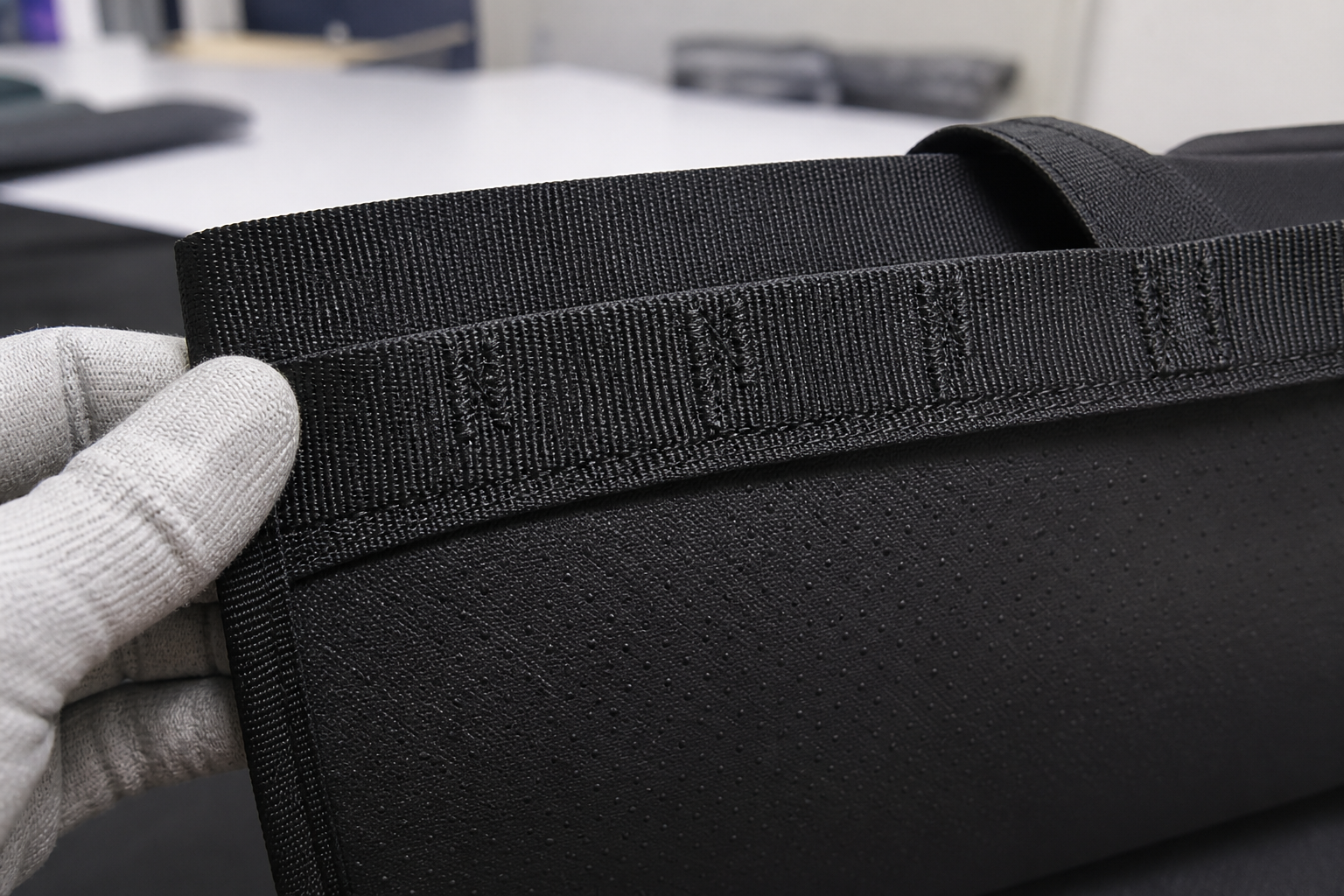
ASTM D751 includes seam-strength and dead-load seam-strength methods for coated fabrics. These are relevant references when a program needs a defined seam evaluation, although the finished extender still needs its own agreed installation and use protocol. Ask to inspect the webbing root, strap-adjustment area, board-pocket seams, panel corners and edge binding on the actual finished sample.
| Hidden detail | What can change between quotations | What to verify on the sample |
|---|---|---|
| Anti-slip base | Material, thickness, coverage and attachment | Coverage, abrasion points and edge finish |
| Webbing | Width, construction, hand feel and specification | Root anchoring, adjustment function and consistent stitching |
| Thread | Type, size, colour and process control | Stitch consistency, skipped stitches and seam appearance |
| Bar-tack reinforcement | Stitch program, placement and number of reinforcement points | Reinforcement at strap roots and stress concentration points |
| Edge binding | Binding material, width and fold construction | Exposed core edges, tidy corners and abrasion areas |
What Does a Fair Quality Comparison Look Like?
The objective is not to make every product premium. It is to remove ambiguity.
A fair comparison evaluates like-for-like finished samples. First align the materials and construction. Then install the samples in the target vehicle geometry, inspect the load path, define the test condition and compare cost with the same acceptance standard.
Use this procurement sequence:
- Define the product job. Is it a soft seat cover, a hammock, or a hard-bottom platform intended to bridge a defined gap? Do not merge these into one vague term.
- Define the material stack. Specify the outer shell, coating, lining, padding, core, underside, webbing, thread, binding and hardware.
- Define the installed geometry. Record target vehicle class, footwell span, front-seat position and known fit exclusions.
- Build a sample matrix. Compare the proposed core and fabric directions while holding the dimensions and intended installation constant.
- Agree the finished-product test. State load placement, duration, temperature condition where relevant, cycles, recovery expectation and visible seam/edge criteria.
- Approve the complete sample. Do not approve a loose board or fabric swatch as proof of finished-product performance.
- Lock the approved specification. The PO, QC sheet and future sample must reference the same material stack and acceptance criteria.
This process usually shortens decision time. It turns the conversation from “Why is your price higher?” into “Which construction does our program need, and how will we verify it?”
How Should Buyers Evaluate a “Cheaper but Similar” Quote?
A lower quote is not automatically wrong. It may represent a different product brief. The problem is hidden substitution.
When a quote is materially lower, ask the supplier to identify every material and construction change in writing. Do not assume the difference is only margin. The comparison may involve fabric construction, coating, lining, core material, recycled-content control, base fabric, webbing, thread, reinforcement, hardware, inspection or packaging.
Use this short clarification checklist before comparing unit prices:
- Is the outer fabric's complete finished specification the same, not only the denier label?
- Is the coating family and expected test requirement the same?
- Is the lining specified at the same areas and construction?
- Is the padding type and quilting construction the same?
- Is the core design the same: panel type, thickness, panel count, edge treatment and resin declaration?
- Is the anti-slip base equivalent in material and coverage?
- Are webbing, thread, bar-tacks and attachment hardware specified in the same way?
- Is the sample evaluated in the same vehicle-gap and finished-product test condition?
- Are the same packaging and inspection requirements included?
This checklist protects both sides. It lets a supplier offer an entry version transparently, while preventing a buyer from unknowingly approving a different construction under the same product name.
How Does LISO HOME Turn Material Choices Into a Sourcing Conversation?
The purpose of a quality discussion is to help a buyer reach a specification that can be sampled, inspected and repeated.
LISO HOME can discuss custom dimensions, colour, logo, fabric direction, packaging and feature configuration against a defined product brief. We do not treat an unexplained capacity, generic “waterproof” wording or a material name alone as a finished-product specification.
For the commercial product range and an OEM discussion, visit our Pet Car Accessories manufacturer page. When you request a quotation, provide the target vehicle class, market, expected quantity, desired material direction and customization needs through our RFQ contact path. That gives the project team the information needed to compare a suitable sample construction rather than quote a generic image.
FAQ
Does 1200D always mean a better dog car seat extender?
No. Denier is only one part of the shell specification. The weave, finished fabric mass, coating, seam construction, core design and test requirement can all change the finished product. Compare the complete construction and agreed performance checks.
Is TPU coating always better than PU or PVC coating?
No. TPU, PU and PVC are different coating families. The correct choice depends on the target product brief, hand feel, flexibility, market requirements and agreed test evidence. Ask for the selection rationale and the relevant performance test.
Is 10 mm PP board automatically suitable for large dogs?
No. Board thickness does not provide a universal capacity rating. The board geometry, resin system, panel size, unsupported span, attachment route, load placement and test condition all affect the finished extender's behavior.
Is recycled PP always lower quality than virgin PP?
No. Recycled PP should not be treated as automatically inadequate. Its properties may vary with feedstock and processing. The buyer should request declared resin content, relevant material control and finished-product test evidence for the specific construction.
Does an anti-slip base make the product safe for every vehicle?
No. An anti-slip layer is one material feature. It does not establish universal fit, vehicle anchoring, pet restraint or crash performance. Those are separate product and evidence questions.
What is the best way to compare two hard-bottom extender quotations?
Ask both suppliers for a layer-by-layer material stack, an installed-geometry assumption, an approved sample and the same finished-product acceptance plan. Then compare cost only after the construction is aligned.
Conclusion
The visible fabric never tells the whole story. Define every layer, inspect the finished sample and compare one testable specification before you compare price.