How We Evaluated
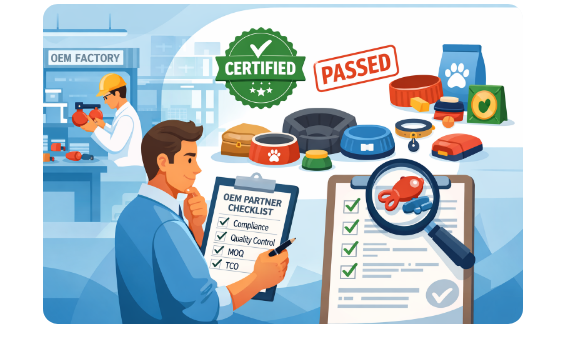
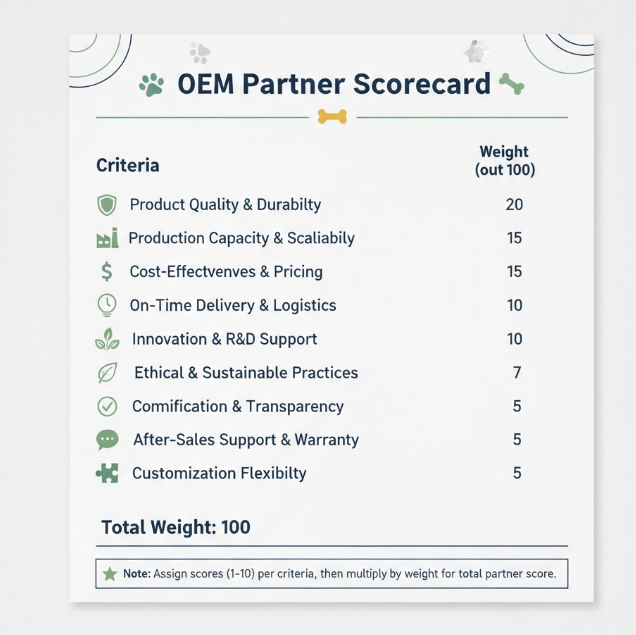
A good OEM is not the cheapest quote—it’s the partner that minimizes risk-adjusted total cost. We evaluate OEM pet product manufacturing partners using a weighted approach:
| Criteria | Weight | What “Good” Looks Like |
|---|---|---|
| 1) Compliance & certifications | 18% | Verified certificates + SKU-linked test reports |
| 2) Quality management system (QMS) | 15% | Documented controls, CAPA discipline, traceability |
| 3) Product safety & materials control | 12% | Material specs, CoA/CoC, restricted substances control |
| 4) QC execution & AQL plan | 10% | Clear AQL, in-line & final inspection, closed-loop actions |
| 5) Engineering & DFM ability | 10% | DFM feedback, tooling plan, fast prototyping iterations |
| 6) Lead time & capacity | 10% | Capacity proof, bottleneck plan, OTIF performance |
| 7) MOQ & scalability | 8% | Flexible MOQ + scale plan + supply chain stability |
| 8) Cost transparency (TCO) | 7% | Clear cost breakdown + yield/scrap/logistics assumptions |
| 9) IP protection & NDA discipline | 6% | NDA + tooling ownership + access control |
| 10) Communication & governance | 4% | Weekly cadence, issue log, change control |
1. Compliance & Certifications — Best for Risk Control
Suggested score: ⭐ 4.8/5 (when evidence is SKU-linked)
Direct answer: Compliance is the #1 selection factor because it determines whether your products can legally ship and survive marketplace or regulatory audits.
What to verify
- Certificate authenticity: issuer, scope, factory name/address, validity dates.
- Test reports: must reference your material + your design + your labeling (not generic samples).
- Market fit: US/EU/UK requirements can differ by category and claims.
Common pitfall: “We have certifications” ≠ “Your SKU is compliant.” Ask for SKU-specific test evidence and a change-notification policy that triggers re-testing.
2. Quality Management System (QMS) — Best for Consistency at Scale
Direct answer: A strong QMS prevents “good samples, bad mass production.”
What to check
- Do they have a documented control plan from incoming to pack-out?
- Are nonconformities tracked with CAPA and closure evidence?
- Can they prove traceability (lot numbers, production records, supplier batches)?
Data-driven tip: Request a 12-month defect trend and ask how they reduced the top 3 defects.
3. Product Safety & Materials Control — Best for Avoiding Recalls
Direct answer: Materials control is the fastest way to reduce safety risk in OEM pet supplies.
What “good” looks like
- Material spec sheet + approved vendor list
- Restricted substances control (inks, coatings, plastics, metals)
- CoA/CoC per lot for safety-critical materials
Common pitfall: Sub-suppliers get swapped without notice. Require written change control and re-testing triggers for any material or process changes.
4. QC Execution & AQL Plan — Best for Repeatable Quality
Direct answer: A QC checklist only works if it’s measurable and enforced.
Pet product manufacturer quality control checklist (copy/paste)
| Stage | What to Inspect | Evidence Required |
|---|---|---|
| Incoming (IQC) | Material ID, dimensions, contamination/odor, CoA/CoC | Incoming report + photos |
| In-line | CTQs, assembly fit/strength, visual defects | Process logs + defect Pareto |
| Packaging | Label accuracy, warnings, barcode scan | Pack-out checklist + samples |
| Final inspection | AQL sampling, functional tests, drop test (if relevant) | Final report + AQL record |
| Pre-shipment | Carton integrity, counts, palletization | Shipping checklist + photos |
Data-driven tip: Define CTQs (Critical-to-Quality) with numeric tolerances, not “looks OK.”
5. Engineering & DFM Ability — Best for Faster Launch
Direct answer: OEMs with DFM capability reduce redesign cycles and tooling surprises.
What to request
- A DFM report with risks (sharp edges, small parts, weak joints)
- Tooling plan + timeline + trial run acceptance criteria
- Prototype iteration speed and cost logic
Common pitfall: “Yes, we can do it” without DFM detail often leads to late changes and delays.
6. Lead Time & Capacity — Best for OTIF Reliability
Direct answer: Lead time reliability matters more than average lead time.
What to validate
- Capacity evidence: line count, shift plan, bottleneck process capacity
- Peak season plan: buffers, staffing, subcontracting rules
- OTIF history: punctuality metrics for recent shipments
Data-driven tip: Put OTIF targets + penalties/credits into your supply agreement.
7. MOQ & Scalability — Best for Growth Without Switching
Direct answer: The right MOQ structure lets you test demand and scale without changing factories.
What “good” looks like
- Pilot MOQ for first order + ramp plan for repeats
- Backup line or capacity contingency for best-sellers
- Stable upstream suppliers (packaging and key materials)
Common pitfall: Unrealistically low MOQ can hide higher unit cost or unstable scheduling.
8. Cost Transparency (TCO) — Best for Real Savings
Direct answer: Lowest unit price often loses to lower TCO once defects, freight, and delays are included.
What to ask for
- Cost breakdown: material, labor, overhead, packaging, tooling amortization
- Assumptions: yield, scrap rate, carton/pallet configuration
- Logistics: Incoterms, peak freight risk, warehousing needs
Data-driven tip: Compare suppliers with a simple TCO model:
TCO = unit price + (defect rate × rework/returns) + expedite freight + delay cost
[🎯 CTA: Request a free OEM TCO calculator template tailored to your pet product category.]
9. IP Protection & NDA Discipline — Best for Brand Protection
Direct answer: IP protection is operational, not legal-only—tooling ownership and access control matter.
Must-haves
- NDA (and NNN where applicable) signed by factory + key sub-suppliers
- Tooling ownership, storage rules, and end-of-life return policy
- Controlled access to CAD files, drawings, and mold data
Common pitfall: Shared workshops and unmanaged subcontractors increase leakage risk.
10. Communication & Project Governance — Best for Fewer Surprises
Direct answer: Clear governance reduces delays caused by vague approvals and unmanaged changes.
What to set up
- Weekly cadence: timeline, risks, actions, owners
- Change control: ECO/ECN for materials, tooling, packaging
- Single source of truth: spec sheet + golden sample + test plan
[🎯 CTA: Share your BOM/spec and target market, and we’ll send a one-page OEM partner scorecard you can issue to suppliers.]
Comparison Summary (Weighted Scorecard)
Direct answer: Use this table to compare 3–5 candidates and avoid “gut-feel” decisions.
| Supplier | Compliance (18) | QMS (15) | Materials (12) | QC (10) | DFM (10) | Lead time (10) | MOQ (8) | TCO (7) | IP (6) | Governance (4) | Total (100) |
|---|---|---|---|---|---|---|---|---|---|---|---|
| Supplier A | |||||||||||
| Supplier B | |||||||||||
| Supplier C |
How to Choose (Decision Path)
Direct answer: Shortlist by compliance first, validate quality repeatability second, then negotiate MOQ/lead time and TCO.
- Hard filter: market compliance + SKU-linked test evidence
- Validate: QMS, traceability, QC records, CAPA closure
- Pilot order: lock CTQs + AQL, confirm lead time, validate packaging/labeling
- Scale contract: OTIF KPI + change control + IP + cost breakdown
FAQ Schema
Q: What is an OEM pet product manufacturing partner?
A: An OEM pet product manufacturing partner is a factory that manufactures pet products to your specifications and brand requirements, often supporting materials sourcing, QC execution, packaging, and compliance documentation for your target market.
Q: How to choose an OEM partner for pet products?
A: Start with SKU-level compliance evidence, then evaluate QMS maturity, materials control, and QC execution (CTQs + AQL). Finally compare lead time reliability, MOQ scalability, IP protection, and total cost of ownership (TCO) across suppliers.
Q: What should be included in a pet product manufacturer quality control checklist?
A: Include incoming material checks (CoA/CoC), in-line checks for CTQs, packaging/label accuracy, final inspection with AQL sampling and functional tests, plus pre-shipment carton/pallet verification with report and photo evidence.
Q: Which certifications matter for OEM pet supplies compliance and certifications?
A: It depends on product type and destination market. Verify applicable safety standards, chemical restrictions, and labeling rules—and ensure certificates and lab reports match the factory entity and your SKU materials/design.
Q: Why is TCO more important than unit price in pet product manufacturing?
A: TCO captures hidden costs from defects, rework/returns, delays, expedited freight, and compliance re-testing. A slightly higher unit price can be cheaper overall if quality and delivery are stable.
Key Takeaways
- The best OEM pet product manufacturing partner proves SKU-level compliance, not generic certificates.
- Strong QMS + traceability prevents “sample good, mass production bad.”
- Use a measurable pet product manufacturer quality control checklist with CTQs and AQL sampling.
- Lead time reliability (OTIF) and change control matter as much as unit price.
- Compare suppliers using TCO, not quotes alone, to avoid expensive surprises in pet product manufacturing.
[🎯 CTA: Want a supplier-ready RFQ pack (spec sheet + QC plan + compliance evidence list)? Contact us for a B2B template you can send to OEM candidates.]