1. Is a Faux Fur Blanket Safe for Daily Use?
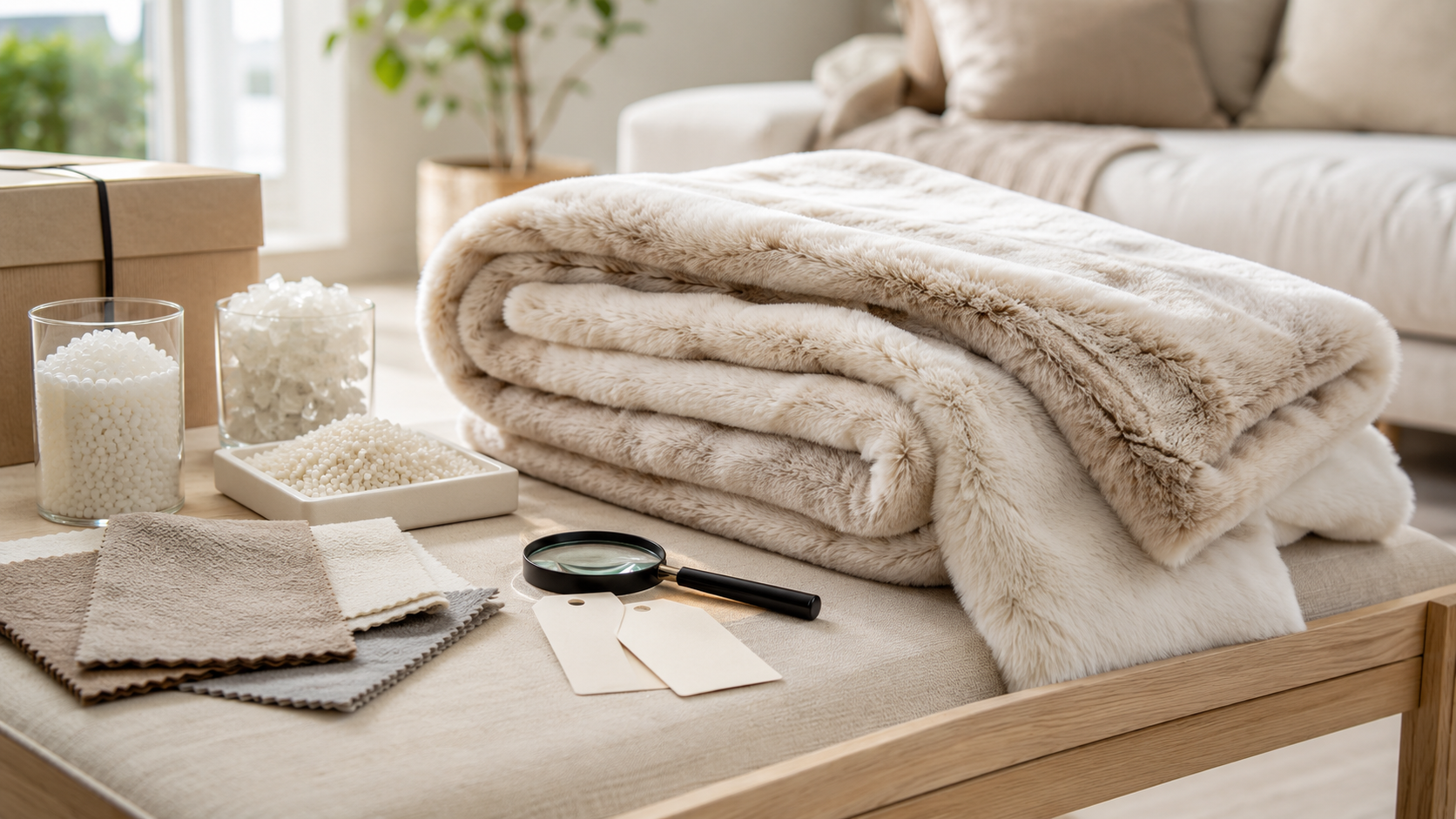
Short answer: A high-quality faux fur blanket can be safe for daily home use, but safety must be supported by material control, dyeing control, finishing control and harmful substance testing.
Most faux fur blankets are made from polyester, recycled polyester, acrylic blends or other synthetic fibers. Synthetic fiber itself does not automatically mean unsafe. The key question is whether the product has been properly controlled and tested during sourcing, dyeing, finishing and production.
B2B buyers should check:
- Whether the fabric has any strong or irritating odor
- Whether dyes and auxiliaries meet target market requirements
- Whether formaldehyde, heavy metals, azo dyes or phthalates are controlled
- Whether the finished product has passed harmful substance testing
- Whether the fiber content label and care label are accurate
- Whether the product is suitable for the intended use, such as adult home use, children, pets, hotels or gift programs
Risk reminder:
Safety should not be treated as a simple marketing claim. It should be proven by materials, testing, certification scope and supply chain control.
2. What Does OEKO-TEX STANDARD 100 Mean for Faux Fur Blankets?
Short answer: OEKO-TEX STANDARD 100 helps verify that textiles and related components have been tested for harmful substances according to their intended use and skin contact level.
For faux fur blankets, OEKO-TEX can help improve buyer and consumer confidence in:
- Skin-contact home textile safety
- European and North American market acceptance
- Retailer supplier approval
- Product page and packaging trust signals
- Family, baby-related, hotel and sensitive-use product development
However, buyers should not simply ask, “Do you have OEKO-TEX?” Instead, they should confirm:
- Whether the certificate is valid
- Whether the certificate covers the fabric or finished faux fur blanket used for the order
- Whether the certificate holder matches the supplier, fabric mill or production source
- Whether the certificate is still within its validity period
- Whether the certification scope includes fabric, trims, labels, thread, dyeing, printing or other relevant components
- Whether the OEKO-TEX label can legally be used on hangtags, packaging or product pages
A better supplier question is:
Can you provide a valid OEKO-TEX certificate covering the fabric or finished faux fur blanket used for this order?
3. Can a Faux Fur Blanket Be Machine Washed?
Short answer: Many faux fur blankets can be machine washed, but the final care instruction must be based on fabric structure, sample washing tests and approved care labels.
B2B buyers should not rely only on a supplier’s verbal statement that the blanket is “machine washable.” Instead, they should request washing test results and evaluate the product before bulk production.
Buyers should check:
- Sample washing test results
- Size change before and after washing
- Shedding after washing
- Fabric softness and pile recovery
- Color change after washing
- Edge seam distortion
- Odor, glue layer or backing changes after washing
- Final care label wording
Common care guidance may include:
- Machine wash cold
- Use gentle cycle
- Use mild detergent
- Wash separately
- Do not bleach
- Avoid high-temperature tumble drying
- Do not iron
- Do not wring strongly
- Air dry recommended
- Gently brush to restore texture after drying
Risk reminder:
The final care label should always be based on actual product testing, not copied from generic washing instructions.
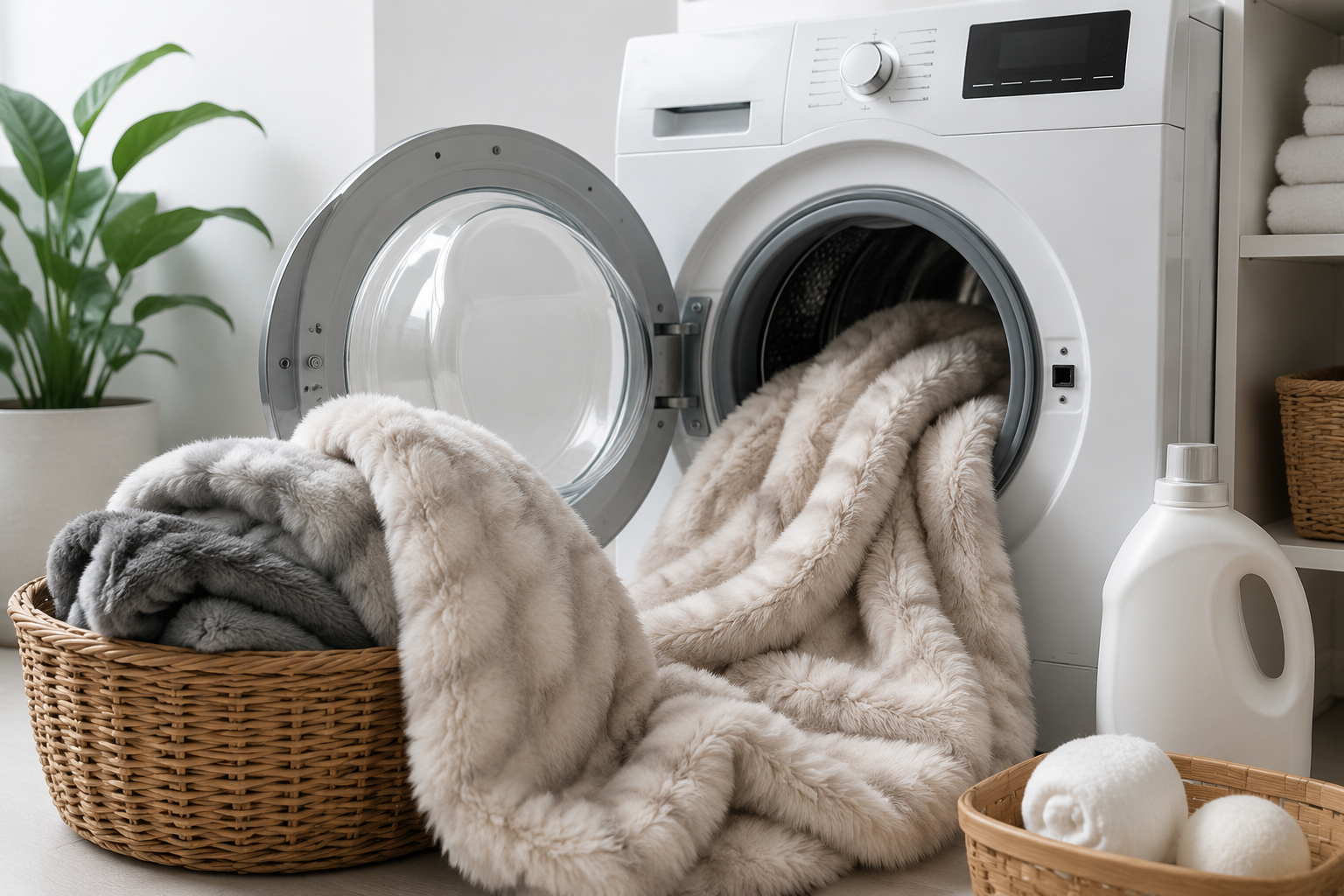
4. Why Does a Faux Fur Blanket Shed, Mat or Become Hard After Washing?
Short answer: Shedding, matting, clumping or stiffness after washing is usually related to heat, strong agitation, detergent residue, unstable finishing, long pile height or poor fabric construction.
Common causes include:
- Washing with hot water
- High-temperature tumble drying
- Strong machine agitation
- Use of bleach or harsh alkaline detergent
- Excess detergent residue
- Unstable fabric finishing
- Long pile height with poor pile direction control
- Different shrinkage rates between face fabric and backing
- Incorrect care label instructions
- Lack of washing tests before bulk production
B2B buyers should run two types of tests during development:
Consumer-use test
Simulate normal household washing conditions, such as cold water, gentle cycle and air drying.
Risk-condition test
Test product behavior under higher-risk conditions, such as stronger agitation, warmer water or improper drying, to decide whether stronger care warnings are needed.
5. Does a Faux Fur Blanket Need REACH Compliance for the EU Market?
Short answer: Yes. Faux fur blankets sold into the EU should be reviewed for REACH requirements, especially SVHC risks and supply chain communication obligations.
For faux fur blankets, potential REACH risk points may include:
- Dyes and pigments
- Finishing auxiliaries
- Coatings or lamination adhesives
- Water-repellent, stain-resistant or flame-retardant finishes
- Printing inks
- PU labels, PVC packaging or decorative components
- Metal accessories
- Packaging materials
B2B buyers should request:
- REACH compliance declaration
- SVHC test report or risk assessment
- Chemical control list
- Fabric and trim source information
- Order-specific testing documents
- SCIP-related confirmation where applicable
Risk reminder:
“REACH compliant” should not be treated as a vague supplier promise. It should be supported by testing, material information and supply chain documentation.
6. What Compliance Points Matter for the U.S. Market?
Short answer: For the U.S. market, faux fur blanket buyers should pay attention to fiber content labeling, country of origin, care labeling, Prop 65 risk and additional requirements for children’s products or specific retail channels.
Depending on the product type, use case, target users and sales state, buyers may need to review:
- Fiber content label
- Country of origin label
- Care label
- Children’s product requirements if marketed for babies or children
- Chemical restrictions and retailer-specific standards
- California Prop 65 risk
- Customer or channel-specific test protocols
If the product is a regular adult home blanket, its requirements may differ from children’s sleepwear, clothing, mattresses or bedding products. Buyers should avoid applying unrelated product standards without confirmation.
Risk reminder:
For California sales, Prop 65 risk should be managed through material review, third-party testing and label assessment.
7. What Textile Labeling Issues Should EU Buyers Consider?
Short answer: Faux fur blankets sold in the EU should have accurate fiber composition labeling and should avoid any wording that could mislead consumers into thinking the product contains real fur.
Common fiber content examples include:
- 100% Polyester
- 100% Recycled Polyester
- Front: 100% Polyester / Reverse: 100% Polyester
- Shell: 100% Polyester / Backing: 100% Polyester
Buyers should confirm:
- Whether fiber composition is accurate
- Whether local language labeling is required
- Whether multi-language care labels are needed
- Whether importer information is required
- Whether country of origin information is needed
- Whether care symbols should be included
- Whether any non-textile animal-origin components are present
- Whether the term “faux fur” is used clearly and does not mislead consumers
8. Can Faux Fur Blankets Be Made with Sustainable Materials?
Short answer: Yes. Faux fur blankets can be made with recycled polyester, but sustainability claims must be specific, verifiable and not exaggerated.
Recycled polyester is commonly used in faux fur fabric, fleece, sherpa and other home textile materials. It may help brands:
- Reduce dependence on virgin polyester
- Build eco-conscious home textile collections
- Meet some retailer requirements for sustainable materials
- Create differentiated product stories
- Support European and North American sustainability-focused programs
However, buyers should understand:
Using recycled polyester does not automatically make a product fully sustainable or eco-friendly.
Before making recycled material claims, buyers should confirm:
- Actual recycled polyester percentage
- Whether GRS or RCS documentation is available
- Whether the certification scope covers fiber, yarn, fabric or finished product
- Whether the supply chain has chain-of-custody control
- Whether hangtags and product pages accurately state recycled content
- Whether packaging also involves environmental claims
- Whether the wording may create greenwashing risk
9. GRS vs RCS: Which One Matters for Faux Fur Blankets?
Short answer: RCS is mainly used to verify recycled material content and supply chain traceability, while GRS offers broader requirements including recycled content, chain of custody, social, environmental and chemical criteria.
| Standard | Main Focus | Suitable Use Case | B2B Value |
|---|---|---|---|
| RCS | Recycled content and supply chain traceability | Basic recycled material claims | Verifies recycled content |
| GRS | Recycled content, traceability, social, environmental and chemical requirements | Higher-level sustainable product programs | Stronger sustainability support |
For faux fur blanket buyers:
- RCS may be enough for basic recycled content claims.
- GRS is usually more suitable for premium sustainable collections, European buyers, North American brands and retailer-driven programs.
Buyers should confirm:
- Whether the supplier can provide GRS or RCS certificates
- Whether the certificate belongs to the supplier, fabric mill or yarn mill
- Whether transaction certificates are available
- Whether recycled content percentage matches product claims
- Whether the certificate covers the target product category
- Whether hangtag, packaging and webpage claims are supported
10. Testing Checklist for Bulk Faux Fur Blanket Orders
Short answer: Testing requirements should be based on target market, sales channel, customer requirements and product use case.
| Test Item | Purpose |
|---|---|
| Fiber composition test | Confirms that fiber content matches the label |
| Colorfastness test | Checks color transfer during rubbing, washing or use |
| Dimensional stability test | Checks shrinkage or deformation after washing |
| Washing test | Evaluates softness, pile condition, shedding and seams |
| Shedding test | Assesses loose fiber and ongoing shedding risk |
| Pilling test | Useful for fleece, sherpa or backing structures |
| Formaldehyde test | Controls harmful substance risk |
| Azo dye test | Required for certain market regulations |
| Heavy metal test | Controls risks from dyes, trims and accessories |
| Phthalate test | Relevant for plastic labels, prints, coatings or packaging |
| REACH SVHC screening | Common requirement for EU markets |
| Prop 65 risk testing | Important for California sales |
| OEKO-TEX documentation | Supports product safety claims |
| GRS/RCS documentation | Supports recycled material claims |
Not every order requires every test. However, buyers entering large retailers, the EU market, children’s product categories or premium brand programs should expect stricter testing and documentation requirements.
11. How to Evaluate a Reliable Faux Fur Blanket Supplier
Short answer: A reliable supplier should not only offer a competitive price but also demonstrate certification support, testing knowledge, production control and documentation traceability.
B2B buyers should evaluate suppliers based on:
1. Valid certification documents
Relevant documents may include OEKO-TEX, GRS, RCS, BSCI, ISO 9001 or other certifications depending on the order requirements.
2. Understanding of target market requirements
A capable supplier should understand requirements such as REACH, SVHC, Prop 65, fiber content labeling, care labeling and retailer testing standards.
3. Testing support during sample development
A professional supplier should be able to identify potential risks in materials, colors, finishing, trims and packaging before bulk production.
4. Bulk production consistency
Certification and sample approval are only the beginning. Buyers should confirm pre-production samples, inline inspection, final inspection and shipment approval procedures.
5. Documentation traceability
This is especially important for recycled polyester projects. Buyers should ask for evidence from raw material to finished product instead of relying on a simple “recycled polyester” statement.
12. Safe Marketing Claims for Faux Fur Blankets
Short answer: Environmental and safety claims should be specific, verifiable and limited to what the product documentation can support.
Avoid vague or exaggerated claims such as:
- 100% eco-friendly
- Completely sustainable
- Zero impact
- Green blanket
- Planet-friendly without proof
- Chemical-free
Use more specific claims such as:
- Made with recycled polyester
- Contains 60% recycled polyester
- GRS-certified recycled polyester fabric available
- Faux fur blanket made with OEKO-TEX certified fabric
- Recyclable packaging available upon request
- Designed for long-lasting comfort
A safer principle for B2B marketing is:
Be specific, be verifiable and do not overpromise.
13. Market Compliance Overview
| Market | Key Concerns | Buyer Should Prepare |
|---|---|---|
| EU | REACH/SVHC, textile fiber labeling, multi-language requirements | REACH declaration, SVHC report, accurate fiber labels |
| U.S. | Fiber content, care label, country of origin, Prop 65 | Care label, composition label, Prop 65 risk review |
| California | Prop 65 chemical exposure warning risk | Material review, third-party testing, label assessment |
| Children’s Products | Small parts, shedding, chemical safety, frequent washing | Child-related testing, stricter material review |
| Sustainable Collections | Recycled polyester, GRS/RCS, green claims | Certificates, transaction documents, recycled content percentage |
14. Recommended Claim Wording
| Claim | Recommended? | Reason |
|---|---|---|
| Eco-friendly faux fur blanket | Not recommended | Too broad and may be considered misleading |
| 100% sustainable blanket | Not recommended | Difficult to prove |
| Green blanket | Not recommended | Vague and unsupported |
| Made with 60% recycled polyester | Recommended | Specific and verifiable |
| GRS-certified recycled polyester fabric available | Recommended | Supported by certification scope |
| Faux fur blanket made with OEKO-TEX certified fabric | Recommended if true | More accurate than claiming the whole product is certified |
| Recyclable packaging available upon request | Recommended if true | Specific and limited claim |
15. Faux Fur Blanket FAQ
Q1: Is a faux fur blanket safe?
A high-quality faux fur blanket can be safe for daily home use, but buyers should confirm material safety, harmful substance testing, odor control, shedding performance and applicable certification documents.
Q2: Can a faux fur blanket be OEKO-TEX certified?
Yes, but buyers should confirm whether the certificate covers the fabric, trims or finished product used for the specific order. The certificate should be valid and within the correct scope.
Q3: Can a faux fur blanket be machine washed?
Many faux fur blankets can be machine washed, but this must be confirmed through sample washing tests. Cold water, gentle cycle, mild detergent and air drying are commonly recommended, but final care labels should be based on testing.
Q4: Why does a faux fur blanket become hard or matted after washing?
Common reasons include hot water, high-temperature drying, strong agitation, detergent residue, unstable finishing or long pile height. Buyers should test washing performance before confirming bulk orders.
Q5: Is recycled polyester faux fur blanket more sustainable?
Recycled polyester may reduce dependence on virgin polyester, but it does not automatically make the product fully sustainable. Buyers should confirm recycled content percentage, GRS/RCS documentation and supply chain traceability.
Q6: Which is better for faux fur blankets, GRS or RCS?
RCS is suitable for basic recycled content verification. GRS is stronger for premium sustainable product lines because it also includes broader environmental, social and chemical requirements.
Q7: Do faux fur blankets exported to the EU need REACH review?
Yes. Buyers should review REACH and SVHC risks and request compliance declarations, test reports or risk assessment documents from suppliers.
Q8: Do faux fur blankets need flame-retardant testing?
This depends on the target market, product use, customer requirements and product category. Buyers should not directly apply standards from clothing, mattresses or children’s sleepwear without confirmation from a testing body.
Q9: How can buyers reduce after-sales complaints?
The key is to control shedding, washing deformation, color difference, odor, packaging compression marks and misleading care instructions. Testing should be completed before bulk production.
Q10: Can suppliers simply claim “eco-friendly material”?
No. Buyers should request material proof, GRS/RCS certificates, transaction documents or order-specific evidence. Environmental claims must accurately reflect the actual product content and certification scope.
Conclusion: Faux Fur Blanket Safety, Washing and Sustainability Must Be Proven by Documents and Testing
Faux fur blankets are attractive products for premium home decor, winter gifts, retail collections and e-commerce visual merchandising. However, for B2B buyers, they involve more than softness and appearance.
A bulk-ready faux fur blanket should meet the following expectations:
- Safe and reliable materials
- Controlled harmful substance risk
- Stable washing performance
- Low shedding risk
- Accurate care labels
- Clear fiber content labels
- Verified recycled material claims where applicable
- Target market compliance review
- Consistent sample-to-bulk production quality
- Reliable supplier documentation and quality management
For B2B buyers, the recommended purchasing process is:
Confirm target market → define regulatory and customer requirements → select suitable materials → verify certificates → complete sample testing → approve care label and packaging claims → approve pre-production sample → control bulk quality → keep order documents and test records.
If your brand is developing custom faux fur blankets, recycled polyester faux fur blankets, OEKO-TEX fabric blankets or winter home textile gift collections, LISO HOME can support material selection, OEM/ODM development, sample making, private label customization, packaging solutions and export-oriented production.
Contact LISO HOME to request sample development suggestions, compliance document checklists or bulk quotation support.