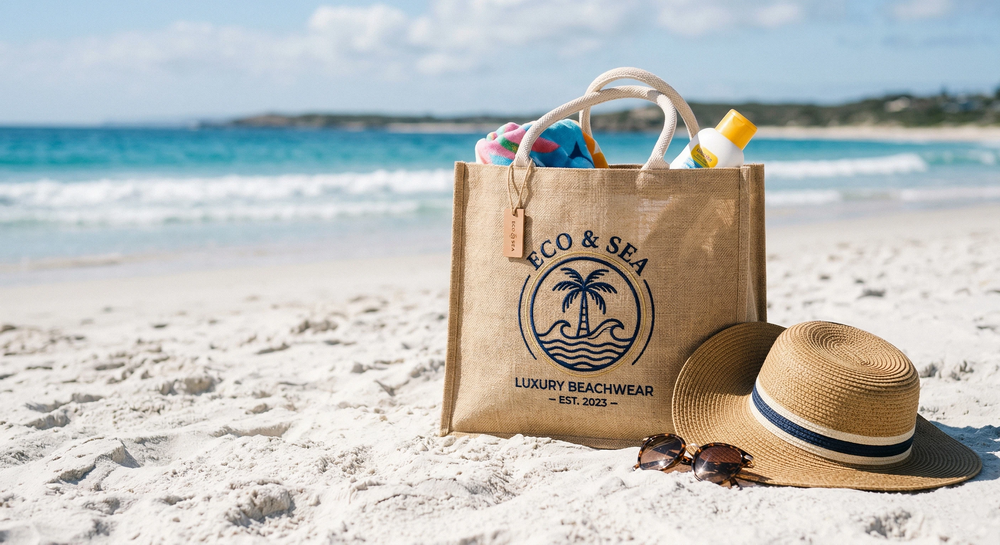
Most suppliers sell a beach bag. I have seen resort buyers look for something else. They want a bag that proves their brand values in public, or the product fails.
Resort and travel brand buyers will often pay 20-30% more for a custom eco beach bag when it helps them tell a material story, show visible repair thinking, and deliver a full sustainable unboxing experience. They are not buying a cheap carry-all. They are buying a branded sustainability statement that guests can carry beyond the property.
I have worked with buyers who run resorts, island brands, and tourism destinations. In almost every project, the real discussion starts after the basic bag spec is done. The size, zipper, color, and logo matter. Still, those are not the details that shape trust. The details that change the deal are often hidden at first. Once I learned to frame those details the right way, I saw quotes rise and client relationships become much stronger.

Why do resort and tourism buyers think differently from normal wholesalers?
Most suppliers still treat every “eco beach bag” inquiry in the same way. That is where they miss money. A resort brand is not asking which bag will sell fastest in a retail channel. I have seen them ask a much harder question: can this bag represent our values when a guest carries it by the pool, on the boat, or through the airport?
Resort and tourism buyers do not buy like volume wholesalers. They buy for brand image, guest experience, and value alignment. The bag is part product, part marketing tool, and part proof of what the brand claims to stand for.
In my experience, this is the first mindset shift that suppliers need to make. A normal wholesaler often cares about price, speed, and what moves best. A resort or destination brand buyer cares about meaning, consistency, and guest perception. That sounds abstract, but it changes very practical things in the sourcing process.
I have sat in meetings where the buyer spent more time on hangtag wording than on bag dimensions. That surprises factories that are used to bulk trading. Yet it makes sense. The bag may be given in a room package, sold in a boutique, used in a beach club, or featured in social content. One product touches many parts of the brand.
Here is how I usually explain the difference:
| Buyer type | Main question | What they compare | Why it matters |
|---|---|---|---|
| Normal wholesaler | Will this item sell well? | Price, speed, margin | They care about turnover |
| Resort brand | Does this item express our brand well? | Story, feel, design logic | They care about brand image |
| Tourism destination operator | Can this item represent the place? | Local meaning, guest use, content value | They care about destination identity |
Once a supplier understands this, the offer changes. The pitch should stop sounding like a factory list. It should start sounding like a brand solution. This is also why these clients can become high-stickiness B2B accounts. They are not only buying units. They are buying confidence. When a supplier helps them look thoughtful and consistent, switching becomes harder.
Why does a material story matter more than “recycled PET”?
Many suppliers stop at the words “recycled material.” In my experience, that is not enough for high-end resort and travel buyers. They want a material story that a guest can understand in one line and remember later.
A strong material story turns a beach bag from a low-interest item into a branded content asset. Claims like “made from recycled PET” are weak on their own. Claims tied to origin, quantity, or place create emotional and marketing value.
I have seen a big difference between generic sustainability claims and specific ones. If a buyer hears “recycled PET,” they may nod and move on. If they hear “this bag is made from the equivalent of X recycled water bottles,” the idea becomes clear. If the fabric comes from recovered local fishing nets, the idea becomes even stronger. Now the material links to a place, a problem, and a recovery story.
This is why some origin-based materials can cost 20-30% more than standard recycled inputs and still get approved. The buyer is not only paying for fiber. They are paying for a message they can print on the bag, add to the room booklet, place in the gift shop display, or use in a social post.
I often tell suppliers to prepare the material story in layers:
| Layer | Example | Why buyers like it |
|---|---|---|
| Simple fact | Made with recycled content | Easy to state, but weak alone |
| Quantified fact | Made from the equivalent of X bottles | Easy for guests to grasp |
| Origin fact | Made from recovered coastal plastic or local fishing nets | Gives place-based meaning |
| Brand use case | Story can be printed on tag, insert, or bag body | Turns the product into marketing content |
There is also a trust issue here. Resort buyers are often careful because sustainability claims can backfire. They do not want vague words that sound good but say little. They want a story they can repeat with confidence. So, a supplier that prepares clear claim language, proof points, and guest-facing wording is no longer just offering material. That supplier is reducing brand risk.
That is one reason premium pricing becomes easier. The supplier is selling a usable story, not only a bag shell.
Why is visible repair design becoming a quiet filter in supplier selection?
One trend I have seen more often in higher-end Western resort projects is the idea that product life should be visible. The buyer does not just want a bag that lasts. They want a bag that shows it was designed to last.
Visible repair design helps buyers support circular design goals. When a handle, strap, or trim can be replaced instead of forcing full disposal, the product fits the sustainability story better and makes the supplier look more advanced.
This is still underused in many supplier offers. Most factories focus on reducing defect rate, which is important. Yet some buyers now ask a deeper question: if one part fails, what happens next? If the answer is “throw the whole bag away,” that weakens the sustainability claim.
I have seen strong reactions when suppliers offer replaceable handles, spare parts, or a simple repair kit. These options are not always expensive. In many cases, the real barrier is not cost. The real barrier is that suppliers never thought to package repair as part of the product value.
Here is how repair thinking changes the offer:
| Design element | Standard approach | Circular approach | Buyer response |
|---|---|---|---|
| Handle damage | Replace full bag | Offer replacement handle or hardware | Feels more responsible |
| Small hardware failure | Treat as defect waste | Send spare component | Extends useful life |
| After-sales support | None | Clear replacement process | Builds trust |
| Sustainability claim | “Durable” | “Designed for longer life and repair” | Sounds more credible |
I think this matters for two reasons. First, it helps the buyer explain the product internally. A team can show that the bag was chosen not only for recycled material, but also for longer life and lower waste. Second, it gives the end guest a better experience. A product that can be repaired feels more premium. It also feels more honest.
From the supplier side, this creates stickiness. Once a client starts relying on your spare parts logic, repair guide, or replacement system, you are harder to replace with a lower-price competitor. The relationship starts to move from order-taking to light system support. That is where B2B loyalty gets stronger.
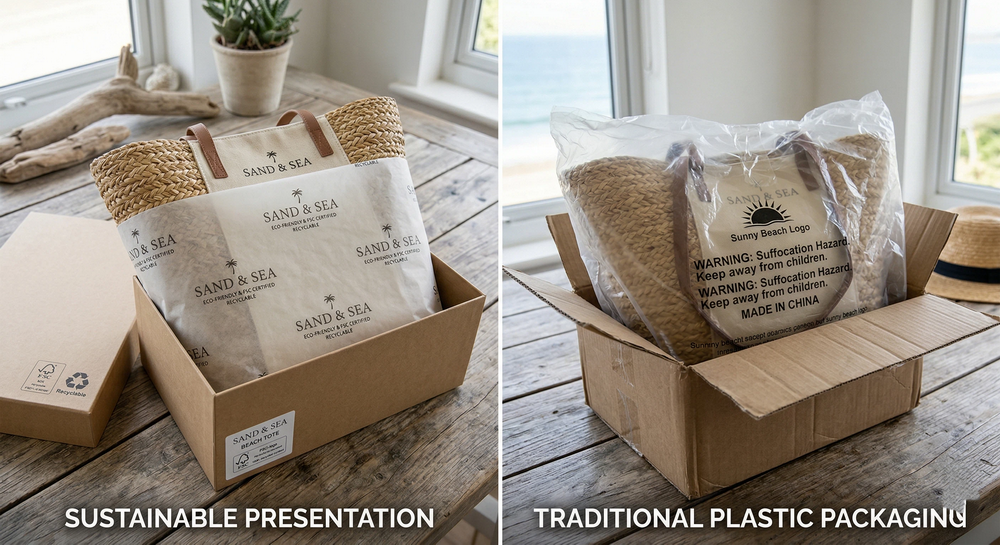 Some suppliers still treat packaging as an afterthought. In resort and travel brand projects, I have learned that packaging is often the first physical proof of the sustainability promise. If that first touchpoint feels wrong, the whole story weakens.
Sustainable packaging matters because the guest experience starts the moment the bag is received. A biodegradable or lower-impact pack option may only add $0.05-$0.10 per unit, but it protects the brand story and improves the perceived quality of the program.
I have seen buyers care deeply about this even when the cost gap is small. To some suppliers, switching from a clear plastic polybag to a compostable or more sustainable alternative looks minor. To the buyer, it is part of a complete narrative. If the hotel says it values the planet, then wraps the bag in standard throwaway plastic, the message breaks at the exact moment the guest sees the product.
This is why I tell suppliers to stop quoting packaging as a side note and start presenting it as part of the sustainability architecture of the item.
A simple way to structure the offer is this:
| Packaging choice | Added cost | Brand effect | Strategic value |
|---|---|---|---|
| Standard plastic bag | Lowest | Weakens story | Looks inconsistent |
| Biodegradable bag | Low increase | Supports story | Easy win |
| Recycled paper wrap or insert | Moderate | Adds tactile brand feel | Better for premium positioning |
| Printed sustainability insert | Small | Helps guest understand value | Turns packaging into communication |
The key point is that buyers remember the guest’s first impression. In many resort settings, that moment is part of a room arrival, welcome package, boutique purchase, or event gift. It is not only packaging. It is staging.
When suppliers present packaging this way, they stop sounding like factories cutting cents. They start sounding like partners who understand guest experience. That shift often supports a higher quote because the client sees better thinking, not just higher cost.
Conclusion
When I help suppliers serve resort and travel brands, I focus on story, repair, and packaging. Those three hidden needs often justify higher pricing and create longer, stronger B2B relationships.