TL;DR
A good Pallet cushion for outdoor wholesale is not just about shape or price. Large buyers in Europe, North America, and Australia should evaluate it by use case first, then verify the material system behind that use case: fabric construction, UV/weather resistance, water repellency, colorfastness, filling stability, metal contamination control, and shipping-ready packaging. The safest procurement approach is to ask suppliers to tie every claim to a named test method, inspection standard, and packing protocol instead of relying on generic words like “outdoor,” “waterproof,” or “sun-resistant.”
Outdoor buyers usually lose margin on pallet cushions in three places: premature fading, customer complaints after light rain or seasonal exposure, and avoidable logistics cost from poor packing design. For wholesale and eCommerce programs, the right specification is therefore scenario-based: poolside and patio programs need stronger weathering and colorfastness control, hospitality projects need appearance consistency lot to lot, and online sellers need rebound-safe compression packing that survives parcel handling without damaging loft or shape.
[📊 Cite: AATCC states it develops industry test methods used for textile quality control; AATCC standards page and testing overview.]
What is the best way to source a Pallet cushion for outdoor wholesale?
The best way to source a Pallet cushion is to start with the end-use environment, then lock fabric, finish, filling, inspection, and packing requirements to that environment in writing.
That means a buyer should not begin with thickness or color alone. A patio retail program, a hospitality terrace project, and an eCommerce pallet seating SKU may all look similar, but they need different performance priorities and different risk controls.
A practical buying sequence is: define the use scenario, define the fabric and finish system, define the testing method, define the acceptance criteria, then define shipping and inspection rules. This reduces argument later because terms like “anti-UV” and “water-resistant” mean very little unless the supplier also names the standard behind them.
[📊 Cite: ISO 105-B02 covers color fastness to artificial light using xenon arc; ISO 4920 covers resistance to surface wetting by spray test; ASTM G154 is used for accelerated UV exposure of materials.]
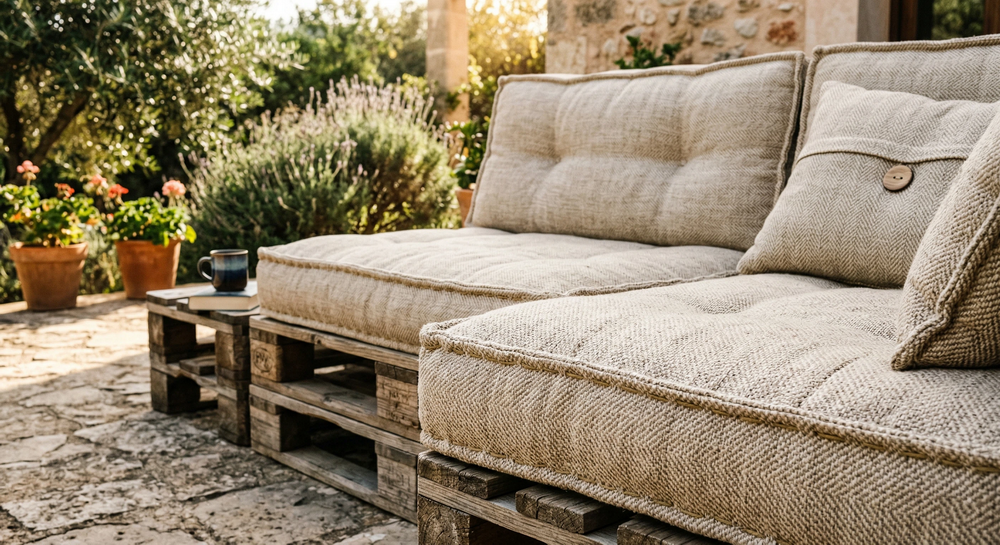
Why does use case matter more than headline specs?
Use case matters more than headline specs because outdoor cushion failure usually happens in the field, not on the showroom table.
For example, a cushion used on a covered balcony may mainly need surface water repellency and decent abrasion/color stability. A cushion used in open-sun Australian or Southern European conditions will place much more stress on lightfastness and weathering performance, so the buyer should emphasize UV-related testing and batch consistency.
For eCommerce sellers, the use case includes the shipping path. A cushion can pass fabric checks and still fail commercially if compression packing leaves permanent creases, distorted edges, or insufficient rebound after delivery.
Which outdoor scenarios should buyers use to define their specification?
The right specification should be built around at least one of the following outdoor scenarios, because each one changes the risk profile.
1. Covered patio or balcony
This scenario usually prioritizes appearance, comfort, and occasional splash resistance. The buyer should focus on fabric hand feel, color consistency, staining risk, and basic repellency rather than the most aggressive weathering package.
2. Open patio, garden, or poolside
This scenario requires stronger lightfastness and better weather resistance. The key concern is not just one rain event, but repeated sun-plus-moisture exposure that can fade color, weaken finish performance, and shorten shelf-life for the retailer.
3. Hospitality, resort, or project seating
This scenario prioritizes repeatability across lots. Procurement teams need tighter shade control, consistent fill weight, dimensional stability, and clearer incoming and final inspection plans because mismatched batches create visible project-level issues.
4. ECommerce and marketplace fulfillment
This scenario prioritizes packability and returns prevention. The cushion must recover shape after compression, fit the parcel strategy, and arrive with packaging that protects corners, zippers, labels, and vacuum-packed rebound quality.
What fabric details should wholesale buyers check first?
The first fabric details to check are fiber type, fabric construction, finish system, and how the supplier proves outdoor performance.
For many outdoor cushion programs, solution-dyed or other fade-managed constructions are preferred because sunlight is one of the main reasons for complaints. However, buyers should not accept fiber claims alone; they should request the specific lightfastness or weathering test method used and the latest lab report tied to the same fabric code and colorway.
Water performance also needs precision. ISO 4920 specifically measures resistance to surface wetting in a spray test, and it is not intended to predict rain penetration through the fabric, which means “water-repellent” is not the same as waterproof. If a supplier claims both, buyers should ask what was tested for surface wetting and what was tested for penetration resistance.
The same principle applies to crocking and wash behavior. If the cushion has dark shades, printed covers, or removable washable covers, buyers should ask for the relevant crocking and laundering evidence rather than assuming color performance will hold in real consumer use.
[📊 Cite: ISO 4920 says the spray test determines resistance to surface wetting and does not predict rain penetration; AATCC identifies TM8 as Colorfastness to Crocking and TM61 as Colorfastness to Laundering; AATCC TM127 is the hydrostatic pressure method for water resistance.]
What does “anti-UV” really mean for an outdoor pallet cushion?
“Anti-UV” only becomes meaningful when the supplier links it to a named exposure method and a defined result.
In procurement, buyers often hear broad claims such as UV-proof, fade-resistant, or sun-resistant. Those claims are incomplete unless the supplier states whether the fabric was assessed using outdoor light exposure, xenon-arc light exposure, or accelerated UV weathering, and whether the result refers to color change, strength retention, or both.
ISO 105-B02 specifies a xenon-arc method for evaluating the effect of artificial light on textile color. ISO 105-B04 specifies a xenon-arc simulated weathering approach for textile color under weathering conditions, while ASTM G154 is a commonly used accelerated UV exposure practice for materials more broadly. For outdoor pallet cushions, the buyer should confirm which method is being used, because different methods answer different questions.
A useful commercial rule is simple: never approve “anti-UV” without a test method, exposure condition, report date, and sample identification. That makes the claim auditable for both procurement and technical teams.
[📊 Cite: ISO 105-B02 defines xenon-arc testing for color fastness to artificial light; ISO 105-B04 defines xenon-arc simulated weathering for textile color; ASTM G154 covers fluorescent UV exposure of materials; AATCC lists TM16.1 Outdoor and TM16.3 Xenon-Arc lightfastness methods.]
Why are water repellency and water resistance different buying questions?
They are different buying questions because they measure different failure modes.
Water repellency usually refers to how well the fabric surface resists wetting. ISO 4920 and AATCC TM22 are spray-based methods used to assess that surface behavior, which is useful for cushions exposed to dew, splashes, or light rain.
Water resistance goes further and addresses water penetration under pressure. AATCC TM127 is the hydrostatic pressure method, and it answers a tougher question than a surface spray test. If the product will be left outside for long periods, or if the cover is marketed as a stronger barrier layer, the buyer should ask whether only surface wetting was tested or whether penetration resistance was also evaluated.
This distinction matters commercially because many claim disputes start with language, not manufacturing. A cushion can pass a repellency test and still disappoint a customer who expected rainproof performance.
[📊 Cite: ISO 4920 states the spray test is for resistance to surface wetting and not for predicting rain penetration; AATCC explains TM22 as a quick, low-cost way to screen water repellency; AATCC TM127 is the hydrostatic pressure method for water resistance.]
How should buyers evaluate colorfastness for outdoor pallet cushions?
Buyers should evaluate colorfastness across light, rubbing, and where relevant laundering, because outdoor complaints rarely come from a single cause.
Lightfastness matters because outdoor pallet cushions spend long periods exposed to daylight or simulated daylight. Crocking matters because dark fabrics, textured weaves, and frequent handling can transfer color to clothing or adjacent surfaces. Laundering matters when covers are removable and sold as washable.
Instead of asking for a vague “high colorfastness,” buyers should require the supplier to specify which standard was used and what the result means for the intended channel. AATCC recognizes methods for light exposure, crocking, and laundering, while ISO 105-B02 is a key reference for xenon-arc light exposure on textile color.
For large programs, colorfastness should also be checked color by color. A fabric family may perform differently across navy, charcoal, terracotta, or deep green, so approval should be tied to the actual colorway, not just the base cloth.
[📊 Cite: AATCC identifies TM16.1/TM16.3 for colorfastness to light, TM8 for crocking, and TM61 for laundering; ISO 105-B02 is the xenon-arc lightfastness method for textiles.]
What filling and inner construction issues create the most complaints?
The most common filling-related complaints are flattening, uneven support, slow rebound after compression, and edge distortion after storage or shipping.
For procurement teams, this means the inside of the cushion deserves almost as much attention as the fabric shell. Buyers should confirm the filling material, fill weight tolerance, insert construction, compartment strategy if any, and whether the cushion is designed to hold shape after vacuum or roll packing.
A low-priced outer cover can hide a high return rate if the fill shifts or collapses. Technical buyers should therefore request rebound checks after packing, weight consistency by size, and a simple post-unpack recovery protocol before shipment approval.
For hospitality or project orders, consistent seat feel across the lot matters as much as durability. Uneven fill from cushion to cushion creates visible and functional inconsistency that becomes obvious once the full installation is in place.
Why does needle detection still matter for pallet cushion suppliers?
Needle detection still matters because metal contamination is a product safety and quality-control issue, especially in sewn soft goods.
Pallet cushions are fabric-based products that typically pass through cutting, sewing, trimming, and packing operations. That means large buyers should ask whether the factory has a broken-needle or metal contamination control procedure, whether finished goods are scanned when required, and whether the process is documented for traceability.
This is especially important for risk-sensitive retailers and private-label programs. Even if local regulation does not prescribe one universal textile needle-detection rule for every cushion, buyers often still require factory-level controls because the commercial and reputational cost of a contamination incident is high.
A simple procurement question works well here: “Show us your broken-needle control SOP, machine calibration records, and finished-goods scanning records for this order.” That shifts the discussion from claims to evidence.
[📊 Cite: CEIA states textile metal detectors are used to detect metal contaminants and help prevent machinery/product issues; Oshima describes garment needle detectors for metal contamination control in textile QC.]
How should compression packing be handled for wholesale and eCommerce orders?
Compression packing should only be used when the cushion can recover shape reliably and the pack design has been validated for the real delivery channel.
For wholesale container shipments, compression can reduce shipping cube and improve loading efficiency, but the commercial win disappears if the customer opens the package and sees misshapen edges, wrinkled covers, or weak rebound. The right test is therefore not just “Can it be compressed?” but “Can it recover after storage, handling, and transit?”
For eCommerce, packing should match the parcel environment. ISTA 3A is designed for packaged-products shipped through parcel delivery systems up to 150 lb/70 kg, and ASTM D4169 provides a laboratory framework for evaluating shipping units against distribution hazards. These are useful reference points when a buyer wants the factory to validate a cushion’s pack-out, carton, and recovery performance before launch.
The operational takeaway is straightforward: specify pack method, compression ratio if used, recovery time expectation after unpacking, and transit test responsibility before mass production. That is the difference between freight savings and a returns problem.
[📊 Cite: ISTA says Procedure 3A is for packaged-products shipped through a parcel delivery system up to 150 lb/70 kg; ASTM D4169 provides a uniform basis for evaluating shipping units in distribution environments.]
Which standards and checkpoints should buyers put into a purchase specification?
Buyers should write standards and checkpoints directly into the PO, tech pack, or quality agreement so the supplier’s promise becomes enforceable.
Below is a practical framework for outdoor Pallet cushion sourcing:
| Checkpoint | Why it matters | What to ask the supplier for |
|---|---|---|
| Fabric identification | Prevents material substitution | Fabric code, composition, weight, weave, finish description |
| UV/light performance | Reduces fading complaints | Test method used: ISO 105-B02 / ISO 105-B04 / AATCC TM16 / ASTM G154, plus report |
| Water performance | Prevents vague “waterproof” claims | ISO 4920 or AATCC TM22 for repellency; AATCC TM127 if water resistance is claimed |
| Colorfastness | Protects appearance and user experience | Light, crocking, laundering reports tied to approved colorway |
| Filling consistency | Prevents flattening and uneven feel | Fill specification, weight tolerance, rebound check, size tolerance |
| Needle/metal control | Reduces contamination risk | Broken-needle SOP, detector calibration, scanning records where applicable |
| Packaging | Protects delivery performance | Compression method, carton spec, unpack recovery check, transit validation |
| Final inspection | Controls lot acceptance | AQL plan and inspection record before shipment |
ANSI/ASQ Z1.4 is an established acceptance sampling system used with AQL-based inspection plans. For large-volume buyers, that gives procurement and QA teams a shared framework for deciding how lot acceptance will work before goods leave the factory.
[📊 Cite: ASQ states ANSI/ASQ Z1.4 provides plans, procedures, and acceptance levels for inspections; ANSI/ASQ Z1.4 is an acceptance sampling system for inspection by attributes.]
What compliance points matter for Europe, North America, and Australia-facing programs?
The most relevant compliance point is that market access depends on more than product appearance; chemical and documentation readiness also matter.
For Europe, REACH remains a core framework for chemicals compliance. For U.S.-facing business, California Proposition 65 is frequently reviewed by brands and importers because listed chemicals and warning obligations can create risk if materials are not controlled upstream.
This does not mean every pallet cushion needs the same test matrix in every country. It does mean wholesale buyers should align raw materials, restricted-substance management, and document retention with target-market requirements before scale-up, rather than after a listing goes live or a container lands.
For cross-border programs, the best practice is to combine performance testing with a materials compliance file. That usually includes supplier declarations, test reports where needed, labeling/artwork checks, and traceable material records by fabric lot and filling batch.
[📊 Cite: The European Commission states REACH requires registration obligations for substances above 1 tonne per year per company and governs chemicals compliance in the EU/EEA; California OEHHA maintains the current Proposition 65 chemical list online.]
What should procurement teams ask a pallet cushion supplier before placing a bulk order?
Procurement teams should ask for proof, not adjectives.
Ask the supplier which outdoor scenario the proposed Pallet cushion spec is built for. Then ask which standards were used for lightfastness, surface wetting, water resistance if claimed, colorfastness, inspection sampling, and packaging validation.
Technical teams should ask for fabric code-level reports, not generic company brochures. Commercial teams should ask how the supplier controls lot consistency, fill tolerance, compression rebound, and packaging for container versus parcel channels.
A concise supplier checklist can look like this:
- What exact fabric and finish system is used for this SKU?
- Which light/UV test method supports the outdoor claim?
- Is the product tested for water repellency only, or also for water penetration resistance?
- How is colorfastness verified for the approved colorway?
- What filling material and weight tolerance are controlled per size?
- Is there a broken-needle or metal contamination control process?
- Can the cushion be compression packed without unacceptable shape loss?
- What inspection plan and AQL level will be used before shipment?
- What compliance documents are available for the target market?
[🎯 CTA: Ask suppliers for a test-method matrix, latest reports by fabric code/colorway, and a packaging validation sample before PO release.]
FAQ
1. Is a water-repellent pallet cushion the same as a waterproof pallet cushion?
No. Water repellency usually refers to surface wetting resistance, while waterproof or water-resistant claims may require different tests that assess water penetration under pressure. Buyers should ask which test method supports the claim.
2. What is the most important performance indicator for an outdoor pallet cushion?
There is no single indicator for every program. For open-sun outdoor use, lightfastness and weather resistance are critical; for eCommerce, rebound after compression and transit-safe packaging can be just as important.
3. Why should wholesale buyers care about needle detection for cushions?
Because pallet cushions are sewn textile products, metal contamination control is part of responsible factory quality management. Buyers should ask for the factory’s broken-needle procedure and related records.
4. Should buyers approve a fabric based on one generic test report?
No. Approval should be linked to the actual fabric code, finish, and colorway being ordered. Different constructions and colors can behave differently in light, rubbing, and wet conditions.
5. What is the safest way to compare pallet cushion suppliers?
Compare them using the same specification sheet and the same evidence list: named standards, current reports, fill details, inspection plan, and packaging validation results. That makes quotes more comparable and lowers sourcing risk.
<p>If you are sourcing a reliable <a href="https://lisohome.com/product/outdoor-patio/custom-outdoor-cushions/">outdoor cushion OEM manufacturer</a>, LISO offers custom patio cushions with waterproof fabrics, MOQ from 200 units, and samples ready within 14 days. <a href="https://lisohome.com/product/outdoor-patio/custom-outdoor-cushions/">Request a free quote →</a></p>