Introduction: Why Tablecloth Material Matters in Wholesale Purchasing
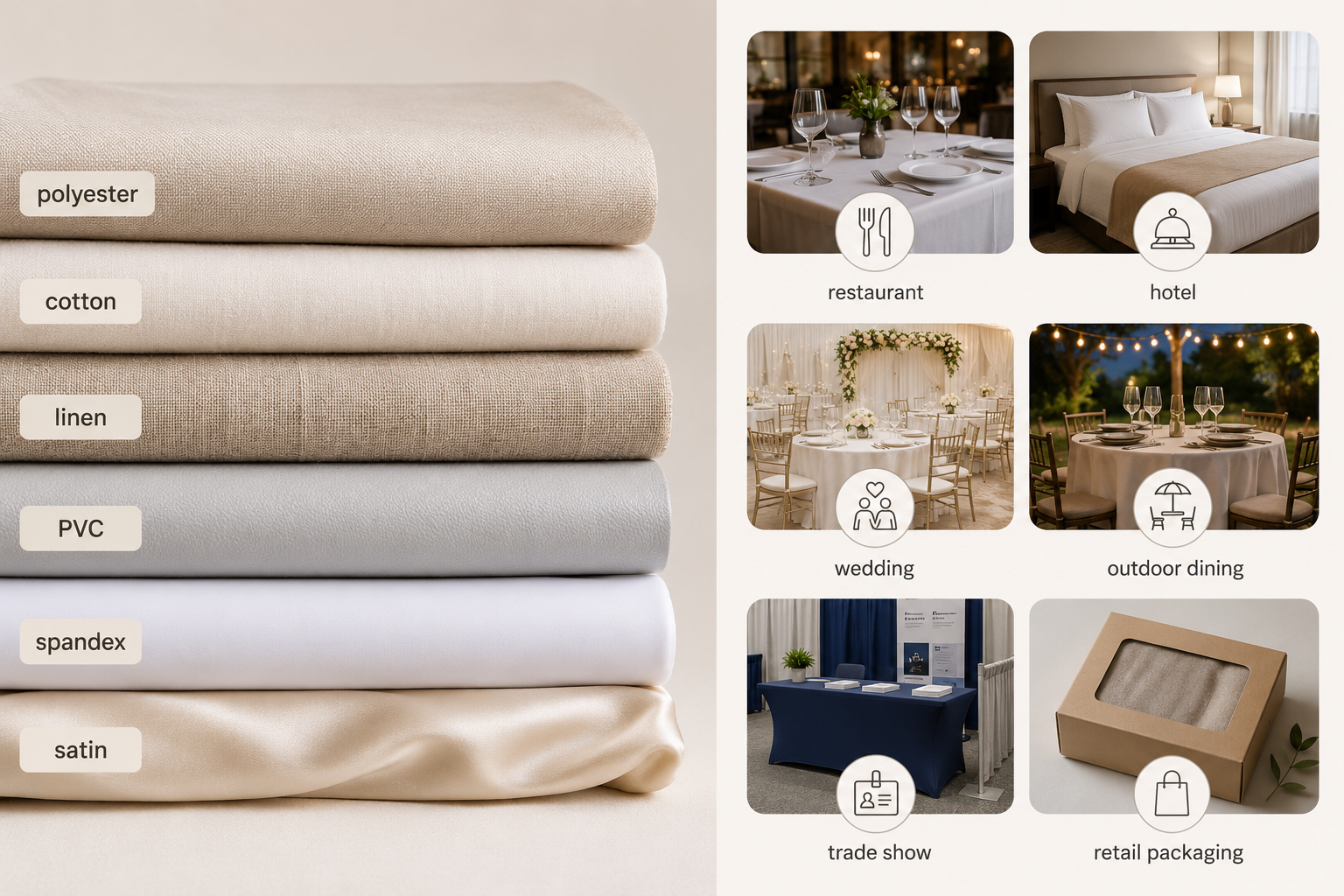
For B2B buyers, tablecloth material is not just a design choice. It affects product appearance, durability, washing cost, inventory planning, customer experience, and long-term cost per use. A restaurant may need tablecloths that can withstand repeated laundering. A hotel may require stable sizing, formal appearance, and consistent color across repeat orders. A wedding rental company may care about drape, color range, and reuse value. A retail or e-commerce brand may focus on packaging, texture, print quality, and customer perception.
This tablecloth material guide is written for importers, wholesale distributors, restaurant buyers, hotel and banquet suppliers, wedding and event rental companies, retail brands, e-commerce sellers, promotional product buyers, and private label home textile brands. It explains common wholesale tablecloth materials, their advantages and limitations, and the practical questions buyers should ask before placing bulk tablecloths orders.
There is no single best material for every buyer. The right choice depends on target market, usage frequency, cleaning method, price position, customization needs, and required product life. A professional tablecloth manufacturer should be able to help buyers compare materials, confirm specifications, arrange samples, and recommend suitable options for different applications.
Q1: What Are the Most Common Materials Used for Wholesale Tablecloths?
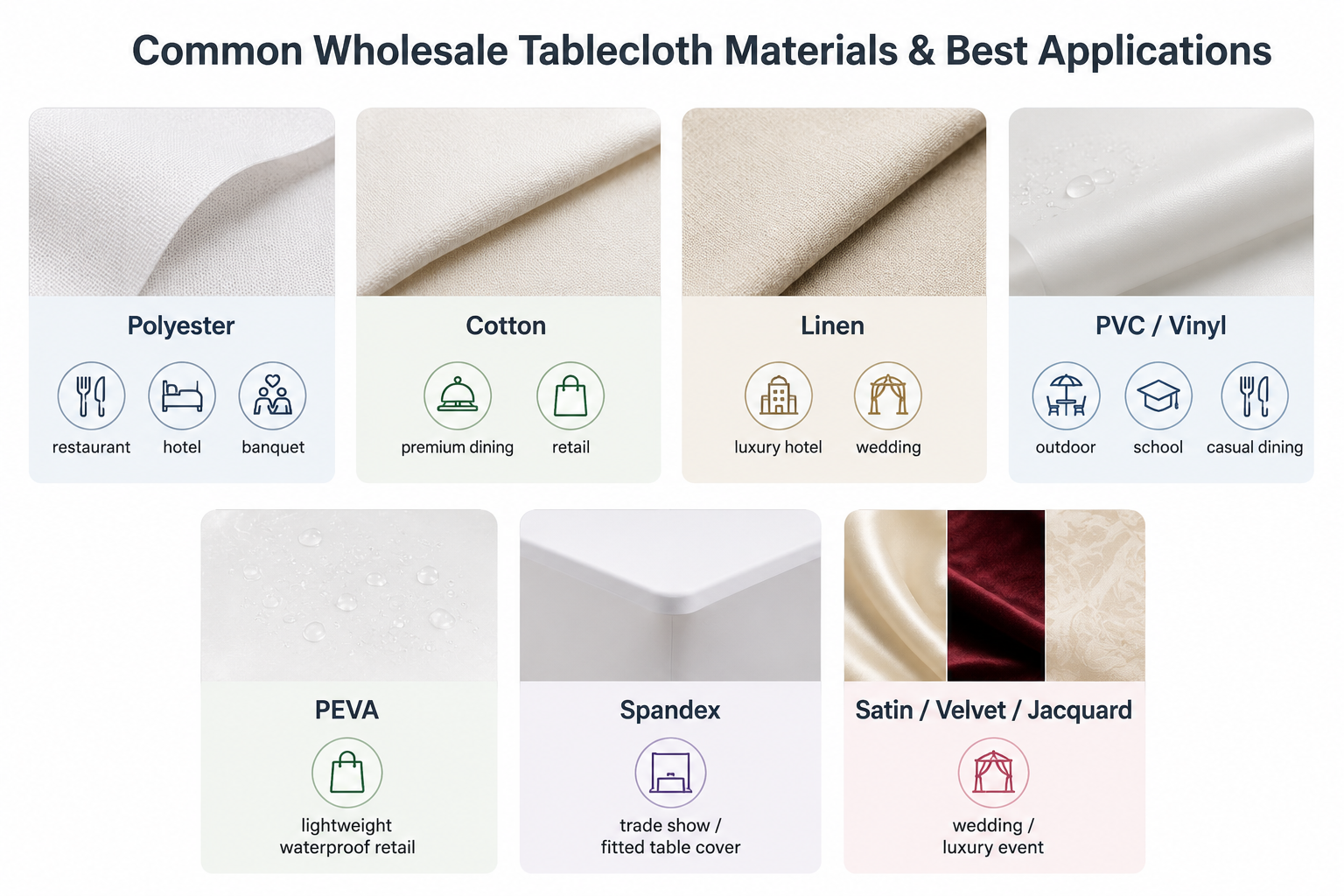 Wholesale tablecloths are available in many materials. Each material has its own performance level, cost structure, maintenance requirement, and target application. The most common materials include polyester, cotton, linen, cotton-polyester blend, vinyl/PVC, PEVA/EVA, spandex, satin, velvet, jacquard, and disposable PE, PP, or non-woven materials.
| Material | Best For | Key Benefits | Main Limitations |
|---|---|---|---|
| Polyester | Restaurants, hotels, banquets, events, wholesale distributors | Durable, cost-effective, wrinkle-resistant, easy to wash, suitable for bulk production | Less natural hand feel than cotton or linen |
| Cotton | Premium dining, retail home textiles, natural product lines | Soft, breathable, natural texture, good retail appeal | Wrinkles easily, may shrink, requires more ironing |
| Linen | Luxury hotels, boutique restaurants, weddings, premium home textiles | Premium texture, elegant drape, high perceived value | Higher cost, wrinkles easily, needs careful maintenance |
| Cotton-polyester blend | Restaurants, hospitality, retail, balanced-use products | Combines cotton softness with polyester durability | Performance depends on blend ratio, yarn, weave, and finishing |
| Vinyl/PVC | Outdoor dining, schools, casual restaurants, parties, retail | Waterproof, oil-resistant, wipe-clean, cost-effective | Less textile-like feel, not ideal for premium dining |
| PEVA/EVA | Retail, lightweight waterproof tablecloths, casual use | Lightweight, waterproof, flexible, PVC alternative | Usually less heavy-duty than thick PVC |
| Spandex | Trade shows, exhibitions, promotional displays, fitted table covers | Stretch fit, clean appearance, suitable for branding | Not suitable for traditional dining table settings |
| Satin | Weddings, banquets, decorative events | Glossy surface, elegant visual effect | Can snag or crease, requires careful handling |
| Velvet | Premium events, weddings, luxury displays | Rich texture, strong decorative value | Higher cost, heavier, more difficult to clean |
| Jacquard | Hotels, banquets, fine dining | Woven pattern, formal appearance, premium look | Higher production cost than plain fabric |
| Disposable PE/PP/non-woven | Fast food, catering, parties, temporary events | Low cost, convenient, no laundry required | Limited reuse, less premium appearance |
Conclusion: Polyester is often the most practical material for large-volume commercial table linens, while cotton, linen, jacquard, satin, and velvet are more suitable for premium or decorative markets. PVC, PEVA, and disposable materials are better for waterproof, wipe-clean, or temporary-use applications.
Q2: Is Polyester the Best Material for Wholesale Tablecloths?
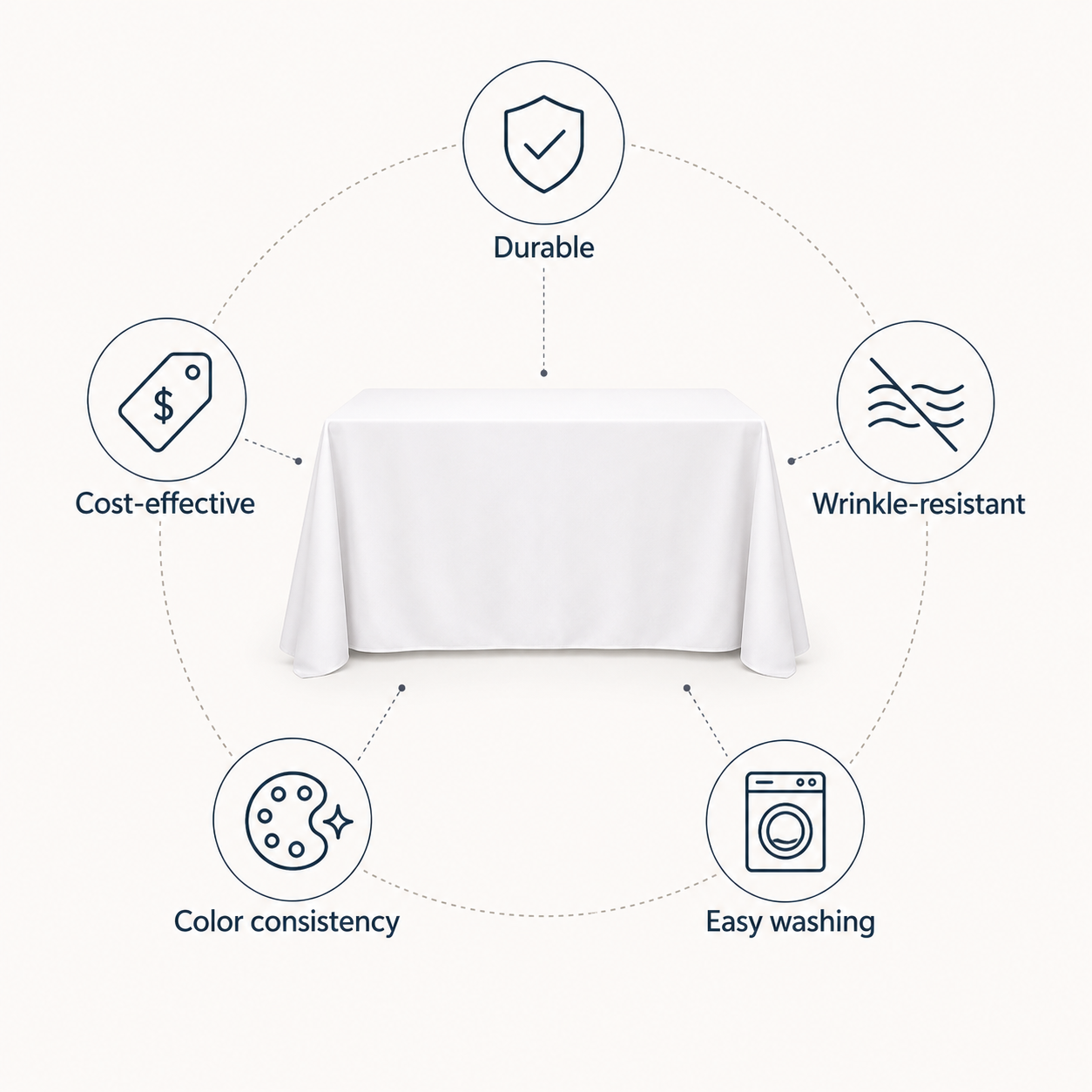 Polyester is not the best material for every market, but it is one of the most practical and widely used wholesale tablecloth materials. It is commonly selected by restaurants, hotels, banquet halls, wedding suppliers, event rental companies, and wholesale distributors because it balances durability, price, maintenance, and production efficiency.
For commercial table linens, polyester offers several advantages. It resists wrinkles better than cotton or linen, dries relatively quickly, and is suitable for repeated washing when the fabric quality and sewing are appropriate. It also supports stable color production, which is important for buyers who need repeat orders in the same shade.
Polyester is also suitable for bulk production. A tablecloth manufacturer can produce polyester tablecloths in standard sizes, custom sizes, standard colors, custom colors, different GSM levels, and various edge finishes. For custom printed tablecloths, polyester is commonly used for dye sublimation printing, digital printing, and promotional table covers.
However, polyester also has limitations. It does not offer the same natural texture as cotton or linen. For luxury restaurants, boutique hotels, and premium home textile brands, buyers may prefer cotton, linen, linen blend, or jacquard fabrics because these materials create a more refined hand feel and visual impression.
Conclusion: Polyester is a strong choice for wholesale tablecloths when durability, cost control, color consistency, and easy maintenance are the main priorities. For premium markets, buyers may need to compare polyester with cotton, linen, jacquard, or blended fabrics before making a final decision.
Q3: Cotton vs Polyester Tablecloths: Which Is Better for Commercial Use?
The comparison between polyester vs cotton tablecloths is common in B2B sourcing. The better choice depends on the buyer’s market position, laundry process, expected product life, and customer expectations.
| Factor | Cotton Tablecloths | Polyester Tablecloths |
|---|---|---|
| Feel | Soft, natural, breathable | Smooth, practical, less natural |
| Wrinkle resistance | Wrinkles more easily | Better wrinkle resistance |
| Washing durability | Good if properly finished, but needs more care | Strong for repeated commercial washing |
| Shrinkage risk | Higher if not pre-shrunk or properly treated | Generally lower under standard care conditions |
| Cost | Usually higher | Usually more cost-effective |
| Best applications | Premium dining, retail home textiles, natural product lines | Restaurants, hotels, events, banquets, large-volume wholesale orders |
Cotton is suitable when buyers want a more natural product story. It works well for premium dining, boutique restaurants, retail home textile collections, and brands that emphasize softness and natural fibers. Cotton can also be dyed or printed, but buyers should confirm shrinkage rate, color fastness, washing instructions, and fabric finishing before approving bulk production.
Polyester is generally more practical for large-volume commercial programs. Restaurants, hotels, banquet suppliers, and event rental companies often prefer polyester because it is easier to wash, easier to manage in inventory, and more stable for repeat orders.
The choice should not be based only on fiber content. Yarn quality, weave, GSM, dyeing process, finishing treatment, and sewing quality also affect performance. A well-made polyester tablecloth may perform better in commercial washing than a low-quality cotton tablecloth. A premium cotton fabric may offer better retail value than a basic polyester fabric.
Conclusion: Choose cotton when natural texture and retail appeal are important. Choose polyester when durability, wrinkle resistance, washing efficiency, and cost per use are the main concerns.
Q4: When Should Buyers Choose Linen Tablecloths?
Linen tablecloths wholesale orders are usually positioned for premium markets. Linen is commonly used by luxury hotels, boutique restaurants, wedding planners, high-end event suppliers, and premium home textile brands. Its natural texture, elegant drape, and high perceived value create a more refined table setting than basic synthetic fabrics.
Linen is especially suitable for buyers who serve upscale hospitality or event clients. It photographs well, feels natural, and supports a premium brand image. For weddings, fine dining, and boutique hotel dining rooms, linen can help create a more elegant and carefully curated atmosphere.
However, linen is not the easiest material to manage. It is more expensive than polyester and poly-cotton blends. It wrinkles easily, and while some customers like the relaxed natural look, others may see wrinkles as a maintenance issue. Linen may also shrink if it is not properly pre-washed, pre-shrunk, or finished.
Before ordering linen tablecloths, buyers should confirm:
- Whether the fabric is 100% linen or a linen blend
- Linen content percentage
- Fabric weight and GSM
- Shrinkage rate after washing
- Whether the fabric is pre-washed or pre-shrunk
- Recommended care instructions
- Color fastness to washing and rubbing
- Size tolerance after laundering
- MOQ and repeat-order availability
For commercial programs, buyers should also ask whether the supplier has experience producing linen tablecloths for hospitality or event use. Linen requires more careful production control than basic polyester.
Conclusion: Linen is a good choice for premium hospitality, weddings, boutique restaurants, and luxury retail collections. It offers a high-end look, but buyers should plan for higher cost and more careful maintenance.
Q5: What Are Cotton-Polyester Blend Tablecloths?
Cotton-polyester blend tablecloths, also called poly-cotton tablecloths, combine the softness of cotton with the durability and easier care of polyester. They are a practical option for buyers who want a more natural hand feel than pure polyester but do not want the higher shrinkage risk and maintenance cost of 100% cotton.
Common blend ratios include 65/35 and 80/20. A 65% polyester and 35% cotton blend usually provides better wrinkle resistance, lower shrinkage, and stronger commercial practicality. A fabric with higher cotton content generally feels softer and more natural, but it may wrinkle more and require more ironing.
The blend ratio affects:
- Softness
- Wrinkle resistance
- Shrinkage risk
- Durability
- Cost
- Washing performance
- Dyeing and printing performance
- Final product positioning
However, buyers should not judge a blended fabric by ratio alone. GSM, yarn count, weave structure, dyeing process, and finishing treatment also affect the final tablecloth performance. Two 65/35 poly-cotton fabrics can feel very different if one uses better yarn, tighter weaving, or stronger finishing.
For restaurants and hotels, poly-cotton blends can offer a balance between appearance and laundry performance. For retail brands, they can provide a softer hand feel while keeping the price more competitive than pure cotton or linen.
Conclusion: Cotton-polyester blends are suitable when buyers need balanced performance. They are softer than polyester, easier to maintain than cotton, and more cost-effective than linen.
Q6: Are Vinyl, PVC, and PEVA Tablecloths Suitable for Wholesale Buyers?
Yes. Vinyl, PVC, PEVA, and EVA tablecloths are suitable for many wholesale and retail buyers, especially when waterproof performance and easy cleaning are more important than textile hand feel.
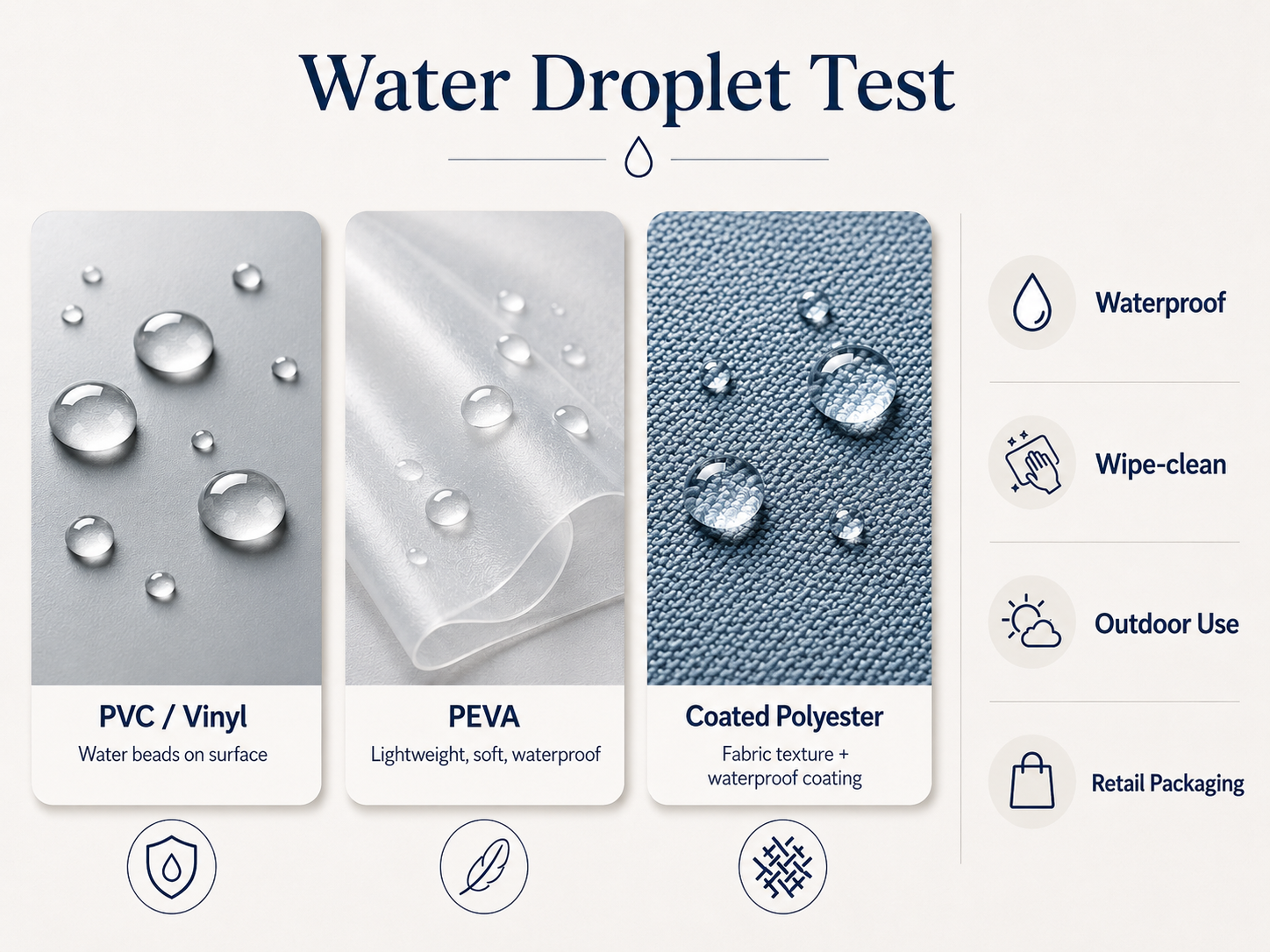
Vinyl and PVC tablecloths are commonly used for outdoor dining, casual restaurants, schools, parties, fast food, temporary events, supermarkets, and retail channels. They are waterproof, oil-resistant, wipe-clean, low maintenance, and cost-effective. Buyers often choose them for environments where spills are frequent and laundry service is not practical.
PEVA and EVA are often used as lightweight waterproof alternatives to PVC. They are common in printed retail tablecloths, casual dining products, and household-use table covers. They are flexible and easy to handle, but usually less heavy-duty than thicker PVC materials.
| Material | Waterproof Performance | Wipe-Clean Ability | Best Use |
|---|---|---|---|
| PVC/vinyl | Excellent | Excellent | Outdoor dining, schools, casual restaurants, retail tablecloths |
| PEVA/EVA | Good to excellent, depending on thickness and construction | Good | Lightweight waterproof retail products, casual use |
| Coated polyester | Water-resistant or waterproof depending on coating | Good | Outdoor restaurants, reusable commercial tablecloths |
| Disposable PE | Waterproof | Good for single use | Parties, catering, temporary events |
When comparing PVC vs PEVA tablecloths, buyers should consider thickness, flexibility, odor control, print quality, packaging style, and destination-market compliance requirements. Buyers should avoid assuming that one material is automatically “eco-friendly” or “safer” without proper test reports or certification. For regulated markets, chemical compliance should be confirmed before bulk production.
Conclusion: PVC, vinyl, and PEVA are practical choices for waterproof tablecloth material. They are especially useful for casual dining, outdoor use, retail programs, parties, and temporary-use applications.
Q7: What Materials Are Best for Event and Wedding Tablecloths?
An event tablecloth fabric guide should consider both appearance and reuse value. Wedding and event buyers often need tablecloths that look attractive, match theme colors, photograph well, and can be reused across multiple events.
Polyester
Polyester is the standard choice for many event rental companies because it is durable, affordable, washable, and available in many colors and sizes. It is suitable for banquets, conferences, weddings, parties, and catering events.
Satin
Satin provides a glossy surface and elegant visual effect. It is often used for weddings, formal dinners, cake tables, gift tables, and decorative overlays. However, satin may snag, crease, or show handling marks more easily than standard polyester.
Velvet
Velvet creates a rich and premium look for weddings, luxury events, seasonal decorations, and display tables. It is heavier and more expensive, but it has strong visual impact.
Sequin
Sequin tablecloths are mainly decorative. They are suitable for photo areas, dessert tables, reception tables, and special event themes. They usually require careful handling and are not ideal for heavy dining use.
Spandex
Spandex table covers wholesale buyers often serve trade shows, exhibitions, hotel conference setups, cocktail tables, and fitted display tables. Spandex creates a clean, fitted appearance and is useful for branded event presentations.
Jacquard
Jacquard fabric has woven patterns that create a formal and premium appearance. It is suitable for hotels, banquets, fine dining events, and higher-end hospitality settings.
Conclusion: Event buyers should choose materials based on event type, reuse frequency, maintenance capacity, color requirements, and budget. Polyester is the most practical base material, while satin, velvet, sequin, spandex, and jacquard serve more decorative or specialized needs.
Q8: What Is GSM and Why Does It Matter for Tablecloth Materials?
GSM means grams per square meter. It measures fabric weight and helps buyers compare thickness, drape, durability, shipping weight, and cost. In wholesale tablecloth materials, GSM is one of the most important specifications to confirm before ordering.
A lower GSM fabric is usually lighter and more economical. It may be suitable for promotional products, short-term events, or price-sensitive retail programs. However, it may not provide the same drape, opacity, or long-term durability as a heavier fabric.
Medium GSM fabrics are often used for restaurants, hotels, banquets, and general wholesale orders because they balance cost and performance. High GSM fabrics usually feel heavier, drape better, and may offer a stronger appearance, but they also cost more and increase shipping weight.
| GSM Level | General Features | Typical Use |
|---|---|---|
| Low GSM | Lightweight, lower cost, easier to ship | Promotional events, temporary use, budget retail |
| Medium GSM | Balanced weight, practical for regular use | Restaurants, hotels, banquets, rental companies |
| High GSM | Heavier hand feel, better drape, stronger appearance | Premium hospitality, luxury events, higher-end retail |
Buyers should not compare GSM without considering fabric type. A 180 GSM polyester fabric and a 180 GSM linen fabric may not feel or perform the same because fiber, yarn, weave, and finishing are different. GSM is important, but it should be reviewed together with material composition, weave structure, shrinkage rate, color fastness, and intended use.
Buyers should also avoid choosing tablecloths by price alone. A low unit price may mean lighter fabric, weaker sewing, poor color fastness, or shorter service life. For commercial buyers, cost per use is often more important than initial unit price.
Conclusion: GSM affects product performance, price, and shipping cost. Buyers should request samples and confirm GSM, hand feel, drape, and washing performance before approving bulk production.
Q9: Which Tablecloth Materials Are Easiest to Clean and Maintain?
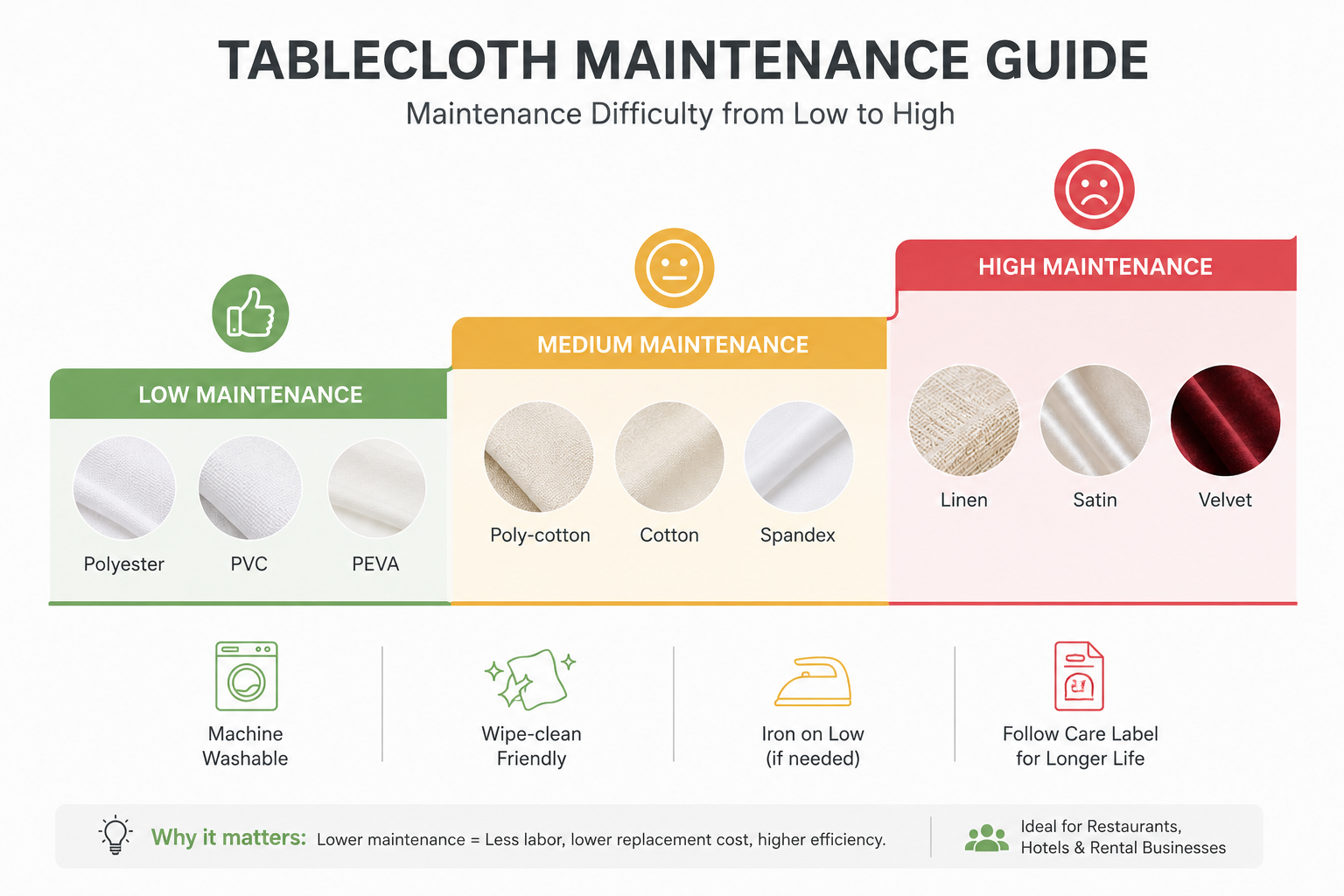
Cleaning and maintenance are major cost factors for B2B buyers. Restaurants, hotels, banquet halls, and rental companies should consider washability, color fastness, shrinkage, stain resistance, and ironing requirements before choosing materials.
| Material | Cleaning Method | Maintenance Level |
|---|---|---|
| Polyester | Machine washable, quick drying, usually easy to iron | Low |
| Cotton | Machine washable, may need ironing, shrinkage control required | Medium |
| Linen | Careful washing, ironing often required | High |
| Vinyl/PVC | Wipe clean with damp cloth | Low |
| PEVA | Wipe clean, light cleaning depending on construction | Low |
| Satin | Gentle washing, careful handling required | Medium to high |
| Velvet | Special care or gentle cleaning | High |
| Spandex | Machine washable, avoid high heat | Low to medium |
Polyester is usually one of the easiest textile materials for repeated washing. PVC and PEVA are easiest when wipe-clean maintenance is required. Cotton and linen need more attention because of wrinkling and possible shrinkage. Satin and velvet require more careful handling because their surface appearance can be affected by rough washing.
For commercial orders, buyers should not rely only on general material descriptions. They should ask suppliers to clarify shrinkage rate, color fastness to washing, color fastness to rubbing, and performance after repeated laundering. If the product is intended for hotels, restaurants, or rental companies, sample washing tests are strongly recommended before bulk approval.
Conclusion: Polyester and poly-cotton are practical choices for high-frequency commercial washing. PVC, vinyl, and PEVA are more efficient when wipe-clean maintenance is required.
Q10: Which Tablecloth Materials Are Best for Outdoor Use?
Outdoor tablecloths need to handle moisture, spills, wind, sunlight, and frequent cleaning. Suitable options include PVC/vinyl, PEVA, coated polyester, water-resistant polyester, polyester with waterproof backing, and disposable PE, PP, or non-woven tablecloths.
PVC and vinyl are strong choices for waterproof and wipe-clean use. They work well for outdoor restaurants, casual dining areas, schools, parties, and retail channels. PEVA is a lighter waterproof option, often used for retail and casual outdoor products.
Coated polyester or polyester with waterproof backing can be a good choice when buyers want a textile appearance with improved water resistance. However, buyers should confirm whether the material is water-resistant or fully waterproof. Performance depends on coating type, coating weight, backing material, seam construction, and test requirements.
Disposable PE, PP, and non-woven tablecloths are suitable for temporary events, catering, fast food, festivals, and parties. They reduce laundry work but are not designed for long-term reuse.
Outdoor buyers should ask:
- Is the material waterproof or only water-resistant?
- Can it be wiped clean?
- Is it reusable or disposable?
- Is it suitable for outdoor restaurant use?
- Does the color fade easily under sunlight?
- Can the fabric withstand repeated cleaning?
- Are there any chemical compliance requirements for the target market?
Conclusion: For outdoor restaurants, reusable PVC/vinyl, PEVA, or coated polyester can be practical options. For temporary outdoor events, disposable PE, PP, or non-woven tablecloths may be more economical.
Q11: What Is the Best Material for Restaurant Tablecloths?
The best material for restaurant tablecloths depends on restaurant type, service style, washing frequency, and budget.
For daily restaurants, polyester or poly-cotton is usually the most practical choice. These materials provide good durability, stable color, lower shrinkage risk, and easier washing. They are suitable for restaurants that need consistent appearance and frequent laundering.
For fine dining restaurants, cotton, linen, linen blend, or jacquard tablecloths may be more appropriate. These materials create a more premium dining atmosphere, but they require more maintenance and higher investment.
For outdoor restaurants, PVC, PEVA, coated polyester, water-resistant polyester, or polyester with waterproof backing may be better choices. They help manage spills, moisture, and cleaning time.
For fast food, temporary dining, or high-turnover casual service, disposable PE, PP, or non-woven tablecloths may be suitable.
Restaurant buyers should evaluate:
- Washing cycles
- Stain resistance
- Wrinkle resistance
- Color stability
- Shrinkage rate
- Ironing requirements
- Replacement rate
- Cost per use
- Availability of repeat orders
Conclusion: Polyester and poly-cotton are often the most practical materials for daily restaurant use. Fine dining buyers may choose cotton, linen, linen blend, or jacquard for a more premium presentation.
Q12: What Is the Best Material for Hotel and Banquet Tablecloths?
Bulk tablecloths for hotels need to support formal appearance, repeated washing, consistent sizing, and long-term supply. Common choices include polyester, jacquard, poly-cotton blend, high-GSM polyester, and linen or linen blend for luxury hotels.
Hotels and banquet halls often require large tablecloth sizes, matching napkins, table runners, chair covers, and coordinated colors. For this reason, repeat-order availability is very important. A buyer should confirm whether the tablecloth manufacturer can maintain consistent color, fabric weight, and size specifications across future orders.
High-GSM polyester is popular for banquets because it offers good drape, durability, and cost efficiency. Jacquard adds a formal woven pattern and is suitable for hotel dining rooms, banquet halls, and formal event setups. Linen or linen blend is suitable for luxury properties that prioritize premium appearance over lower maintenance cost.
Hotel buyers should consider:
- Formal appearance
- Large-size production capability
- Good drape
- Washing durability
- Stable sizing
- Color consistency
- Inventory replenishment
- Custom packaging or labeling
- Matching napkins, runners, and chair covers
- Long-term repeat-order stability
Conclusion: Polyester, jacquard, and poly-cotton are practical hotel choices. Luxury hotels may choose linen or linen blends for premium dining rooms, weddings, and special events.
Q13: What Is the Best Material for Custom Printed Tablecloths?
The best material for custom printed tablecloths depends on the printing method, design style, order quantity, and end use.
Polyester is one of the most common choices for digital printing, dye sublimation printing, and logo printing. It supports bright graphics, efficient bulk customization, and stable production. It is widely used for promotional tablecloths, event table covers, trade show displays, branded restaurant linens, and corporate marketing products.
Spandex is ideal for fitted promotional table covers. It stretches tightly around display tables, creating a clean and professional shape. Spandex table covers wholesale buyers often serve trade show suppliers, exhibition companies, promotional product companies, and corporate branding clients.
Cotton can be printed for natural-style retail products, but buyers should consider shrinkage, color fastness, and print hand feel. It is more suitable for home textile brands or natural product lines than for high-volume promotional use.
PVC and PEVA are common for printed retail tablecloths and waterproof designs. They can be produced with patterns, seasonal designs, or private label packaging for supermarkets, discount stores, and e-commerce channels.
Logo embroidery is another customization option, especially for hotels, restaurants, and premium hospitality clients. Embroidery works best when the fabric weight and construction can support the stitching without distortion.
Conclusion: Polyester is usually the most versatile material for custom printed tablecloths. Spandex is best for fitted promotional displays, while PVC and PEVA are suitable for waterproof printed retail products.
Q14: How Should Buyers Choose Tablecloth Material by Business Type?
Different buyers need different material strategies. The right choice should match the sales channel, usage environment, customer expectations, and target price.
| Buyer Type | Recommended Materials | Why |
|---|---|---|
| Restaurants | Polyester, poly-cotton, cotton, PVC/PEVA for outdoor areas | Balance of durability, washability, appearance, and cost |
| Hotels | Polyester, jacquard, high-GSM polyester, linen blend | Formal appearance, repeat-order consistency, large-size availability |
| Wedding/event companies | Polyester, satin, velvet, sequin, spandex, jacquard | Visual impact, color variety, reuse potential |
| Outdoor dining suppliers | PVC/vinyl, PEVA, coated polyester, water-resistant polyester | Waterproof or water-resistant performance, easy cleaning |
| Retail brands | Cotton, polyester, PEVA, PVC, linen blend | Packaging appeal, texture, print options, target price flexibility |
| Importers/wholesalers | Polyester, PVC, PEVA, poly-cotton, disposable materials | Broad market demand, scalable production, competitive pricing |
| Trade show suppliers | Spandex, polyester | Fitted display, logo printing, easy transport |
| Promotional product companies | Polyester, spandex, non-woven, printed PVC/PEVA | Custom printing, branding, event use |
For importers and distributors, material selection should also consider market coverage. A basic polyester line may serve restaurants and event suppliers. PVC or PEVA tablecloths may support retail and outdoor markets. Spandex covers may serve trade show and promotional channels. Cotton, linen, or jacquard products may target higher-margin hospitality or retail customers.
Conclusion: Buyers should not select material based on one universal rule. Material choice should be based on business type, target customer, cleaning method, price level, and customization requirements.
Q15: What Questions Should Buyers Ask Before Ordering Wholesale Tablecloths?
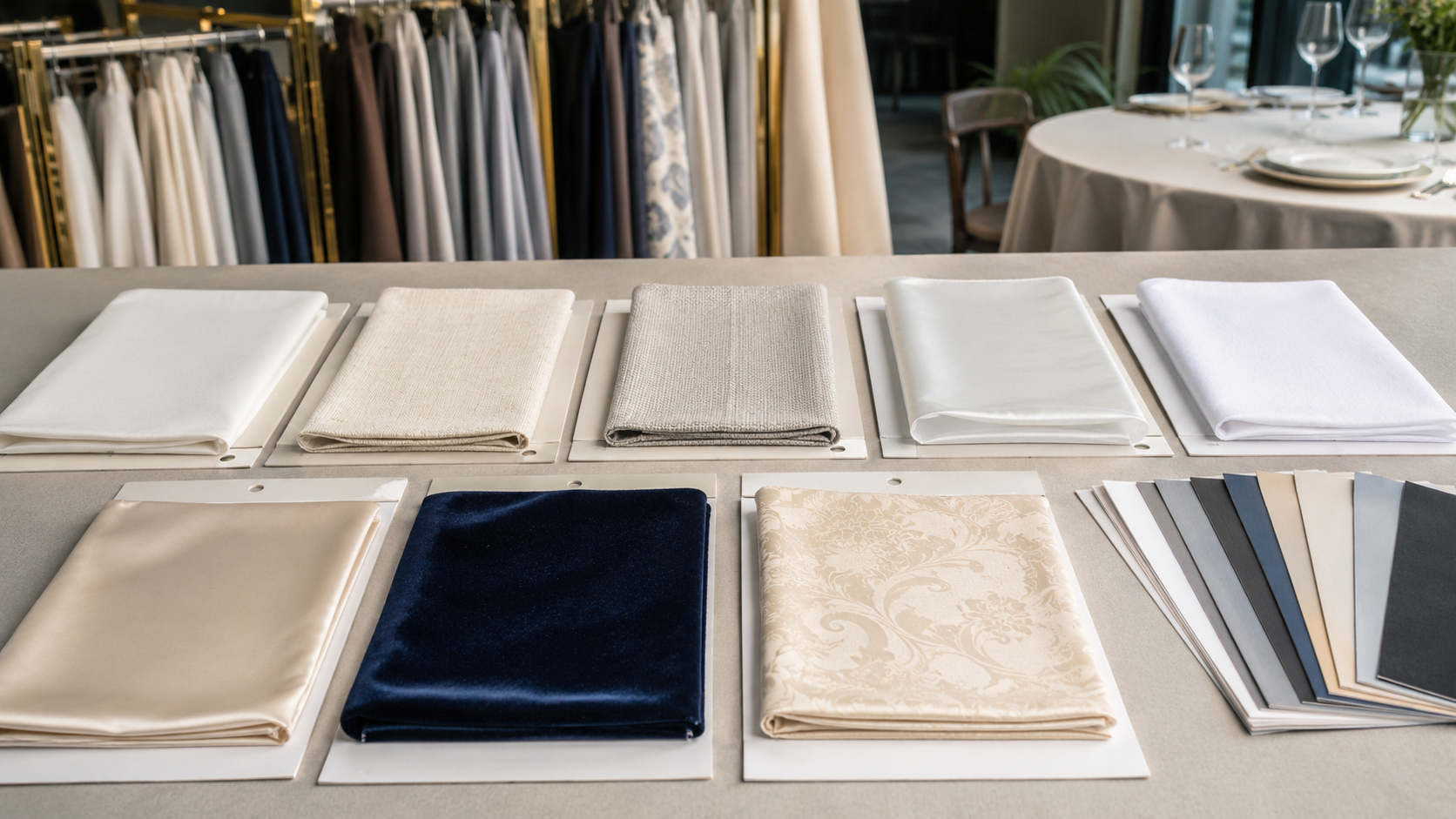
Before placing wholesale tablecloths orders, buyers should ask practical questions that affect product quality, compliance, and long-term supply.
Important questions include:
- What material options are available for my target application?
- What GSM do you recommend for restaurant, hotel, event, outdoor, or retail use?
- Is the fabric wrinkle-resistant?
- Is the material stain-resistant, water-resistant, or waterproof?
- If the fabric is waterproof, is it coated, laminated, or backed?
- Can you produce custom sizes and shapes?
- Are custom colors available?
- Can you match Pantone colors or existing fabric samples?
- Can you produce custom patterns or printed designs?
- Is logo printing or embroidery available?
- What is the MOQ for standard and custom tablecloths?
- Can you provide pre-production samples?
- What is the shrinkage rate after washing?
- What are the recommended washing and care instructions?
- Can you provide color fastness information?
- Can you provide retail packaging, private label, or care labels?
- Can you include fiber content labels?
- Do you offer OEM/ODM service?
- What is the lead time for samples and bulk production?
- Can the same fabric and color be reordered in the future?
- Are relevant test reports or compliance documents available if required?
- Can you support carton marks and export packaging requirements?
For regulated markets, buyers should ask whether the supplier can provide relevant documentation, such as OEKO-TEX STANDARD 100 certification, REACH-related chemical compliance test reports, fiber content labels, care labels, or other market-specific documents. Requirements may differ by country, sales channel, product type, and customer policy.
Conclusion: Clear specifications reduce sourcing risk. Buyers should confirm material, GSM, size, color, shrinkage, washing performance, packaging, MOQ, compliance documents, and customization details before approving bulk production.
Q16: How Can Buyers Reduce Cost Without Choosing Low-Quality Material?
Cost reduction does not always mean choosing the cheapest material. For commercial buyers, cost per use is often more important than unit price.
The basic formula is:
Cost per use = Unit price ÷ Estimated number of uses
For example, if a low-priced tablecloth loses its appearance after only a small number of washing cycles, its actual cost per use may be higher than a better fabric that remains serviceable for much longer. Buyers should estimate this based on their own laundry process, service standard, and replacement policy.
A buyer may compare two options internally. One cheaper tablecloth may be used only 10 times before replacement, while a higher-quality option may remain acceptable for 80 uses. These numbers are only examples. Actual service life should be confirmed through sample testing, previous usage records, or supplier experience with similar applications.
Buyers can reduce cost in smarter ways:
- Choose suitable GSM instead of automatically selecting the lowest weight
- Use standard colors to reduce dyeing cost and lead time
- Use standard sizes where possible
- Order in bulk to improve production efficiency
- Select materials based on actual application
- Avoid over-specifying premium fabrics for low-margin uses
- Confirm washing performance before bulk production
- Use private label packaging only where it adds sales value
- Work with a tablecloth manufacturer that can recommend material alternatives
For example, a high-GSM polyester may be suitable for hotel banquets, while a medium-GSM polyester may be enough for casual restaurant use. PVC or PEVA may be more cost-effective than washable textile fabric for outdoor tables with frequent spills.
Conclusion: Buyers should evaluate total value, not only unit price. The right material, GSM, size, and finishing can reduce long-term cost without sacrificing necessary quality.
Q17: Can Tablecloth Materials Be Customized?
Yes. A professional tablecloth manufacturer can offer many customization options for wholesale distributors, importers, hotels, restaurants, event suppliers, promotional buyers, and private label brands.
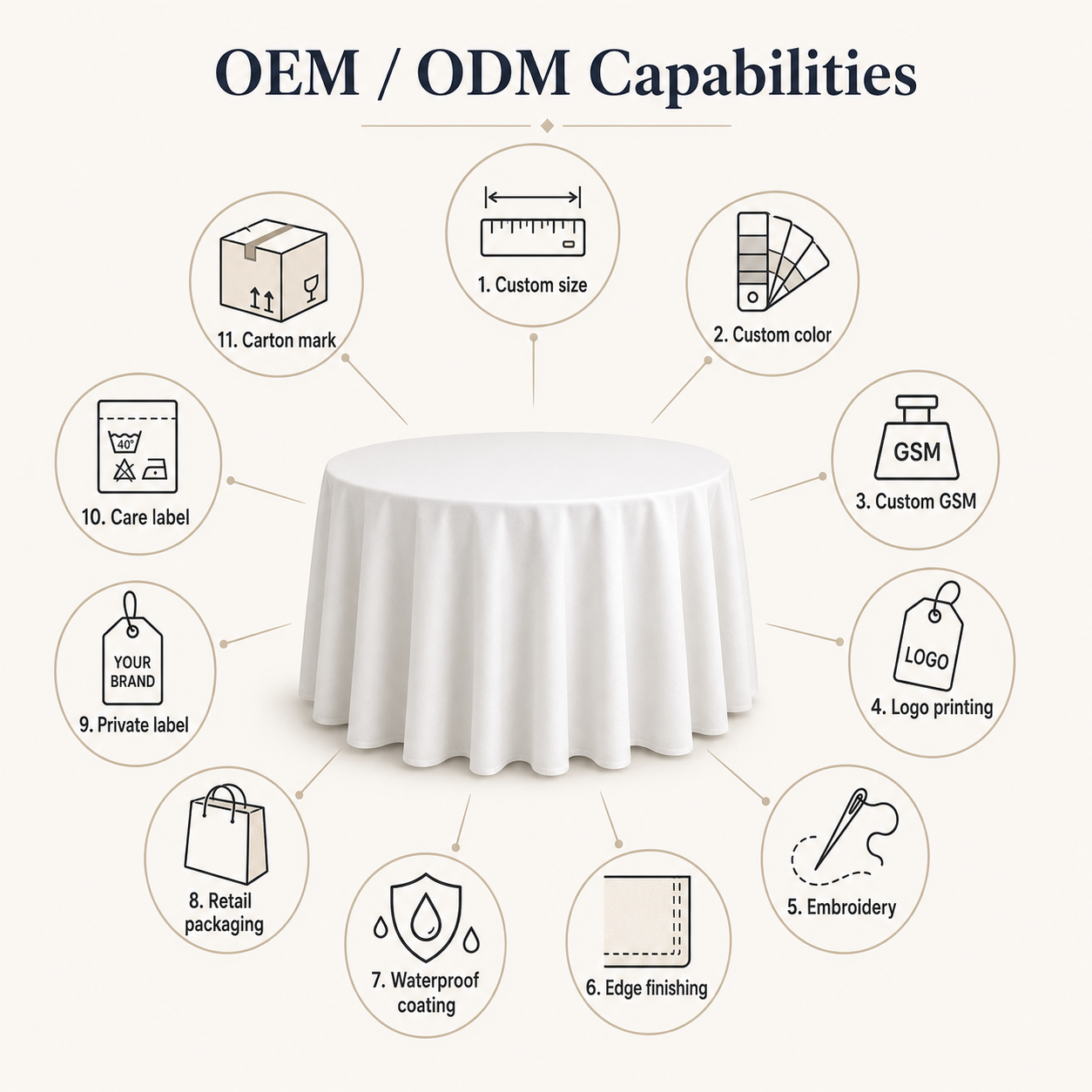
Common custom tablecloth materials and production options include:
- Custom fabric material
- Custom GSM
- Custom size and shape
- Custom color
- Printed patterns
- Logo printing
- Logo embroidery
- Edge finishing, such as hemmed, overlocked, or special border styles
- Waterproof coating
- Water-resistant treatment
- Stain-resistant treatment
- Flame-retardant treatment if required by the market
- Retail packaging
- Private label
- Care label
- Fiber content label
- Carton mark
- OEM/ODM service
- Custom sets with napkins, runners, chair covers, placemats, or fitted covers
For B2B buyers, customization should be connected to the target market. A hotel buyer may need custom size, stable color, matching napkins, and logo embroidery. An e-commerce brand may need private label packaging, care labels, and product photography consistency. A promotional buyer may need custom printed tablecloths with fast lead time. An outdoor dining supplier may need PVC, PEVA, or coated polyester materials.
Before starting custom production, buyers should confirm sample cost, sample lead time, bulk MOQ, color approval method, printing method, packaging details, and quality inspection standard.
Conclusion: Tablecloth customization is not limited to printing. Material, GSM, finishing, coating, packaging, labeling, and OEM/ODM details can all be adjusted according to the buyer’s business model.
Q18: Final Recommendation: Which Tablecloth Material Should You Choose?
There is no single best material for every buyer. The right choice depends on application, target price, washing method, desired appearance, and customization needs.
Choose polyester for durability, cost-effectiveness, easy maintenance, and general commercial use. It is suitable for restaurants, hotels, banquets, event rental companies, and large-volume wholesale orders.
Choose cotton for natural comfort, soft hand feel, and retail appeal. It is suitable for premium dining, home textile brands, and natural-style product lines.
Choose linen for premium hospitality, boutique restaurants, weddings, and luxury table settings. It offers elegant texture and high perceived value, but requires higher cost and more careful maintenance.
Choose poly-cotton for balanced performance. It is softer than polyester and easier to manage than pure cotton.
Choose PVC, vinyl, or PEVA for waterproof and wipe-clean use. These materials are practical for outdoor dining, schools, casual restaurants, retail channels, and party products.
Choose spandex for trade shows, exhibitions, promotional displays, and fitted table covers.
Choose satin, velvet, sequin, or jacquard for decorative events, luxury weddings, banquets, and premium hospitality settings.
Conclusion: Buyers should match the material to the business case. The right tablecloth material should deliver suitable appearance, performance, maintenance level, compliance support, and cost per use for the target market.
Conclusion: Work With a Tablecloth Manufacturer Before Bulk Ordering
Choosing wholesale tablecloth materials requires more than comparing prices. Material affects durability, cleaning cost, appearance, shrinkage, color fastness, waterproof performance, customization options, and customer satisfaction. A restaurant buyer, hotel supplier, wedding rental company, retail brand, and promotional product buyer may all need different materials, even if the product name is the same.
Before placing an order, buyers should confirm fabric composition, GSM, size tolerance, shrinkage rate, washability, color fastness, stain resistance, waterproof or water-resistant performance, printing method, packaging requirements, MOQ, lead time, and repeat-order availability. Samples are especially important because they allow buyers to check hand feel, thickness, drape, color, sewing quality, and cleaning performance before bulk production.
An experienced tablecloth manufacturer can help buyers compare materials, develop custom tablecloth materials, prepare samples, calculate wholesale pricing, and support OEM/ODM production. Whether you need commercial table linens for restaurants, bulk tablecloths for hotels, linen tablecloths wholesale, waterproof tablecloth material, spandex table covers wholesale, or custom printed tablecloths for promotional use, selecting the right material is the first step toward a successful order.
Contact us for wholesale tablecloth samples, custom sizes, OEM packaging, material recommendations, and bulk production support.