Choose high-performance ergonomic cushions for offices with evidence-based criteria: pressure relief, posture support, durability, hygiene, and procurement-ready compliance.
What “High-Performance” Means in Office Cushions
High-performance ergonomic cushions for offices are cushions that deliver repeatable comfort and support outcomes under real workplace conditions (8+ hours/day, varied users, and frequent movement). That means performance is not a feeling—it’s the combination of pressure relief, posture support, thermal comfort, and durability that holds up over time.
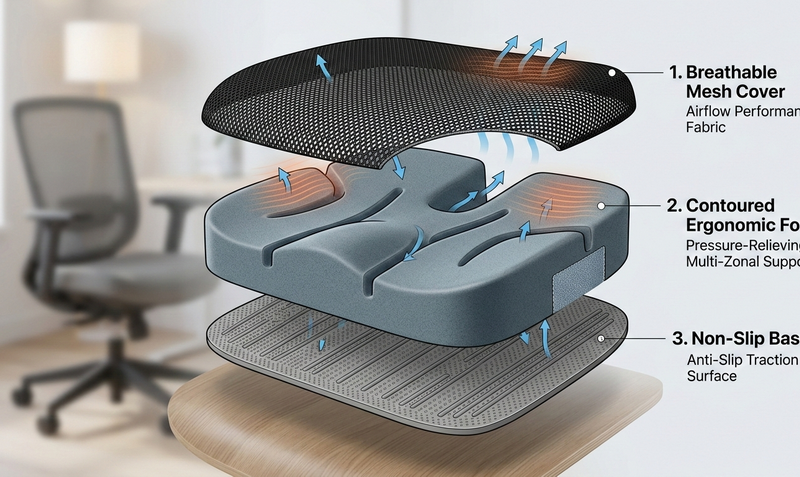 In B2B contexts, “high-performance” also includes operational outcomes: fewer discomfort complaints, fewer ad-hoc accommodation requests, improved workstation satisfaction scores, and a product lifecycle that doesn’t collapse after a quarter.
[📊 Cite: Workplace ergonomics guidance from occupational health agencies; studies on sitting pressure distribution and musculoskeletal discomfort]
The 7 Buyer Criteria That Matter Most
A truly ergonomic cushion must solve a specific biomechanical problem. Start by mapping your office reality (who uses it, how long they sit, and what chairs you already have) to the criteria below.
1) Pressure Distribution and Tailbone Relief
A good cushion reduces peak pressure under the ischial tuberosities (“sit bones”) and, when needed, unloads the coccyx. The direct answer: look for contoured designs and evidence of pressure reduction, not just “plushness.”
What to evaluate:
- Coccyx cut-out (for tailbone sensitivity) vs. continuous support (for general comfort)
- Contour stability: the cushion should not “bottom out” when the user shifts
- Thickness: too thin won’t offload pressure; too thick can raise seat height and disrupt desk ergonomics
Procurement tip: If you’re buying for a mixed population, prioritize models with gentle contouring and optional tailbone channel rather than aggressive medical-style cutouts.
2) Posture Support (Pelvic Positioning)
Ergonomic cushions should help maintain a neutral pelvis and discourage slumping. The direct answer: a slightly forward pelvic tilt or stable neutral base is often better than soft sink-in foam, which can promote posterior pelvic tilt.
Features to consider:
- Wedge profiles (subtle forward tilt) for users who slouch
- Raised side bolsters for lateral stability (useful for long seated sessions)
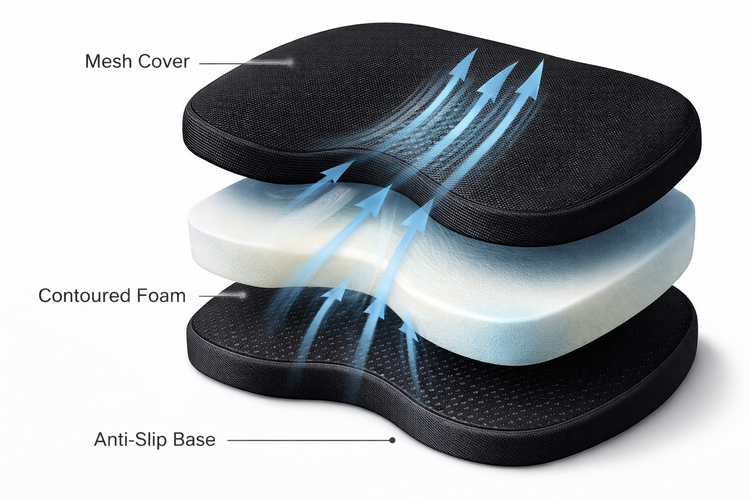
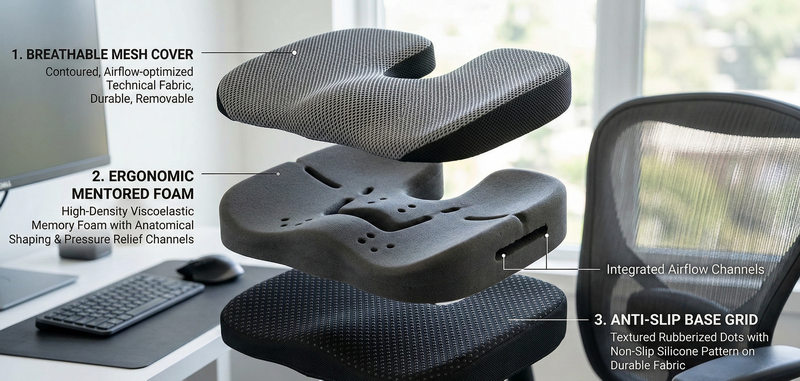
- Anti-slip base to prevent micro-movements that lead to fatigue
3) Thermal Comfort and Breathability
High-performance in offices includes not trapping heat—especially in warm climates or for long meetings. The direct answer: favor breathable covers, ventilation channels, and materials that dissipate heat.
Common signals:
- Perforated foam, 3D mesh covers, or airflow channels
- Removable/washable covers to manage odor and hygiene
- Gel layers can feel cool initially but vary widely in heat retention over hours
4) Adjusting Seat Height Without Breaking Desk Ergonomics
Adding a cushion changes seat height, which affects elbow angle, shoulder tension, and monitor alignment. The direct answer: choose thickness that preserves 90–100° elbow angles at the desk and doesn’t force shoulder elevation.
Rule of thumb for B2B:
- If your chairs are already near minimum height for shorter users, avoid very thick cushions.
- Consider offering two thickness options (standard + slim) to cover more body types.
5) Durability Under Real Office Use
B2B cushions fail differently than consumer cushions: more hours, more users, more movement. The direct answer: spec for compression resistance, tear strength, and edge integrity, not just density claims.
Ask suppliers for:
- Compression set testing or durability claims (ideally with test methods)
- Warranty terms that reflect office realities (12–24 months is common in institutional buying)
- Cover seam quality and zipper durability
6) Hygiene for Shared Seating and Hot-Desking
If your workplace uses hoteling/hot desks, sanitation is not optional. The direct answer: select cushions with removable, washable covers, antimicrobial-treated fabrics (where appropriate), and wipeable surfaces for rapid cleaning.
Operational considerations:
- Color choices that hide stains (dark gray/black) vs. brand aesthetics
- Spare covers for quick swap-outs
- Simple labeling for inventory tracking (asset tags or embroidered IDs)
7) ROI Alignment: Outcomes Procurement Can Defend
High-performance cushions should earn their place in budgets with clear value drivers. The direct answer: connect cushion selection to measurable employee experience and ergonomics KPIs, such as:
- Reduction in discomfort reports
- Decrease in individual accommodation requests
- Higher workstation satisfaction scores
- Lower replacement rate vs. cheap cushions
[📊 Cite: HR/ergonomics benchmarks on discomfort reporting and workplace intervention outcomes]
Material Science: Foam vs Gel vs Air vs Hybrid
The best material depends on your use case and your population. The direct answer: hybrids often win in offices because they balance support, cooling, and durability.
Quick Comparison Table
| Material Type | Strengths | Limitations | Best For |
|---|---|---|---|
| High-density foam (contoured) | Stable support, posture control, cost-effective | Can trap heat; poor foam can bottom out | Standard office seating, broad rollout |
| Gel (gel layer or gel grid) | Initial cooling feel, pressure distribution | Can be heavy; cooling may fade; quality varies | Long sit sessions, heat-sensitive users |
| Air cell cushions | Adjustable pressure; excellent offloading | Can feel unstable; puncture risk; maintenance | Tailbone pain, specialized needs |
| Hybrid (foam + gel/mesh) | Balanced comfort + support + breathability | Slightly higher cost | Best “one model for most” B2B programs |
How to spot “cheap foam”: fast flattening, uneven rebound, permanent dents, and edge collapse. In B2B, those translate directly into complaints and repurchase churn.
Fit & Compatibility: Chairs, Body Types, and Work Styles
A cushion that’s great in isolation can fail on your actual chairs. The direct answer: test fit across your top 3 chair models and your common work patterns (desk work, calls, meetings).
Chair Compatibility Checklist
- Seat pan depth: cushion shouldn’t push users forward and remove back support contact
- Chair contour match: overly curved chair seats can destabilize flat cushions
- Armrest height: added cushion height can raise elbows too high
- Tilt mechanisms: cushion should stay stable during recline and forward tilt
Body Type Coverage Strategy (B2B-Smart)
Instead of trying to find one cushion for everyone, adopt a coverage approach:
- Primary model: fits 70–80% of users (moderate contour, breathable cover, standard thickness)
- Slim model: for shorter users or low-height desk constraints
- Specialty model: limited stock for tailbone sensitivity or medical needs (often air cell or deeper cut-out)
This reduces over-customization while still meeting comfort diversity.
High-performance ergonomic cushions for offices must survive cleaning routines. The direct answer: choose materials and covers that match your facility protocols (wipe-down, laundering frequency, disinfectant compatibility).
What to Ask Vendors (Non-Negotiables)
- Are covers machine washable? At what temperature?
- Are materials compatible with common disinfectants (e.g., quats, alcohol wipes)?
- Are replacement covers available, and what’s the lead time?
- How does the cushion handle edge wear from frequent sitting/standing transitions?
Recommended Maintenance SOP (Simple and Scalable)
- Daily (hot desks): wipe external surfaces; inspect for visible soiling.
- Weekly: swap covers or launder covers in batches.
- Quarterly: compression check—replace units that bottom out or show deformity.
[📊 Cite: Facility cleaning guidance for shared workplace textiles and surfaces]
Compliance, Certifications, and Sustainability Signals
For B2B credibility, performance includes safety and sourcing signals. The direct answer: look for certifications that map to your organization’s procurement standards, especially for indoor environments.
Common signals to evaluate (varies by region and policy):
- Low-VOC / indoor air quality claims (if applicable)
- Flammability compliance relevant to office furnishings
- Material transparency (supplier declarations, restricted substances)
- Sustainability: recycled cover fabrics, reduced packaging, repairable/replaceable covers
Buyer caution: Certifications are only useful if they match your compliance needs. Don’t overpay for labels that don’t reduce risk or improve adoption.
Procurement Checklist and Pilot Plan
If your goal is traffic and inquiries, make it easy for buyers to act. The direct answer: run a short pilot with defined success metrics, then scale with the winning spec.
B2B Procurement Checklist (Copy/Paste)
| Category | Requirement | Pass/Fail |
|---|---|---|
| Ergonomics | Contoured support; optional tailbone relief | |
| Comfort | Doesn’t bottom out after 30 minutes | |
| Thermal | Breathable cover; minimal heat buildup | |
| Fit | Works on top chair models; anti-slip base | |
| Hygiene | Removable/washable cover; disinfectant compatible | |
| Durability | Compression resilience + warranty terms | |
| Logistics | Stable supply, lead times, replacement covers | |
| Compliance | Meets internal safety/material standards |
A Simple 2–4 Week Pilot Framework
- Select 2–3 cushion candidates (foam, hybrid, specialty).
- Recruit a representative user group (different heights, roles, and sitting durations).
- Measure outcomes:
- Comfort score (weekly)
- Heat/build-up complaints
- Stability/slip issues
- Chair compatibility notes
- Decide based on adoption + durability + total cost per seat per year.
TCO mindset: A cushion that lasts 18 months and gets used daily is often cheaper than a low-cost unit replaced every 3–6 months due to flattening or complaints.
[🎯 CTA: Want a spec sheet to compare suppliers fast? Request our B2B ergonomic cushion evaluation template and sample procurement language.]
Key Takeaways
- High-performance ergonomic cushions for offices are defined by pressure relief + posture stability + durability, not softness.
- Choose a cushion thickness that doesn’t break desk ergonomics (armrest and elbow height matter).
- For most B2B rollouts, hybrid designs balance comfort, cooling, and long-term support.
- Build a scalable program with a primary model + slim option + specialty stock for specific needs.
- A short pilot with clear metrics produces procurement-ready proof and reduces returns.
FAQ Schema
Q: What makes a cushion “high-performance” for office use?
A: A high-performance office cushion maintains pressure relief, posture support, and stability over long workdays while resisting compression and staying easy to clean. It should fit common office chairs, avoid heat buildup, and hold up under daily use with a reliable warranty.
Q: Are gel cushions better than foam for office chairs?
A: Gel can improve initial cooling and pressure distribution, but quality varies and some gel designs retain heat over time. High-density contoured foam is often more stable for posture support. Many offices choose hybrids to balance both.
Q: Will an ergonomic cushion make my chair too high?
A: It can. Adding even 1–2 inches can raise elbow height and strain shoulders if the chair can’t adjust down. For shorter users or fixed desks, consider slim cushions or ensure chair height range can accommodate the added thickness.
Q: What’s the best cushion type for hot-desking and shared seating?
A: Cushions with removable, machine-washable covers and wipeable surfaces work best. Prioritize anti-slip bases, easy labeling, and available replacement covers so facilities can maintain hygiene without downtime.
Q: How do we choose one cushion for a diverse workforce?
A: Use a coverage strategy: pick one primary model with moderate contouring for most users, add a slim option for height constraints, and keep limited specialty units for tailbone sensitivity or medical needs. Validate with a short pilot.
[Author: Company Name | Role: Ergonomics & Workplace Solutions Team]
[🎯 CTA: If you’re sourcing ergonomic cushions at scale, contact us for bulk pricing, samples, and a pilot plan designed for procurement teams.]
If you are sourcing a reliable outdoor cushion OEM manufacturer, LISO offers custom patio cushions with waterproof fabrics, MOQ from 200 units, and samples ready within 14 days. Request a free quote →