Learn how to evaluate a custom memory foam cushions bulk supplier using measurable specs, compliance signals, and TCO thinking—so you can reduce returns, speed up launches, and win repeat orders.
Introduction
Custom memory foam cushions look simple, but bulk sourcing is rarely simple. In B2B, the risk isn’t “the cushion feels slightly different”—it’s returns, odor complaints, inconsistent batches, delayed launches, and warranty exposure.
At the same time, demand for memory foam products continues to grow across home, healthcare, hospitality, and mobility use cases. That growth attracts more factories and traders—so the buyer’s job becomes separating real manufacturing control from glossy catalog claims.
[📊 Cite: Market growth reports on memory foam category demand and expansion (e.g., memory foam mattress/pillow market estimates 2024–2030).]
This deep-dive gives you a supplier-evaluation framework that works whether you’re sourcing:
- Seat cushions (office, stadium, mobility, vehicles)
- Back/ lumbar supports
- Wheelchair/medical cushions
- Bench/boat/RV cushions
- OEM kits for branded retail or DTC bundles
[🎯 CTA: If you want a faster shortlist, ask suppliers for a “3-sample spec pack” (different density/ILD combos) plus their QC tolerance sheet—this single request eliminates most unreliable vendors.]
1) Why “Supplier Choice” Decides Cushion Performance (More Than Foam Type)
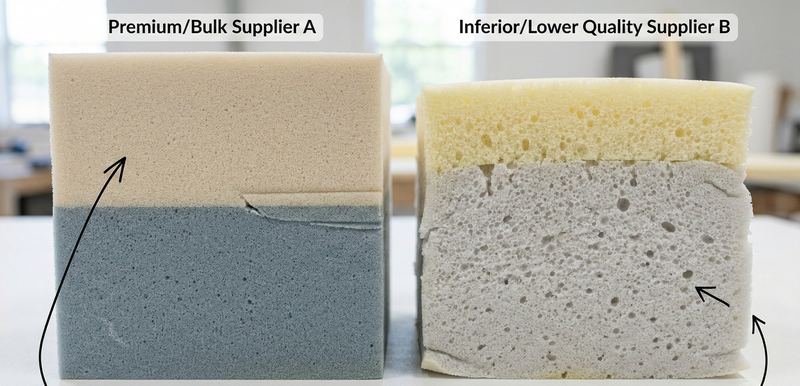
A cushion’s real-world performance is mainly driven by process control—not marketing terms like “gel-infused,” “premium,” or “NASA-grade.”
A reliable custom memory foam cushions bulk supplier should be able to repeat performance from batch to batch. In practice, buyers feel inconsistency when:
- The foam bottoms out after a few weeks
- The same SKU feels firmer/softer between shipments
- Odor or VOC complaints spike in warm seasons
- The cover fit changes due to foam dimension drift
These issues often come from variability in:
- Foam formulation and curing time
- Cutting tolerance and tool calibration
- Storage conditions and compression packing method
- Incoming material variation (base polyols/isocyanates, additives)
Bottom line: foam is a chemical and process product. Your supplier is either a controlled manufacturer—or a “batch lottery.”
2) What “Custom Memory Foam” Really Means in B2B Specs
“Custom” can mean many things. To avoid misalignment, define customization in spec language—not appearance language.
Core specs you should lock down (and why they matter)
| Spec | What it controls | Typical buyer mistake |
|---|---|---|
| Density (kg/m³ or lb/ft³) | durability, support, long-term compression set | treating density as “softness” |
| ILD/IFD (Indentation Force Deflection) | perceived firmness under load | not specifying test method/conditions |
| Resilience & recovery time | how “slow” memory foam feels | ignoring temperature sensitivity |
| Compression set | how much thickness loss after repeated load | not requiring a threshold |
| Dimensional tolerance | cover fit + packing consistency | no tolerance sheet requested |
| Odor/VOC | customer acceptance + compliance risk | only sniff-testing one sample |
Actionable spec tip: request a supplier’s test conditions (sample size, temperature, humidity, time after production) because ILD can shift depending on how it’s measured.
Design variables that change cost and performance
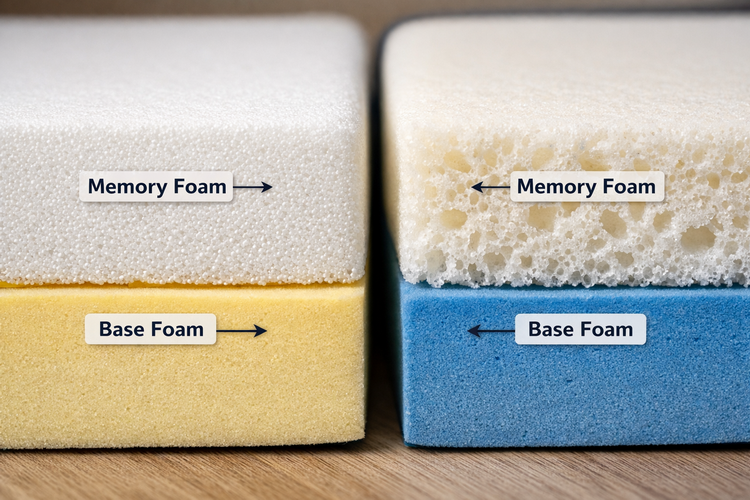
- Layering: memory foam top + high-density base foam (common for seats)
- Contouring: U-shape coccyx cut-out, ergonomic channels, wedge angles
- Additives: gel particles, copper/graphite infusion, cooling phase-change fabrics
- Cover system: removable, waterproof, anti-slip bottom, zipper spec, seam reinforcement
3) The Supplier Scorecard: How to Vet a Bulk Supplier in 30 Minutes
If your goal is inquiries and conversions on a B2B site, this is the section that makes buyers trust you—because it’s operationally real.
The 30-minute supplier scorecard (request + verify)
| Category | What to ask for | What “good” looks like |
|---|---|---|
| Manufacturing role | Are you factory or trading company? Factory address, workshop photos, process flow | consistent facility details + traceable production steps |
| Quality system | ISO 9001 certificate (or equivalent QMS evidence), QC checkpoints | documented incoming/in-process/final checks |
| Material traceability | batch codes, lot records, incoming material COA | can trace a defect to a batch |
| Spec capability | density/ILD range, tolerance sheet, testing equipment list | can commit tolerances in writing |
| Sampling discipline | sample lead time, sample labeling, spec report for each sample | samples shipped with clear spec tags |
| Capacity & lead time | monthly output, peak capacity, typical lead time by MOQ | stable planning + buffer strategy |
| Packaging | compression ratio, carton tests, labeling, pallet patterns | protects shape + reduces freight damage |
| After-sales | defect policy, replacement terms, root-cause process | transparent corrective action workflow |
[📊 Cite: ISO 9001 is widely used as a quality management system framework to deliver consistent products and improve performance; use ISO explanations as baseline.]
Red flag shorthand: if a supplier can’t provide tolerances or test conditions, they’re quoting “comfort,” not engineering.
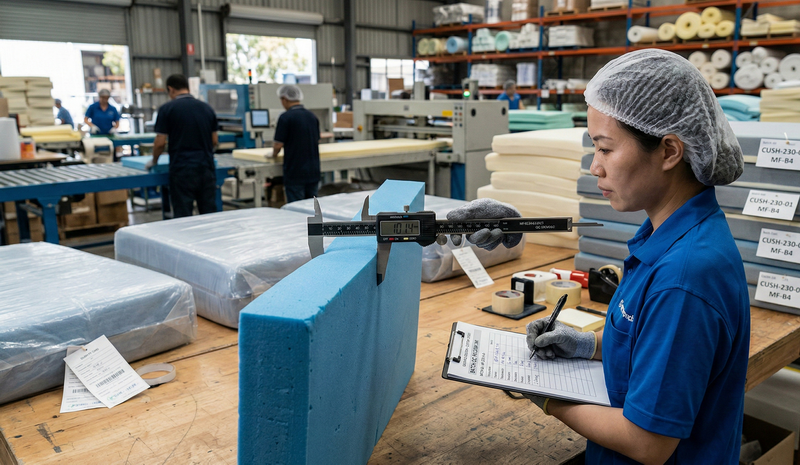
[🎯 CTA: Ask for a one-page “QC Control Plan” for your cushion SKU (incoming foam, cutting, lamination, cover sewing, final inspection). Suppliers who can produce it are usually the ones who can scale.]
4) Compliance & Market Requirements: What Buyers Commonly Miss
Compliance is where many cushion projects fail—especially when you move from sample to bulk, or from one market to another.
Common compliance signals B2B buyers look for
-
Low-emission foam programs (often requested by US/EU buyers)
[📊 Cite: CertiPUR-US program overview and what it generally covers (content restrictions + emissions).] -
Flammability considerations (especially for furniture applications in the US)
For upholstered furniture components sold into California, buyers often reference TB117-2013 smolder resistance testing methods.
[📊 Cite: California TB117-2013 scope and effective adoption notes; confirm applicability by product category.] -
REACH / RoHS / Prop 65 (depending on materials and market)
Even if foam itself is compliant, cover fabrics, zippers, anti-slip coatings, and inks can trigger issues.
Important nuance: certifications often apply to specific foam pours or producers, not automatically to every cushion you cut and sew. Your supplier should clarify what’s certified: foam material, final product, or just a component.
5) TCO Deep Dive: The Real Cost of “Cheaper Foam”
Many buyers optimize for unit price and MOQ—but bulk cushion sourcing is a TCO game.
A simple TCO model for cushion sourcing
| Cost Driver | Typical hidden cost | How a strong supplier reduces it |
|---|---|---|
| Defect rate (cut tolerance, bonding) | returns + rework labor | tighter tolerance + in-process QC |
| Odor/VOC complaints | negative reviews + refunds | controlled curing + low-emission foam |
| Compression packing damage | warped foam + claims | validated compression ratio + recovery test |
| Lead-time variability | stockouts + expedited freight | capacity planning + raw material buffers |
| Inconsistent feel | SKU drift + brand damage | batch control + spec testing |
Practical example (how “cheap” becomes expensive)
If a supplier is $0.40 cheaper per unit but causes:
- 2% higher defect/return rate
- one urgent air shipment per quarter
- more customer service load due to odor complaints
…the “cheaper” supplier often costs more within one season.
What to do instead: define acceptance metrics (density/ILD ranges, tolerance, odor window, recovery time) and make them contractual.
[🎯 CTA: Request a supplier’s “Defect Handling SOP” and “Corrective Action Report template.” The best partners already use them.]
6) Sampling & Pilot Orders: A Practical Buying Workflow
Sampling is not a feel-test; it’s a verification plan.
The buyer workflow that reduces risk
-
Spec alignment (paper stage)
Confirm density, ILD, dimensions, layering, cover materials, packaging method. -
Sample set (3 variants, labeled)
Ask for:- Variant A: comfort-forward
- Variant B: durability-forward
- Variant C: balanced Each must arrive with a mini spec sheet.
-
In-house verification
- Fit check with covers
- Recovery after compression pack test (24–72 hours)
- Odor check in warm room
- Load test (use your realistic user weight + time)
-
Pilot order
Place a small bulk run and inspect with a checklist (below).
Incoming inspection checklist for pilot orders
| Check | Standard | Notes |
|---|---|---|
| Dimensions | within tolerance sheet | measure 10 pcs / lot |
| Weight per cushion | ± tolerance | fast proxy for density consistency |
| Cover stitching | no skipped stitches | inspect stress points |
| Odor | within agreed threshold | define “airing time” rule |
| Recovery | returns to spec thickness | record time to recover |
7) Packaging, Logistics, and Scaling Without Surprises
For bulk custom memory foam cushions, logistics is part of product engineering.
Packaging questions that predict your landed cost
- What compression ratio is used (and validated)?
- How long is foam kept compressed?
- Do cartons have drop-test or burst strength specs?
- Are cushions shipped flat, rolled, or vacuum-packed?
- What is the pallet pattern and container optimization plan?
A high-performing supplier will proactively share:
- carton dimensions and container load plan
- labeling formats (SKU, batch, barcode, country-of-origin)
- moisture control approach (desiccants, liner bags)
Scaling tip: confirm how they handle peak season capacity and raw material fluctuations.
Key Takeaways
- A custom memory foam cushions bulk supplier should prove consistency with density/ILD targets, tolerance sheets, and traceability—not just offer a low quote.
- Verify quality system evidence (e.g., ISO 9001-style controls) and request a SKU-level QC plan before placing bulk orders.
- Don’t treat compliance as a checkbox—confirm what’s certified (foam vs final cushion) and align with your target market’s requirements (e.g., low emissions programs, smolder resistance standards where applicable).
- Use TCO to decide: defects, odor complaints, lead time variability, and packaging damage often outweigh unit-price savings.
- Run a structured 3-variant sampling and a pilot order with incoming inspection to prevent scale-up surprises.
[🎯 CTA: Want a supplier shortlist fast? Send a single RFQ that includes (1) density/ILD targets + tolerances, (2) packaging method, (3) compliance needs, and (4) pilot order plan. High-quality suppliers respond with data—not just pricing.]
FAQ Schema
Q: What should I ask a custom memory foam cushions bulk supplier before ordering?
A: Ask for a tolerance sheet (dimensions/weight), density and ILD targets with test conditions, a QC control plan, packaging method (compression ratio and recovery test), and proof of traceability (batch/lot records). These documents reveal whether the supplier can scale consistently.
Q: Is higher density always better for memory foam cushions?
A: Not always. Higher density generally supports durability, but comfort depends on ILD, layering, temperature response, and intended use (seat vs back vs medical). The right approach is specifying both density and ILD ranges for your load and usage profile.
Q: How do I reduce odor complaints for bulk memory foam cushions?
A: Require controlled curing time, low-emission foam evidence, and define an “odor acceptance window” in your spec (including airing time after unpacking). Also validate vacuum packing and storage duration, because over-compression can worsen odor perception.
Q: What is the best MOQ strategy when sourcing wholesale memory foam seat cushions?
A: Start with a small pilot order that matches real packaging and shipping conditions, then scale based on defect rate and recovery results. Negotiate MOQs by separating foam cutting from cover sewing if your supplier supports modular production.
Q: How can I compare two bulk suppliers objectively?
A: Use a scorecard: documentation quality (tolerances, test conditions), traceability, sampling discipline, QC system evidence, lead time stability, packaging validation, and after-sales corrective action process. Price should be evaluated only after these are confirmed.
[Author / Brand placeholder: Your company is a B2B supplier of custom foam solutions. Add your factory capability summary, service regions, and inquiry contact here.]
[🎯 CTA: Ready to source? Request a quote with your target dimensions, usage scenario, annual volume, and destination market. We’ll reply with a spec sheet, sampling plan, and a landed-cost-optimized packaging recommendation.]
<p>If you are sourcing a reliable <a href="https://lisohome.com/product/outdoor-patio/custom-outdoor-cushions/">outdoor cushion OEM manufacturer</a>, LISO offers custom patio cushions with waterproof fabrics, MOQ from 200 units, and samples ready within 14 days. <a href="https://lisohome.com/product/outdoor-patio/custom-outdoor-cushions/">Request a free quote →</a></p>