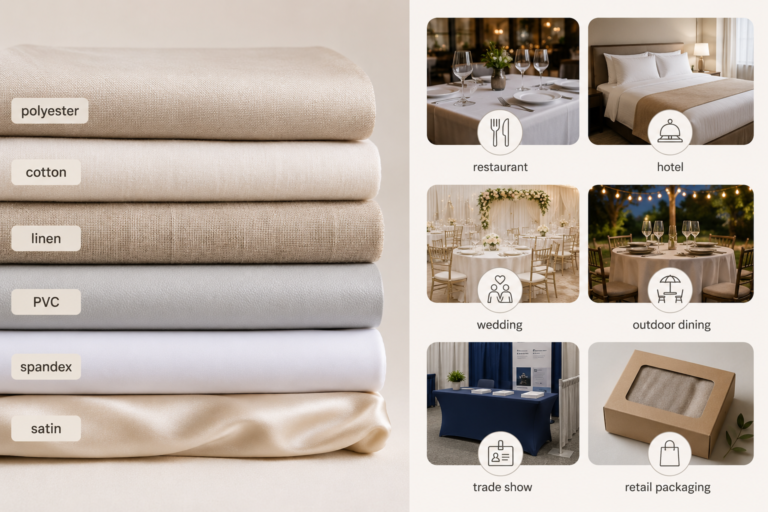
A B2B sourcing guide for hotels, event companies, linen rental operators, and hospitality wholesalers
A tablecloth that looks cheap after 20 washes is not a low-cost product — it is a recurring replacement cost.
For hotels, restaurants, banquet venues, linen rental companies, event planners, and wholesalers, table linen procurement should not be based on unit price alone. The real purchasing metric is cost per use.
Every commercial tablecloth affects operational cost in several ways:
- Laundry frequency
- Drying time
- Ironing or calendering labor
- Shrinkage control
- Stain removal efficiency
- Replacement cycle
- Fire safety compliance
- Brand presentation
This guide answers the key technical questions B2B buyers should ask before sourcing commercial table linens in bulk.
1. Fabric Selection: Which Tablecloth Fabric Offers the Best ROI?
Q1: 100% cotton, poly-cotton, or polyester — which is better for commercial laundering?
The best fabric depends on the application. A luxury hotel may prioritize hand feel and drape, while a linen rental operator may prioritize wash durability, low shrinkage, and easy maintenance.
Below is a practical comparison for high-frequency commercial use.
100% Cotton Tablecloths
Cotton offers a premium natural hand feel and a traditional fine-dining appearance. It is often selected by luxury restaurants, heritage hotels, and high-end hospitality venues where tactile quality is a priority.
However, cotton requires more careful maintenance in commercial laundry environments.
Common considerations include:
- Higher moisture absorption
- Longer drying time
- Higher risk of shrinkage if not properly pre-shrunk
- More ironing or pressing required
- Higher sensitivity to aggressive detergents and bleaching
- Progressive fiber weakening after repeated industrial washing
For buyers who prioritize natural texture and classic luxury, cotton can still be a suitable choice. However, for high-turnover banquet, rental, and catering operations, the total operating cost may be higher than synthetic alternatives.
Poly-Cotton Blend Tablecloths
Poly-cotton blends are designed to balance the soft feel of cotton with the improved durability and dimensional stability of polyester.
Typical blend ratios include:
- 65/35 polyester-cotton
- 60/40 polyester-cotton
- 50/50 polyester-cotton
Compared with 100% cotton, poly-cotton tablecloths usually offer:
- Better shrinkage control
- Faster drying
- Improved durability
- Lower ironing requirements
However, buyers should pay attention to pilling performance, especially under repeated tumble drying and mechanical friction. Lower-grade blends may develop surface fuzz or pills over time, affecting the visual quality of the table setting.
Poly-cotton is suitable for mid-range restaurants, catering companies, and banquet venues that want a balance between comfort, durability, and cost.
100% Polyester and Spun Polyester Tablecloths
For high-frequency commercial laundering, polyester is one of the most widely used materials in the hospitality and event linen industry.
Premium spun polyester is typically made from polyester staple fibers engineered into low-hairiness yarns, such as ring-spun, air-jet, or vortex-spun constructions. The goal is to create a softer, cotton-like hand feel while retaining the operational advantages of polyester.
Key advantages include:
- Low shrinkage
- Good dimensional stability
- Fast drying
- Strong color retention
- Good wrinkle recovery
- Lower ironing labor
- Strong resistance to repeated washing
Polyester has low moisture absorption, which helps reduce drying time and shrinkage. For oily stains such as grease, sauce, and dressing, buyers should specify soil-release finishing or oil-repellent finishing and validate performance under their own laundry conditions.
Premium polyester tablecloths can be engineered for long service life under controlled industrial laundry protocols. However, actual durability depends on:
- Washing temperature
- Detergent chemistry
- Bleach exposure
- Drying temperature
- Stain type
- Handling method
- Fabric construction
- Finishing quality
For wholesalers, event rental companies, banquet halls, and high-turnover hospitality programs, spun polyester often delivers the best balance of durability, price, and maintenance efficiency.
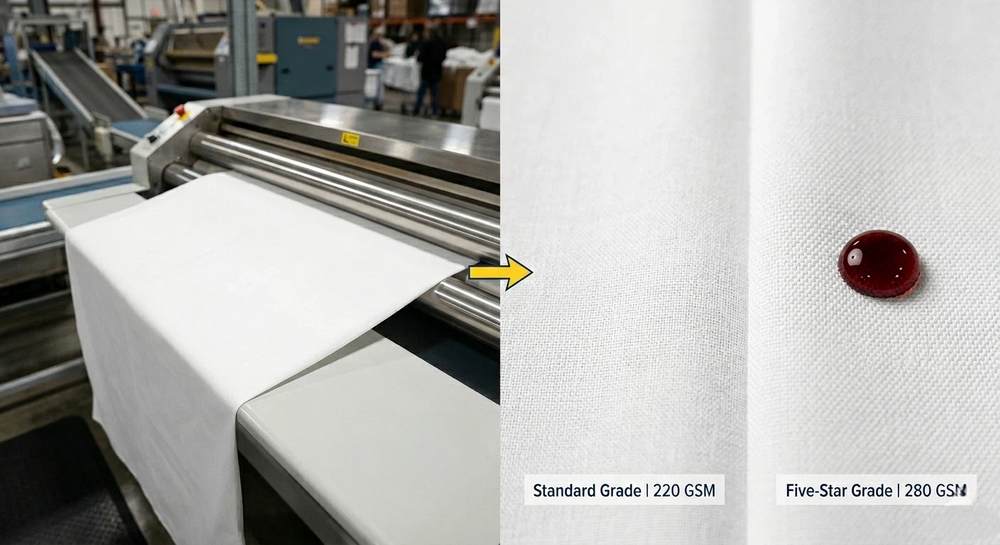
2. GSM: How Fabric Weight Affects Drape, Durability, and Cost
Q2: What GSM should B2B buyers choose for commercial tablecloths?
GSM stands for grams per square meter. It measures fabric weight and is one of the most important specifications in table linen sourcing.
However, GSM should not be evaluated alone. A higher GSM does not automatically mean better quality. Buyers should also check:
- Yarn quality
- Weave density
- Fabric construction
- Finishing process
- Shrinkage performance
- Colorfastness
- Laundry durability
- Edge stitching quality
Below is a practical GSM reference for commercial tablecloth sourcing.
Under 180 GSM: Lightweight / Promotional Tier
Tablecloths under 180 GSM are generally lightweight and cost-efficient.
They may be suitable for:
- Promotional events
- Short-term exhibitions
- Low-frequency use
- Budget catering
- Disposable or semi-disposable programs
Potential limitations include:
- Less opacity
- Weaker drape
- Lower resistance to heavy commercial laundering
- Higher risk of seam distortion
- Less premium appearance
This tier is usually not recommended for hotels, linen rental operators, or high-frequency banquet use.
200–240 GSM: Standard Commercial Tier
This is one of the most common GSM ranges for commercial polyester and poly-cotton tablecloths.
It offers a good balance between:
- Durability
- Drape
- Laundry efficiency
- Drying speed
- Cost control
- Bulk shipping weight
A 220 GSM tablecloth, for example, can provide a clean and professional table presentation while remaining practical for frequent washing and large-volume operations.
This range is suitable for:
- Hotels
- Restaurants
- Banquet halls
- Catering companies
- Wedding venues
- Event rental companies
- Hospitality wholesalers
260–300 GSM: Premium / Luxury Tier
Heavier tablecloths in the 260–300 GSM range are often used for premium dining, luxury events, and five-star hospitality settings.
They usually provide:
- Better drape
- More structured folds
- Higher opacity
- A more premium hand feel
- Stronger visual presence on the table
This tier is commonly used for:
- Fine dining restaurants
- Luxury hotels
- VIP events
- Premium wedding venues
- High-end banquet programs
Dense weaves and performance finishes can also slow liquid penetration, giving service staff more time to blot spills before full absorption. However, spill resistance depends on fiber type, weave construction, and finishing treatment — not GSM alone.
For hospitality buyers, it is recommended to request water-repellency, oil-repellency, or absorbency test results when spill performance is important.
3. Commercial Performance Comparison
The table below provides a general sourcing reference. Actual performance should be validated according to the buyer’s laundry process and quality requirements.
| Technical Parameter | 100% Cotton | Poly-Cotton Blend | Premium Spun Polyester |
|---|---|---|---|
| Typical Commercial Use | Luxury dining, premium restaurants | Mid-range hospitality, catering | Banquet, event rental, wholesale, high-turnover venues |
| Hand Feel | Natural and soft | Balanced | Cotton-like, depending on yarn quality |
| Shrinkage Control | Moderate to challenging | Better than cotton | Excellent when heat-set properly |
| Drying Speed | Slow | Medium | Fast |
| Wrinkle Recovery | Low | Medium | Good |
| Ironing Requirement | High | Medium | Low to medium |
| Color Retention | Depends on dyeing and washing | Medium to good | Good to excellent |
| Oil Stain Release | Requires proper laundry chemistry | Medium | Best with soil-release finishing |
| Commercial Wash Durability | Depends heavily on cotton quality and laundry method | Good | Very good |
| Cost Per Use | Can be higher | Moderate | Often lower for high-turnover use |
Note: The figures and performance descriptions above are general sourcing references. Buyers should request test reports or sample testing under their own laundry conditions before bulk purchasing.
4. Industrial Laundry Performance: What Should Buyers Test?
Q3: What laundry-related specifications should be confirmed before bulk orders?
For B2B buyers, a tablecloth sample should not only be judged by appearance. It should also be tested under realistic laundry conditions.
Before confirming bulk production, buyers should check the following:
Shrinkage Rate
Ask the supplier for dimensional change data after repeated washing.
Important details include:
- Washing temperature
- Drying method
- Number of wash cycles
- Measurement method
- Fabric condition before testing
For hotels and rental companies, low shrinkage is critical because tablecloth size directly affects table coverage and presentation.
Colorfastness to Laundering
Colorfastness determines whether the tablecloth maintains its shade after repeated washing.
This is especially important for:
- Black tablecloths
- Burgundy tablecloths
- Navy tablecloths
- Forest green tablecloths
- Custom PMS colors
- Dark banquet linens
Buyers should request colorfastness testing when ordering custom-dyed or dark-colored table linens.
Pilling Resistance
Pilling affects the long-term appearance of tablecloths.
It is especially relevant for:
- Poly-cotton blends
- Lower-grade spun yarns
- High-friction commercial drying
- Linen rental operations
A smooth table surface is important for restaurants, hotels, and event companies because visible pilling makes the table setting look old and poorly maintained.
Seam and Edge Durability
Commercial tablecloths experience strong mechanical stress during washing, extraction, drying, folding, and transport.
Buyers should inspect:
- Hem width
- Stitch density
- Thread quality
- Corner construction
- Seam slippage
- Edge unraveling
For heavy-duty commercial use, reinforced stitching and consistent edge finishing are essential.
5. Fire Retardancy and Venue Compliance
Q4: Why is flame retardancy important for commercial tablecloth procurement?
For hotels, event venues, exhibitions, convention centers, and public spaces, textile fire safety can be a procurement requirement.
Buyers may need flame-retardant tablecloths for:
- Trade shows
- Exhibition booths
- Conference venues
- Hotels
- Banquet halls
- Public events
- Government or institutional projects
One commonly requested standard is NFPA 701, which evaluates the flame propagation behavior of certain textiles and films under defined test conditions.
However, buyers should understand that a fire test report is not a universal safety guarantee. It applies to the tested fabric construction, test method, and conditions shown in the report.
When sourcing flame-retardant tablecloths, always confirm:
- Which standard is required in the target market
- Whether the fabric was tested as delivered
- Whether the finish is washable
- Whether the certificate applies to the same batch
- Whether the finished product matches the tested construction
Topical Flame-Retardant Treatment
Topical FR treatment means the flame-retardant chemical is applied to the finished fabric surface.
Advantages:
- Lower initial cost
- Flexible for different fabric types
- Suitable for short-term or low-frequency use
Limitations:
- May degrade after repeated commercial laundering
- Performance depends on chemistry and fixation process
- May require re-treatment
- Wash durability must be verified
Buyers should not rely only on the first test report. They should confirm how many washes the FR performance is certified to withstand.
Inherently Flame-Retardant Fibers
Inherently flame-retardant, or IFR, fabrics use fibers where flame-retardant properties are built into the polymer structure rather than applied only as a surface finish.
Advantages:
- FR function is not easily washed off
- More suitable for repeated laundering
- Better for long-term commercial programs
- More stable for rental and hospitality operations
However, buyers should still request batch-level test documentation and confirm that the tested fabric construction matches the delivered goods.
For regulated venues, recommended documents include:
- NFPA 701 test report, if required
- Batch or lot number reference
- Fabric composition
- GSM and construction details
- Wash durability information
- Supplier declaration of conformity
- Target-market compliance documents
6. OEM and ODM Customization for B2B Table Linens
Q5: What customization details should corporate buyers specify?
For B2B orders, customization is not only about size and color. It affects branding, laundering performance, storage efficiency, and long-term operating cost.
Below are the key OEM/ODM parameters buyers should confirm.
Custom Size
Commercial buyers should provide exact table dimensions and desired drop length.
Common table types include:
- Round banquet tables
- Rectangular dining tables
- Trestle tables
- Cocktail tables
- Conference tables
- Trade show tables
- Buffet tables
For formal dining and hotel use, drop length affects the final appearance. For trade shows, full-length drops may be required to hide storage underneath the table.
Fabric Composition
Buyers should specify whether they need:
- 100% polyester
- Spun polyester
- Polyester-cotton blend
- 100% cotton
- Recycled polyester
- Flame-retardant polyester
- Polyester-spandex stretch fabric
Each fabric has different performance characteristics, so composition should be matched with the actual use scenario.
GSM Selection
For bulk tablecloth programs, GSM should be selected based on:
- Target price
- Laundry method
- Required drape
- Shipping cost
- Venue positioning
- Expected service life
A good supplier should be able to recommend different GSM options for budget, standard, and premium product tiers.
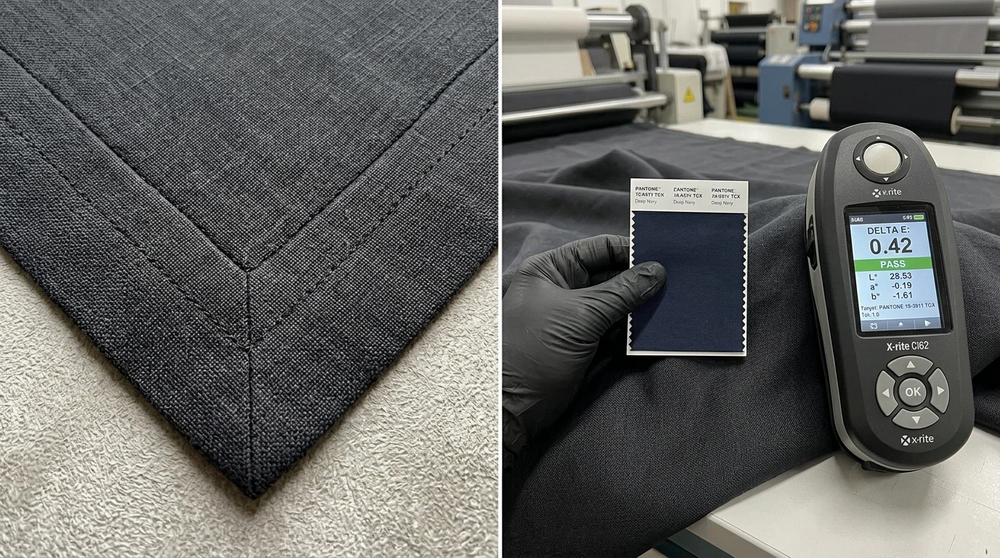
PMS Color Matching
For hotels, restaurant chains, event brands, and corporate buyers, color consistency is important.
Buyers can request:
- PMS color matching
- Lab dip approval
- Bulk fabric color confirmation
- Colorfastness testing
- Delta E tolerance control
For large chain buyers, consistent color across repeat orders is critical for brand presentation.
Edge Finishing
Common edge options include:
- Standard hemmed edge
- Overlocked edge
- Mitered corner
- Reinforced corner
- Custom border stitching
Mitered corners are often used for premium square or rectangular tablecloths because they reduce bulky overlapping fabric at the corners and create a cleaner drop.
For high-turnover wholesale or rental programs, durable overlocking and strong stitching may be more practical.
Functional Finishing
Depending on the buyer’s market, tablecloths can be finished with:
- Soil-release finish
- Water-repellent finish
- Oil-repellent finish
- Anti-pilling finish
- Soft-touch finish
- Wrinkle-resistant finish
- Flame-retardant finish
For buyers selling into Europe, North America, or regulated hospitality markets, PFAS-free water-repellent and soil-release options are increasingly preferred.
If fluorocarbon chemistry is used, suppliers should provide market-specific compliance documentation.
Logo and Brand Customization
Corporate tablecloths can be customized with:
- Embroidery
- Woven logo labels
- Printed labels
- Heat transfer logos
- Dye-sublimation printing
- Custom packaging
- Barcode or SKU labeling
For commercial laundry environments, embroidery thread and label materials should be selected for wash durability and colorfastness.
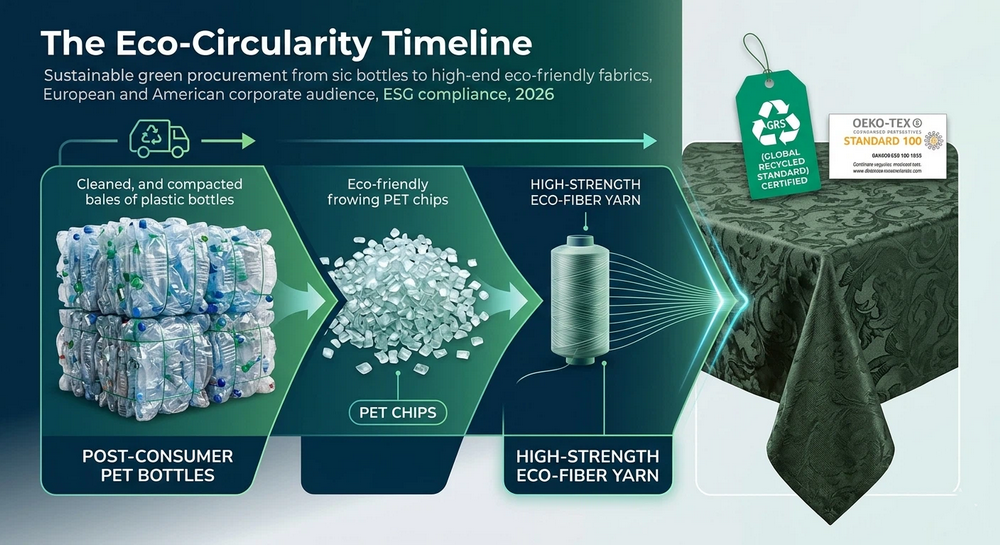
7. Sustainability: What Should Buyers Ask About Recycled Polyester?
Q6: Are recycled polyester tablecloths suitable for commercial use?
Recycled polyester tablecloths are increasingly popular among hotels, event companies, and wholesalers with sustainability requirements.
Recycled polyester is commonly made from post-consumer PET bottles or other recycled polyester sources. When processed correctly, it can provide performance similar to virgin polyester in many table linen applications.
Potential advantages include:
- Support for ESG procurement goals
- Reduced dependence on virgin raw materials
- Good durability
- Strong dimensional stability
- Compatibility with hospitality linen programs
However, buyers should avoid vague sustainability claims. Instead, they should request documentation.
Recommended documents include:
- GRS certificate
- Transaction certificate
- Recycled content declaration
- Supplier certification scope
- Chemical compliance documentation
- Product-specific environmental data, if carbon claims are made
If a supplier claims carbon reduction or lower environmental impact, buyers should request product-specific LCA or carbon-footprint documentation.
8. Tablecloth Trends for Hospitality and Events
Q7: What tablecloth trends should wholesalers and hospitality buyers watch?
For 2026 and beyond, table linen trends are moving toward a combination of performance, texture, and responsible sourcing.
Deep and Moody Color Palettes
Hotels, wedding venues, and event planners are moving beyond plain white table settings.
Popular commercial color directions include:
- Navy blue
- Deep ocean blue
- Charcoal
- Forest green
- Burgundy
- Champagne
- Warm beige
- Terracotta
- Chocolate brown
These colors help create a more immersive dining or event atmosphere.
For dark shades, buyers should pay close attention to colorfastness and shade consistency across production batches.
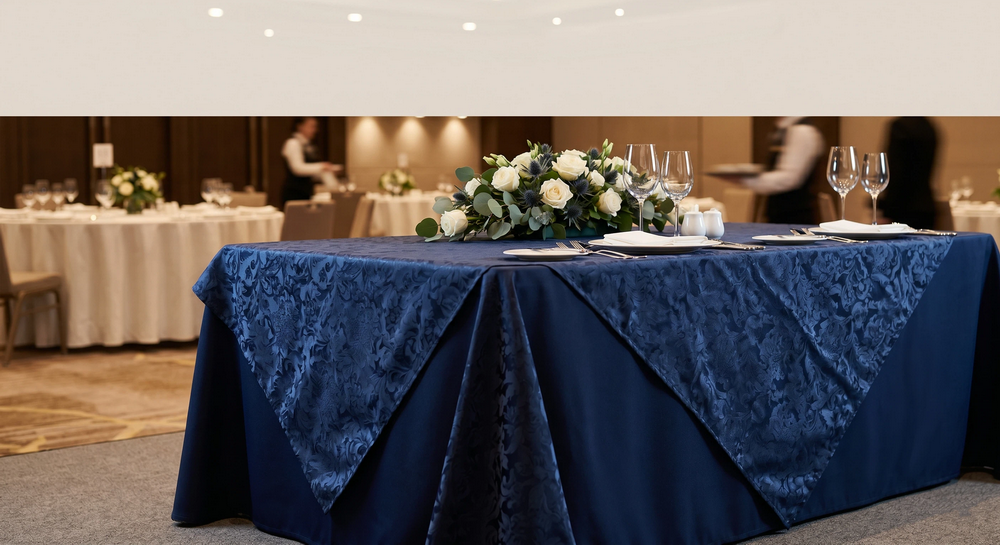
Textured Jacquard and Damask Weaves
Instead of relying only on printed patterns, many premium venues prefer woven textures.
Popular options include:
- Tone-on-tone jacquard
- Damask patterns
- Geometric textures
- Subtle stripe weaves
- Matte and lustrous yarn contrast
These fabrics create a premium look under venue lighting and are suitable for hotels, banquet halls, and formal dining programs.
Recycled Polyester and Certified Materials
Sustainability is becoming a purchasing requirement for many corporate buyers.
Wholesalers and hospitality groups may request:
- GRS recycled polyester
- OEKO-TEX related documentation
- PFAS-free finishing
- Reduced packaging
- Recyclable cartons
- Supplier traceability
For B2B sourcing, sustainability claims should always be supported by certificates and transaction documents.
Stretch Tablecloths for Trade Shows
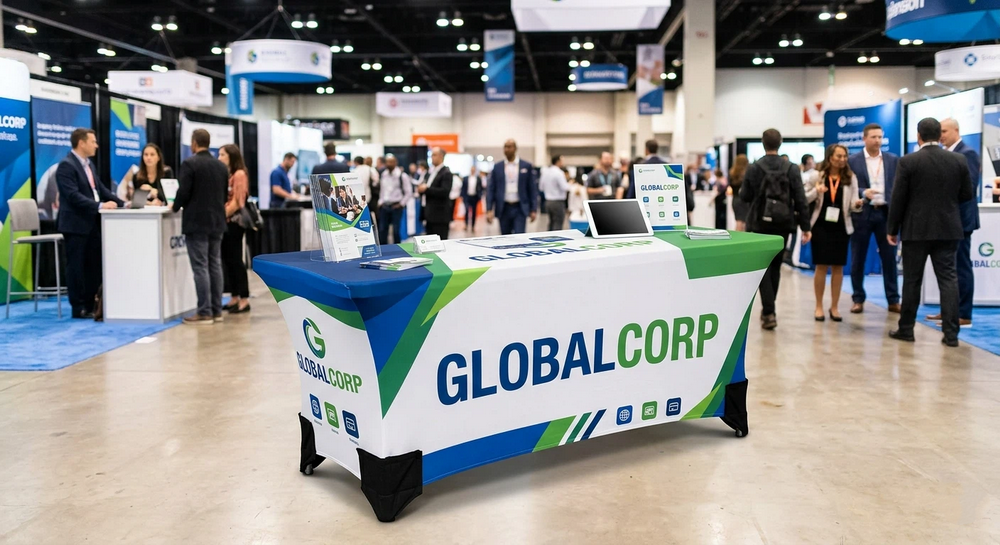
Custom stretch tablecloths are widely used in exhibitions, conferences, and promotional events.
Common features include:
- Polyester-spandex fabric
- Full table coverage
- Reinforced foot pockets
- Wrinkle-resistant appearance
- Dye-sublimation printing
- Custom logo branding
Stretch tablecloths are especially suitable for:
- Trade show booths
- Product launches
- Corporate events
- Registration desks
- Conference tables
- Promotional displays
For this category, buyers should confirm fabric recovery, print clarity, seam strength, and packing method.
9. B2B Table Linen Sourcing Checklist
Before placing a bulk order, buyers should confirm the following specifications with the supplier.
| Buyer Requirement | What to Ask the Supplier |
|---|---|
| Fabric composition | Is it polyester, spun polyester, poly-cotton, cotton, recycled polyester, or stretch fabric? |
| GSM | What GSM options are available for budget, standard, and premium tiers? |
| Fabric construction | Is it plain weave, twill, jacquard, damask, or stretch knit? |
| Shrinkage | What is the dimensional change after repeated washing? |
| Colorfastness | Has the fabric been tested for laundering colorfastness? |
| Pilling resistance | Is the fabric suitable for high-frequency commercial laundry? |
| Laundry durability | Can the fabric be tested under the buyer’s wash protocol? |
| Flame retardancy | Is NFPA 701 or another regional fire standard required? |
| FR durability | Is the FR effect topical or inherently flame-retardant? |
| Sustainability | Are GRS or other recycled material documents available? |
| Finishing | Is soil-release, water-repellent, oil-repellent, or PFAS-free finishing available? |
| Custom color | Can the supplier provide PMS matching and lab dips? |
| Edge finishing | Are hemmed edges, overlocked edges, or mitered corners available? |
| Logo customization | Is embroidery, label sewing, or dye-sublimation printing available? |
| Packaging | Can the supplier provide custom cartons, SKU labels, or barcode labels? |
| MOQ | What is the minimum order quantity by size, color, and fabric? |
| Lead time | What is the production lead time for bulk and repeat orders? |
| Sample policy | Can the buyer receive swatches or pre-production samples? |
10. Recommended Fabric Choices by Application
| Application | Recommended Fabric | Recommended GSM | Key Requirements |
|---|---|---|---|
| Hotel banquet halls | Spun polyester or poly-cotton | 220–260 GSM | Durability, drape, low shrinkage |
| Fine dining restaurants | Cotton, poly-cotton, premium polyester | 240–300 GSM | Premium hand feel, elegant drape |
| Event rental companies | Spun polyester | 200–240 GSM | Wash durability, low ironing, fast drying |
| Wedding venues | Polyester, jacquard, damask | 220–300 GSM | Appearance, color options, drape |
| Trade shows | Polyester-spandex stretch fabric | Depends on knit structure | Logo printing, wrinkle resistance |
| Outdoor catering | Polyester with functional finish | 200–240 GSM | Easy cleaning, water repellency |
| Institutional buyers | Polyester or FR polyester | 220–260 GSM | Compliance, durability, repeat supply |
| Wholesalers | Polyester, spun polyester, recycled polyester | 180–260 GSM | Price tiers, color range, stable supply |
Conclusion: Focus on Cost Per Use, Not Unit Price
In commercial table linen procurement, the cheapest tablecloth is not always the most economical choice.
For hotels, event venues, restaurants, linen rental companies, and wholesalers, the real value comes from:
- Longer service life
- Lower shrinkage
- Faster drying
- Less ironing labor
- Better stain management
- Reliable color consistency
- Safer compliance documentation
- Stable repeat production
By evaluating fabric composition, GSM, laundry performance, flame-retardant requirements, customization options, and certification documents, B2B buyers can reduce replacement costs and improve long-term operational efficiency.
A reliable table linen supplier should not only provide competitive pricing. The supplier should also help buyers choose the right fabric, confirm technical specifications, prepare samples, support compliance documentation, and maintain consistent quality across repeat orders.
Request a Custom Table Linen Quote
We supply commercial table linens for hotels, restaurants, banquet venues, event companies, linen rental operators, and global wholesalers.
Our available options include:
- Polyester tablecloths
- Spun polyester tablecloths
- Poly-cotton tablecloths
- Recycled polyester table linens
- Flame-retardant tablecloths
- Jacquard and damask tablecloths
- Stretch table covers
- Custom printed tablecloths
- OEM and ODM table linen programs
For Wholesalers
Request our bulk price list, MOQ, carton specifications, and container loading plan.
For Hotels and Event Venues
Request a fabric swatch kit with different GSM, colors, and edge finishing options.
For Regulated Venues
Contact us for flame-retardant fabric options with batch-level test documentation.
For Custom Projects
Send us your table size, target GSM, color requirement, fabric preference, and order quantity. Our team will recommend the most suitable table linen solution for your market.