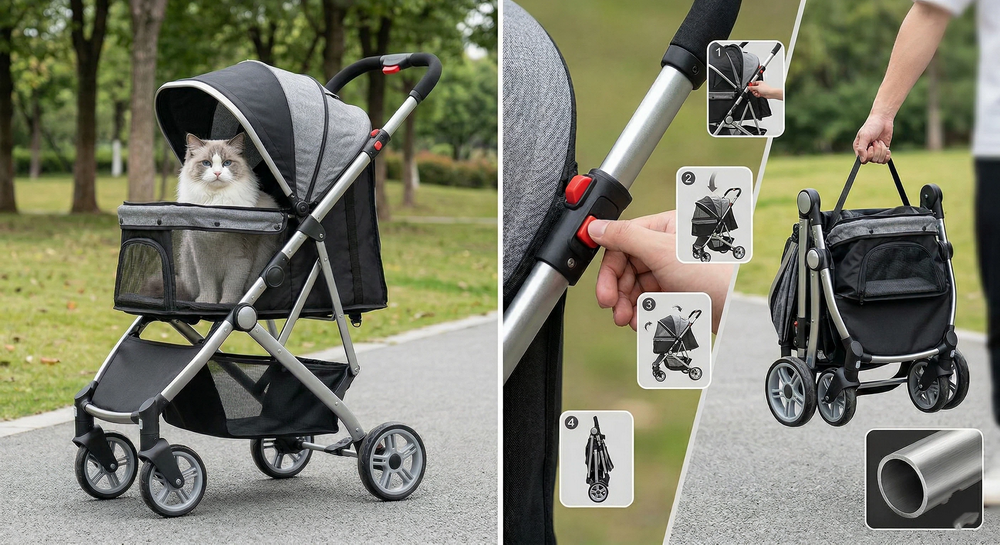
You want a stroller that folds small, rides light, and still fits your pet. Every product page promises all three. Almost none of them deliver.
A true travel pet stroller1 must fold to 45×25×15 cm or less, weigh under 4 kg2, and still open to a space large enough for a medium cat or small dog3. Very few factories in China4 can hit all three targets at once. Most "travel" models on the market are standard strollers with a different label.
Most importers discover this problem after they have already placed a first order. The stroller arrives. It does not fit in a standard checked bag. It is too heavy for carry-on. The "travel" label was marketing, not engineering. This article breaks down why the three requirements conflict at a physics level, how to tell a real travel stroller from a renamed one, and how to write an RFQ that filters for factories that can actually solve the problem.
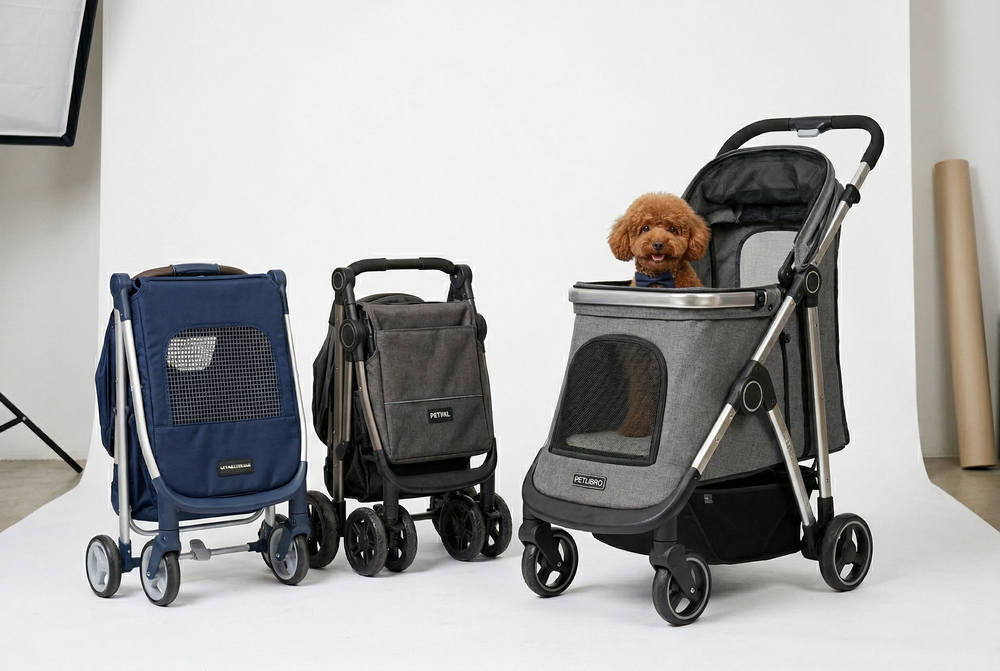
Why Do "Small Fold," "Large Interior," and "Lightweight" Work Against Each Other?
You want a stroller that disappears when folded. You also want your pet to have real space inside. And you need the whole thing to be light enough to carry through an airport. Pick any two. Getting all three is an engineering problem5, not a design choice.
These three requirements conflict at the material and structural level. A smaller fold requires thinner frame tubes6. A usable interior requires the frame to open wide. A light total weight requires low-density materials7 that must still carry a live animal safely. Solving all three at once requires precision material engineering — not just resizing an existing product.
Here is what the conflict looks like in practice.
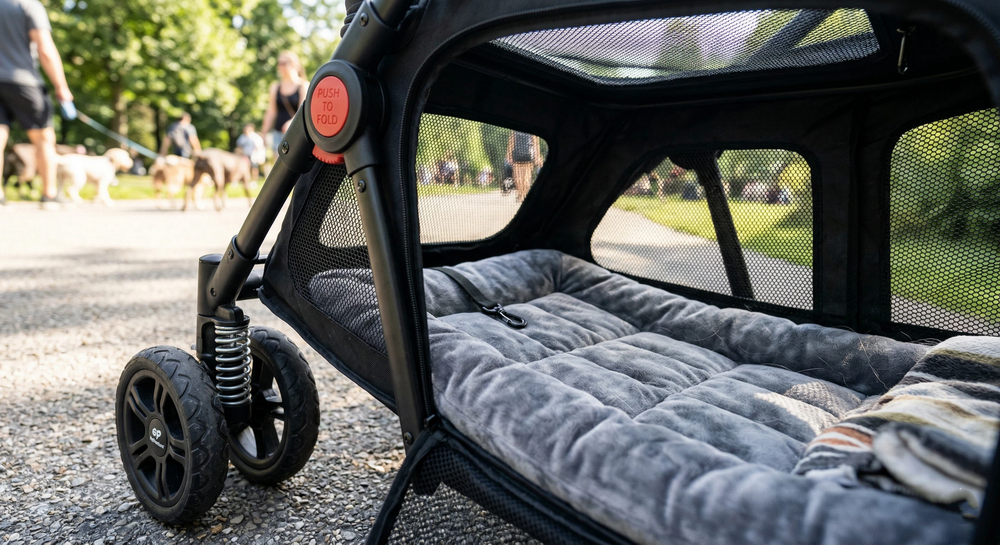
The Three-Way Engineering Conflict
Each requirement pulls the design in a different direction. Shrinking one creates pressure on the others.
| Requirement | What It Demands | What It Breaks |
|---|---|---|
| Fold small | Thin frame tubes6, compact hinge geometry | Frame rigidity when open |
| Open large | Wide tube spacing, larger frame joints | Fold volume increases |
| Weigh under 4 kg | Low-density materials like 6061 aluminum8 | Thinner walls reduce load capacity |
The only real solution is a chassis designed from scratch9 for travel. The hinge system has to fold the frame in a way that reduces volume without reducing interior space. The tube diameter and wall thickness have to be calculated together with the alloy grade. This is not complex assembly work. It is product engineering. Most factories that build standard strollers do not do this. They assemble parts from existing tooling. A travel stroller built this way will always miss at least one of the three targets.
Why Are Most "Travel" Pet Strollers Just Renamed Standard Models?
Go to any sourcing platform10 and search "travel pet stroller1." You will see hundreds of listings. Check the folded dimensions on the product page. Most will read 60 cm × 30 cm × 30 cm, or close to it. That size will not fit inside a standard 28-inch checked suitcase. It does not meet IATA carry-on limits11. It is a regular stroller with the word "travel" in the title.
Most factories rename their existing stroller as a "travel" model without changing the frame, fold geometry, or materials. The folded dimensions stay at the 60 cm range because the underlying tooling was never designed for a smaller target. Changing the label costs nothing. Redesigning the chassis requires new tooling investment12 and engineering capability most factories do not have.
I have spent time inside Chinese factories — four of them directly, and I have visited or sourced from many more. There is a pattern I see again and again. When you bring a spec that requires real product development work, the first answer is almost always some version of "that is too difficult" or "we cannot do it." It is a reflex, not a conclusion. Very few factories have a culture of working through a problem from zero with the customer. Most want to find the closest existing product and offer it with a small modification.
That is not a criticism. It is just how most factories are structured. Their value is in production efficiency, not in development. But for a product like a true travel stroller — where the spec itself requires engineering from scratch — that reflex will cost you time and lead you to the wrong source.
What "We Cannot Do It" Actually Means
When a factory says it cannot meet a fold target, there are two possible reasons. Understanding which one you are dealing with changes how you respond.
| Factory Response | What It Usually Means | What You Should Do |
|---|---|---|
| "Our current tooling cannot achieve this" | Honest. They build from existing molds. | Ask if they would invest in new tooling for a committed volume. |
| "No one can reach this spec" | Almost never true. | Ask for their engineering team's contact. If there is no engineering team, move on. |
| "We can get close — maybe 50×28×18 cm" | They are trying. Worth continuing the conversation. | Push for a sample before committing. |
| No response to the spec question at all | They did not read your RFQ carefully. | Red flag. |
The factories that can actually build a true travel stroller will engage with your spec directly. They will tell you what material grade they plan to use, what hinge design, and what the trade-off is on interior space. That conversation is the filter.
What Are the Exact Specs That Define a Real Travel Pet Stroller?
The travel category13 needs a clear definition before you can source it correctly. Without a spec target, every factory will tell you their product qualifies. With a target, the factories that qualify will self-identify — and most will not.
A true travel pet stroller must fold to 45 cm × 25 cm × 15 cm or smaller, weigh 4 kg or less complete, and open to an interior of at least 55 cm × 35 cm × 38 cm to comfortably fit a medium cat or small dog3. Any product that cannot meet the fold and weight targets together is a standard stroller, regardless of what it is called.
These numbers are not arbitrary. They come from real travel constraints.
Why These Numbers
Each target connects to a specific real-world requirement.
| Spec Target | Real-World Constraint It Solves |
|---|---|
| Fold: 45 × 25 × 15 cm | Fits inside most 28-inch checked luggage with room for other items |
| Weight: under 4 kg | Total travel bag weight stays manageable; fits airline carry-on weight limits in many markets |
| Interior: 55 × 35 × 38 cm | Adequate for cats up to 6 kg or dogs up to 8 kg; not cramped for a 2-hour transit |
| Frame material: 6061-T6 aluminum | Achieves sub-4 kg weight while maintaining structural integrity at expected pet weights |
I estimate that fewer than ten factories in China4 can hit the fold and weight targets simultaneously on a product with a properly sized interior. Most of them are not in the locations that come up first in a sourcing search. Some of them are quiet. They do not spend on trade show booths. They do product development work for mid-size brands that want exclusivity. Those are the factories worth finding.
The way to find them is not to browse listings. It is to write the spec into your first message and watch who responds with specifics.
How Do You Write an RFQ That Filters for Capable Factories?
Most importers send the same message to fifty factories. The message asks for a quote on a travel pet stroller1. The replies all look the same. Everyone says yes. No one gets disqualified. You end up evaluating samples you did not need to order.
An RFQ that leads with the fold dimension target — 45 × 25 × 15 cm — will eliminate most factories in the first round of replies. Capable factories will engage with the spec. Incapable ones will either say they cannot do it or quietly ignore the requirement and quote a standard product. The spec is the filter.
Here is what a functional RFQ for this product category should include.
Travel Pet Stroller RFQ — Key Requirements to Include
Use this as the core of your supplier inquiry. Every item here is a qualification gate, not a preference.
| RFQ Item | What to Write | Why It Filters |
|---|---|---|
| Folded dimension | "Must not exceed 45 × 25 × 15 cm. Please confirm your current product or development capability." | Eliminates factories without a travel-specific chassis |
| Total weight | "Fully assembled weight must be under 4 kg. Please state the actual weight of your sample." | Eliminates factories using steel or heavy alloy frames |
| Frame material | "Please specify alloy grade and tube wall thickness used in your travel model." | Shows whether they have an engineering specification or are guessing |
| Interior dimension | "Minimum interior: 55 × 35 × 38 cm when fully open. Please confirm." | Confirms they have not solved the fold by shrinking the interior |
| MOQ for development | "What is your MOQ if we require a new fold geometry sample first?" | Filters factories that only work from existing tooling |
| Lead time | "What is the development sample14 lead time from confirmed spec to first physical sample?" | Flags factories that are vague because they have not done this before |
Send this RFQ to fifteen factories. Expect two or three useful replies. That is normal. The factories that respond with specific material grades, actual folded dimensions from a physical sample they already have, and a realistic development timeline — those are the ones worth calling.
<section class="wp-block-group" data-cluster-target="pet-stroller" style="margin:32px 0;padding:24px;border:1px solid #d9e6e4;border-radius:14px;background:#f7fbf9;"> <h2 style="margin:0 0 12px;color:#1f2a26;font-size:24px;line-height:1.25;">Related OEM sourcing page</h2> <p style="margin:0 0 14px;color:#4f5f59;line-height:1.7;">If this article is part of a stroller development project, use the core product page to compare frame platform, wheel choice, fold size, carton planning, load rating, MOQ and 2-in-1 options. Continue with the <a href="https://lisohome.com/product/pet-travel/pet-stroller-manufacturer/">pet stroller manufacturer page</a>.</p> <ul style="margin:0;padding-left:20px;color:#4f5f59;line-height:1.7;"><li>City, senior dog, travel and large dog stroller programs</li><li>Frame, wheel and fold-size decisions</li><li>Load, brake and carton QC</li></ul> </section>
Conclusion
Most travel pet stroller1s are standard products with a new label. The fold target of 45×25×15 cm and a weight under 4 kg are your filter. Write the spec into your RFQ, and let the factories qualify themselves.
Explore this link to find top-rated travel pet strollers that meet your needs. ↩
Discover why weight matters for travel convenience and ease of use. ↩
Find strollers specifically designed for your pet's size and comfort. ↩
Discover reputable factories that specialize in quality pet stroller production. ↩
Learn about the complexities involved in creating a functional travel stroller. ↩
Explore the role of frame tubes in stroller stability and weight. ↩
Discover materials that balance weight and strength in stroller design. ↩
Learn why this material is favored for lightweight and durable strollers. ↩
Learn about the benefits of custom designs for travel pet strollers. ↩
Find reliable platforms to source quality pet strollers. ↩
Ensure your stroller meets airline regulations for travel. ↩
Explore how tooling impacts the quality and feasibility of stroller production. ↩
Learn the specifications that qualify a stroller as a true travel model. ↩
Understand the importance of development samples in ensuring quality. ↩