<p>Pet carrier backpacks look simple until sampling starts. Then fabric, bottom structure, coating, stitching, cleaning, and MOQ can change the real cost fast.</p>
<p><strong>Buyers should check bottom structure, Oxford fabric weight, coating type, strap stitching, zipper quality, mesh strength, cleaning design, and realistic MOQ before approving a pet carrier backpack sample. These checks help new brands, wholesalers, and Amazon sellers avoid weak products, hidden tooling cost, and avoidable customer complaints.</strong></p>
<figure class="wp-block-image size-large"><img src="https://lisohome.com/wp-content/uploads/2026/06/pet-carrier-backpack-fabric-inspection-hero.png" alt="pet carrier backpack sourcing inspection" loading="lazy" title="Pet Carrier Backpack Fabric and Coating Inspection" /></figure>
<p>I do not think a pet carrier backpack should be judged by price first. I usually start with the parts that carry weight, touch pets, collect dirt, and decide whether a buyer can reorder the same quality later. A low price can look attractive on the first sample. But if the fabric is thinner than promised, if the coating cannot stop liquid, or if the shoulder straps are weak at the connection point, the product can become expensive after the first batch. This is why I treat a <a href="https://lisohome.com/product/pet-travel/pet-backpack-carriers/">custom pet backpack carrier</a> as a sourcing program, not only as one bag.</p>
<p>For a new brand, a wholesaler, or an Amazon seller, this decision is also about MOQ discipline. A buyer may want a new molded bottom, many colors, a metal logo, special packaging, and low MOQ at the same time. That is usually not realistic. A better sourcing plan starts with the right structure, then chooses fabric and customization that match the order size.</p>
<h2>Why Should Buyers Check the Bottom Structure Before Custom Logo or Color?</h2>
<p>Many new buyers think the plastic bottom is a small change. It is not. At low MOQ, a molded bottom can become one of the most expensive parts.</p>
<p><strong>Buyers should check the bottom structure first because molded plastic parts may need tooling, mold fees, and higher order volume. If the order is small, an existing bottom structure is usually safer than opening a new plastic mold for a custom pet carrier backpack.</strong></p>
<figure class="wp-block-image size-large"><img src="https://lisohome.com/wp-content/uploads/2026/06/pet-backpack-bottom-board-zipper-checklist.png" alt="pet carrier backpack bottom structure" loading="lazy" title="Pet Carrier Backpack Bottom Board and Zipper Checklist" /></figure>
<h3>What changes the bottom structure decision?</h3>
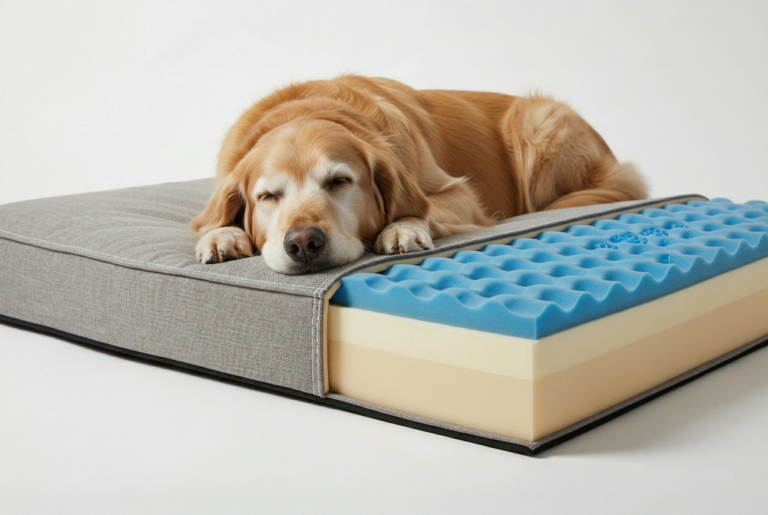
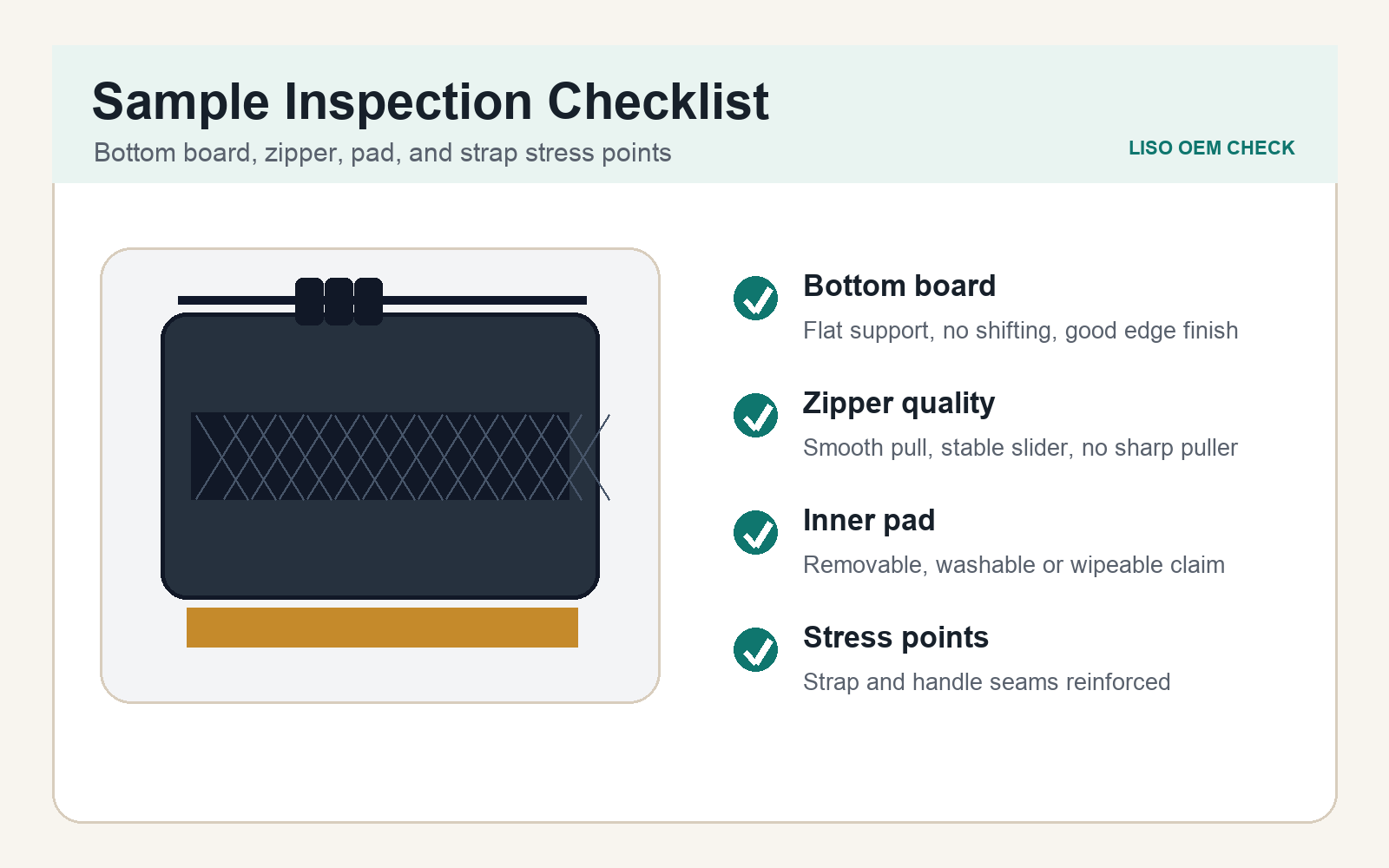
<p>The bottom board is not only a flat support piece. It decides pet comfort, bag shape, load distribution, cleaning method, and the final unit cost. Some buyers ask for a custom plastic bottom because they have seen a competitor product. They may think the factory can make it as easily as changing a logo. In real production, a custom plastic part often needs a mold. The mold fee must be paid before mass production. If the order is large, the cost can be spread across many units. If the order is small, each backpack carries too much of that cost.</p>
<p>For 0-1 buyers, I usually suggest a more practical route. Use an existing structure first. Improve the fabric, coating, stitching, and removable pad. Then test market demand. After the buyer has stable sales and repeat orders, a custom molded bottom can make more sense.</p>
<figure class="wp-block-table"><table><thead><tr><th>Bottom option</th><th>Best for</th><th>Main risk</th><th>Buyer note</th></tr></thead><tbody><tr><td>Existing board structure</td><td>Low MOQ and first order</td><td>Less visual uniqueness</td><td>Best starting point for new brands</td></tr><tr><td>Reinforced textile bottom</td><td>Lightweight travel products</td><td>Needs good stitching and binding</td><td>Good when flexibility matters</td></tr><tr><td>Custom molded plastic bottom</td><td>Mature product line</td><td>Mold fee and high unit cost at low MOQ</td><td>Better after sales volume is proven</td></tr></tbody></table></figure>
<p>I would not spend the first development budget on a new plastic bottom unless the buyer already has volume. I would rather use that budget to improve fabric, coating, load-bearing seams, and the inner pad. Those details affect reviews more quickly.</p>
<h2>How Should Buyers Choose 600D, 900D, PU, or PVC Coating?</h2>
<p>Fabric words can sound clear, but real fabric quality is not always clear. A supplier can say 600D, while the actual fabric may feel different.</p>
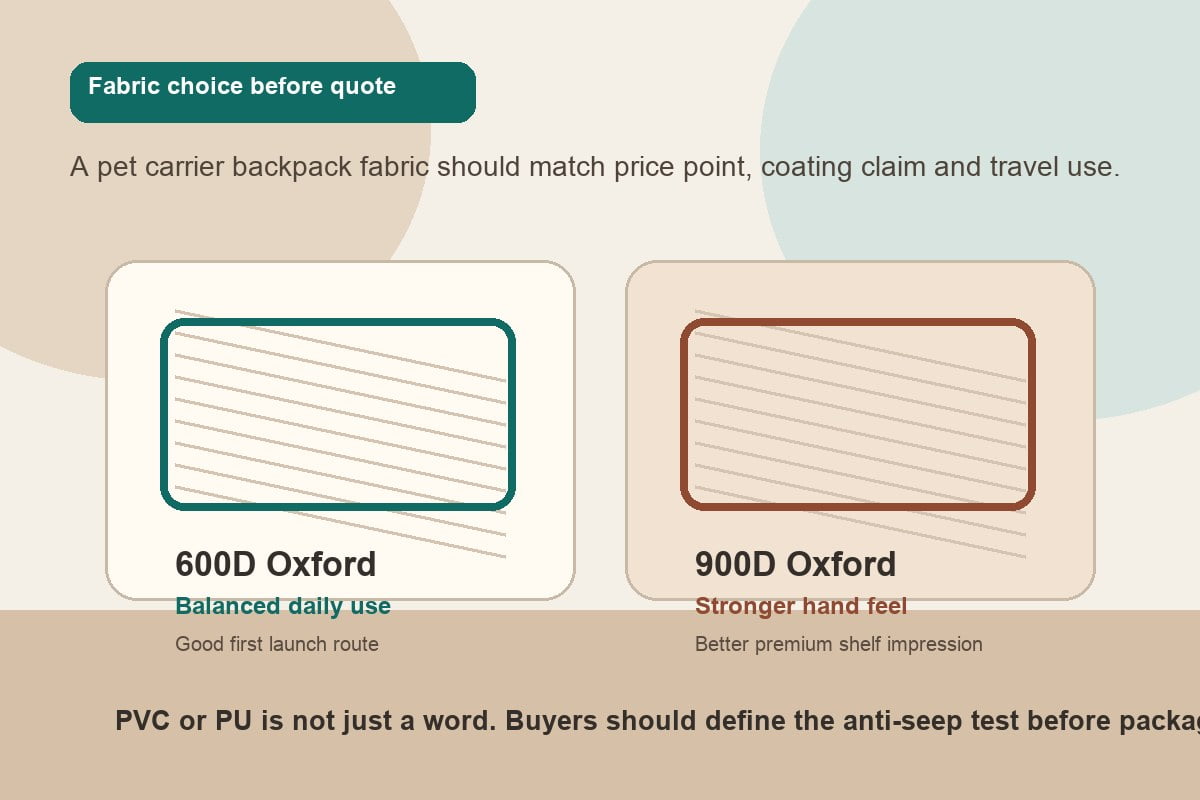
<p><strong>For most pet carrier backpacks, 600D Oxford can be enough. If the buyer wants a mid-to-high-end product, 900D Oxford can improve hand feel and positioning. For travel or car-use scenes, buyers should also confirm coating performance, not only the fabric denier.</strong></p>
<figure class="wp-block-image size-large"><img src="https://lisohome.com/wp-content/uploads/2026/06/600d-900d-oxford-pvc-pu-pet-carrier-backpack.jpg" alt="600D 900D Oxford pet carrier backpack fabric" loading="lazy" title="600D and 900D Oxford Fabric Choice for Pet Carrier Backpacks" /></figure>
<h3>What should buyers compare?</h3>
<p>I do not choose fabric only by the number printed on a quotation. 600D and 900D can both work, but they support different price points. A normal pet carrier backpack can use 600D Oxford when the buyer wants a balanced cost and reliable daily-use product. If the buyer wants a stronger fabric hand feel and a better retail position, 900D can help the product stand out from similar items.</p>
<p>The coating decision is just as important. Some products use PU water-repellent coating. That can help with light splashes. But a pet backpack has a different risk. If a pet urinates inside the bag, simple water-repellent treatment may not stop liquid from seeping through. If liquid reaches a car seat or aircraft seat, foam can absorb odor. The surface may look clean later, but the smell can remain inside the cushion.</p>
<figure class="wp-block-table"><table><thead><tr><th>Material choice</th><th>Best for</th><th>Main risk</th><th>Buyer note</th></tr></thead><tbody><tr><td>600D Oxford</td><td>Balanced cost and daily use</td><td>May look too standard for premium positioning</td><td>Good for first product line</td></tr><tr><td>900D Oxford</td><td>Mid-to-high-end positioning</td><td>Higher material cost</td><td>Better hand feel and stronger shelf impression</td></tr><tr><td>PU water-repellent coating</td><td>Light splash resistance</td><td>May not stop deeper liquid seepage</td><td>Ask what claim the coating supports</td></tr><tr><td>PVC coating or anti-seep backing</td><td>Better liquid barrier needs</td><td>Can change hand feel and cost</td><td>Useful for car or travel scenarios</td></tr></tbody></table></figure>
<p>I prefer to explain coating by use scene. If the product is only for short city walks, PU water-repellent treatment may be acceptable. If the product is positioned for car travel, airport movement, or longer pet travel, I would ask the supplier to confirm anti-seep performance more carefully. The word “waterproof” should not be used too loosely. The buyer should define the test and the claim before packaging is printed.</p>
<h2>How Can Buyers Verify Fabric Quality Before Placing an Order?</h2>
<p>A sample bag can look fine in photos. The real question is whether the fabric, coating, and weight match what the supplier promised.</p>
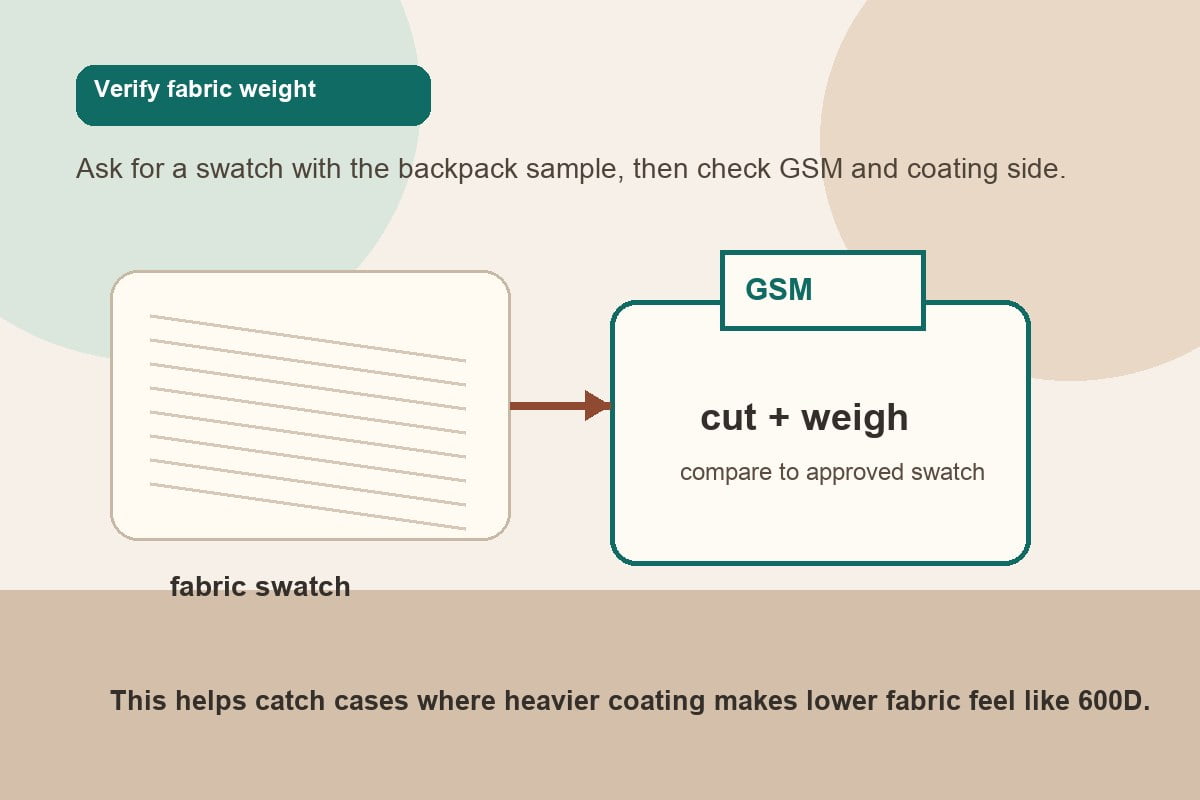
<p><strong>Buyers should ask the supplier to send a fabric swatch together with the pet carrier backpack sample. Then they can test GSM or fabric weight with a cutter and scale, compare hand feel, and check whether the coating matches the promised specification.</strong></p>
<figure class="wp-block-image size-large"><img src="https://lisohome.com/wp-content/uploads/2026/06/pet-carrier-backpack-fabric-gsm-swatch-test.jpg" alt="pet carrier backpack fabric GSM test" loading="lazy" title="Pet Carrier Backpack Fabric GSM Swatch Test" /></figure>
<h3>What is the practical inspection method?</h3>
<p>Some buyers only touch the finished sample and decide by hand feel. That is risky. A lower-denier fabric can feel thicker if the coating is heavier. This can make a 500D-style fabric feel close to 600D in a quick touch test. It does not mean the base fabric is the same. It only means the surface feel has been changed.</p>
<p>I suggest one simple step. Ask the supplier to send one extra hand-feel fabric swatch with the finished backpack sample. The buyer can use a GSM cutter and scale to measure fabric weight. The buyer can also bend, scratch, and compare the coating side. This is not a full laboratory test, but it is much better than trusting one line in a quotation.</p>
<p>Buyers should also keep the approved swatch. When bulk production starts, that swatch becomes the reference for incoming material and final inspection. If the bulk fabric feels different, the buyer has something clear to compare.</p>
<figure class="wp-block-table"><table><thead><tr><th>Check item</th><th>Why it matters</th><th>How to check</th></tr></thead><tbody><tr><td>Fabric swatch</td><td>Confirms base material before bulk</td><td>Ask supplier to send it with the sample</td></tr><tr><td>GSM or fabric weight</td><td>Helps catch lower material substitution</td><td>Use GSM cutter and scale</td></tr><tr><td>Coating side</td><td>Shows whether the product is only water-repellent or more anti-seep</td><td>Compare surface and back coating</td></tr><tr><td>Hand feel</td><td>Supports retail positioning</td><td>Keep approved swatch for bulk comparison</td></tr><tr><td>Simple liquid test</td><td>Checks the buyer's real use claim</td><td>Test with defined time and pressure</td></tr></tbody></table></figure>
<p>This step is especially useful for Amazon sellers and new brands. They may not have an internal fabric team. But they can still create a simple approval standard. A supplier who refuses to send a swatch or cannot explain fabric weight clearly may be competing only by price.</p>
<h2>Which Load-Bearing and Cleaning Details Should Buyers Inspect on the Sample?</h2>
<p>A pet backpack does not fail only at the bottom. Straps, handles, side seams, zipper ends, mesh, and connection points all carry risk.</p>
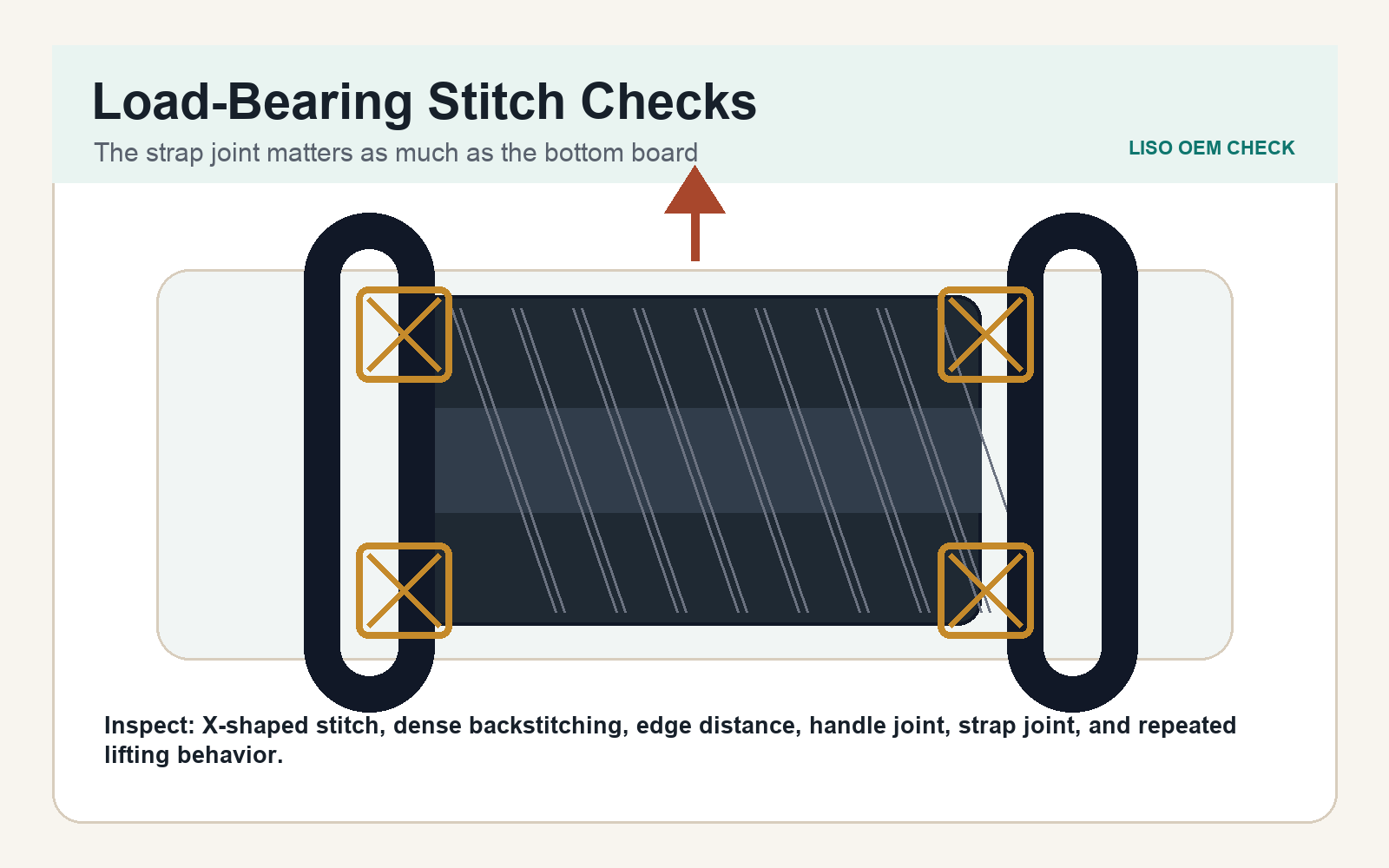
<p><strong>Buyers should inspect shoulder straps, handles, side seams, zippers, mesh panels, bottom support, and fabric water resistance before approving a pet backpack sample. Strong X stitching, backstitching, and reinforced connection points reduce the risk of tearing during real use.</strong></p>
<figure class="wp-block-image size-large"><img src="https://lisohome.com/wp-content/uploads/2026/06/pet-backpack-x-stitch-strap-reinforcement.png" alt="pet backpack X stitching shoulder strap inspection" loading="lazy" title="Pet Backpack X Stitching Shoulder Strap Reinforcement" /></figure>
<h3>What should the sample inspection include?</h3>
<p>Many buyers focus on the bottom board because it is easy to see. I agree that the bottom is important. But I also look at every place where force moves from the pet to the bag and then to the human body. The shoulder strap connection is one of the most important points. The handle connection also matters. Side seams and bottom binding can open if the sewing is weak or too sparse.</p>
<p>For LISO's pet backpack work, I pay close attention to X-shaped stitching and backstitching at connection points. This is a small detail, but it shows whether the factory understands load-bearing. A clean product photo cannot show this fully. The sample must be pulled, opened, zipped, bent, and checked by hand.</p>
<p>Cleaning design also affects reviews. A removable inner pad is still the most practical cleaning feature. Full-bag washing can be realistic only when the structure supports it. For example, some detachable designs or top-opening zipper styles are easier to wash and dry. A buyer should not claim the whole bag is washable unless the fabric, board, padding, zipper, and reinforcement can handle that use.</p>
<figure class="wp-block-table"><table><thead><tr><th>Sample point</th><th>What to inspect</th><th>Why it matters</th></tr></thead><tbody><tr><td>Shoulder straps</td><td>X stitching, backstitching, connection density</td><td>Carries the pet and the bag weight</td></tr><tr><td>Handles</td><td>Reinforcement at connection points</td><td>Often used when lifting quickly</td></tr><tr><td>Side seams</td><td>Stitch density and binding</td><td>Prevents seam opening</td></tr><tr><td>Zipper</td><td>Smooth pull, end reinforcement, tooth quality</td><td>A weak zipper creates returns fast</td></tr><tr><td>Mesh panels</td><td>Tear resistance and ventilation</td><td>Pets push against mesh during use</td></tr><tr><td>Fabric coating</td><td>Water or anti-seep test</td><td>Reduces cleaning and odor complaints</td></tr></tbody></table></figure>
<p>If the buyer has only one sample inspection hour, I would start with these points. A pretty backpack with weak connection stitching is not a good product. A slightly simpler backpack with correct fabric and reinforced stress points can create better repeat orders.</p>
<h2>What Low-MOQ Customization Is Realistic for New Pet Brands?</h2>
<p>Low MOQ is possible, but it needs discipline. A buyer cannot ask for every custom detail and still expect a low first-order cost.</p>
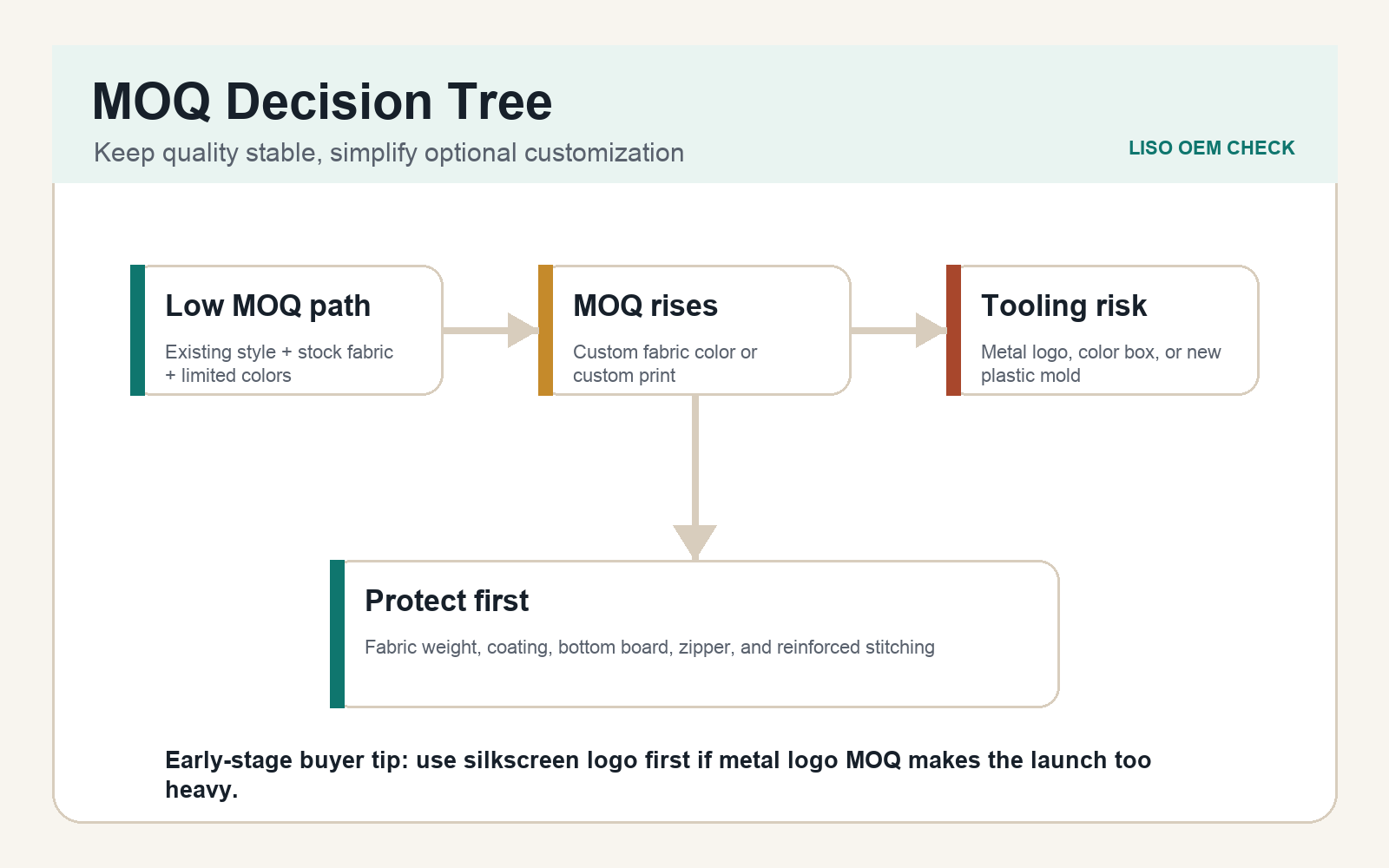
<p><strong>For low MOQ pet carrier backpacks, buyers should use existing styles, in-stock fabric, limited colors, and simple logo methods such as silkscreen printing. Custom molded plastic bottoms, many colors, metal logos, and complex packaging usually raise MOQ or unit cost quickly.</strong></p>
<figure class="wp-block-image size-large"><img src="https://lisohome.com/wp-content/uploads/2026/06/pet-backpack-carrier-moq-decision-tree.png" alt="pet carrier backpack MOQ logo packaging decision" loading="lazy" title="Pet Carrier Backpack MOQ Logo Packaging Decision" /></figure>
<h3>What should buyers give up first?</h3>
<p>New brands often want the product to look unique from day one. I understand that pressure. But the first order should prove product-market fit. It should not carry every possible custom cost. A better low-MOQ path is to select an existing backpack structure, choose an in-stock fabric, limit the color range, and add a simple logo. Silkscreen printing is often more realistic than metal logo development when the order is small.</p>
<p>Fabric customization can still be possible at low MOQ if the buyer uses available fabric routes and prints on that base. But a molded plastic bottom is a different decision. It usually needs tooling. The buyer should avoid it unless the quantity is high enough to spread the mold fee. The same logic applies to too many colorways and special packaging. Each extra SKU makes production, inspection, and inventory harder.</p>
<figure class="wp-block-table"><table><thead><tr><th>Buyer request</th><th>Low-MOQ fit</th><th>Cost risk</th><th>My sourcing view</th></tr></thead><tbody><tr><td>Existing style</td><td>Strong</td><td>Low</td><td>Best starting point</td></tr><tr><td>In-stock fabric</td><td>Strong</td><td>Low to medium</td><td>Keeps sample and bulk faster</td></tr><tr><td>Printed logo</td><td>Strong</td><td>Low</td><td>Good for first brand launch</td></tr><tr><td>Many colors</td><td>Weak</td><td>Medium to high</td><td>Adds SKU pressure</td></tr><tr><td>Metal logo</td><td>Weak</td><td>Medium to high</td><td>Often needs higher quantity</td></tr><tr><td>Color box</td><td>Weak at small volume</td><td>Medium</td><td>Use only if retail channel needs it</td></tr><tr><td>Molded plastic bottom</td><td>Poor at low MOQ</td><td>High</td><td>Avoid until volume is proven</td></tr></tbody></table></figure>
<p>Buyers should also connect this article decision to one focused sourcing page. A pet carrier backpack should be compared with a dedicated <a href="https://lisohome.com/product/pet-travel/pet-backpack-carriers/">pet backpack carrier manufacturer</a> program and a <a href="https://lisohome.com/product/pet-travel/pet-carrier-manufacturer/soft-sided-backpack-carrier/">soft-sided backpack carrier manufacturer page</a> because shoulder strap strength, fabric coating, mesh, bottom-board structure, cleaning design and MOQ planning are different from car accessories, dog beds or stroller programs.</p>
<p>For the first backpack order, I would not chase every custom feature. I would choose a stable structure, verify the fabric, improve coating for the right use scene, reinforce the load-bearing points, and keep packaging simple. That gives the buyer a stronger chance to launch, learn, and reorder.</p>
<section class="wp-block-group" data-cluster-target="pet-backpack" style="margin:32px 0;padding:24px;border:1px solid #d9e6e4;border-radius:14px;background:#f7fbf9;"> <h2 style="margin:0 0 12px;color:#1f2a26;font-size:24px;line-height:1.25;">Related OEM sourcing page</h2> <p style="margin:0 0 14px;color:#4f5f59;line-height:1.7;">If this article is part of your backpack sample review, use the core product page to compare fabric weight, PVC coating, shoulder strap reinforcement, mesh, bottom-board structure and realistic low-MOQ choices. Continue with the <a href="https://lisohome.com/product/pet-travel/pet-backpack-carriers/">pet backpack carrier manufacturer page</a>.</p> <ul style="margin:0;padding-left:20px;color:#4f5f59;line-height:1.7;"><li>Backpack carrier structure and stress points</li><li>600D or 900D Oxford fabric choices</li><li>Logo, color and packaging choices by MOQ</li></ul> </section>
<h2>Conclusion</h2>
<p>A good pet carrier backpack starts with honest material, realistic MOQ, reinforced stress points, and cleaning logic that matches real travel use.</p>