Why 2026 Procurement Teams Are Rebalancing Toward “Profitable Sustainability”
Retail procurement in 2026 is less about choosing the “greenest” SKU and more about selecting defensible sustainability that still turns inventory and protects margin. Two forces are converging:
-
Stronger scrutiny of environmental claims (“recycled,” “eco,” “carbon neutral”) is pushing retailers to demand better substantiation and documentation. Environment+1
-
Regulatory attention on product sustainability and supply chains is increasing in major markets (especially the EU), raising the bar for traceability and responsible sourcing. European Commission+1
That’s why RPET beach towels are catching procurement attention: they sit at the intersection of commercial upside (seasonal demand + premiumization) and documentable sustainability (recycled content + traceability frameworks).
What Exactly Is an RPET Beach Towel—and What It’s Not
An RPET beach towel is typically made from recycled PET, commonly sourced from post-consumer plastic bottles (exact feedstock depends on the supply chain). The key procurement question isn’t “is it recycled?”—it’s:
-
How much recycled content is in the yarn/fabric? (e.g., 50% / 70% / 100% RPET)
-
Can the supplier prove it consistently by lot/PO?
-
Does the finished towel meet performance and durability expectations?
Common RPET towel constructions (what retailers actually buy)
-
Microfiber suede / peach-skin: Smooth, packable, vibrant prints, fast drying
-
Waffle weave: Texture, quick dry, lightweight, often perceived as “premium travel”
-
Terry-style (poly terry or blends): More “traditional towel” appearance, heavier hand feel
-
Hybrid blends: Cotton face + RPET back (or similar) to balance feel vs. dry time (availability varies by supplier)
What RPET is not
-
Not automatically “low quality.” Quality depends on fiber grade, knitting/weaving, finishing, and QC.
-
Not automatically “compliant.” Claims must be backed by credible documentation (see compliance section).
-
- -
The Profit Case: How RPET Beach Towels Create Margin and Pricing Power
Retailers don’t profit from materials—they profit from perceived value and sell-through. RPET beach towels can support both.
Premiumization levers that customers feel (and pay for)
-
Print differentiation: Seasonal prints, resort-inspired patterns, limited drops
-
Hand feel & drape: Suede-like microfiber or structured waffle
-
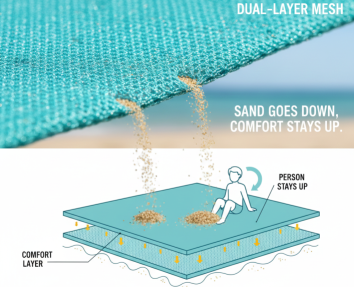
Functional cues: Quick-dry, sand-resistant surface, lightweight travel format
-
Packaging that upgrades value: Belly bands, giftable boxes, recycled paper hangtags
Bundles that lift AOV without heavy discounting
RPET towels work well in sets because they’re lightweight and design-led:
-
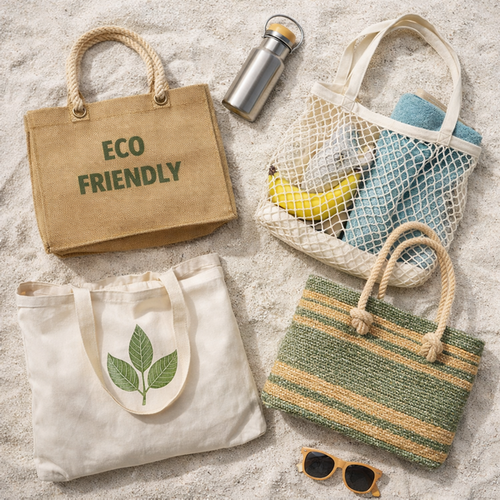
Towel + beach bag
-
Towel + water bottle + pouch
-
Family pack (2–4 towels with coordinated prints)
: Private label advantage
Private label teams can use RPET towels as a fast “brand story” SKU: recycled content + design exclusivity + packaging = clear differentiation. Textile Exchange also highlighted industry initiatives pushing recycled polyester sourcing—useful context when positioning these lines to internal stakeholders. Textile Exchange
Pro Tip (Merchandising): If you want margin without “luxury pricing,” build a 3-tier assortment:
-
Entry: 1–2 core prints, lighter GSM, basic packaging
-
Mid: better hand feel, stronger color story, improved finishing
-
Premium: upgraded weave/finish + giftable packaging + “travel-ready” features
-
- -
Faster Turns: Why RPET Towels Fit 2026 Inventory Strategy
Beach towels are seasonal, but modern retail cycles reward SKUs you can test, repeat, and replenish quickly.
Easier SKU testing
Compared to bulky cotton terry, many RPET formats are:
-
More compact to store and ship (helps replenishment logistics)
-
Better for design refreshes (print-led SKUs are easier to rotate)
Seasonality plays
RPET towel programs map cleanly to:
-
Spring/Summer travel ramps
-
Holiday travel peaks
-
Resort and coastal “always-on” assortments (for destination retail)
-
- -
Sustainability and Compliance: What Retailers Can Safely Claim—and How to Prove It
Retailers increasingly need claims that stand up to scrutiny. EU policy initiatives are explicitly targeting misleading environmental claims, and broader sustainability requirements are evolving. Environment+2Textile Exchange+2
A practical “claim hierarchy” for RPET towels
-
Recycled content claim (best when certified): “Made with X% recycled polyester”
-
Traceability claim (with chain-of-custody evidence): transaction-level documentation
-
Chemical safety claims (market-specific): testing and restricted substance compliance
-
Responsible production claims: social audit reports, supplier standards
Documentation buyers commonly request
-
GRS / RCS scope certificates + transaction documentation (where applicable)
-
Chemical compliance testing aligned with target market needs (e.g., restricted substance expectations vary by region)
-
Factory audit reports (BSCI/SMETA/SEDEX equivalents depending on retailer policy)
Also note: the EU’s Ecodesign for Sustainable Products Regulation (ESPR) entered into force in July 2024 and is designed to enable broader sustainability requirements across product groups, with textiles frequently cited in related policy discussions. European Commission+1 And the EU Corporate Sustainability Due Diligence Directive entered into force in July 2024 (scope and obligations depend on the company and evolving implementation). European Commission+1
Important: Sustainability legislation and thresholds can change through political processes. Some EU sustainability rules have faced proposed or approved rollbacks in late 2025, so procurement teams should keep documentation robust even as details evolve. Reuters+1
Spec Sheet Procurement Should Standardize (To Reduce Returns and Bad Reviews)
A towel that “looks great in a photo” can still fail in reviews. Standardize specs so suppliers can’t under-deliver.
Core performance specs
-
Absorbency expectations (define how you’ll test it)
-
Dry time (relative performance, not absolute promises unless tested)
-
Pilling/snags resistance
-
Edge finishing: stitching density, hem type, corner reinforcement
-
Shrinkage tolerance after wash
Print and color durability
-
Colorfastness (wash/rub/light) targets (market-specific)
-
Print method selection: sublimation vs reactive-style looks vs jacquard patterns (depends on construction)
Packaging and retail readiness
-
Barcode placement, polybag alternatives, carton marks, display hooks, inserts—define once and reuse across SKUs.
-
- -
Supplier Selection Framework (Use This Scorecard)
Below is a practical table retailers can use to qualify suppliers and protect both margin and brand risk.
| Procurement Factor | Recommended Standard (Example) | Why It Matters | How to Verify |
|---|---|---|---|
| Recycled-content proof | Certification + transaction-level evidence (when applicable) | Defensible claims, less greenwashing risk | Certificates, transaction docs, lot mapping Environment+1 |
| Fabric construction | Defined weave/knit + finishing spec | Controls hand feel, durability, shrinkage | Approved sample + production swatches |
| GSM & size tolerance | Clear tolerance range | Consistency across stores/online | Pre-production sample + AQL inspection |
| Colorfastness target | Minimum grades per test | Reduces returns and complaints | Lab report from recognized lab |
| QC system | AQL plan + inline inspections | Predictable quality at scale | QC records, inspection reports |
| MOQ by design/color | Transparent MOQs | Prevents cost surprises | Quotation sheet per variant |
| Lead time & capacity | Sampling + production timeline | Supports seasonal windows | Production plan + historic OTIF |
| Packaging compliance | Retail-ready packaging standard | Faster receiving + shelf execution | Packaging mock + checklist |
| Social compliance | Audit aligned with retailer policy | Risk reduction | Audit reports, CAPA records |
| Traceability process | PO → batch → shipment mapping | Claims integrity | Traceability SOP + records |
Expert Advice: Ask suppliers to quote two scenarios:
-
“First order” (new print + new packaging)
-
“Repeat order” (existing print + standardized packaging) This exposes the true levers for faster replenishment and better margin.
Cost Breakdown and Pricing Strategy (How to Protect Margin)
RPET towel costs usually move with:
-
Yarn/fiber input and recycled content requirements
-
GSM and size
-
Printing complexity and color coverage
-
Finishing and packaging choices
-
Compliance documentation and testing expectations
Data not confirmed: exact cost deltas vary widely by region, factory setup, and certification requirements. Don’t rely on “RPET is always cheaper/more expensive”—treat it as a program you optimize.
A pricing ladder retailers can execute
-
Entry: value prints, simplified packaging, fewer colorways
-
Mid: upgraded hand feel + better finishing + improved packaging
-
Premium: higher perceived value (design, feature cues, giftable packaging, travel positioning)
-
- -
Key Takeaways
-
RPET beach towels fit 2025 procurement priorities: margin, speed, and defensible sustainability claims. Environment+1
-
The profit isn’t in “RPET” alone—it’s in spec discipline + design differentiation + packaging + assortment strategy.
-
Winning retailers treat RPET towels as a repeatable program (scorecard + spec sheet + RFQ template), not a one-off seasonal buy.
-
- -
FAQ (10)
-
What does RPET mean in beach towels? RPET means recycled polyester made from recycled PET inputs, used to produce polyester yarn and fabric.
-
Are RPET beach towels absorbent? They can be, but absorbency depends on construction (microfiber, waffle, terry) and finishing—not just recycled content.
-
What’s the safest recycled-content claim for retailers? A quantified claim (“X% recycled polyester”) supported by documentation is generally safer than vague “eco-friendly” wording. Environment+1
-
Do I need GRS certification? Many retailers prefer third-party certification for recycled content and traceability, especially as claim scrutiny increases. Textile Exchange
-
Which RPET towel style sells best? Print-led microfiber or waffle weaves often perform well for travel/compact positioning, while terry-like options fit traditional towel expectations.
-
How do I reduce returns? Standardize GSM, size tolerance, colorfastness targets, and packaging specs—then enforce AQL QC and pre-shipment checks.
-
Is RPET always more sustainable than cotton? Not always in every metric. Sustainability depends on lifecycle factors and supply chain practices; avoid absolute claims without evidence. Environment
-
What compliance trends matter most for textiles in 2025? Green-claims substantiation and product sustainability frameworks are key themes in the EU policy landscape. Environment+2European Commission+2
-
What’s a practical MOQ strategy? Start with fewer base fabrics and standardized packaging, then vary prints to expand assortment with lower operational complexity.
-
How do I brief my supplier for faster lead times? Lock the base spec (fabric, GSM, finishing) and treat prints as modular, so repeats can run faster.
Buyer Checklist (10 items)
-
Define target margin and retail price ladder (entry/mid/premium)
-
Choose construction: microfiber / waffle / terry / hybrid
-
Set RPET % requirement and acceptable tolerance language
-
Lock size, GSM, and shrinkage tolerances
-
Define colorfastness and print durability targets
-
Confirm required documentation (certifications, transaction evidence, testing) Environment+1
-
Specify packaging: materials, barcodes, carton marks, display method
-
Establish sampling workflow: lab dip/strike-off → pre-pro → production approval
-
Apply supplier scorecard + AQL QC plan
-
Build a replenishment plan for peak season and repeat orders
RFQ Template (Copyable)
Paste this into email/WhatsApp/Alibaba message to suppliers:
Subject: RFQ – RPET Beach Towels (Private Label / Wholesale) – 2025 Program
1) Product Basics
-
Product: RPET beach towel
-
Intended market: (EU/US/AU/Other)
-
Target retail tier: Entry / Mid / Premium
-
Size: (e.g., 70×140 cm / 80×160 cm / custom)
-
GSM: (target range + tolerance)
-
Construction: Microfiber suede / Waffle / Terry-style / Hybrid
-
Recycled content: (e.g., 70% RPET / 100% RPET)
2) Design & Color
-
Number of designs:
-
Printing method preferred: (supplier recommendation OK)
-
Colorfastness requirements: (wash/rub/light targets if you have them)
3) Quality Requirements
-
Absorbency expectation/testing method:
-
Shrinkage tolerance after wash:
-
Stitching/hem requirements:
-
Packaging requirements: (belly band/box/hangtag, barcode placement)
4) Compliance & Documentation
-
Required certifications: (GRS/RCS/OEKO-TEX/Other)
-
Required test reports: (market-specific)
-
Social audit requirement: (BSCI/SMETA/Other)
5) Commercial Terms
-
MOQ per design/color:
-
Sample lead time:
-
Production lead time:
-
Incoterms: EXW / FOB / CIF (port: )
-
Target price range: (optional)
6) Submission Please quote first order vs repeat order pricing and provide:
-
Similar product photos/specs
-
Documentation list (certs, test options)
-
Packing details (pcs/carton, carton size, GW/NW)
-
- -
If you’re building a 2026 seasonal assortment, share your target price tiers and channels (in-store / online / resort) and we’ll propose a 3-tier RPET beach towel lineup designed for margin and replenishment speed.