Introduction: Why In-Cabin Flights Trigger Dog Anxiety
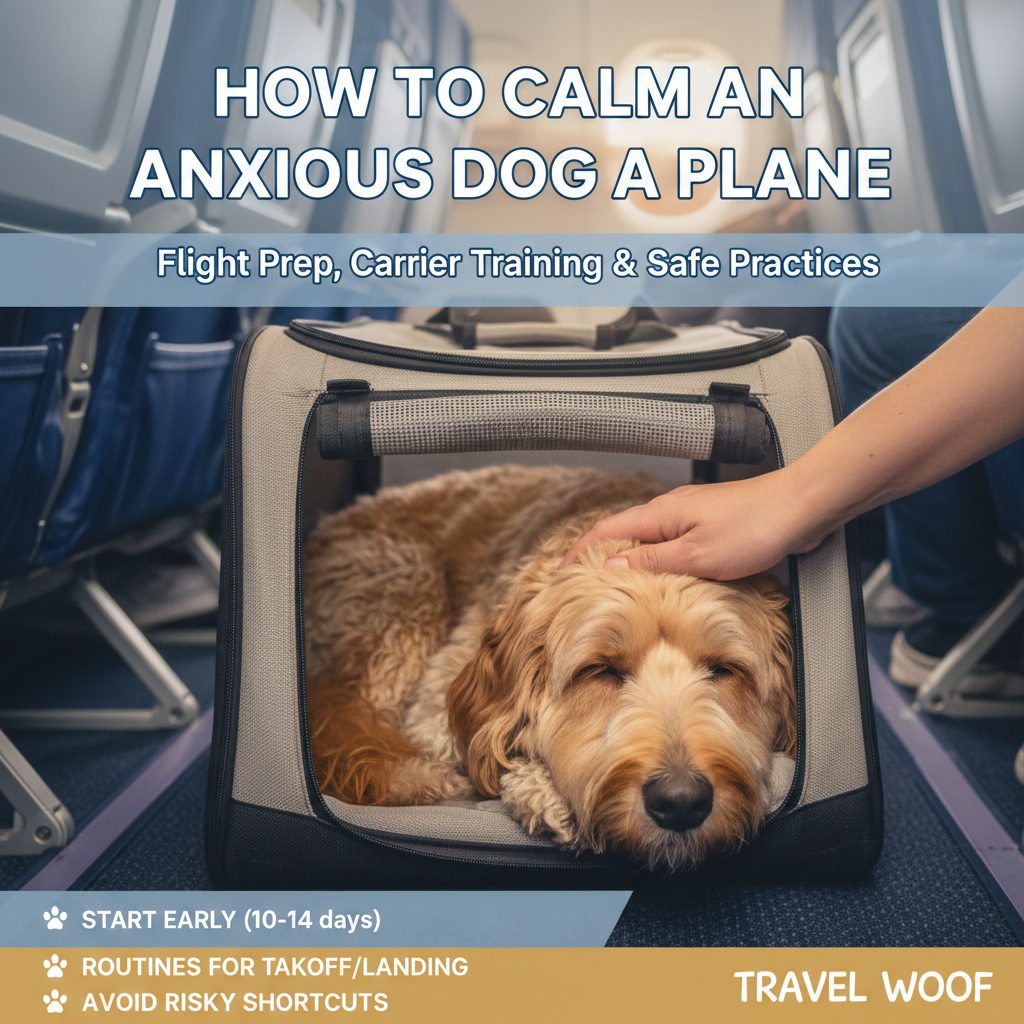
Flying in-cabin with an anxious dog can feel stressful. However, most problems are predictable. Noise, motion, crowds, and confinement stack together. As a result, dogs may whine, paw, drool, or panic.
The good news is this: calm flights are trainable. In fact, the best results come from simple routines repeated over time. Therefore, this guide focuses on practical calming methods. It also covers what to do during takeoff, landing, and turbulence. Finally, it explains what not to do, especially around sedation.
Who This Guide Is For (And What “In-Cabin” Really Means)
This guide is written for frequent travelers, rescue adopters, and pet travel service providers (including wholesalers and retailers) who want a realistic plan for flying with an anxious dog in the cabin—especially when the dog is borderline size and comfort + compliance are both tight constraints.
“In-cabin” typically means your dog rides in a carrier placed under the seat in front of you. That reality drives everything:
- Your dog must remain in the carrier most or all of the time (depending on airline rules).
- Space is limited: posture, ventilation, and the ability to turn or settle matter.
- Cabin noise, pressure changes, and motion can trigger panic, nausea, or reactivity.
Note: Airline and country rules vary (US vs UK/EU). Always verify your specific carrier’s pet policy before travel.
Why Dogs Get Anxious on Planes (So You Can Treat the Cause)
Many flight problems are not “bad behavior.” They’re a mismatch between a dog’s coping skills and a high-intensity environment.
Noise/panic triggers
Jet engines, announcements, clapping seatbelts, and rolling luggage can create a sustained “alarm” soundscape. Dogs sensitive to noise may escalate quickly if they’ve never been trained to settle through it.
Separation vs confinement stress
Some dogs panic because they can’t reach you; others panic because they feel trapped. The training approach differs:
- Separation stress benefits from predictable presence cues and gradual distance.
- Confinement stress benefits from carrier-as-den conditioning and short successful reps.
Motion sickness vs anxiety (they can overlap)
Motion sickness may look like anxiety: drooling, lip licking, yawning, trembling, whining. If nausea is involved, no amount of “reassurance” will fix it—you need prevention and a vet plan.
Reactivity in tight spaces
Airports compress triggers: strangers staring, kids rushing, other animals, carts. A reactive dog can go over threshold fast, especially in lines.
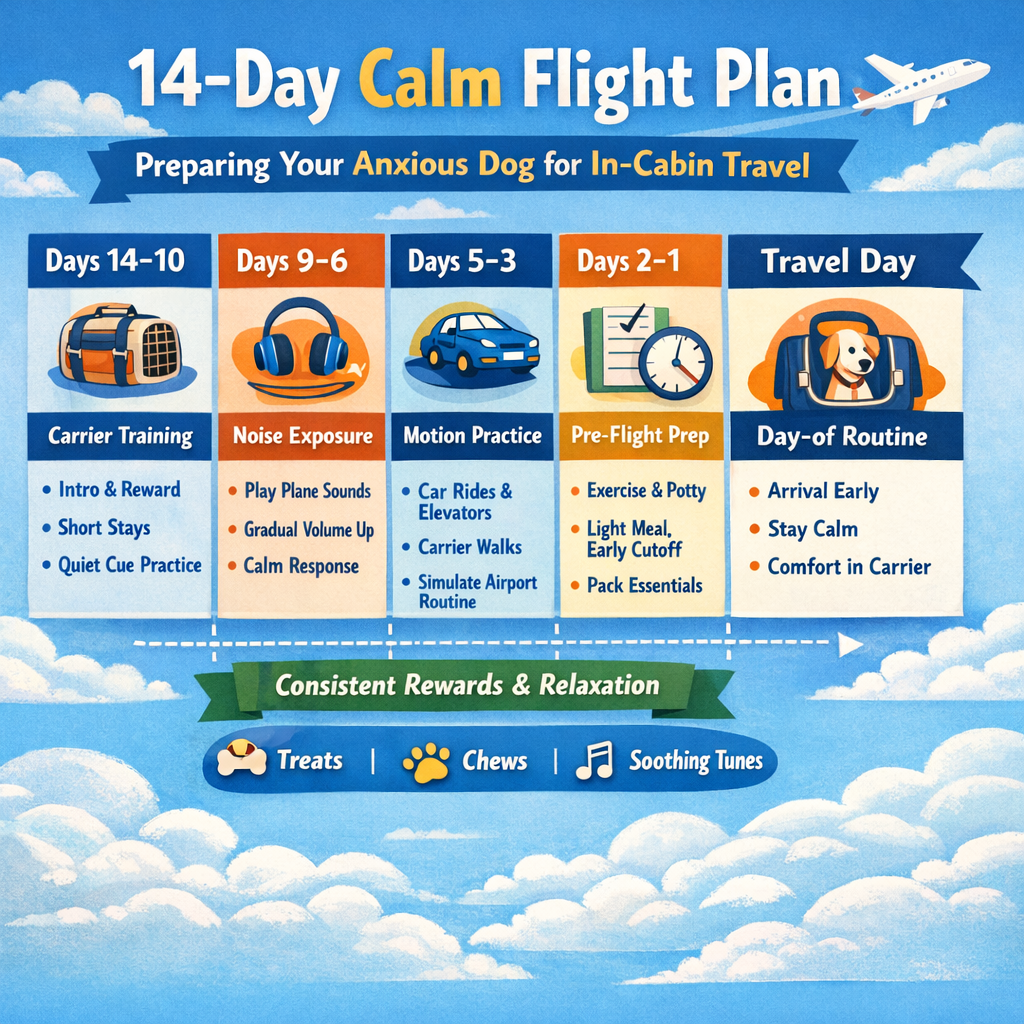
Pre-Flight Timeline: A Practical 14-Day Plan to Build Calm
If your goal is “quiet, settled, resting in the carrier,” train that behavior in small, repeatable wins.
Days 14–10: Carrier = safe den
- Leave the carrier out at home with the door open.
- Toss high-value treats inside; reward voluntary entry.
- Feed one meal per day near or inside the carrier.
- Add a familiar-smelling liner (washed with unscented detergent).
Days 9–6: Short confinement + “settle” cue
- Practice 1–3 minute sessions: dog enters → door closes → reward calm → door opens.
- Teach a simple cue (e.g., “settle”) and reward quiet.
- Gradually extend duration only if your dog stays below panic threshold.
Days 5–3: Noise exposure (desensitization)
- Play airplane cabin sounds at low volume while your dog relaxes.
- Pair with calm activities (lick mat, quiet chew, gentle massage).
- Increase volume slowly across sessions—avoid “flooding” (too much, too fast).
Days 2–1: Motion practice + airport simulation
- Short car rides with the carrier secured on a stable surface.
- Practice carrying the carrier, waiting in a hallway, taking an elevator, standing in a line.
- Add “micro-stressors” (zipper sound, rolling suitcase nearby) at low intensity.
Travel day routine (simple and consistent)
- Do a calm exercise session (not exhausting chaos).
- Plan potty timing.
- Use a light meal with an early cutoff to reduce nausea risk.
- Pack essentials in one place (treats, wipes, spare pad, water plan).
Pro Tip (Trainer-style guidance):
Train in 1–3 minute reps and end on a win. If your dog escalates (scratching, panting hard, frantic whining), you waited too long—reduce duration next rep.
Carrier Acclimation That Actually Works (Not Just “Put Them In It”)
Step 1: Explore
Reward any investigation: sniffing, stepping in, turning around. Don’t force entry.
Step 2: Nap
When your dog is choosing the carrier, start rewarding calm stillness. Aim for “head down” moments.
Step 3: Travel
Add movement gradually:
- gentle lift → set down → reward
- short carry around the home → reward
- short car ride → reward
Comfort setup that supports calm
- Familiar scent: a small unwashed T-shirt (no strong perfume).
- Absorbent pad + spare.
- A safe, quiet chew (only if your dog reliably chews safely under stress).
- Optional: a light cover flap to reduce visuals (never block airflow).
Choosing an In-Cabin Carrier for an Anxious, Borderline-Size Dog
For borderline dogs, your carrier choice can reduce anxiety or create it.
Under-seat reality checks
Your dog should be able to:
- lie down comfortably
- change position slightly
- access ventilation on multiple sides
Soft-sided vs semi-structured
- Soft-sided can fit under more seats and flex slightly, but needs anti-collapse support and reliable airflow.
- Semi-structured can feel more stable (helpful for motion-sensitive dogs) but may be less forgiving under-seat.
Escape prevention for reactive dogs
Look for:
- secure zippers (double zippers, lock loops)
- strong stitching at stress points
- stable base to prevent tipping during movement
“Airline compliant” is not one number
Each airline can publish different dimensions and enforcement varies by aircraft. Your goal is to choose a carrier that is:
- stable, ventilated, washable
- sized to your dog’s measured length/height
- realistically compatible with typical under-seat spaces
Table: Carrier Features Mapped to Anxiety Scenarios (Practical Buying Guide)
| Anxiety scenario | Carrier feature that helps | Why it helps | What to avoid |
|---|---|---|---|
| Noise/panic | Privacy panel + breathable mesh | Reduces visual stimulation while preserving airflow | Fully sealed covers that reduce ventilation |
| Separation stress | Top-entry access + calming routine | Easier to reward calm without opening the “main door” | Constant door opening that increases arousal |
| Motion sickness | Rigid/stable base + low sway | Reduces rocking and jostling sensations | Flimsy bottoms that bend and bounce |
| Reactivity to people/animals | Multiple mesh sides + optional visual shield | Lets you control exposure (see less, breathe well) | No ventilation or poor visibility control |
| Confinement stress | Adequate internal height + anti-collapse frame | Prevents the “crushed cave” feeling | Narrow, collapsing carriers |
| Escape attempts | Double zippers + reinforced seams | Lowers risk of mid-trip escapes | Weak zippers, thin fabric at corners |
B2B note (for service providers/wholesalers): Standardizing features like stable bases, strong ventilation, quiet hardware, and reinforced zippers can reduce negative reviews, travel incidents, and returns—especially for anxious or reactive dogs.
What to Do at the Airport (The High-Stimulation Zone)
Arrive early, reduce pressure
Rushing increases handler stress, and dogs absorb that. Build extra time for potty and calming reps.
Security screening strategy
Many airports require the dog to be removed from the carrier during screening. Prep:
- Practice “out → hold → back in” at home.
- Use a harness that’s secure (avoid slip-out risk).
- Keep distance from crowds whenever possible.
Gate routine: create a predictable “quiet corner”
- Choose a low-traffic spot.
- Use your “settle” cue.
- Reward quiet—small treats, spaced out.
- Avoid constant petting if it amps your dog up.
Preventing reactivity
If people approach:
- Step aside, block with your body.
- Use a simple phrase: “He’s training—please give space.”
What to Do During Takeoff, Landing, and Turbulence (Step-by-Step)
These are the highest-risk moments for anxious dogs.
Takeoff (noise spike + pressure changes)
- Place the carrier fully under seat early (avoid last-second shoving).
- Use a light cover flap if it calms your dog (keep ventilation clear).
- Start calm reinforcement before the plane moves: cue “settle,” reward quiet.
- If your dog is sensitive to pressure changes, offer small swallows (tiny treat) to encourage natural swallowing.
Turbulence (motion + uncertainty)
- Keep the carrier stable and forward-facing if possible.
- Don’t shake or tap the carrier to “correct” whining.
- Use a low, calm voice cue once, then reward a pause in noise.
60-second reset protocol (if whining/pawing starts):
- Wait for a half-second of quiet → reward.
- Repeat 3–5 times.
- If escalating, reduce input: cover flap, stop talking, calm breathing.
Landing (stress rebound)
Landing often triggers renewed whining as dogs anticipate release.
- Reward calm intermittently.
- Don’t promise “we’re almost there” with excited tone—stay neutral.
Motion Sickness on Flights: Practical Prevention Without Guesswork
Common signs
Drooling, repeated swallowing, yawning, vomiting, “sad” posture, refusing treats.
Feeding and hydration
- Avoid a large meal right before flying.
- Bring a small amount of water; offer tiny sips if your dog tolerates it.
Vet options (worth discussing in advance)
If your dog has a history of vomiting in cars, ask a veterinarian about anti-nausea strategies well before travel. Don’t trial new meds on flight day.
Stability matters
A carrier with a stable base and low sway can reduce nausea triggers. Movement during boarding (bumping the carrier) can worsen symptoms—carry smoothly.
Safety “What NOT to Do” (Especially Around Sedation)
Don’t use sedation as a DIY shortcut
Sedation decisions should be made with a veterinarian, especially for dogs with airway risk, health conditions, or severe panic. Some airlines restrict sedated pets and sedation can introduce safety risks in travel environments.
Don’t experiment on travel day
No new:
- calming chews/supplements
- medications
- foods
- tight gear (new harness/muzzle)
Don’t block ventilation
Over-covering is a common mistake. Visual shielding can help—just keep airflow open.
Don’t accidentally reinforce panic
If whining reliably triggers immediate attention, some dogs learn to escalate. Reward the behavior you want: quiet pauses and settling.
Don’t use unsafe calming tools
Avoid anything that risks overheating or restricts breathing. Comfort should never reduce airflow.
Post-Flight Decompression: Preventing Regression After One Bad Trip
First 30 minutes
- Quiet walk, water, gentle praise
- Avoid crowded reunions or letting strangers greet immediately
24-hour reset
Return to normal routines and do a short “carrier calm” session at home to end the experience with control.
When to get help
If your dog shows persistent fear, refusal to enter the carrier, or escalating aggression, involve a qualified trainer or veterinary behavior professional.
Notes for Rescues, Retailers, and Service Providers (Reducing Stress + Support Tickets)
If you support customers who travel with anxious dogs, the biggest lever is education + fit guidance:
- Provide a 1-page “14-day plan” insert or QR code video.
- Include a measurement guide (length, height, weight, turning room).
- Encourage pre-flight practice (elevator, line waiting, carrier carry).
- Standardize carrier specs that reduce failure points: ventilation, stability, reinforced seams, reliable zippers, washable liners.
About LISO LTD (lisohome.com): As a pet travel product manufacturer and wholesaler, LISO LTD can support B2B partners with consistent carrier specifications and packaging inserts that help end users prepare dogs properly—reducing complaints and improving outcomes.
Key Takeaways
- Calm flights come from training + repetition, not last-minute tricks.
- The carrier is more than a container—it’s a behavior training tool and a stress-management environment.
- Treat takeoff/landing/turbulence as planned stress spikes with a scripted routine.
- Prioritize safety: ventilation, stability, and vet-guided decisions for any medication.
FAQ (Snippet-Optimized)
Can my anxious dog fly in cabin if they’re borderline size?
Possibly, but comfort and airline under-seat space are the limiting factors. Measure your dog and choose a stable, ventilated carrier that allows lying down and repositioning, then confirm airline dimensions.
How do I train my dog to stay calm in an under-seat carrier?
Use short, daily “settle” sessions that reward quiet behavior and gradually increase duration. Pair carrier time with calm rewards (treats, lick mat) and practice gentle movement.
What should I do if my dog panics during takeoff?
Focus on reducing stimulation and rewarding brief calm pauses rather than trying to “talk them out of it.” Use a light visual cover (without blocking airflow), keep your voice neutral, and reward quiet moments.
Is it safe to sedate a dog for flying?
Sedation should only be considered with veterinary guidance and should never be trialed for the first time on travel day. Some airlines restrict sedated pets, and sedation can increase risk depending on the dog and situation.
How can I prevent motion sickness on a flight?
Start with feeding timing, stable carrier handling, and a vet plan if your dog has a history of vomiting. Practice motion in advance (short car rides) and avoid big meals right before travel.
Should I cover the carrier during the flight?
A partial cover can reduce visual triggers for some dogs, but airflow must remain clear. Use breathable panels and avoid sealing the carrier.
What calming aids are safest to test before travel?
Start with training-based calming first, then discuss any supplements or medications with a veterinarian. Always trial at home in low-stakes settings before using during travel.
How early should I arrive at the airport with a dog?
Earlier than usual—plan extra time for potty, calm reps, and avoiding crowded lines. A rushed handler often equals a stressed dog.
Buyer Checklist (10 items)
- Measure dog (length/height) + confirm “borderline” fit realistically
- Confirm airline in-cabin pet rules (dimensions, fees, documents)
- Carrier acclimation: dog enters voluntarily and can settle 10–20 minutes
- Noise training: airplane sounds at moderate volume without escalating
- Motion practice: short rides without vomiting or panic
- Security plan: “out → hold → back in” practiced with secure harness
- Day-of schedule: exercise, potty timing, meal cutoff for nausea control
- Pack essentials: pads, wipes, small treats, spare liner, waste bags
- Gate routine: quiet corner + settle cue + reward plan
- In-flight plan: takeoff/landing/turbulence steps + calm reset protocol
RFQ Template (Copyable) — Pet Travel Carriers (In-Cabin)
Copy/paste this to request quotes from manufacturers/wholesalers (e.g., LISO LTD / lisohome.com or other suppliers):
Company / Buyer:
Market: US / UK / EU / Global
Customer segment: Frequent travelers / Rescues / Retail / Service providers
Target carrier type: Soft-sided / Semi-structured / Backpack / Wheeled (if applicable)
Key specifications:
- Target external dimensions (L×W×H):
- Max recommended load (kg/lb):
- Base structure: rigid insert / anti-collapse frame / reinforcement points
- Ventilation: mesh sides count + airflow priority (yes/no)
- Entry points: front / top / side (specify)
- Hardware: zipper type, double zipper, lock loops, stitching reinforcement
- Safety: internal tether point (yes/no)
- Comfort: removable/washable liner (yes/no), absorbent pad compatibility
- Materials: fabric type, water resistance, scratch resistance
- Colorways:
- Branding: logo method (print/patch/embroidery), placement
- Packaging: retail box / polybag / insert card / QR training guide
- Certifications/compliance requirements (if any):
- MOQ per SKU/color:
- Sample request: yes/no (quantity)
- Lead time:
- Shipping terms: FOB / EXW / DDP (specify)
- Destination port/city:
- Budget range (optional):
Notes (important):
We prioritize stability, ventilation, and reinforced zippers for anxious/reactive dogs.
Conclusion
If you support frequent travelers or rescues, we can help you standardize a carrier spec (ventilation + stability + escape prevention) and provide training inserts to reduce incidents and returns—reach out to LISO LTD for a spec discussion.