1) What “Windproof Beach Mat” Really Means (and What It Doesn’t)
A windproof beach mat is a mat designed to reduce wind lift and resist sliding through a combination of anchoring, edge control, and surface grip. It does not mean the mat is impossible to move under strong gusts or in all ground conditions.
In practice, “windproof” is best understood as system performance:
- Mat design (edge shape, tie-down points, material stiffness)
- Anchoring method (stakes, sand anchors, sand pockets)
- Setup technique (tensioning, orientation, how you load the mat)
If any one element is weak—especially anchoring—wind will find the weak spot.
2) Why Beach Mats Blow Away: The Aerodynamics in Plain English
A beach mat blows away when wind creates lift under the mat edge, similar to how a kite catches air. The main trigger isn’t “wind on top”—it’s wind getting underneath.
Typical failure sequence:
- A gust hits the windward edge.
- The edge flutters and lifts slightly.
- Air pressure builds underneath (a “sail” effect).
- Anchors pop out (in sand) or a corner tears (weak loop/grommet).
- The mat flips and tumbles.
This is why edge design and tensioning can be as important as raw mat weight.
3) Beach Mat Stakes vs Sand Anchors vs Sand Pockets: Which Works Best?
Direct answer:
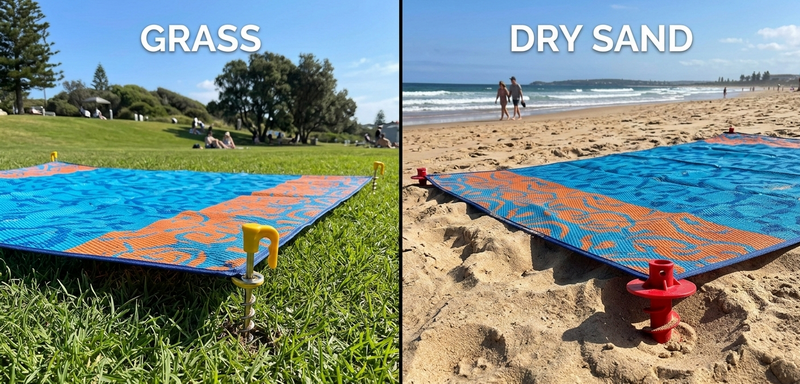
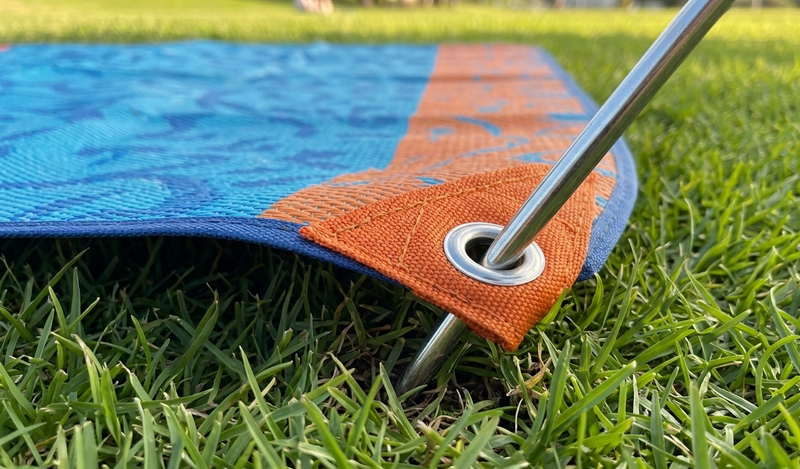
- Stakes win on grass/soil, especially when angled and driven deep.
- Sand anchors / sand screws win on loose sand, because they create a larger “bite” volume.
- Sand pockets can be excellent on sand when filled properly and placed on the windward side, but are slower to set up.
Head-to-head comparison (real-world decision table)
| System | Best Surface | Strength in Wind | Setup Speed | Common Failure Mode | Best For |
|---|---|---|---|---|---|
| Standard stakes (thin metal/plastic) | Grass/soil | Medium | Fast | Pull-out in loose sand | Parks, lawns, firm ground |
| Long/wide sand stakes | Damp/packed sand | Medium–High | Fast | Pull-out in very dry sand | Typical beach days |
| Sand anchors / sand screws | Loose dry sand | High | Medium | Improper burial / wrong angle | Windy beaches, dunes |
| Sand pockets (fillable corners) | Sand | High (if filled well) | Slow–Medium | Underfilled pockets | Minimal accessories, family use |
| Hybrid (anchors + sand pockets) | Sand | Very High | Medium–Slow | User setup error | Serious wind, large mats |
[📊 Cite: Field testing note—anchoring performance depends heavily on sand moisture/compaction and correct installation technique.]
4) How Deep Do Stakes Need to Be to Work?
Direct answer: Depth is “surface-dependent.” The softer the ground, the deeper (or wider) you need to go.
Practical depth guidelines (rule-of-thumb)
- Grass / firm soil: Drive stakes deep enough that only the hook/head is exposed, and angle them away from the pull direction (often ~30–45°).
- Packed wet sand (near shoreline): Stakes can work if driven as deep as possible and the mat is tensioned.
- Loose dry sand (upper beach / dunes): Standard stakes often fail even when deep. Use sand anchors/screws or sand pockets, or bury a “deadman” anchor (see below).
Why depth alone isn’t enough in sand
Dry sand “flows” under load. Even deep stakes can “wiggle” and loosen as the edge flutters. That’s why bigger surface area (anchors/screws/pockets) often beats just going deeper.
Pro technique: “Deadman” anchor (for any strap loop)
If you have straps instead of dedicated anchors:
- Tie the strap to a sturdy object (small bag, driftwood piece, or a bundled towel).
- Bury it horizontally in sand 8–12 inches deep.
- Pack sand firmly and tension the strap.
This creates a large resistance mass—often far stronger than a thin stake.
5) What Wind Conditions Still Flip a Mat (and Why “Windproof” Has Limits)
Direct answer: Any mat can fail when gusts are strong enough to lift the edge faster than your anchors can resist—especially if the mat is empty (no body weight) and the windward edge is loose.
Instead of chasing one universal wind-speed number, use this practical threshold model:
- Light breeze: Most mats stay put with minimal anchoring.
- Moderate breeze + gusts: Mats begin to flutter; weak anchors pull out; edge design becomes critical.
- Strong gusts: Even good anchors may hold, but the mat can tear at loops/grommets if reinforcement is weak.
The “empty-mat” reality
A mat that’s stable while people sit on it can still blow away the moment everyone stands up. If you’re testing wind resistance, always test both:
- Unloaded mat (worst case)
- Loaded mat (real use)
[📊 Cite: Practical insight—most blow-away incidents happen during transitions: unloading, shaking sand off, or leaving the mat unattended.]
6) Sand vs Grass vs Gravel: How to Choose the Right Anti-Wind System
Direct answer: Pick anchoring based on what the ground can “hold.”
A) Sand (dry, loose)
Choose:
- Sand anchors / sand screws OR sand pockets
Look for: - Large anchor surface area
- Reinforced corner loops (stitched webbing > thin grommets)
- Edge shape that reduces flapping (see Section 7)
Avoid relying on:
- Thin standard stakes as the only solution
B) Sand (damp, packed)
Choose:
- Long/wide sand stakes, plus good tensioning
Tip: - Set up slightly closer to damp sand if safe/legal and comfortable (many beaches have firmer sand lower down).
C) Grass / soil
Choose:
- Standard stakes are usually enough
Look for: - Multiple tie-down points (not only 4 corners)
- Strong stitching at loops
D) Gravel / rocky ground
Choose:
- Weight-based + edge control, or tie to fixed objects
Practical options: - Use bags, water bottles, or gear placed on windward edge
- Tie-down to a cooler handle, bench leg, or a weighted bag
- If stakes can’t penetrate, don’t force them—avoid tearing your tie points
7) What Matters More: Mat Weight vs Stakes vs Edge Design?
Direct answer: For true wind resistance, anchoring method + edge control usually matters more than “mat self-weight” alone.
Here’s a realistic priority order:
-
Anchoring quality (stakes vs anchors vs pockets)
A great mat with weak anchors still flips. A basic mat with proper anchors often holds. -
Edge design (anti-flap geometry + tensioning points)
If the windward edge flutters, it pumps air under the mat and “works” anchors loose. -
Mat weight / stiffness
Heavier mats resist sliding and initial lift, but weight alone loses once wind gets underneath.
Design features that help “windproof” performance
- More than 4 tie points (mid-edge points reduce edge lift)
- Reinforced webbing loops (bar-tack stitching)
- Low-profile edges or curved corners that reduce flapping
- Textured underside that increases friction (helpful on grass, less on loose sand)
[📊 Cite: Buyer insight—many purchasers overvalue initial weight and undervalue edge flutter control and reinforcement quality.]
8) Anti-Wind Setup: Step-by-Step (Fast, Repeatable)
Direct answer: A windproof setup is about reducing lift first, then locking corners.
-
Orient correctly
- Place the narrowest edge toward the wind if possible.
- Keep the windward edge low and tight.
-
Pre-tension before anchoring
- Lay the mat flat and pull corners until the surface is smooth (not drum-tight).
-
Anchor windward side first
- Secure the two windward corners first to stop lift from starting.
-
Angle stakes/anchors correctly
- For stakes: angle away from pull direction.
- For sand anchors: bury/screw deep and tension straps without over-stressing loops.
-
Add “edge weight” where it matters
- Place bags or gear along the windward edge, not just in the center.
-
Re-check after 5 minutes
- After a few gusts, sand shifts and straps settle. Tighten once, then stop (over-tightening can tear loops).
[🎯 CTA: Want a windproof beach mat line built for retail or Amazon? Request samples and get a wholesale quote—materials, corner reinforcement, and anchor options can be customized.]
9) Field Test Checklist (Practical “Pass/Fail”)
Direct answer: A mat is “wind-ready” if it stays flat, corners don’t creep, and tie points show no stress after gust cycles.
5-minute test (works on-site)
- Flutter check: Does the windward edge lift repeatedly?
- If yes: add mid-edge tie-down or weight the edge.
- Corner creep: Do anchors slowly migrate or loosen?
- If yes: upgrade to sand anchors/screws or switch to sand pockets.
- Loop stress: Any visible stretching, tearing, or metal grommet deformation?
- If yes: reinforcement is insufficient for windy use.
- Unloaded stability: Step off the mat for 60 seconds. Does it stay put?
- If no: treat it as “not windproof” for unattended moments.
Quick scoring (use this for product evaluation)
| Test Item | Pass Criteria | Fail Signal | Fix |
|---|---|---|---|
| Edge lift | Minimal flutter | Repeated flapping | Add windward weight + more tie points |
| Anchor hold | No pull-out | Corner creeping | Use sand anchors/screws or pockets |
| Tie point durability | No stress marks | Stitch/grommet damage | Reinforced webbing + bar-tacks |
| Unloaded test | Holds 60s | Flips or drifts | Improve anchoring + edge control |
Key Takeaways
- A windproof beach mat is a system: anchor + edge control + setup technique.
- Stakes work best on grass/soil; sand anchors or sand pockets usually win on loose dry sand.
- Stake depth helps, but surface area matters more in sand—thin stakes often pull out.
- Most failures happen when wind gets under the edge, so edge design and tensioning are critical.
- Validate performance with a 5-minute field test—especially the unloaded mat check.
FAQ Schema
Q: Do beach mat stakes really stop wind blow-away?
A: Stakes can stop blow-away on grass or firm soil, and sometimes on packed damp sand. On loose dry sand, basic stakes often pull out because sand shifts under gusts. For truly windy beaches, sand anchors/screws or sand pockets usually provide more reliable hold.
Q: How deep should I push stakes into sand for a beach mat?
A: Push stakes as deep as possible and leave only the head exposed, but depth alone may not solve pull-out in loose dry sand. If the mat still creeps or flutters, switch to sand anchors/screws, sand pockets, or a buried “deadman” anchor to increase holding surface area.
Q: Beach mat stakes vs sand anchors—what’s the main difference?
A: The main difference is holding mechanics. Stakes rely on friction along a thin shaft, which works well in soil. Sand anchors create a larger resistance volume in sand, making them more stable under gusts and repeated edge flutter.
Q: Beach mat with sand pockets vs stakes—which is better?
A: Sand pockets can be better on beaches because they add heavy mass at corners and reduce lift when filled correctly. Stakes are faster and work well on grass, but can fail on dry sand unless they’re wide/long sand-specific stakes.
Q: What should I look for in the best beach mat for windy beach use?
A: Look for reinforced corner loops (stitched webbing), multiple tie-down points along edges, an edge shape that reduces flapping, and an anchoring system designed for sand (anchors/screws or sand pockets). A mat’s weight helps, but anchoring and edge control usually matter more.
[Brand/Author bio placeholder: Outdoor mat & picnic mat manufacturer | OEM/ODM support | Wholesale and custom branding available]
[🎯 CTA: Request samples and get a quote—tell us your target channel (wholesale, retail, gift customization, or Amazon) and we’ll recommend the best windproof configuration (stakes, sand anchors, or sand pockets).]