Introduction
A beach mat is a portable ground layer designed to keep you comfortable and cleaner than sitting directly on sand, grass, or pebbles. However, “beach mat” covers everything from straw-like weaves to sand-free mesh and padded foldable mats, and the wrong pick usually fails in one predictable way: sand sticks, corners lift in wind, backing leaks, or it’s annoying to carry.
This checklist is built for buyers searching how to choose a beach mat, especially if you also care about sandproof beach mat performance and want the best beach mat for sand without overpaying.
[📊 Cite: Consumer product reviews commonly cite sand resistance, portability, and durability as top satisfaction drivers for outdoor ground covers.]
1) Material: choose the fabric first, not the pattern
A beach mat’s material determines how it handles sand, water, heat, and wear. Start here because everything else (comfort, weight, cleaning) follows.
Common beach mat materials and what they’re best at
| Material type | What it feels like | Sand behavior | Water behavior | Best for |
|---|---|---|---|---|
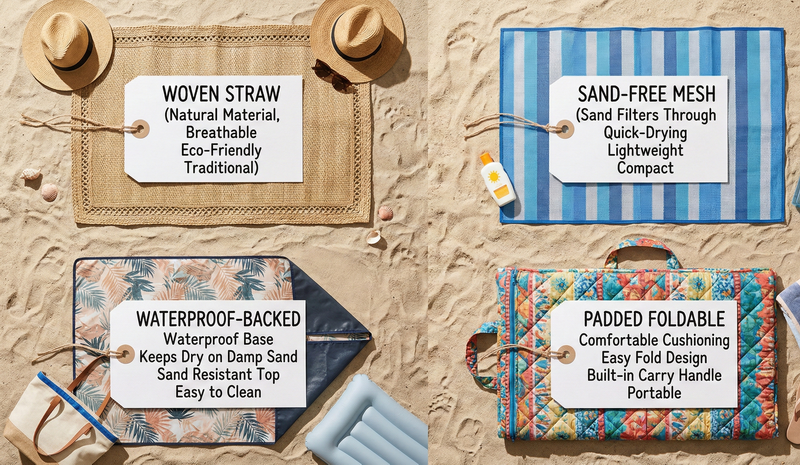
| Sand-free mesh (double-layer weave) | Smooth, flexible | Sand falls through more easily | Dries fast, doesn’t trap water | Best beach mat for sand, windy beaches |
| Woven polypropylene / plastic straw | Firm, woven texture | Sand shakes off well | Water-resistant, dries fast | Budget-friendly, easy shake-clean |
| Polyester / nylon (single-layer) | Thin, fabric-like | Sand can cling depending on coating | Quick-dry but may hold dampness | Lightweight carry, casual use |
| Padded / quilted (foam or batting) | Softer and thicker | Sand can stick in seams | Can absorb water unless backed | Comfort-first, short walks |
| Waterproof-backed (PEVA/TPU backing) | Fabric top + slick backing | Sand depends on top layer | Best barrier from wet sand | Damp beaches, grass, picnics |
Rule of thumb:
- If your #1 problem is sand everywhere, prioritize sand-free mesh or a tight woven plastic straw.
- If your #1 problem is damp ground, prioritize waterproof backing.
- If your #1 problem is hard ground, prioritize padding (but accept added bulk).
2) Sand resistance: “sandproof” claims vary—check the construction
A “sandproof beach mat” should reduce sand sticking and make cleanup easier. In practice, sand resistance comes from surface texture + weave + coatings.
What to look for
- Double-layer sand-free weave: sand can drop through when lifted and lightly shaken.
- Low-static, smooth finishes: reduce cling from fine, dry sand.
- Fewer stitched channels: quilting seams can trap sand permanently.
Red flags
- Heavy quilting + fuzzy top fabrics can become a sand magnet.
- Loose weaves can let sand pile underneath and feel gritty.
[🎯 CTA: If you hate bringing sand home, shortlist mats that specify “sand-free weave” or show demos where sand drops through when lifted.]
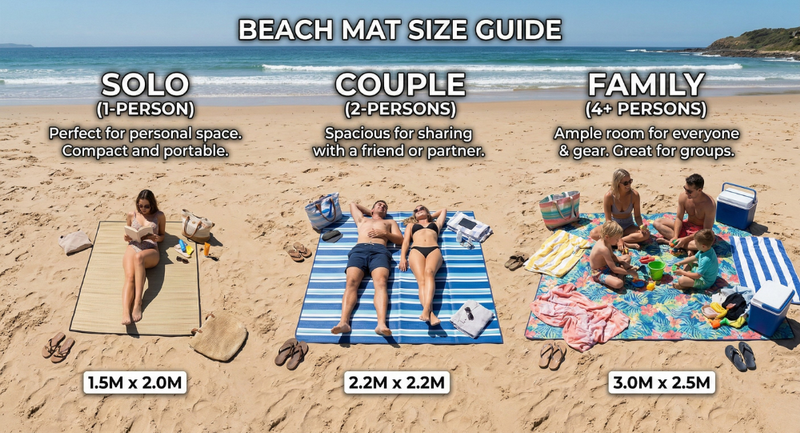
3) Size: pick by “use case,” not the product photo
A beach mat should be sized for how you sit, sprawl, and store gear. A mat that’s too small forces you onto sand; too big becomes a sail in wind and is harder to carry.
Practical sizing guide
- Solo + bag: aim for space to sit/lie + gear zone.
- Couple: make sure two people can sit comfortably without knees on sand.
- Family: prioritize a large footprint and strong anchoring.
Tip: If you’ll use it for both beach and park, choose a size that fits your trunk and is easy to fold—not just “bigger is better.”
4) Weight & carry system: comfort starts before you reach the sand
A beach mat is only “portable” if you’ll actually bring it. Evaluate weight, fold/roll method, and the carry handle/strap.
What to check
- Carry strap width: wider straps feel lighter over distance.
- Closure method: buckles/Velcro/elastic that stays closed when sandy.
- Folded dimensions: a compact fold beats a long roll if you bike or take transit.
Decision shortcut:
- Long walk to the beach → choose a lighter, simpler carry design.
- Short walk / car parked close → you can justify thicker padding.
5) Anchor points: wind is the real test
On breezy beaches, corner anchors matter more than brand names. A good beach mat should stay put when you stand up, shake sand off, or when the wind kicks up.
Strong anchor options
- Corner pockets you can fill with sand
- Grommets/loops that work with stakes
- Weighted corners (helpful but not always enough)
Weak anchor setups
- Decorative corner tabs that don’t hold tension
- No anchors at all (fine only for calm conditions)
6) Waterproofing & backing: know what “water-resistant” really means
“Water-resistant” often means the fabric won’t soak instantly—but dampness can still seep through. If you sit on wet sand, a mat with a true barrier backing is usually the difference between comfortable and soggy.
Quick checks
- Back coating (PEVA/TPU) for moisture barrier
- Seam construction: stitched seams can leak if not sealed
- Dry time: thicker padding dries slower, especially in humid climates
If you beach after swimming: pick faster-drying tops that won’t stay clammy.
7) Comfort & texture: don’t ignore skin feel and heat
A beach mat should feel good against skin and not become unbearably hot.
Comfort factors to evaluate
- Texture: rough straw-like weaves can irritate sensitive skin over time.
- Padding: helps on pebbly beaches but increases bulk.
- Heat behavior: darker colors and some plastics can get hot in full sun.
Practical tip: If you sunbathe a lot, choose a surface that won’t cling to sunscreen and can be wiped clean.
8) Durability: inspect the stress points that fail first
Durability is less about the fabric headline and more about the edges, stitching, and anchor reinforcement.
High-wear zones to inspect
- Edge binding (frays first if thin)
- Carry handles and strap attachments
- Anchor loops/grommets (should be reinforced)
Buyer mindset: A slightly higher-priced mat with better reinforcement often wins on total cost of ownership because it survives multiple seasons.
[📊 Cite: Outdoor textile durability is strongly influenced by seam reinforcement and edge binding quality, not just fabric weight.]
9) Cleaning & maintenance: your future self will thank you
The best beach mat for sand is the one you can clean in under a minute. Sand, salt, and sunscreen residue build up fast.
Easy-clean features
- Shake-clean weave (mesh or tight woven)
- Wipeable top surface (coated fabrics)
- Machine washable (confirm drying guidance)
Cleaning reality check
- Padded mats often trap sand in stitching lines.
- Waterproof backings can hold sand at folds and creases—check if it opens flat.
[🎯 CTA: Before buying, imagine cleaning it at the car: if it can’t be shaken or wiped quickly, it’s not the right “every weekend” mat.]
Quick Decision Matrix: which type fits your beach style?
| Your main need | Best pick | Why it works | Trade-off |
|---|---|---|---|
| Less sand stuck everywhere | Sand-free mesh mat | Sand drops through; shake-clean | Can feel thin on rocks |
| Picnic + damp ground | Waterproof-backed mat | Blocks moisture | Can trap heat; bulkier |
| Comfort on pebbles | Padded foldable mat | Softer, insulates | Heavier; sand in seams |
| Budget + easy cleanup | Woven plastic straw | Sand shakes off fast | Texture may feel firm |
Mistakes to Avoid When Choosing a Beach Mat
- Choosing only by price and ignoring anchors and carry design.
- Assuming “sandproof” means no sand ever—it usually means easier removal.
- Buying oversized mats for windy beaches without sand pockets or stake loops.
- Picking plush quilted tops if you visit beaches with fine, dry sand.
People Also Ask / Related Questions
- What is the best material for a beach mat on sand?
- Are sand-free beach mats actually worth it?
- How big should a beach mat be for two people?
- What’s the difference between a beach mat and a beach blanket?
- How do you keep a beach mat from blowing away?
FAQ Schema
Q: How do I choose the right beach mat?
A: Choose a beach mat by matching the material to your conditions (sand, damp ground, rocks), then confirm size, weight/carry system, and anchor points. For sand-heavy beaches, prioritize sand-free mesh or tight woven mats. For wet sand, prioritize a waterproof backing.
Q: What’s the best beach mat for sand?
A: The best beach mat for sand is typically a sand-free mesh (double-layer) mat because sand can fall through and shake off more easily. Tight woven plastic mats also shake clean well, but mesh usually performs better with fine, dry sand.
Q: What should I look for in a sandproof beach mat?
A: Look for a sand-shedding weave, minimal quilting seams, and a surface that resists static cling. Also check that the mat has corner pockets or stake loops, because sandproof doesn’t help if the mat keeps flipping in the wind.
Q: Do I need a waterproof beach mat?
A: You need a waterproof beach mat if you frequently sit on wet sand, damp grass, or near the shoreline. A waterproof backing blocks moisture, but it may add bulk and can trap heat in strong sun.
Q: How do I keep my beach mat from blowing away?
A: Use mats with sand pockets, stake loops, or grommets, and place heavier items (bag, cooler, shoes) near corners. On very windy beaches, choose a mat designed with anchoring in mind rather than relying on weight alone.
Key Takeaways
- Material is the #1 decision: mesh for sand, waterproof backing for damp, padding for rocks.
- “Sandproof” usually means sand shakes off easier, not “zero sand.”
- Anchors matter: sand pockets or stake loops prevent frustration in wind.
- Choose size based on your real layout (people + gear), not marketing photos.
- Don’t ignore carry design—portability decides whether you’ll use it often.
[🎯 CTA: If you tell us your beach conditions (windy or calm, wet or dry sand, how far you walk), we can recommend the best beach mat type and the exact features to prioritize.]