Introduction
A cushion “fails” long before it tears. Cushion service life usually ends when the seat bottoms out, feels soft, or doesn’t rebound, even if the fabric still looks fine.
The most common cause is filling fatigue: repeated loading permanently reduces thickness and changes hardness. The good news is that you can prevent most of it by specifying and validating the right high-density resilient filling—and by purchasing against fatigue performance rather than only initial feel.
Why cushions fail early (and what “service life” actually means)
Cushion service life refers to the time until comfort and support drop below an acceptable threshold, not the time until the cushion physically breaks.
Typical “end-of-life” symptoms procurement teams hear:
- “It’s sagging after a few months.”
- “The cushion got soft and flat.”
- “We’re seeing warranty returns for bottoming-out.”
The underlying mechanisms are predictable:
- Loss in thickness (permanent set).
- Loss in hardness (softening / reduced load-bearing).
- Compression set (foam doesn’t recover after static load).
- Bonding or lamination issues (layers shear or delaminate under use).
If you define service life as “maintains ≥X% of original thickness and hardness after Y cycles,” suppliers can compete on measurable performance.
The 30% lever: high-density resilient filling, explained
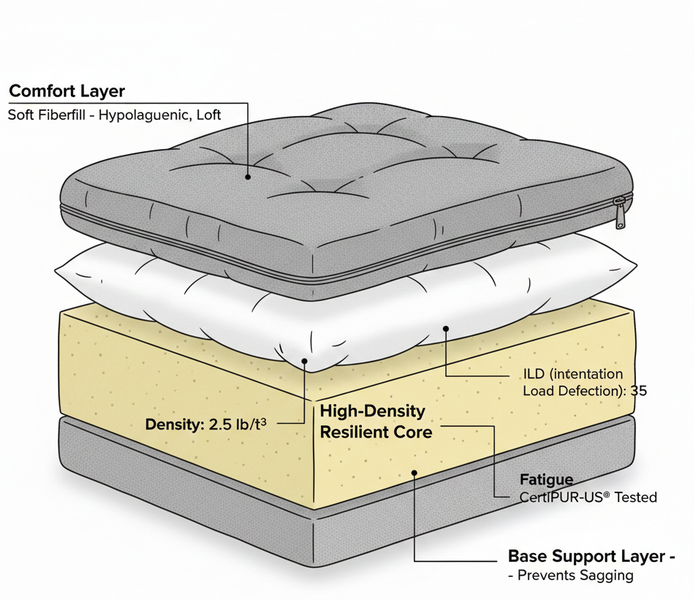
High-density resilient filling refers to a cushion core material engineered to maintain thickness and support under repeated loading, typically by using:
- Higher foam density (more polymer per unit volume, generally improves durability)
- High Resilience (HR) foam chemistry (better elastic recovery and energy return)
- Or latex / engineered hybrids (excellent resilience, typically higher cost)
Why this can add ~30% cushion life:
- Higher density + resilient structure slows the rate of permanent thickness loss.
- Better rebound reduces stress concentration, which slows cell wall damage.
- More stable hardness curve keeps “feel” consistent over time, reducing early replacement.
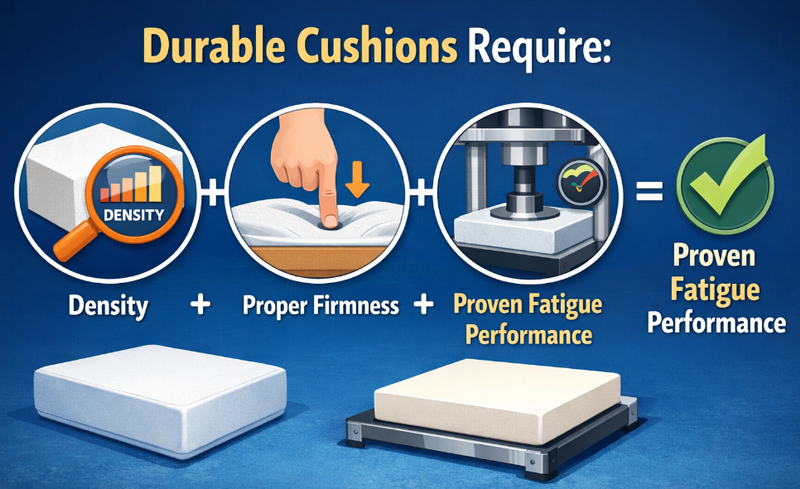
Important nuance: density alone is not a magic number. A durable cushion combines density + correct hardness + proven fatigue results.
Spec targets that correlate with longer cushion life
Start with performance-driven specs that buyers can compare across suppliers, then tune for comfort.
Recommended spec baseline (B2B seating and upholstery)
| Spec Category | What to Specify | Practical Target Range | Why It Matters |
|---|---|---|---|
| Material Type | HR polyurethane foam (or latex / hybrid) | HR foam preferred for seating | HR structures typically rebound better under cyclic load |
| Density | kg/m³ (or lb/ft³) | ≥ 35–45 kg/m³ for heavy-use seating (adjust by use case) | Higher density generally improves durability and slows “crush” |
| Hardness (Indentation) | 40% indentation hardness index (or ILD/IFD equivalence) | Set by comfort goal (e.g., medium-firm seat) | Prevents “soft but short-lived” foam choices |
| Compression Stress/Strain | Stress at 40% compression | Request measured curve, not just a single point | Captures load-bearing behavior under realistic compression |
| Fatigue Performance | Loss in thickness + hardness after pounding | Define max % loss allowed | Best predictor of service-life decline |
| Compression Set | % set after defined time/temp | Lower is better (set a max) | Screens out foams that take a permanent set quickly |
| Resilience / Hysteresis | Ball rebound / hysteresis loss | Higher rebound or lower hysteresis (as needed) | Keeps comfort “spring” longer |
[📊 Cite: ISO 2439 covers indentation hardness methods for flexible cellular materials. :contentReference[oaicite:1]{index=1}]
[📊 Cite: ISO 3386-1 defines compression stress/strain characterization for low-density flexible cellular materials. :contentReference[oaicite:2]{index=2}]
How to translate “high-density resilient” into supplier-ready language
Use three lines that remove ambiguity:
- “Foam type: HR polyurethane foam suitable for load-bearing upholstery.”
- “Density: minimum ___ kg/m³, with certificate of analysis per lot.”
- “Fatigue requirement: after ISO 3385, thickness loss ≤ % and hardness loss ≤ %.”
This forces the discussion toward durability, not marketing labels.
Test plan: what to request, which standards to cite, and pass/fail thresholds
A durability program is only useful if it measures what fails in the field: thickness and hardness loss after repetitive loading.
1) Indentation hardness (comfort + baseline control)
- Standard: ISO 2439 (indentation hardness) :contentReference[oaicite:3]{index=3}
- What to request:
- Method used (A/B/C/D)
- Indentation level (commonly 40% / 30s)
- Test piece thickness and conditioning
- How to use it:
- Set acceptable range by comfort category (e.g., “medium seat,” “firm seat”)
- Reject lots that drift outside the band (consistency is durability’s best friend)
2) Fatigue pounding (the service-life predictor)
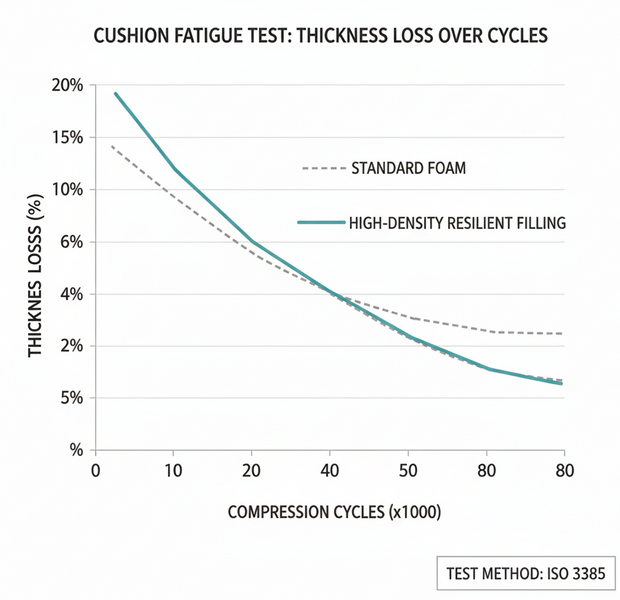
- Standard: ISO 3385 (fatigue by constant-load pounding) :contentReference[oaicite:4]{index=4}
- Output to require:
- Loss in thickness (%)
- Loss in hardness (%)
- Practical pass/fail suggestion (tune to your warranty + usage):
- “Thickness loss ≤ 8–12% after test”
- “Hardness loss ≤ 15–20% after test”
- Buyer tip: Require the supplier to report pre/post thickness and hardness, not only “pass.”
3) Compression stress/strain curve (load-bearing behavior)
- Standard: ISO 3386-1 (compression stress/strain) :contentReference[oaicite:5]{index=5}
- Why it matters:
- Two foams can share the same hardness number but behave differently across the compression range.
- What to request:
- Full stress/strain data (not just one point)
- Stress at 40% compression as a comparable KPI
4) Urethane foam test method set (optional but widely recognized)
- Standard: ASTM D3574 (urethane foam test methods) :contentReference[oaicite:6]{index=6}
- Use it for:
- A standardized “basket” of checks (density, hardness, compression set, etc.)
- Procurement note: If your supply base is split across regions, allowing ISO or ASTM equivalents can reduce friction while keeping the data comparable.
Design and process tips that preserve performance in production
High-performing filling can still fail early if the cushion build traps it into bad mechanics.
Layering strategy (avoid false softness)
A common durable build is: comfort layer + high-density resilient core + stabilizing base.
- Keep the comfort layer thin enough that the core does the load-bearing work.
- Use a base layer that prevents bottoming-out but does not create a hard edge.
Cut-and-sew and compression packaging
- Over-compressing during packaging can increase early compression set for some materials.
- Ask suppliers how they pack and how long the product is held compressed.
Lot control and traceability
- Require:
- COA per lot (density, hardness)
- Date code and batch traceability
- This reduces “mystery drift” that shows up as warranty spikes.
RFQ template for high-density resilient cushion filling
Use this RFQ to standardize supplier quotes and force apples-to-apples comparisons.
A) Project overview
- Application: Seating cushion / back cushion / bench / hospitality / office / outdoor (specify)
- Target cushion service life: months/years under usage profile
- Annual volume: ___ units
- Target lead time: ___ days
- Shipping/incoterms: ___
B) Cushion filling requirements (core)
- Material: High-density resilient filling (HR polyurethane foam / latex / hybrid)
- Density: ≥ ___ kg/m³ (report actual)
- Indentation hardness: ISO 2439 Method at % / s, target (range ± ___) :contentReference[oaicite:7]{index=7}
- Compression stress/strain: ISO 3386-1 curve required; report stress at 40% :contentReference[oaicite:8]{index=8}
- Compression set: max ___% (state method, time, temperature)
- VOC/chemical compliance (if applicable): REACH / CA Prop 65 / other: ___
- Flammability (if applicable): CAL TB117-2013 / BS 5852 / other: ___
C) Durability test requirements (mandatory)
- Fatigue: ISO 3385
- Loss in thickness: ≤ ___%
- Loss in hardness: ≤ ___%
- Provide full test report including pre/post measurements :contentReference[oaicite:9]{index=9}
D) Construction and dimensional requirements
- Foam block size or cut parts: ___
- Cut tolerance: ± ___ mm
- Shape: slab / contoured / CNC-cut / molded
- Cover interface: glued / laminated / loose insert (specify adhesive type if bonded)
E) Documentation to submit with quotation
- Datasheet + COA sample
- ISO/ASTM test reports (raw data preferred)
- Process flow summary (foam production + cutting + curing + packaging)
- Warranty terms and exclusions
- 2–3 reference customers in similar use case (optional)
F) Commercials
- Price per unit at volumes: / / ___
- Tooling/setup fees (if any): ___
- MOQ: ___
- Payment terms: ___
Key Takeaways
- A cushion lasts longer when the filling resists thickness loss and hardness loss under repeated load.
- “High-density resilient filling” should be specified as density + hardness + fatigue performance, not a marketing label.
- Use ISO 3385 to measure thickness/hardness loss after pounding, and make it a quote requirement. :contentReference[oaicite:10]{index=10}
- Use ISO 2439 and ISO 3386-1 to lock in comfort and load-bearing behavior with repeatable numbers. :contentReference[oaicite:11]{index=11}
- A standardized RFQ prevents “cheap initial feel” from winning over true total cost of ownership.
FAQ Schema
Q: What is the best way to extend cushion service life without changing the entire cushion design?
A: The best lever is upgrading the core to high-density resilient filling and validating it with fatigue testing. Require ISO 3385 results (loss in thickness and hardness) and control comfort with ISO 2439 indentation hardness so suppliers can’t substitute softer, short-lived foam. :contentReference[oaicite:12]{index=12}
Q: Does higher foam density always mean a longer-lasting cushion?
A: Higher density often improves durability, but it is not sufficient by itself. A long-lasting cushion also needs the right hardness and proven fatigue performance (thickness and hardness retention after cyclic loading), ideally documented with ISO 3385 and hardness checks per ISO 2439. :contentReference[oaicite:13]{index=13}
Q: Which test best predicts real-world cushion sagging?
A: Fatigue pounding tests that report loss in thickness and loss in hardness are the most practical predictors of sagging and softening. ISO 3385 is specifically designed to assess service performance of flexible cellular materials intended for load-bearing upholstery. :contentReference[oaicite:14]{index=14}
Q: What standards should I put in an RFQ for cushion filling?
A: Common, widely recognized options include ISO 2439 for indentation hardness, ISO 3385 for fatigue pounding (thickness/hardness loss), and ISO 3386-1 for compression stress/strain behavior. Many suppliers also support ASTM D3574 for urethane foam test methods. :contentReference[oaicite:15]{index=15}
Q: How do I compare two suppliers if both claim “high resilience” foam?
A: Ask for the same dataset: density, ISO 2439 hardness, ISO 3386-1 compression curve, and ISO 3385 fatigue results. Then compare post-fatigue thickness and hardness retention side-by-side; the supplier with lower loss typically delivers longer cushion service life. :contentReference[oaicite:16]{index=16}