Road Tripping in the UK/Australia: Legal Dog Car Seat Belt Tips + Waterproof Car Seat Covers for Mud & Sand
Driving in the UK or Australia with a dog isn’t just about comfort—it’s about legal risk, driver distraction, and vehicle damage. For B2B buyers (pet retailers, automotive accessory wholesalers, rental fleets, and tour operators), two products consistently solve the highest-frequency pain points:
- Dog Car Seat Belt / Safety Tether (used with a harness)
- Waterproof Car Seat Cover (scratch-proof, mud/sand-proof, easy-clean)
Compliance note: This content is general information, not legal advice. Regulations and penalties can change; always check the relevant local authority for the driver’s location.
Why “Dog-in-Car” Compliance Matters for UK/Australia Road Trips
A loose dog can lead to three business-impacting outcomes:
- Driver distraction → enforcement risk (stops, fines, penalty points, insurance disputes)
- Sudden braking → injury risk for pets and passengers
- Interior damage (mud, sand, hair, scratches, odor) → higher cleaning cost and lower resale value
This is why high-intent searches often include keywords like “dog car seat belt law”, “UK Highway Code dog in car”, “NSW dog in car fine”, and “waterproof car seat cover for dogs.”
UK: What the Highway Code Says (And What It Means in Practice)
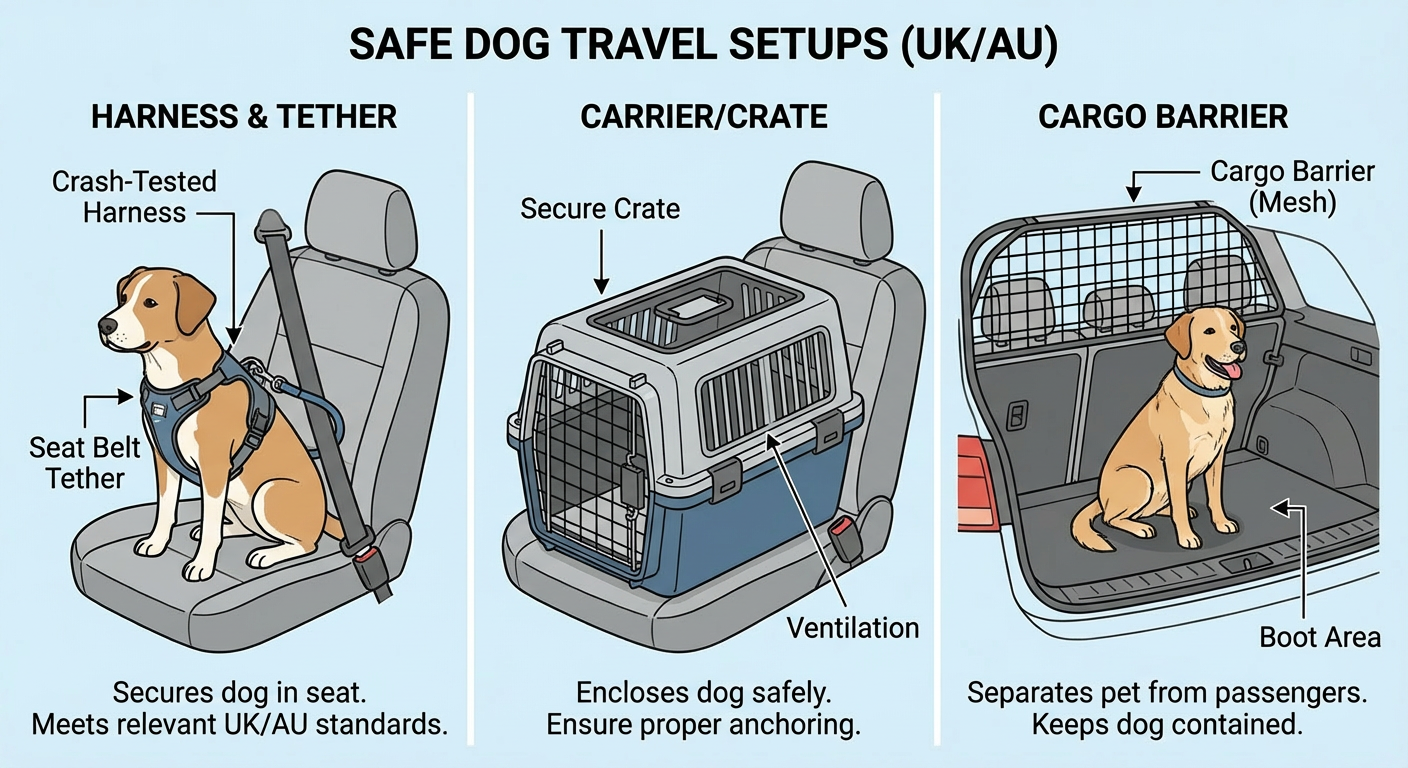
In the UK, Highway Code Rule 57 states that dogs/animals should be suitably restrained so they can’t distract the driver or injure themselves/others during sudden stops. It lists examples: seat belt harness, pet carrier, dog cage, or dog guard.
Source: https://www.gov.uk/guidance/the-highway-code/rules-about-animals-47-to-58
Does Rule 57 have a “fixed fine”?
The Highway Code often sets expectations for safe driving. If an unrestrained dog contributes to poor control or an incident, drivers may face enforcement under broader driving offences (e.g., careless driving / due care). UK sentencing guidance indicates careless driving can carry an unlimited fine depending on severity.
Source: https://www.sentencingcouncil.org.uk/guidelines/careless-driving-drive-without-due-care-and-attention/
B2B messaging takeaway (UK):
Position restraints as tools that help drivers meet the “suitably restrained” expectation.
Australia: State-by-State Reality (Control Rules + Safety Expectations)
Australia is more fragmented: there may not be a single nationwide “dogs must wear a seat belt inside the cabin” rule everywhere, but drivers can still be penalized for not being in proper control or for unsafe transport practices.
Example: NSW explicitly prohibits animals on the driver’s lap
NSW Road Rules (Reg 297) state a driver must not drive if a person or an animal is in the driver’s lap.
Source: https://www5.austlii.edu.au/au/legis/nsw/consol_reg/rr2014104/s297.html
Industry explainers also note enforcement is commonly tied to “control/distraction” scenarios and can involve fines/demerit points (amounts can change).
Example explainer: https://www.codea.com.au/publication/road-series-new-south-wales-the-road-rule-that-bites-back-driving-with-dogs/
“No strict restraint law” ≠ “no risk”
Even where an explicit “seat belt for dogs” rule isn’t stated, transport authorities and safety guidance frequently recommend restraints (harness + tether, crate, or barrier) to reduce distraction and injury risk.
B2B messaging takeaway (Australia):
Frame restraints as driver control + safety best practice, and encourage buyers to check state guidance.
How to Set Up a Dog Car Seat Belt Correctly (So It’s Actually Safer)
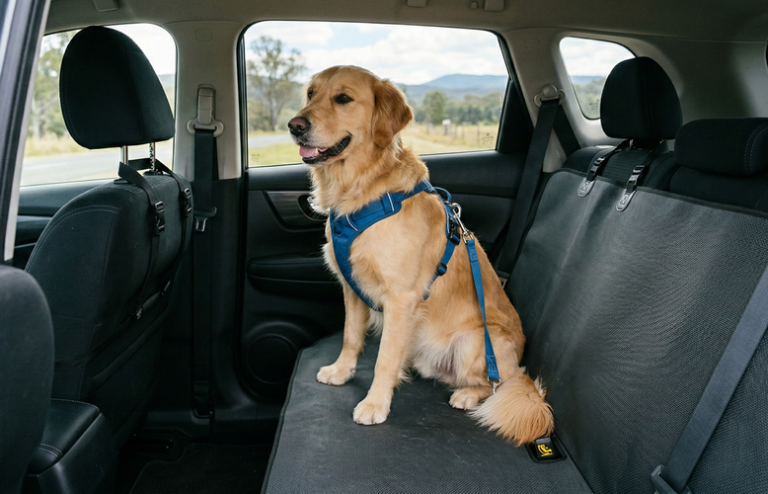
A “dog seat belt” should typically be a tether that connects to a dog harness, not directly to a collar (to reduce neck injury risk in sudden stops).
Recommended setup (high-level)
- Harness-first: Use a well-fitted harness (size by chest girth)
- Limit roaming: Keep tether short enough that the dog can’t reach the driver
- Reliable clip: Prefer locking carabiners or heavy-duty hooks
- Vehicle compatibility: Offer seat-belt buckle style and headrest/anchor style variants
Expert Advice (for B2B product pages):
Avoid absolute legal claims like “required by law.” Use phrasing such as:
- “Designed to help keep dogs suitably restrained and reduce driver distraction” (UK)
- “Supports safer travel and helps drivers maintain proper control” (Australia)
UK Rain & Mud vs Australia Sand: Why Seat Covers Need Waterproof + Scratch-Proof
Two regional realities drive returns and reviews:
- UK: frequent wet weather + muddy trails → water ingress, odor, damp fabric
- Australia: beach trips → fine sand that embeds into stitching and seat seams
What “waterproof” should mean in specs
Look for construction like:
- Top layer: durable Oxford or quilted fabric
- Middle barrier: waterproof membrane (e.g., TPU)
- Bottom: non-slip backing (avoid dye transfer onto light seats)
What “scratch-proof” should mean
- Higher denier fabrics (e.g., 600D+)
- Reinforced stitching at stress points
- Side flaps/door protectors (common scratch zones)
Comparison Table: UK vs Australia Compliance Angles + Product Pairing
| Market | What rules commonly expect | Typical enforcement trigger | Best product pairing | Notes for listing copy |
|---|---|---|---|---|
| UK | Dogs should be suitably restrained (Rule 57 lists harness/carrier/cage/guard) | Distraction, sudden stop incident, “due care” concerns | Harness + seat belt tether + waterproof seat cover | Use “suitably restrained” phrasing; avoid guaranteeing outcomes |
| Australia (varies) | “Proper control” road rules (e.g., NSW bans animal on driver’s lap) | Dog interfering with driving, riding on lap, unsafe transport | Restraint option (tether/crate/barrier) + scratch-proof waterproof cover | Use “recommended for safety/control”; add state-check disclaimer |
Product Requirements That Reduce Returns (And Improve B2B Repeat Orders)
For Dog Car Seat Belts (tethers)
- Hardware: rust-resistant zinc alloy or steel; locking clip preferred
- Adjustability: controlled range (avoid overly long extension)
- Compatibility: seat-buckle + headrest/anchor variants
- Instruction clarity: diagrams + warnings (harness use)
For Waterproof Car Seat Covers
- Barrier layer: membrane-backed; stronger performance than coating-only
- Non-slip base: stable under braking
- Door protection: side flaps reduce scratches
- Cleaning: wipe-clean + machine-washable (if supported)
B2B tip: Add “mud/sand test” visuals in your listing to reduce expectation mismatch and improve conversion.
Implementation Ideas for Fleets, Rental, and Tour Operators (High-Margin B2B)
Don’t limit targeting to pet stores:
- Campervan & car rental companies: sell “pet travel kits” as add-ons
- Pet-friendly hotels: retail covers at reception
- Tour operators: include seat protection + safety gear as an upgrade
Operational pitch: faster cleaning, fewer damage claims, better customer experience.
Key Takeaways
- UK: Rule 57 provides a clear compliance angle—dogs should be suitably restrained.
- Australia: State rules vary, but “proper control” and distraction enforcement still drive purchase intent.
- Best bundle: Dog Car Seat Belt (tether + harness) + Waterproof, scratch-proof Car Seat Cover engineered for mud and sand.
FAQ (SEO-Friendly)
Is it illegal in the UK to drive with an unrestrained dog?
UK guidance says dogs should be “suitably restrained” to avoid distraction or injury. Rule 57 lists harnesses, carriers, cages, or guards as options.
Does Australia require dogs to wear a seat belt in the car?
Not universally—rules vary by state/territory, but drivers can be penalized if the dog affects proper control. NSW specifically prohibits animals on the driver’s lap.
Can a dog sit in the front passenger seat?
It may be allowed, but it must not distract the driver or create a safety risk. Many owners keep dogs in the rear to reduce distraction and airbag risk.
Should a dog seat belt clip to a collar?
No—use a harness. Collars can concentrate force on the neck in sudden stops.
What’s better: seat belt tether, crate, or barrier?
It depends on dog size and vehicle type. Small dogs often suit carriers; larger dogs may need harness+tether or cargo barrier.
Will a waterproof seat cover really stop muddy water?
Only if it has a true waterproof barrier layer and decent seam construction. “Water-resistant” fabric alone can soak through.
Are hammock-style covers safer?
They can help prevent dogs from falling into the footwell, but still use a restraint.
How do I prevent sand from embedding in the cover?
Choose tighter weaves, fewer exposed seams, and wipe-clean surfaces. Avoid deep quilt channels if beach sand is the main issue.
Buyer Checklist (10 items) — For Distributors, Retailers, Fleets
- Confirm target market(s): UK only, AU only, or both
- Choose restraint format: seat-buckle tether / headrest tether / crate option
- Request hardware specs (material, coating, tensile target)
- Verify stitching and stress-point reinforcement photos
- Seat cover: confirm waterproof barrier layer (not just coating)
- Seat cover: confirm non-slip backing doesn’t stain light seats
- Fit: provide size chart + vehicle compatibility list
- Packaging: retail box vs polybag; add barcode + compliance disclaimer
- Branding: logo patch, woven label, hangtag, insert card
- After-sales: spare straps/clips availability + warranty policy
RFQ Template (Copy/Paste)
Product Category: (Dog Car Seat Belt Tether / Waterproof Car Seat Cover / Bundle)
Target Market: (UK / Australia / Both)
Estimated Order Quantity: (e.g., 1,000 pcs per SKU)
Variants Needed: (sizes, colors, car types: sedan/SUV/ute)
Dog Car Seat Belt Specs
- Tether type: (seat-buckle / headrest / anchor)
- Adjustable length range: (___)
- Clip type: (locking carabiner / standard)
- Webbing width: (___)
- Hardware material/coating: (___)
- Packaging: (box/polybag)
- Insert manual / warning card: (Y/N)
Car Seat Cover Specs
- Style: (hammock / bench / cargo liner / front seat)
- Material (top layer): (___)
- Waterproof barrier: (TPU/membrane Y/N)
- Non-slip backing type: (___)
- Side flaps/door protectors: (Y/N)
- Wash method: (wipe / machine wash)
Documentation
- Product warnings/disclaimers language: (UK/AU)
- Test reports available: (material, seam strength, hardware)
Commercial Terms
- Incoterms: (EXW/FOB/CIF/DDP)
- Lead time: (sample days; mass production days)
- Payment terms: (___)
- Warranty/returns support: (___)
Consultion CTA
If you’re unsure which design will perform best for UK mud or Australia sand, contact us with your customer profile (retail, fleet, rental). We’ll recommend a bundle and listing copy aligned with local compliance expectations.
Sources (for internal referencing)
- UK Highway Code (Rule 57): https://www.gov.uk/guidance/the-highway-code/rules-about-animals-47-to-58
- UK sentencing guidance (careless driving): https://www.sentencingcouncil.org.uk/guidelines/careless-driving-drive-without-due-care-and-attention/
- NSW Road Rules (Reg 297): https://www5.austlii.edu.au/au/legis/nsw/consol_reg/rr2014104/s297.html
- NSW explainer (industry commentary): https://www.codea.com.au/publication/road-series-new-south-wales-the-road-rule-that-bites-back-driving-with-dogs/